
Houseplant
Spider Orchid
Brassia verrucosa
Also known as Spider Brassia, Wasp Orchid
Practical guidance for growing spider orchid, Brassia verrucosa, including long trailing petals, the wasp-mimicking flower, pseudobulb watering, bright light, and a warm intermediate climate.
At a glance
- Difficulty
- Moderate
- Water
- Regularly while a pseudobulb is actively growing, reduced once mature
- Light
- Bright indirect light with two to three hours of direct morning sun
- Temperature
- 16 to 28 deg C
- Humidity
- 50-70 percent
- Hardiness
- USDA 10-12, RHS H1b, hardy to 10 C
- Type
- Evergreen epiphytic orchid, flowering yearly from mature pseudobulbs
- Height
- 40-60 cm, with flower spikes extending further
- Native to
- Central America, Mexico
Native to cloud forest and mid-elevation woodland across Mexico and Central America, warm through the year but rarely reaching the extreme heat of true lowland tropics, and with a distinct wetter and drier season. Its flowers evolved to mimic the spider-hunting wasps that pollinate it, a shape that has nothing to do with its cultivation but everything to do with why it looks the way it does. It has no frost tolerance and grows poorly below about 10 deg C.
Hardiness zones describe winter cold alone. Summer heat, humidity, rainfall and the length of the growing season decide as much, so treat the range as the outer limit rather than as a recommendation.
Not known to be toxic
Brassia carries no documented toxic compounds, consistent with the generally clean safety record of the orchid family as a whole. The ASPCA lists Brassia as non-toxic to cats and dogs, and it does not appear on the RHS list of potentially harmful garden plants. No part of the plant is a recognised poisoning hazard, and the long, narrow petals that make the flowers so distinctive pose no more risk if chewed than any other tough plant material would. This is a genus that can be grown without factoring pets into the decision at all.
Sources: ASPCA toxic and non-toxic plants, RHS potentially harmful garden plants
About
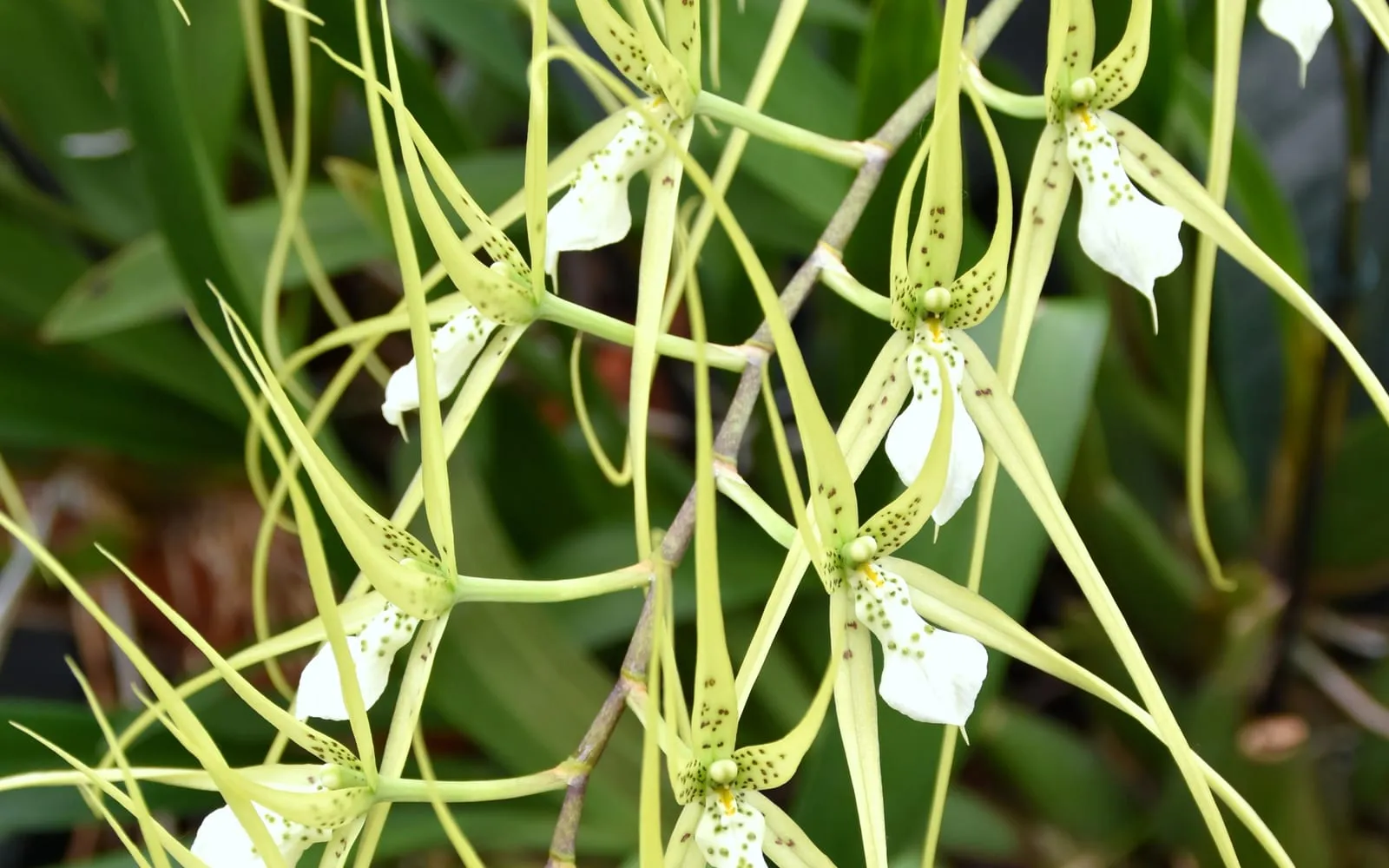
Spider orchid earns its name from flowers built almost entirely out of long, tapering petals and sepals, spreading out from a small central lip like the legs of a spider caught mid-stride. The shape is not decorative accident: it evolved to resemble the spider-hunting wasps that pollinate Brassia in the wild, which investigate the flower as a potential rival or prey and pick up pollen while doing so.
Growth follows the same general pattern as many other epiphytic orchids, clustered pseudobulbs supporting long, arching leaves, but the flower spikes on a mature plant stand out even among showy orchids for their sheer reach, with some spans exceeding 15 cm across a single bloom.
Appearance and character
Pseudobulbs are flattened and oval, clustering at the base of the plant and each carrying one or two long, strap-shaped leaves that arch gracefully outward. Growth is somewhat more open and larger-scaled than many compact orchids, giving a mature specimen real presence even before it flowers.
Flower spikes rise from the base of a newly matured pseudobulb, carrying several blooms in yellow-green heavily barred and spotted with brown, each one dominated by narrow, elongated petals and sepals that taper to fine points and can span 12 to 18 cm from tip to tip. A small, cream to yellow lip sits at the flower’s centre, modest next to the dramatic trailing petals around it. The scent is often noticeably sweet, particularly in the warmth of the day.
A well-grown plant produces several spikes each season, and the flowers are unusually long-lasting for an orchid, often remaining fresh for four to six weeks.
Where it is from
Brassia verrucosa grows through mid-elevation cloud forest and woodland across Mexico and Central America, typically as an epiphyte on tree trunks and branches in conditions that are warm year round without reaching true lowland tropical heat, and that carry a distinct wetter and drier season rather than constant rainfall.
That combination of warmth, elevation and seasonal rhythm places it among what growers call the intermediate orchids, needing conditions milder than a true lowland tropical species and warmer than the small number of cool- growing orchids from higher altitude. In the wild, wasps that hunt spiders to provision their nests pollinate the flowers. That pollination relationship explains the flower shape.
How it grows
Pot it in a coarse, bark-based orchid compost in a pot only just large enough for the current pseudobulb mass, or mount an established plant on bark once it is large enough to tolerate the more frequent watering that mounted growing needs.
Give it bright indirect light with some direct morning sun. Leaves that stay a deep, dark green usually mean too little light, which produces healthy-looking growth that still flowers poorly. Aim for a light yellow-green.
Water generously while a new pseudobulb is actively forming, then ease off once it has matured and the newest leaf has hardened, since the pseudobulb holds enough reserve to carry the plant through a drier spell without harm.
Repot every two years or so, generally straight after flowering, once the bark has started to break down or the clump has outgrown its pot, dividing larger clumps at the same time if more plants are wanted.
Through the seasons
Spring brings the start of new pseudobulb growth. Increase watering as new growth lengthens and resume regular feeding.
Summer is the main growing season, with warmth and consistent moisture supporting fast pseudobulb development ahead of the coming flowering season.
Autumn brings flower spikes from the season’s newly matured pseudobulbs, along with a gradual easing in temperature and watering.
Winter is a quieter, cooler rest. Reduce watering and feeding, keeping the plant above 10 deg C throughout.
Care difficulty
Moderate, comparable to most epiphytic orchids of similar size and showiness. The main skill lies in matching watering to the plant’s growth stage, generous while a pseudobulb is forming and reduced once it has matured, rather than following a fixed schedule regardless of growth stage. Given reasonably bright light and that watering rhythm, it flowers reliably and needs relatively little additional intervention through the rest of the year.
Watering
Water thoroughly while a pseudobulb is actively growing, soaking the mix until water runs freely through it, then allow the roots to approach dryness, showing silvery-green rather than staying a wet, dark green, before watering again.
Ease off once the current pseudobulb has matured and hardened, and reduce further through the cooler winter rest, when the plant is using comparatively little water and a permanently wet mix at lower temperature invites root problems.
Warning signs, diseases and pests
Scale insects settle along the pseudobulbs and on the leaf undersides, appearing as small, flat brown bumps. Scrape them off and treat with horticultural soap, checking regularly since a light infestation spreads quickly across a plant with this much leaf surface.
Mealybug hides in the folds where new growth emerges from a maturing pseudobulb, showing as small white, cottony tufts. Treat the same way as scale, paying close attention to new growth while it is still soft.
Spider mite thrives in hot, dry indoor air and shows as fine speckling on the leaves with faint webbing in bad cases. Raising humidity slightly and wiping the leaves down periodically helps prevent it establishing.
Root rot follows a bark mix that stays wet, particularly over winter, showing as roots turning brown and mushy rather than the healthy silvery green of a dry root. Unpot, trim away dead roots, and repot into fresh bark, watering less generously afterwards.
Growing environment
Bright indirect light with some direct morning sun keeps growth compact and supports reliable flowering; too little light produces dark leaves and few, if any, flower spikes.
Warm, intermediate conditions suit it best, staying above 10 deg C at all times and avoiding the extremes of a true lowland tropical species’ requirements. A conservatory, bright bathroom or well-lit living room all work well.
Moderate to high humidity, around 50 to 70 percent, supports healthy root and leaf growth. A pebble tray kept below the pot’s base, or grouping it with other humidity-loving plants, both help in a dry indoor room.
Feeding
Feed weekly at around quarter strength with a balanced orchid fertiliser through spring and summer, tapering off as the season’s pseudobulbs finish maturing in early autumn.
Reduce feeding sharply through the cooler winter rest, resuming the full routine once vigorous new growth begins again the following spring.
Troubleshooting
It produces plenty of leaves but no flower spikes. Almost always insufficient light. Move the plant to a brighter spot with a little direct morning sun, and expect flowering to follow once a pseudobulb matures fully in those improved conditions.
The leaves have a very dark, almost blue-green colour. A sign of too little light rather than good health, despite looking lush. Gradually increase light levels rather than moving it into strong sun all at once, which can scorch leaves that have adapted to shade.
A pseudobulb has gone soft and shrivelled. Check the roots for rot as the likely underlying cause, since a damaged root system cannot support the pseudobulb even with adequate watering. Trim away any dead roots and repot into fresh, well-draining bark.
The flower spike stopped growing and dried up before opening. Usually a sudden change in conditions, a cold draught, a big swing in humidity, or a knock to the pot, while the spike was developing. Keep the plant in a stable position from the moment a spike appears.
Can I grow it mounted rather than in a pot? Yes, once established, and many growers find flowering improves on a mount thanks to the better airflow around the roots, provided watering is stepped up to compensate for how much faster a mounted plant dries out.
Spider Orchid problem guides
Not sure what is wrong? See the common houseplant pests guide.