
Houseplant
Golden Shower Orchid
Oncidium sphacelatum
Also known as Sharry Baby's Parent Orchid
How to grow golden shower orchid, Oncidium sphacelatum. Why a plant kept damp year-round skips its huge branching spray, judging sun by leaf colour, and giving pseudobulbs the dry rest they need to flower.
At a glance
- Difficulty
- Moderate
- Water
- Regularly while the pseudobulbs are actively growing, reduced sharply once mature
- Light
- Bright light with an hour or two of gentle direct sun
- Temperature
- 13 to 29 deg C
- Humidity
- 40-60 percent
- Hardiness
- USDA 10a-11, RHS H1c, hardy to 8 C
- Type
- Evergreen epiphytic orchid, flowering yearly from mature pseudobulbs
- Height
- 40-60 cm foliage; flower sprays reaching 1-1.5 m or more
- Native to
- Central America, Mexico
From seasonally dry pine-oak forest across Mexico and Central America at mid elevation, a habitat with a pronounced wet and dry season rather than the constant humidity of a lowland rainforest. The zone number covers only the cold side of that pattern. What it leaves out is the dry season the plant expects each year, and a plant kept damp year-round without that seasonal rest grows leaves well but often skips the huge branching flower spray it is grown for.
Hardiness zones describe winter cold alone. Summer heat, humidity, rainfall and the length of the growing season decide as much, so treat the range as the outer limit rather than as a recommendation.
Not known to be toxic
Oncidium carries no documented toxic compounds, in keeping with the orchid family's generally clean safety record. The ASPCA lists Oncidium as non-toxic to cats and dogs, and it does not appear on the RHS list of potentially harmful garden plants. No part of it, including the large pseudobulbs a curious pet might dig at, is considered a poisoning risk. A small number of people report mild skin irritation from handling the roots or repotting mix of some Oncidium relatives, more a contact sensitivity than a true toxicity, so gloves are a sensible precaution for anyone with sensitive skin rather than a strict necessity for most growers.
Sources: ASPCA toxic and non-toxic plants, RHS potentially harmful garden plants
About
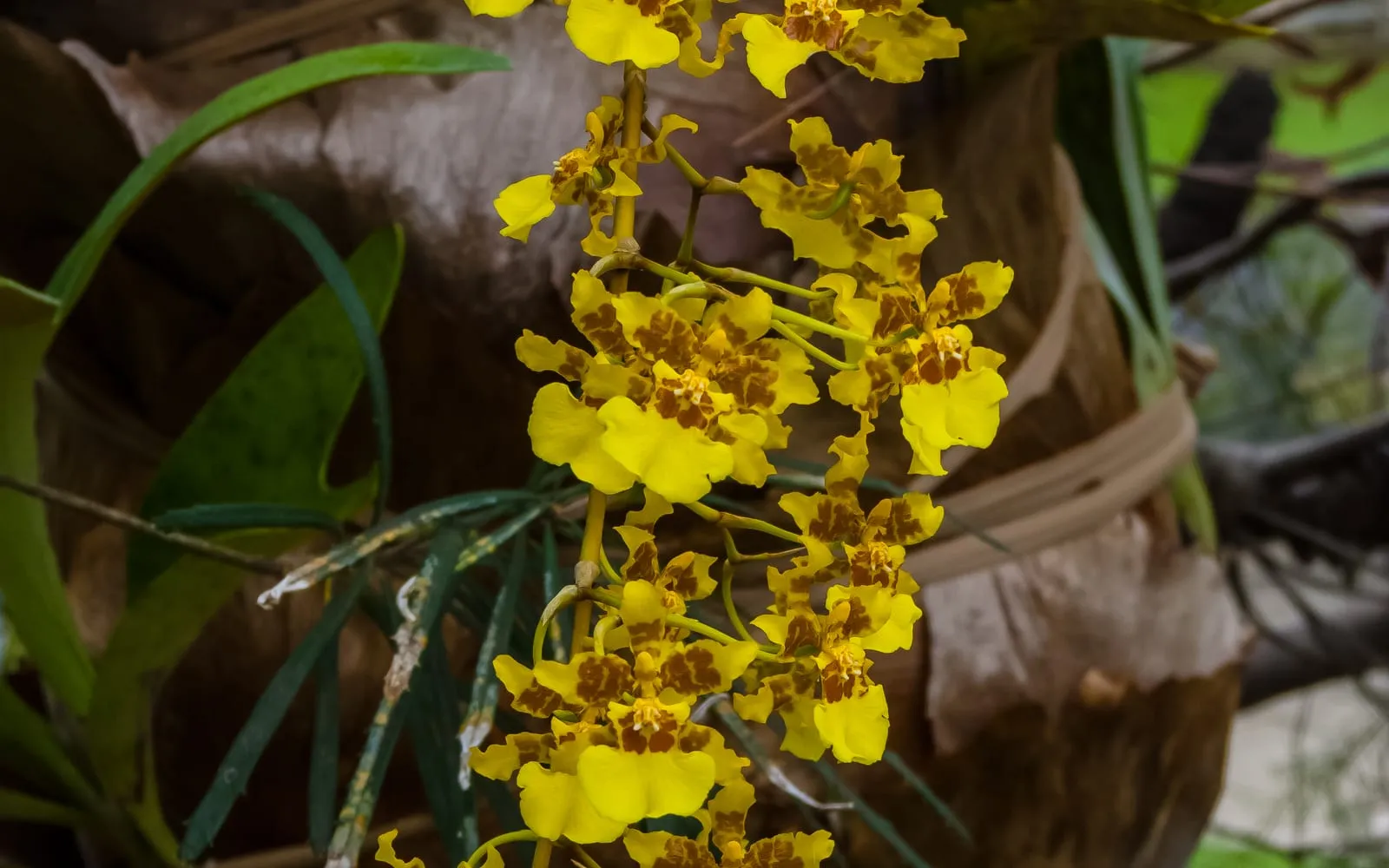
Few houseplants produce a display on the scale golden shower orchid manages. A single mature spike branches over and over as it lengthens, carrying several hundred small yellow flowers barred in reddish brown by the time it finishes opening, and the whole cascade can top a metre and a half from a plant that started life in an ordinary nursery pot. The common name describes exactly what a full spike looks like: a shower of gold pouring down from the top of the plant.
That scale is paid for in reserves stored in unusually large pseudobulbs, thicker and heavier than those of most Oncidium relatives. Whether a plant produces the huge spray it is capable of, rather than a more modest one, comes down largely to whether it gets a proper dry rest each year to build those reserves up.
Appearance and character
The pseudobulbs are the first thing that marks this species out from other, smaller-growing Oncidium species. They are oval, somewhat flattened, and noticeably larger and more substantial, clustering together at the base of the plant. Each carries one or two long, strap-shaped leaves, and older pseudobulbs shrink and lose their leaves with age, staying on as a swollen store of water and food rather than dying away entirely.
A flower spike starts at the base of a pseudobulb that has just finished maturing and keeps branching as it extends, so that by the time it reaches full length it is less a single stem than a loose, arching framework carrying flowers along most of its length. Each bloom is small, no more than 2 or 3 cm across, bright yellow with reddish-brown markings concentrated near the centre, but the sheer number packed onto one spray is what gives the display its impact.
Everything about this plant runs larger than the average Oncidium grown indoors, from the pseudobulbs through to the eventual size of the spray, and it needs proportionally more room to grow into than its smaller relatives do.
Where it is from
Oncidium sphacelatum ranges from Mexico south through Guatemala, El Salvador, Honduras and Nicaragua, growing as an epiphyte in pine-oak forest at middle elevations. Unlike a lowland rainforest orchid, it grows through a year with a clearly defined dry season, weeks or months at a stretch with little rainfall at all.
That dry season is central to how the species builds up to its enormous flower spray. A pseudobulb that grows through the wet months and then properly rests through a dry spell stores enough in reserve to support a spray with hundreds of flowers the following year. Keep the same plant lightly damp all year with no real dry period, and it tends to put out leaves reliably while flowering far more modestly, if at all.
How it grows
Choose a pot with room for the pseudobulb clusters to spread over the next few years rather than one sized tightly to the current plant, since this species outgrows a container faster than most other Oncidium relatives. A coarse, bark-based mix suits it well, and an established plant also does well mounted on bark or cork.
Position it in bright light with an hour or two of gentle morning sun. Leaves with a slight reddish tinge are taking about as much light as they can handle; leaves that stay a deep, unbroken green usually mean the plant would benefit from a little more.
Water generously while a new pseudobulb is visibly forming, then cut back hard once it has finished growing and its leaf has hardened off. Aim for several properly dry weeks after that, echoing the dry season the plant experiences at home, rather than easing off only slightly.
Plan to repot every two or three years, generally straight after flowering, once the bark has started breaking down or the cluster has outgrown its pot. This is also the easiest time to divide an overgrown clump if a second plant is wanted.
Through the seasons
Spring starts the year’s new pseudobulb growth. Step up watering as it lengthens and bring feeding back into the routine.
Summer carries most of that growth through to maturity, with steady watering and feeding while the leaves harden off.
Autumn brings the huge, branching flower spray on a plant that has been rested properly, arriving alongside the first signs of the coming dry spell.
Winter is the dry rest the whole cycle depends on. Cut watering right back and stop feeding, letting the pseudobulbs live off what they have already stored.
Care difficulty
Moderate. The plant does not ask for much beyond ordinary bark-orchid care through most of the year, but the size of its eventual flower spray depends on one deliberate choice: whether it gets a real dry rest each winter rather than being kept lightly watered out of habit. Skip that rest and the plant carries on growing regardless, just with a smaller show to reward the effort. Commit to it and the flower spray tends to scale up year after year as the pseudobulbs mature.
Watering
Soak the mix thoroughly while a pseudobulb is actively growing, then let it approach dryness before watering again rather than keeping it continuously damp.
Once that pseudobulb has matured, pull back sharply and let the dry season set in properly over winter, watering only enough to stop the whole plant visibly shrivelling. Excess moisture during this rest is the single biggest threat to the roots, since the plant is barely using water at all.
Warning signs, diseases and pests
Scale insects settle along the large pseudobulbs as small, flat brown bumps easily missed against the pseudobulb’s own surface texture. Scrape them off by hand and follow with horticultural soap.
Mealybug favours the folds where a new growth emerges from an older pseudobulb, showing up as small tufts of white fluff. Treat it the same way as scale, checking those hidden folds carefully since new growth is most vulnerable while still soft.
Spider mite turns up more often in dry, centrally heated air, especially during the plant’s own dry winter rest when humidity is already low. Fine speckling on the leaves and faint webbing in a bad case are the signs to watch for; raising humidity slightly and wiping the leaves down helps.
Root rot follows a bark mix kept wet through the dry season, when the plant has almost no use for the extra moisture. Roots turn brown and mushy rather than staying firm. Take the plant out of its pot, trim away the damaged roots, and repot into fresh bark, then hold back much more firmly on watering afterwards.
Growing environment
Bright light with a little gentle direct sun keeps growth compact and sets the plant up to flower well; too much sun scorches the leaves, while too little leaves them soft and dark green with a disappointing spray to show for it.
A fairly wide temperature range through the growing season suits it, provided it never drops below 8 deg C, a touch more tolerant of warmth than some other orchids grown indoors.
Moderate humidity of 40 to 60 percent is enough for healthy growth, and this species copes with ordinary room humidity better than many epiphytic orchids, reflecting the dry season it experiences at home.
Feeding
A balanced orchid fertiliser at roughly quarter strength, applied weekly, supports the plant well through spring and summer. Taper this back to monthly once the current season’s pseudobulbs have finished maturing.
Stop feeding entirely through the dry winter rest. Growth has all but stopped by then, and any fertiliser left unused builds up as salts in a mix that is barely being watered.
Troubleshooting
The flower spike came out much smaller than I expected. The likely cause is an insufficient dry rest the previous winter. This species builds its huge spray from reserves stored during a genuine dry period, and a plant watered lightly all year rarely produces anywhere near its full potential. Give it a proper dry winter next time and expect a bigger spray to follow in autumn.
Growth looked strong all summer, but there is still no sign of flowers. Give it a little longer first, since flowering tends to follow once the pseudobulb has fully hardened, sometimes not until autumn rather than straight after growth stops. If a whole season passes with nothing to show, check both the light levels and whether last winter’s dry rest was genuine.
The leaves have taken on a reddish tinge. That points to slightly more direct sun than the plant is entirely comfortable with. It causes no lasting harm, but move the plant back a little from the brightest part of the window once the colour looks like stress rather than a light blush.
The roots have turned brown and mushy. This is root rot, most often from watering through what should have been a dry rest. Trim away the damaged roots, repot into fresh bark, and be considerably stricter about withholding water through the following winter.
Would it do better mounted than potted? Once established, yes, and many growers prefer it that way for the extra airflow around the roots. A mounted plant dries out faster and needs watering more often during active growth, but that faster drying also makes root rot far less likely.
Golden Shower Orchid problem guides
Not sure what is wrong? See the common houseplant pests guide.