
Outdoor plant
Spanish Jasmine
Jasminum grandiflorum
Also known as Royal Jasmine, Catalan Jasmine, Jasmine Absolute Plant
How to grow Spanish jasmine, Jasminum grandiflorum. Why it scrambles rather than twines and needs tying to a support, its almost year-round flowering in a warm climate, and why a plant sold as "Carolina jasmine" is a different, dangerous species entirely.
At a glance
- Difficulty
- Moderate
- Water
- Regularly through the growing season, less in a cool winter rest
- Light
- Full sun for the strongest flowering
- Temperature
- Tender; needs frost protection or winter cover outside a mild climate
- Hardiness
- USDA 9-11, RHS H2-H3, hardy to -5 C
- Type
- Semi-evergreen scrambling shrub or lax climber
- Height
- 3-4 m against a support; 1.5-2 m as a freestanding shrub
- Native to
- South Asia, the Arabian Peninsula
Spanish jasmine is a subtropical plant that tolerates a light frost once established but not the sustained cold that common jasmine tolerates. In a climate that stays warm with no real winter it flowers on and off for most of the year rather than in one defined summer season, since it has no cold-triggered dormancy to interrupt it. Anywhere the ground freezes hard, it needs a container it can be moved under cover for, or a conservatory to live in permanently.
Hardiness zones describe winter cold alone. Summer heat, humidity, rainfall and the length of the growing season decide as much, so treat the range as the outer limit rather than as a recommendation.
Harmful if eaten
- Do not eat
- The black berries that occasionally follow flowering
- Harm from
- Eating it
- Affects
- People
True jasmine of the genus Jasminum, which this species belongs to, carries a reputation as one of the safer flowering climbers to grow around children and pets, and the ASPCA lists Jasminum as non-toxic to dogs, cats and horses. The RHS does not include it among potentially harmful garden plants. Where caution is worth applying is with the name rather than the plant: several unrelated species sold or searched for as jasmine are seriously dangerous, most notably Gelsemium sempervirens, sold as Carolina jasmine, whose gelsemine alkaloid has caused fatal poisonings and which belongs to an entirely different plant family. A gardener buying a plant labelled jasmine should confirm the botanical name reads Jasminum before assuming the ASPCA's non-toxic rating applies, since the common name alone covers plants ranging from harmless to lethal.
Sources: ASPCA (Jasmine, Jasminum species), RHS potentially harmful garden plants
About
Spanish jasmine is the species behind a large share of the world’s jasmine absolute, the concentrated perfume material extracted from hand-picked flowers before dawn, when their scent is at its most intense. Fields of it are grown commercially in Grasse in the south of France, in Egypt and in India specifically for that industry, alongside the closely related common jasmine.
In the garden it behaves less like a determined climber and more like a loose, arching shrub that leans on whatever support it is given, rather than gripping and twining tightly the way many other jasmines do. Left without support it forms a sprawling mound; tied to a wall or a frame it becomes an informal, wide-spreading climber.
Its flowers are larger than common jasmine’s and carry a stronger pink flush on the outside of each petal, and in a consistently warm climate it can flower on and off through most of the year rather than confining itself to a single summer display.
Appearance and character
A semi-evergreen shrub with long, arching, semi-woody stems that scramble rather than twine tightly around a support, reaching 3 to 4 m against a wall or trellis and staying more compact as a freestanding shrub.
Leaves are pinnate, made up of five to seven leaflets, glossy dark green and slightly larger than those of common jasmine, giving the plant a fuller, less delicate texture.
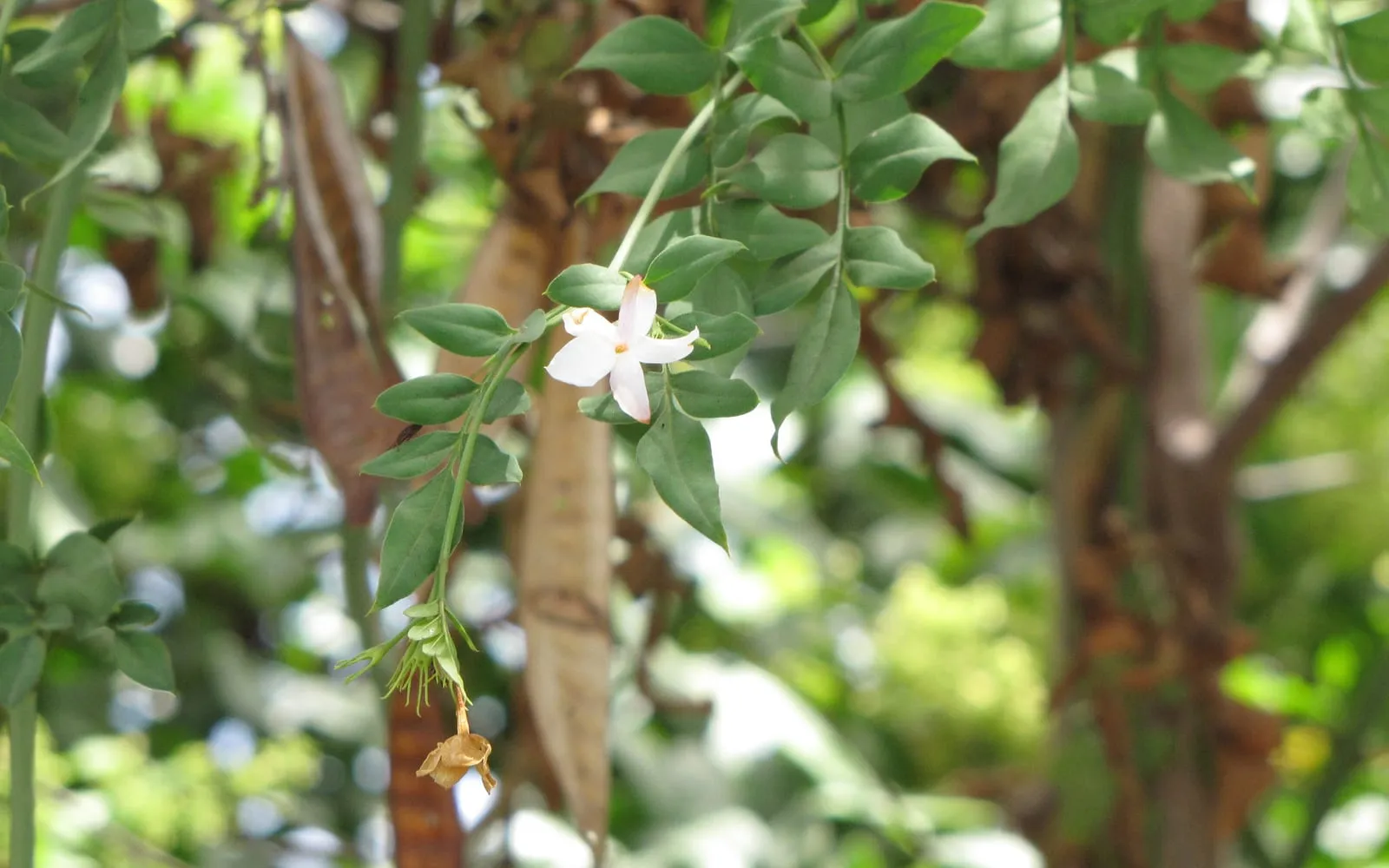
Flowers open white, star-shaped and noticeably larger than common jasmine’s, 2.5 to 4 cm across, carried in loose clusters at the shoot tips. The reverse of each petal carries a distinct rosy-pink flush, more pronounced than the faint blush seen on common jasmine buds, and the scent is rich and heady rather than the lighter fragrance of some other jasmines.
Small black berries occasionally follow flowering where a plant has been pollinated, though most garden specimens are grown and enjoyed for the flowers long before fruit becomes relevant.
Where it is from
Jasminum grandiflorum is generally considered native to South Asia and the Arabian Peninsula, with a long history of cultivation across that region and into East Africa that makes its precise original range hard to separate from where people have grown and spread it over centuries.
It has been cultivated in India for so long, worked into temple garlands, worn in the hair and used in Ayurvedic preparations, that it carries deep cultural associations there quite apart from its later fame in Western perfumery.
The warm, relatively frost-free conditions of its native and long naturalised range explain why the plant has none of the cold tolerance common jasmine developed growing wild through the Caucasus and the Himalaya. It comes from a climate where a hard frost is rare rather than an annual event, and that absence of cold-adapted dormancy is also why it can flower for so much of the year where it is grown outdoors year-round.
How it grows
Plant in fertile, well-drained soil in the sunniest position available, since flowering is directly tied to how much warmth and light the plant receives through the growing season.
Provide a support even though the plant does not twine tightly around it the way common jasmine does. Tie the arching stems in loosely to wires, trellis or a frame, since left unsupported the whole plant tends to flop outward into a wide, low mound rather than climbing.
In any climate where frost is a real winter risk, grow it in a large container that can be moved under cover, into a conservatory, greenhouse or bright frost-free room, once temperatures start to fall in autumn. Outdoor planting in open ground suits only a reliably mild, near-frost-free garden.
Prune lightly after the main flowering flush to keep the arching growth in bounds, removing any stems that have flowered and thinning congested growth to let light and air into the centre of the plant.
Repot a container specimen every second year into fresh compost, since it is a reasonably vigorous grower that exhausts a small pot’s nutrients within a couple of seasons.
Propagate from semi-ripe cuttings taken in summer, which root readily with a little bottom heat.
Through the seasons
Spring is the start of active growth. Move an overwintered container plant back outside once frost risk has passed, and resume feeding as new shoots appear.
Summer is the main flowering season outdoors, often continuing steadily rather than in one short burst, with the scent strongest in the evening.
Autumn is when container plants should come under cover before the first frost. Give the plant a light tidy-up prune once the main flowering has slowed.
Winter is a cooler rest indoors or under glass for a plant grown in any climate with real frost, with reduced watering and no feeding until growth resumes in spring.
Care difficulty
Moderate, and the difficulty is almost entirely about winter management rather than about the plant’s day-to-day needs. In a reliably mild, near-frost-free climate it is an easy, generous, long-flowering shrub that needs little beyond sun and regular water. Everywhere colder, the work of moving a container under cover each autumn and back out each spring is the real commitment, and skipping it in a hard winter can cost the plant outright rather than just a season’s growth.
Watering
Water regularly through spring and summer, letting the surface of the compost or soil dry slightly between waterings rather than keeping it constantly wet.
Reduce watering markedly for a plant spending winter under cover in cooler conditions, since it uses far less water while growth has slowed and overwatering at low light and temperature is a common way to lose one over winter.
A container-grown specimen dries out faster than one in open ground and needs checking more frequently through a hot summer.
Warning signs, diseases and pests
Aphids gather readily on soft new shoot tips, distorting young growth and leaving behind a sticky residue that other problems then build on. A strong jet of water or an insecticidal soap controls a light infestation.
Whitefly is a particular nuisance on plants kept under glass over winter, rising in a small pale cloud when the foliage is disturbed and weakening the plant gradually if left unchecked. Yellow sticky traps help monitor and reduce numbers.
Scale insects appear as small, flat, brownish bumps on older stems, sapping the plant’s vigour slowly rather than suddenly. Wipe away accessible colonies and treat the rest with horticultural soap.
Sooty mould, a black surface growth, follows the sticky honeydew left by aphids or scale rather than attacking the plant directly. Treating the insect responsible and wiping the affected leaves clears it.
A plant that drops its leaves and looks unwell after being moved under cover for winter is usually adjusting to lower light and a cooler temperature rather than suffering a genuine problem, and it typically recovers once growth resumes in spring.
Growing environment
Full sun gives the strongest, most reliable flowering, and a plant kept in shade grows leggy with comparatively few flowers.
Shelter from cold wind matters more for this species than for hardier jasmines, since the semi-evergreen foliage can be damaged by exposure even where temperatures do not quite reach frost.
Fertile, well-drained soil supports steady growth, and a container specimen benefits from a loam-based compost with some added grit for drainage.
Where grown outdoors year-round, a warm wall or a sheltered courtyard comes closest to the frost-free conditions the plant experiences across most of its native and long-cultivated range.
Feeding
Feed every two to four weeks through spring and summer with a high-potassium liquid fertiliser, of the kind sold for tomatoes or roses, to support strong and continued flowering.
Stop feeding entirely once a plant is moved under cover for a cooler winter rest, resuming only once new growth appears the following spring.
Avoid high-nitrogen feeds, which encourage soft leafy growth at the expense of flowers and produce growth more vulnerable to aphids.
Troubleshooting
Can I grow this outdoors through a cold winter? Only in a reliably mild, near-frost-free climate. Everywhere colder, grow it in a container you can move into a conservatory, greenhouse or bright frost-free room before the first frost.
Why does it flop instead of climbing neatly? Spanish jasmine scrambles rather than twining tightly, unlike common jasmine. Tie the arching stems loosely to a support as they grow rather than expecting the plant to grip it unaided.
It dropped leaves after I brought it inside for winter. A normal response to lower light and cooler temperature. Keep it in the brightest spot available and reduce watering, and it typically recovers with fresh growth in spring.
Is it the same plant used for jasmine tea? Not usually. Jasmine tea is most often scented with Jasminum sambac, a different species. Spanish jasmine is grown mainly for the perfume industry and for its scent in the garden.
Is it safe to grow near children or pets? True Jasminum species, including this one, are listed as non-toxic by the ASPCA. Confirm the botanical name if buying an unfamiliar plant sold as jasmine, since some unrelated plants sold under the same common name are seriously toxic.