
Outdoor plant
Common Jasmine
Jasminum officinale
Also known as Summer jasmine, Poet's jasmine, White jasmine
How to grow Jasminum officinale. Why it saves its scent for the evening, the warm wall it needs in a cool climate, when to prune it, and the three unrelated plants sold under the same name.
At a glance
- Difficulty
- Moderate
- Water
- Weekly through the first two summers, then in drought only
- Light
- Full sun. It flowers poorly in shade
- Temperature
- Hardy to about -10 deg C. It needs a sheltered wall inland
- Hardiness
- USDA 7-10, RHS H4, hardy to -10 C
- Type
- Deciduous to semi-evergreen twining climber
- Height
- 6-12 m
- Native to
- The Caucasus, northern Iran, Afghanistan, the Himalaya and western China
- Best month
- August in the Northern Hemisphere, February in the Southern Hemisphere
Scent is released after dusk and needs warmth to volatilise, so a plant on a cold shaded wall smells of almost nothing while the same plant on a sun-warmed wall scents a whole garden. That, rather than survival, is the reason for the sunny sheltered position. Below about -10 C the top growth dies back and regrows from the base in a mild spring.
Hardiness zones describe winter cold alone. Summer heat, humidity, rainfall and the length of the growing season decide as much, so treat the range as the outer limit rather than as a recommendation.
Every month named in this guide is for the temperate Northern Hemisphere. If you garden in the Southern Hemisphere, shift each one by six months, so August becomes February. Closer to the equator the wet and dry seasons matter more than the calendar, and the shift stops being a useful guide.
Not known to be toxic
Non-toxic. The ASPCA lists Jasminum species as non-toxic to dogs, cats and horses, and Jasminum officinale does not appear on the RHS list of potentially harmful garden plants. The part of this entry that matters is which plants share the name. Carolina jasmine, Gelsemium sempervirens, is a different genus in a different family, is highly toxic through gelsemine, and has caused deaths. Night-blooming jasmine, Cestrum nocturnum, belongs to the nightshade family and is also toxic. Star jasmine, Trachelospermum jasminoides, is another family again and carries a milky sap that irritates skin. None of the three is closely related to true jasmine. If a plant is described as jasmine and you are checking whether it is safe, confirm the botanical name first, because the common name spans plants from harmless to lethal. True Jasminum, which is what this guide covers, is safe around children and pets.
Sources: ASPCA (Jasmine, Jasminum species), NC State Extension, Jasminum officinale
About
Walk past a jasmine at midday in July and you may catch nothing at all. Walk past the same plant at nine in the evening and the scent carries across the garden.
The plant is pollinated by night-flying moths, so it releases its volatile compounds as the light fades and holds the peak through the first half of the night. Siting one where you sit out on a summer evening, or under a bedroom window you leave open, is worth more than putting it somewhere you only pass in the morning.
Jasmine absolute, extracted from the flowers of this species and of Jasminum grandiflorum, remains among the most expensive materials in perfumery. The flowers are picked before dawn while the scent is still at full strength.
Appearance and character
A twining deciduous or semi-evergreen climber reaching 6 to 12 metres, with slender green stems that thicken and go woody at the base.
Leaves are pinnate with five to nine narrow pointed leaflets, the end leaflet longer than the rest, giving the whole plant a fine, almost ferny texture.
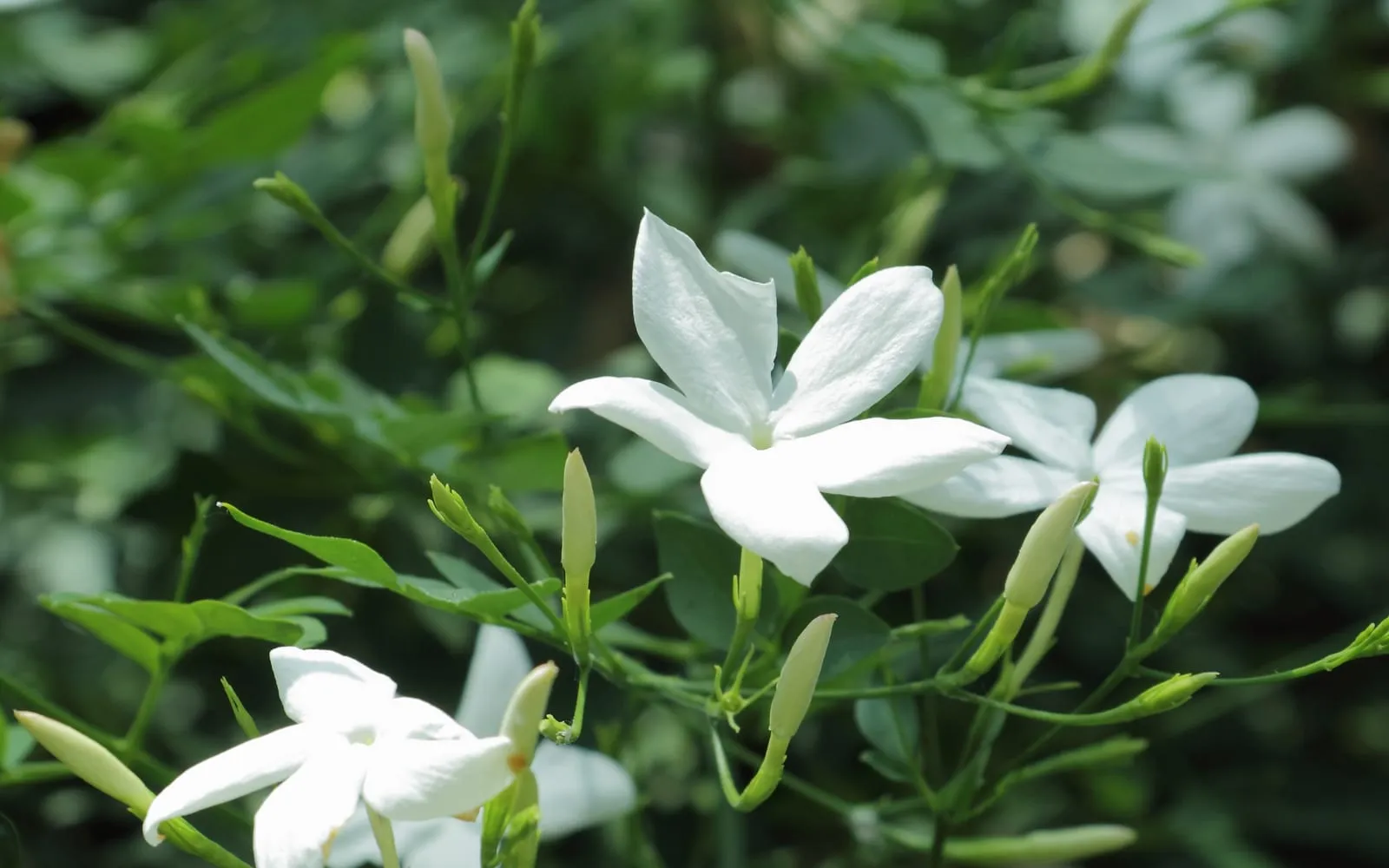
Flowers open white with five lobes, about 2 cm across, in loose clusters at the shoot tips from June until September. The buds are flushed pink or rose on the outside, which is the plant’s most attractive detail and the easiest way to recognise it.
‘Argenteovariegatum’ has grey-green leaves edged cream. ‘Aureum’ is splashed yellow. Jasminum officinale f. affine has larger flowers with a stronger pink flush.
Growth is dense and tangled after a few years, and the plant needs a support it can twine through rather than a flat surface.
Winter behaviour varies. In a mild coastal garden it keeps most of its leaves, and inland it drops them.
Where it is from
A wide native range running from the Caucasus and northern Iran through Afghanistan and the Himalaya into western China, growing in scrub, on rocky slopes and through hedges.
Those are summer-hot, winter-cold, well-drained places. The plant is comfortably hardy in terms of absolute temperature and it flowers in proportion to the summer warmth it receives.
A sheltered sunny wall gives the ripening heat the wood needs to set flower buds. A cold open fence gives a plant that survives and disappoints.
The soil in its range is free-draining and often stony. Heavy wet clay through a temperate winter is the condition it copes with least well.
It has been cultivated so long across Persia, India and the Mediterranean that its exact wild origin is hard to pin down.
How it grows
A twining climber that wraps its stems around any support within reach. It has no tendrils, no suckers and no adhesive pads, so it needs wires, trellis, netting or another plant to scramble through.
Flowers form on the current season’s growth at the tips of side shoots, which is what determines the pruning timing. Cutting the plant back in spring removes the wood that would have flowered.
Growth is fast in a warm summer, adding two metres or more, and slow in a cool one.
Prune immediately after flowering finishes, in early autumn. Take out the stems that have just flowered, thin the congested tangle, and shorten anything growing where you do not want it.
Propagation is easy from semi-ripe cuttings in late summer, and layering a low stem into the soil works reliably.
An old neglected plant becomes a bare tangle with growth only at the top. It tolerates hard renovation in spring at the cost of that year’s flowers.
Through the seasons
Spring brings new growth. Feed as growth starts, and tie in the leading shoots before they tangle. Avoid pruning now.
Summer is the flowering season, from June to September, with the scent strongest in the evening. Water in dry spells and keep feeding.
Early autumn is the pruning window, straight after flowering. Thin the plant and cut out the flowered wood.
Winter may be the risk period inland. Mulch the base after the first frosts. In a cold garden, protect the base with fleece or bracken during a hard spell. A plant cut back by frost usually reshoots from the base.
Care difficulty
Moderate. The plant is undemanding once it is in the right place, and the right place is more specific than for most climbers.
Warmth and shelter decide everything. On a south or west-facing wall in a mild area it flowers freely for months. On a north-facing fence it grows and sulks. In a cold inland garden it may be cut to the ground in a hard winter.
Pruning at the wrong time is the second failure. Cutting it back in spring, which is the instinct with a tangled climber, removes the shoots that were about to flower.
Beyond those two it is a straightforward plant, untroubled by most pests and happy to be left to tangle.
Watering
Water weekly through the first two summers while the plant establishes.
Established plants need water only in prolonged drought. A jasmine trained against a house wall sits in a rain shadow and dries out much faster than open ground, so check it in a dry summer.
Water at the base rather than over the foliage.
Mulch each spring with compost to hold moisture through summer, keeping it clear of the stems.
Container-grown plants need consistent watering through the growing season and should never dry out completely, though they must not sit in water either.
Warning signs, diseases and pests
Plenty of growth and few flowers usually means too little sun, or pruning at the wrong time of year, or too much nitrogen. Work through those three in order.
Blackened shoot tips after winter are frost damage. Cut back to live wood in spring and the plant recovers.
Yellowing leaves with wet heavy soil suggest root rot. Improve drainage.
Aphids cluster on soft new growth and distort the shoot tips. Squash them or wash them off.
Mealybugs are a problem on plants grown under glass or in a conservatory, appearing as white fluff in leaf joints.
Jasmine leaf gall mite causes distorted, thickened, cauliflower-like growth at the shoot tips. Cut out affected shoots and dispose of them.
A bare tangle with leaves only at the top means the plant has not been thinned for years. Renovate it hard in spring.
Failure to flower on a young plant is often patience. Newly planted jasmine may take two or three years to settle before flowering well.
Growing environment
Full sun. This is the single most important factor for flowering, and a plant in shade will grow and disappoint.
A sheltered south or west-facing wall is the ideal position wherever summers are cool. The stored heat in the masonry ripens the wood and protects the plant in winter.
Fertile, well-drained soil that holds some moisture. Improve heavy clay with grit and organic matter, and improve thin sand with compost.
Hardy to about -10 deg C. Coastal and southern gardens grow it without concern. Cold inland gardens should give it the warmest wall available and mulch the base in winter.
Provide a support it can twine through. Horizontal wires 30 cm apart on vine eyes, trellis, or netting all work. It cannot climb a bare wall.
Site it for the scent. Beside a door, under a window, or over a seating area earns far more from the plant than a distant boundary fence.
Shelter from cold drying winds, which damage the semi-evergreen foliage.
Feeding
Feed monthly from spring through summer with a high-potassium fertiliser such as a rose or tomato feed. Potassium supports flowering.
Avoid high-nitrogen feeds, which give lush growth and few flowers on a plant already inclined to grow vigorously.
Mulch in spring with garden compost or well-rotted manure.
Container-grown plants need feeding fortnightly through the growing season, since they exhaust their compost quickly.
Stop feeding by early autumn so the growth hardens before winter.
Troubleshooting
Lots of growth, hardly any flowers. Check sunlight first, since this plant needs full sun. Then check when you prune, because cutting in spring removes the flowering shoots. Then check your feed for excess nitrogen.
When should I prune it? Straight after flowering finishes, in early autumn. Remove the wood that has flowered and thin the tangle.
It got cut back by frost. Wait until spring, cut back to live wood, and it will usually reshoot from the base. Mulch the base next autumn.
I cannot smell anything. Try again in the evening. The scent is released after dusk for night-flying moths and is weak in the middle of the day.
Is this the same as winter jasmine? No. Winter jasmine is Jasminum nudiflorum, with yellow flowers on bare green stems from November to March, and no scent at all. The two are different species with different seasons.
What about star jasmine? Trachelospermum jasminoides is a different family entirely, evergreen, with a milky irritant sap and small white pinwheel flowers. It is often sold as jasmine and is a good plant, just not this one.
Is it safe with a dog? True jasmine is listed non-toxic by the ASPCA. Check the botanical name on anything sold as jasmine, since Carolina jasmine and night-blooming jasmine are unrelated plants and are toxic.
Can I grow it in a pot? Yes, in a large one with good compost, and it will need regular feeding, regular watering and annual pruning to stay manageable.