
Outdoor plant
Winter Jasmine
Jasminum nudiflorum
Also known as Winter-flowering jasmine, Yellow jasmine
How to grow winter jasmine, Jasminum nudiflorum. Flowers on bare stems in January, pruning straight after flowering, training a scrambler, and why it has no scent.
At a glance
- Difficulty
- Easy
- Water
- Rarely once established
- Light
- Full sun to partial shade. Flowers best with more sun
- Temperature
- Fully hardy, to about -20 deg C
- Hardiness
- USDA 6-9, RHS H6, hardy to -20 C
- Type
- Deciduous shrub, scrambling rather than climbing
- Height
- 1-3 m against a support
- Native to
- Western China
- Best month
- November in the Northern Hemisphere, May in the Southern Hemisphere
It flowers on bare wood in midwinter and the buds open in any mild spell from November onwards, opening in succession so a frost costs you a few days rather than the season. It has no twining ability and no tendrils, so it has to be tied to a support. Prune straight after flowering, because it blooms on last year growth.
Hardiness zones describe winter cold alone. Summer heat, humidity, rainfall and the length of the growing season decide as much, so treat the range as the outer limit rather than as a recommendation.
Every month named in this guide is for the temperate Northern Hemisphere. If you garden in the Southern Hemisphere, shift each one by six months, so November becomes May. Closer to the equator the wet and dry seasons matter more than the calendar, and the shift stops being a useful guide.
Not known to be toxic
Non-toxic. The ASPCA lists Jasminum species as non-toxic to dogs, cats and horses, NC State Extension tags Jasminum nudiflorum as pet friendly and non-toxic to cats, dogs and horses, and winter jasmine does not appear on the RHS list of potentially harmful garden plants. The important part of this entry is which plants share the name. Carolina jasmine, Gelsemium sempervirens, is a different genus in a different family, is highly toxic through gelsemine, and has caused deaths. Night-blooming jasmine, Cestrum nocturnum, is in the nightshade family and is also toxic. Neither is closely related to true jasmine. If a plant is described as a jasmine and you are checking it for safety, confirm the botanical name, because the common name covers plants ranging from harmless to lethal. True Jasminum, which is what this guide covers, is safe.
Sources: NC State Extension, Jasminum nudiflorum, ASPCA (Jasmine, Jasminum species)
About
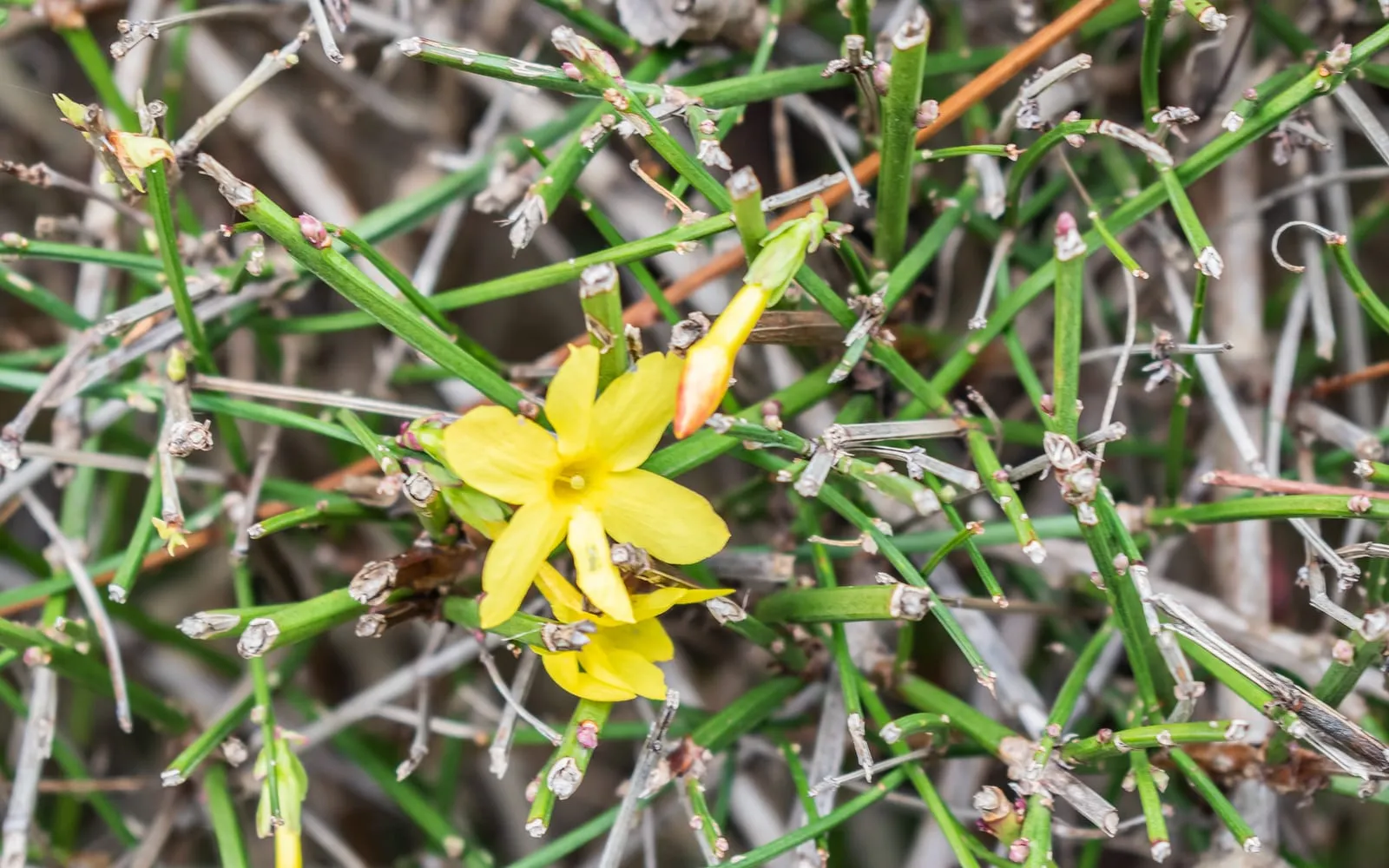
Winter jasmine flowers in January on bare stems, and there is very little competition for that. From November through to March it produces bright yellow star-shaped blooms along leafless green shoots, opening in batches so that frost takes some and the next lot follow.
The botanical name says exactly this. Nudiflorum means naked-flowered, for blooming without leaves.
One expectation needs correcting up front. This plant has no scent. Summer jasmine, Jasminum officinale, is the fragrant white one, and buying winter jasmine for perfume leads to disappointment every time. It is grown for colour in the dead of winter, which is worth plenty on its own.
Appearance and character
Long, slender, four-angled green stems that arch outward and downward, staying green all year and giving the plant some presence even when bare.
Flowers are bright yellow, about 2 cm across, with five or six rounded lobes, borne singly along the stems from November to March.
Leaves are small and divided into three leaflets, appearing after the flowers in spring and dropping in autumn. The plant is deciduous, though the green stems mean it never looks properly bare.
Growth is scrambling rather than climbing. It has no tendrils, no twining stems and no aerial roots, so it will lean on a support and flop off it unless tied in. Left free it makes a mounding shrub that roots wherever a stem touches soil.
Where it is from
Western China, in Gansu, Sichuan and Yunnan, growing on rocky slopes, in ravines and along cliff edges at altitude.
Those slopes are where the scrambling habit comes from. The plant grows over rock and through other vegetation rather than up it, which is why it needs tying to a wall in a garden.
Those slopes have cold winters, which is where the hardiness to minus 20 deg C comes from, and poor stony soil, which is why it thrives on ground where more demanding shrubs fail.
Robert Fortune introduced it to Britain in 1844, and it has been a fixture of Victorian and later gardens ever since, most often trained against a wall by a front door where the winter flowers are seen daily.
How it grows
A deciduous shrub flowering on wood made the previous summer.
That is the fact that governs pruning, and getting it wrong is the only common way to fail with this plant. Cutting it back in autumn or winter, when it looks untidy, removes the flowering wood. Cutting it back immediately after flowering finishes in spring gives the plant the whole growing season to make new shoots for next winter.
Growth is vigorous, and long whippy shoots extend a metre or more in a season.
Layering happens by itself. Any stem that touches soil roots at the node, so a free-growing plant spreads outward into a thicket. Detach a rooted section in autumn to make a new plant, which is the easiest propagation of any shrub in these guides.
Renovation is possible, unlike with lavender and rosemary. An overgrown tangled plant can be cut back hard to 60 cm in spring, and it regrows from old wood, costing one season of flowers.
Through the seasons
Winter is the display, from November through to March. Nothing needs doing except appreciating it. Cut a few stems in bud for a vase indoors, where they open in the warmth.
Spring is pruning, straight after the last flowers fade, usually in late March or April. Cut the flowered shoots back to strong buds, remove a fifth of the oldest stems at the base, and tie in the framework. Mulch afterwards.
Summer is growth, and this is when next winter’s flowers are being made. Tie in the new shoots as they lengthen rather than letting them flop.
Autumn brings leaf fall and the first flowers, often overlapping. Detach any rooted layers now if you want new plants.
Care difficulty
Easy, and forgiving in a way that most winter-flowering plants are not. It tolerates poor soil, shade, cold, pollution and neglect.
The one thing to get right is pruning time. Prune immediately after flowering, never in autumn or winter.
The one thing to keep up with is tying in. This plant does not climb, and an untied winter jasmine against a wall becomes a heap on the ground within two seasons.
Watering
Water new plants regularly through their first growing season while they establish.
After that, almost nothing. Established winter jasmine is drought-tolerant and copes with ordinary temperate conditions without help.
Water during a prolonged summer drought, particularly on a dry sunny wall where the soil at the base gets little rain. The narrow strip against a house wall is often much drier than the rest of the garden.
Container plants need regular watering and are the only situation where this matters much.
Mulch in spring to hold moisture and suppress weeds.
Warning signs, diseases and pests
Very few flowers is the main complaint and it is almost always a pruning error. The plant flowers on last summer’s wood, so an autumn or winter tidy-up removes the buds. Prune after flowering instead.
Aphids cluster on soft new growth in spring and are rarely a serious problem.
Scale insects appear as small brown bumps along the stems with sticky honeydew below, and they are commonest on plants against a warm sheltered wall. Scrape them off or treat in spring when the crawlers are active.
Jasmine leaf blotch causes brown patches on the leaves in summer. It is cosmetic, and collecting fallen leaves reduces it.
A tangled congested mess in the middle of an old plant is the result of never thinning. Take out a fifth of the oldest stems at the base each spring.
Stems rooting where they touch the ground is normal behaviour rather than a problem, and it is useful if you want more plants.
Frost damage to open flowers happens regularly and matters very little, since the plant opens more in succession over four months.
Growing environment
Full sun to partial shade. It flowers more freely with more sun, and it will still flower on a north-facing wall, which few winter-flowering plants manage.
Fully hardy to about -20 deg C. The flowers themselves are damaged by hard frost and are replaced by the next flush.
Soil can be almost anything that drains, including poor, chalky and clay ground. This is a plant for a difficult spot.
A wall or fence is the usual setting, with horizontal wires or trellis to tie into. A north or east wall by a door works well, since the flowers are seen at the time of year you notice them most.
It also works as free-standing ground cover on a bank, where the arching stems root as they spread and hold the soil.
Tie in the growth. Wires at 30 cm intervals and soft twine are all it needs.
Feeding
Very little. A mulch of garden compost or well-rotted manure in spring, applied after pruning, is the whole programme.
Feeding is rarely necessary and over-feeding produces long soft growth at the expense of flowers.
On very poor soil, a general-purpose granular fertiliser in spring is enough.
Avoid high-nitrogen fertiliser, which gives you a mass of green shoots and few blooms.
Troubleshooting
Hardly any flowers. Pruned at the wrong time. This plant flowers on the previous summer’s growth, so prune straight after flowering in spring and never in autumn or winter.
Falling off the wall. It scrambles rather than climbs and has nothing to hold on with. Tie the stems to wires or trellis as they grow.
Tangled and congested in the middle. Never thinned. Remove a fifth of the oldest stems at the base each spring after flowering.
Completely overgrown. Unlike lavender and rosemary, this shrub regrows from old wood. Cut it back hard to 60 cm in spring and lose one year of flowers.
No scent at all. Correct. Winter jasmine has none. For fragrance, grow summer jasmine, Jasminum officinale.
Flowers browned by frost. Normal and temporary. More open in succession over the following weeks.
Stems rooting into the ground everywhere. Natural layering. Detach the rooted sections in autumn for free plants, or cut them off if you want it contained.
Brown bumps on the stems with sticky residue. Scale insects. Scrape them off and treat in spring.