
Outdoor plant
Pink Jasmine
Jasminum polyanthum
Also known as Chinese jasmine
How to grow pink jasmine outdoors or as a container climber. Its intensely fragrant late-winter flowers, and why it needs shelter from hard frost.
At a glance
- Difficulty
- Moderate
- Water
- Regular watering through the growing season, reduced in winter
- Light
- Full sun to partial shade
- Temperature
- Tolerates a brief light frost once established
- Hardiness
- USDA 8-10, RHS H3, hardy to -5 C
- Type
- Evergreen to semi-evergreen twining climber
- Height
- 3-6 m
- Native to
- Southwestern China
Tender to real cold, tolerating a brief light frost once established against a sheltered wall but damaged or killed by a harder freeze. It is grown outdoors year round in a mild climate and as a container or conservatory plant, brought under cover for winter, everywhere colder, where it is also one of the most popular winter-flowering houseplants for its scent alone.
Hardiness zones describe winter cold alone. Summer heat, humidity, rainfall and the length of the growing season decide as much, so treat the range as the outer limit rather than as a recommendation.
Not known to be toxic
Pink jasmine has no toxicity listing from the RHS or the ASPCA and is considered safe around pets and children. There is no documented history of poisoning associated with this species.
Source: RHS
About
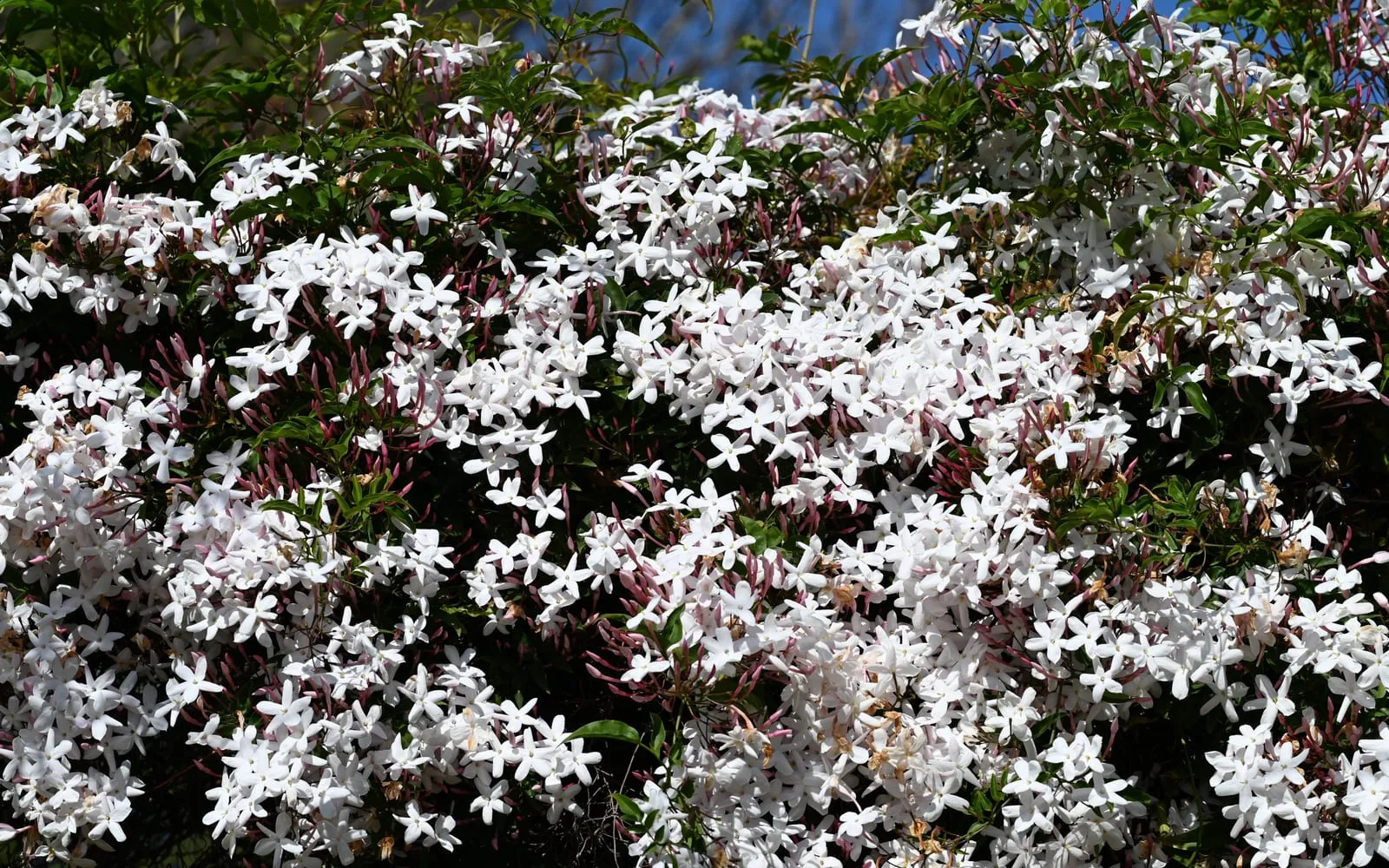
Pink jasmine is grown almost entirely for its scent: masses of small, intensely fragrant white flowers, opening from pink-flushed buds, cover the vigorous twining stems from late winter into spring, filling a conservatory, porch or sheltered patio with fragrance at a time of year when few other climbers are offering anything at all. A single well-grown plant in flower can scent an entire room, which has made it one of the most popular winter and early spring flowering houseplants sold specifically for this purpose.
Outdoors it needs more shelter than the hardier common jasmine, Jasminum officinale, and in anything but a mild climate it is more reliably grown as a container plant that spends summer outside and winter in a bright, cool but frost-free spot, timed to bring its flowering indoors during the darkest months.
Appearance and character
Vigorous, twining stems carry glossy, dark green, divided leaves and produce dense clusters of small, star-shaped flowers, white with a distinct pink flush on the reverse of each petal and in bud, opening from late winter through spring on a well-timed plant. The scent is much stronger than many other jasmine species, part of why this particular species is so often chosen specifically for indoor or conservatory growing.
Left to climb freely, it produces a dense tangle of twining growth that needs a sturdy support, whether a trellis, wires or a hoop for a container specimen, to keep it looking tidy rather than becoming a congested mass of stems.
Where it is from
Forest margins and scrub in southwestern China, in a climate with cool but not severely cold winters and warm, humid summers.
That relatively mild native climate is the reason this species is more tender than several other commonly grown jasmines, and it explains why it performs best either in a reliably mild coastal or urban microclimate outdoors, or as a container plant that avoids the coldest part of winter under cover entirely.
How it grows
A vigorous, twining climber that extends rapidly through the growing season, wrapping its stems around any suitable support as it grows rather than clinging by tendrils or aerial roots. Flower buds typically form on growth made the previous season, so a plant pruned hard immediately after flowering, while a fresh flush of growth still has time to develop and ripen before the following winter, generally flowers more reliably than one left unpruned or cut back at the wrong time of year.
Grown as a container plant brought indoors for winter, its flowering can be timed reasonably reliably by controlling when it is brought into warmth, since a cool period beforehand followed by increasing warmth and light tends to trigger a strong flush of buds.
Through the seasons
Spring is the main flowering period for many plants, with dense clusters of fragrant flowers opening from late winter into spring. Prune to shape once flowering has finished.
Summer is the main growing season, with vigorous new stem extension. Water and feed regularly through this period.
Autumn growth slows as temperatures drop; reduce watering and feeding, and bring container-grown plants under cover before the first frost in a marginal climate.
Winter established outdoor plants in a mild climate tolerate a brief light frost; container-grown plants kept cool and bright indoors often begin flowering during this season.
Care difficulty
Moderate. The plant grows vigorously and needs little in terms of routine care, but achieving strong, reliable flowering depends on correct pruning timing and, in a marginal climate, appropriate winter protection, both of which take a little more attention than a fully hardy climber would need.
Watering
Keep the soil consistently moist through the growing season, never allowing it to dry out completely, particularly for a container-grown plant with a more limited root run than one in open ground. Reduce watering over winter, particularly for a plant being kept cool and semi-dormant ahead of a flowering display.
Warning signs, diseases and pests
Aphids commonly colonise soft new growth and flower buds, and are dislodged easily with a jet of water or treated with insecticidal soap for a heavier infestation. Scale insects can appear on the stems and respond to a horticultural oil treatment, and spider mites occasionally appear in warm, dry indoor conditions, particularly on a container plant overwintered indoors.
Poor or absent flowering most often traces back to pruning at the wrong time, removing the previous season’s growth before it has had a chance to flower, or to insufficient winter chilling for a container-grown plant that has been kept too warm throughout the year to build strong flower buds.
Growing environment
Full sun to partial shade both suit it, and a sheltered position, whether a warm wall outdoors in a mild climate or a bright room indoors, supports the strongest growth and flowering. Humus-rich, moisture- retentive but free-draining soil gives the best results, and a sturdy support is essential for this vigorous twining climber.
Feeding
A balanced liquid feed, applied monthly through spring and summer, supports strong growth and good flower bud formation for the following season. Reduce or stop feeding through autumn and winter as growth slows.
Troubleshooting
The plant grows vigorously but flowers poorly. Check pruning timing first, since cutting back at the wrong point removes the previous season’s flower-bearing growth. Prune promptly after flowering rather than at other times of year.
A container-grown plant has not flowered despite being kept warm and bright. Consider providing a cool period beforehand, since this species often needs a period of lower temperature to trigger strong bud formation, similar to several other winter-flowering climbers.
Growth has become a dense, tangled mass. Prune promptly after flowering to control size and shape, training the strongest stems onto a support and removing excess or crossing growth.
An outdoor plant was damaged by an unexpected hard frost. Cut away clearly dead growth once the risk of further cold has passed; established plants often resprout from the base even after fairly severe dieback, though recovery can take a full growing season.