
Outdoor plant
Yellow Water-Lily
Nuphar lutea
Also known as Brandy bottle, Spatterdock
How to grow the yellow water-lily, Nuphar lutea, in deep water. Planting depth, why it suits streams a true water-lily cannot, and its brandy-bottle scent.
At a glance
- Difficulty
- Easy
- Water
- Grown fully submerged; no watering required
- Light
- Full sun to partial shade
- Hardiness
- USDA 3-10, RHS H7, hardy to -25 C
- Type
- Hardy aquatic perennial
- Height
- Leaves float; flower stalks reach 30-90 cm of water depth
- Native to
- Europe, Western Asia, North Africa
Fully hardy and tolerant of both still ponds and moving water, which sets it apart from most true water-lilies. The thick rhizome anchors firmly enough to withstand a slow current, and survives ice cover so long as the water beneath does not freeze solid. It flowers through summer wherever the water stays above about 12 deg C for several months.
Hardiness zones describe winter cold alone. Summer heat, humidity, rainfall and the length of the growing season decide as much, so treat the range as the outer limit rather than as a recommendation.
Harmful if eaten
- Do not eat
- Rhizome and seeds
- Harm from
- Eating it
- Affects
- People, dogs and horses
The rhizome contains bitter sesquiterpene alkaloids, historically used in small doses as a herbal sedative and, in much larger doses, as a fish poison, which is a reasonable indication of its toxicity in quantity. Eating raw rhizome or seed in any amount can cause vomiting and drowsiness. Cases are rare because the plant is unpalatable and grows out of easy reach in open water, and neither the RHS nor the ASPCA rates it among the more seriously toxic aquatic plants. Treat it as "leave alone" rather than as an emergency risk.
Source: RHS
About
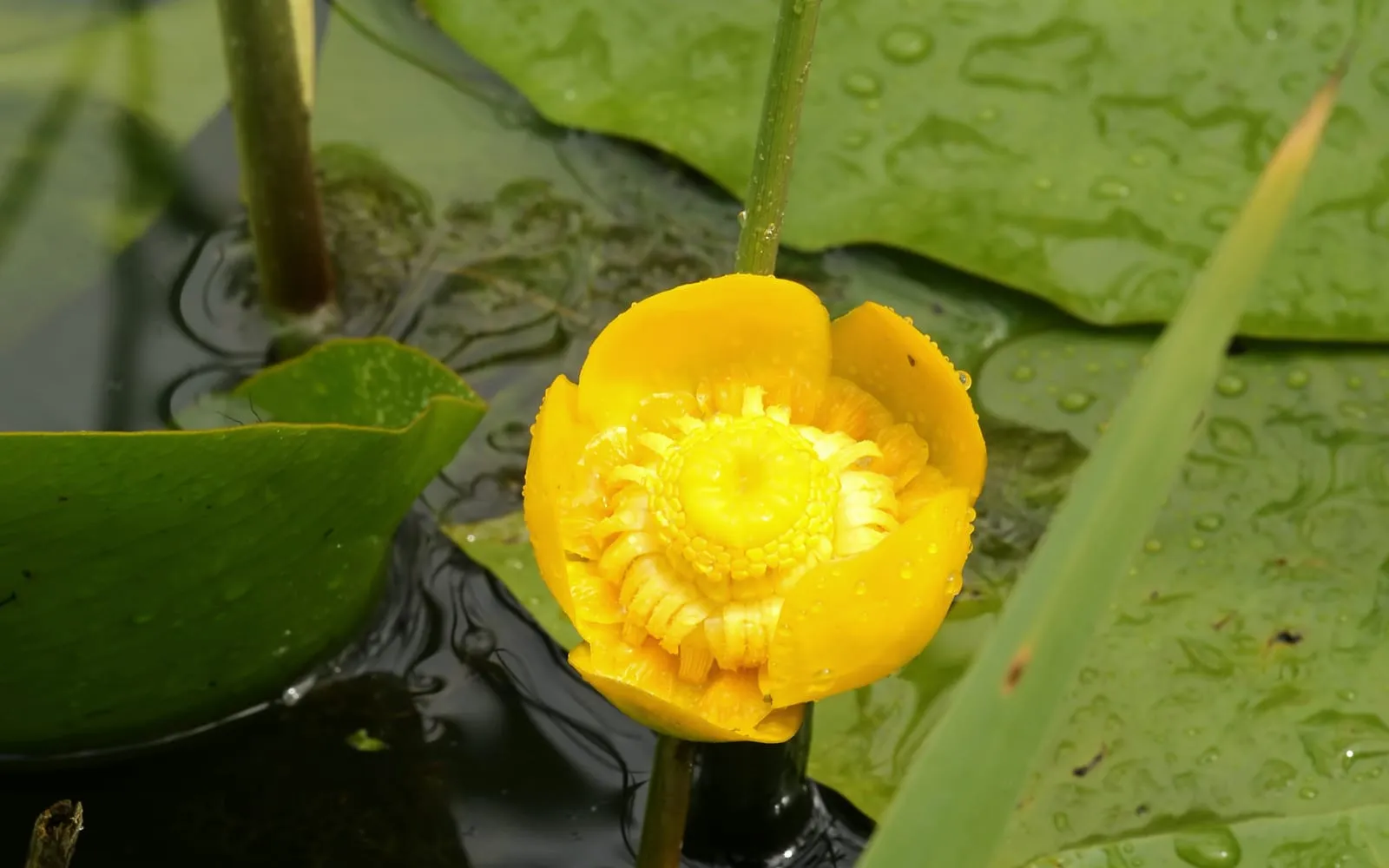
The yellow water-lily is the plant to choose for water too deep or too gently moving for a true water-lily of the Nymphaea genus. Rounded floating leaves spread across the surface much as a Nymphaea’s do, but the flowers are smaller, cup-shaped and bright yellow, held just clear of the water on a stiff stalk rather than floating flat.
Its common name brandy-bottle comes from the shape and faint alcoholic smell of the seed pod once the petals have dropped, a detail that has stuck in folk names across its native range for centuries.
Appearance and character
Leathery, rounded leaves float on the surface and are often joined by a second set of thinner, translucent leaves that stay fully submerged, particularly in deeper or shadier water. Both leaf types grow from the same thick, branching rhizome.
Flowers are smaller than a typical water-lily’s, 4-6 cm across, cup-shaped rather than flat, and a strong yellow rather than white or pink. They stand a few centimetres proud of the water on a rigid stalk and have a faint, sweet, alcoholic scent that gave the plant its bottle-shaped nickname once the petals fall and the flask-like seed pod is left behind.
Where it is from
Lakes, canals, ditches and slow rivers across Europe, western Asia and North Africa, often in deeper or more shaded water than a true water-lily would tolerate. It is a native British species, unlike some of the ornamental water-lily hybrids sold alongside it at the same garden centre.
Its tolerance of moving water and depths beyond a metre comes from a rhizome system built for anchoring in a current, thicker and more robust than the equivalent structure in Nymphaea.
How it grows
A hardy perennial growing from a stout, creeping rhizome that thickens over years and can eventually weigh several kilograms in an old, undisturbed planting. New leaves and flower stalks rise continuously through the growing season from growing points along the rhizome.
Because it tolerates greater depth and gentle current, it suits situations a true water-lily would struggle with: a deep ornamental lake, a slow stream, or a pond with a modest fountain whose ripple would otherwise disturb a water-lily’s flat leaves.
Through the seasons
Spring growth resumes as the water warms, with the first floating leaves appearing through April and May.
Summer is the flowering season, running from June to August, with a steady succession of yellow cups held above the water.
Autumn growth slows as the water cools, and floating leaves begin to die back.
Winter the rhizome is dormant on the pond or lake bed, unharmed by ice on the surface so long as the water beneath it stays liquid.
Care difficulty
Easy, and more forgiving of imperfect conditions than a true water-lily. It tolerates gentle water movement, greater depth, and more shade than Nymphaea species, which makes it the better choice for a stream-fed or partially shaded pond rather than a fault to work around.
Once the rhizome is planted at a suitable depth it needs almost no intervention for years at a time. The only recurring task is dividing an old clump that has stopped flowering as freely as it once did, and even that is a once-a-decade job rather than an annual one.
Watering
Grown fully submerged, with no watering in the conventional sense. Planting depth is generous: 30 cm is enough for a young plant, and a mature rhizome tolerates being covered by well over a metre of water, which is the range a true water-lily cannot match.
Plant the rhizome horizontally in a mesh aquatic basket filled with heavy aquatic loam, with the growing tip left exposed above the soil surface, and lower the basket to its final depth gradually as the plant establishes.
Warning signs, diseases and pests
Few floating leaves despite an established rhizome usually points to water that is too cold or too deep for the plant’s current size rather than disease; raise the basket on bricks if growth looks weak in the first season and lower it again once leaves reach the surface reliably.
Aphids and China mark moth caterpillars affect this species the same way they affect true water-lilies, clustering on leaves and, in the caterpillar’s case, cutting oval discs to build floating shelters. A hose jet deals with aphids; hand-picking deals with the caterpillar cases.
An old, very dense planting that has stopped flowering well has usually filled its basket completely and needs dividing, the same fix as an overcrowded water-lily.
Growing environment
Full sun gives the strongest flowering, though this species tolerates partial shade noticeably better than a true water-lily, which makes it a sound choice for a pond with some overhanging trees. Gentle water movement from a slow stream or a modest fountain is tolerated rather than merely survived.
Feeding
An aquatic plant tablet pushed into the basket each spring is enough for most plantings. A rhizome this size stores considerable reserves, and a season without feeding rarely shows in reduced flowering the way it would in a smaller aquatic plant.
Troubleshooting
Few floating leaves on a young planting. The rhizome is often sitting too deep for its size. Raise the basket on bricks and lower it gradually as growth strengthens.
Leaves developing oval cut-outs or floating leaf-cases nearby. Check for China mark moth caterpillars and remove the cases by hand.
Flowering has declined on an old, established plant. The rhizome has likely filled its basket. Lift it in late spring, divide into sections with a growing point each, and replant.
The pond water has a faint sweet, alcoholic smell near the plant. Expected once flowers fade and the seed pods develop; this is the origin of the plant’s brandy-bottle name and is not a sign of rot.
A dog or other pet has chewed on the rhizome or seed pod. The plant is only mildly toxic, but watch for vomiting or drowsiness and contact a vet if symptoms appear or persist.