
Edible
Saffron Crocus
Crocus sativus
Also known as Saffron, Autumn crocus
How to grow the saffron crocus, Crocus sativus. Planting the corms in summer, picking the three red stigmas at dawn, and why the spice costs what it does.
At a glance
- Difficulty
- Moderate
- Water
- Rarely. Rainfall is generally enough
- Light
- Full sun
- Temperature
- Hardy to about -15 deg C. It needs a dry warm summer dormancy
- Hardiness
- USDA 6-9, RHS H5, hardy to -15 C
- Type
- Hardy perennial corm, dormant in summer
- Height
- 10-15 cm
- Native to
- of cultivated origin
- Best month
- August and October in the Northern Hemisphere, February and April in the Southern Hemisphere
A hot dry summer dormancy is essential, because a corm sitting in damp warm soil through July and August rots, and that is why the crop fails in maritime climates rather than through any lack of winter cold. Flowering comes in autumn and the plant grows through winter. It is a sterile triploid, so every plant descends from corms rather than seed.
Hardiness zones describe winter cold alone. Summer heat, humidity, rainfall and the length of the growing season decide as much, so treat the range as the outer limit rather than as a recommendation.
Every month named in this guide is for the temperate Northern Hemisphere. If you garden in the Southern Hemisphere, shift each one by six months, so August becomes February. Closer to the equator the wet and dry seasons matter more than the calendar, and the shift stops being a useful guide.
Not known to be toxic
- Safe to eat
- The stigmas
Saffron itself is not toxic in culinary use and it appears on neither the RHS list of potentially harmful garden plants nor the ASPCA list of plants toxic to cats and dogs. Very large quantities, in the region of several grams, are recorded as harmful, which is far beyond anything a kitchen would use and would cost a fortune to reach. The serious hazard attached to this plant is confusion. Colchicum autumnale, which is also called autumn crocus and meadow saffron, flowers at the same season, looks similar and is lethal, containing colchicine for which there is no antidote. Its flowers have six stamens and no red stigmas; the saffron crocus has three stamens and three long red stigmas, and its leaves appear with the flowers rather than in spring. Never harvest saffron from a plant you have not planted yourself.
Sources: RHS potentially harmful garden plants, ASPCA toxic and non-toxic plants
About
Saffron is the most expensive spice in the world by weight, and the arithmetic explains it. Each flower produces three red stigmas, they are picked by hand at dawn before the sun opens the bloom fully, and it takes somewhere near 150,000 flowers to make a kilogram of dried saffron.
Growing it in Britain is possible and it was once an industry here. Saffron Walden in Essex is named for the crop, which was grown across east Anglia from the fourteenth century until the eighteenth.
The plant needs a hot dry summer dormancy, which a wet maritime summer fails to supply. Corms sitting in wet warm ground through July rot, and that is why most attempts fizzle out after two seasons. Sharp drainage, a raised bed or a pot kept dry through summer are the answers.
Appearance and character
A low clump, 10 to 15 cm, of narrow grassy dark green leaves with a pale central stripe.
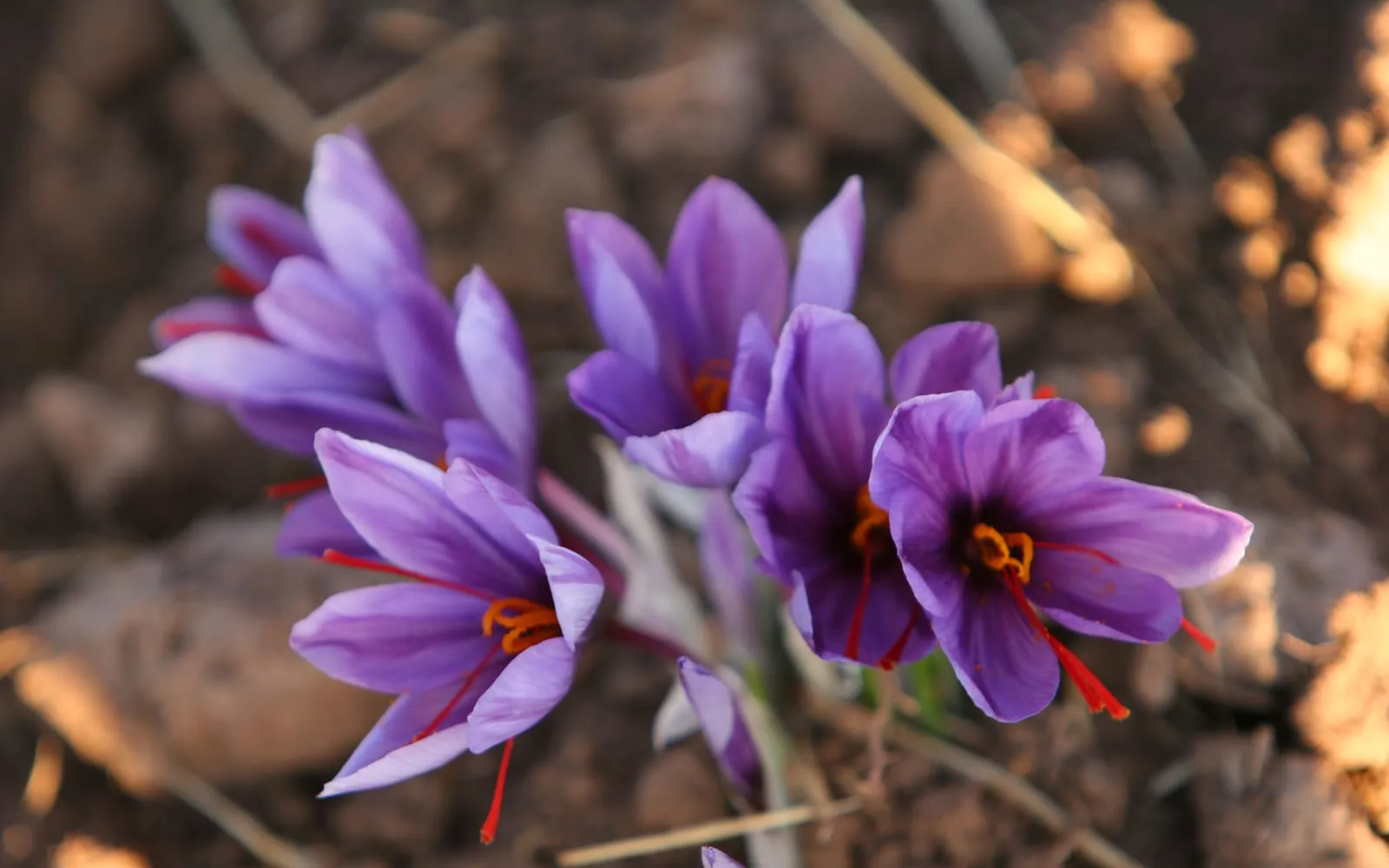
Flowers open in October and November, lilac-purple with darker veining, goblet- shaped, 4 to 5 cm across, opening in sun and closing at night.
The stigmas are the crop. Three long, deep red threads hanging out of each flower, each 2 to 3 cm long, and they are the female part of the flower.
Three yellow stamens sit inside. Counting them is the safety check, since the deadly Colchicum has six.
Leaves appear with or just after the flowers and persist through the winter, dying down in late spring.
The corm is small, round and flattened, wrapped in a fibrous brown tunic, and it splits into offsets each year.
Where it is from
The saffron crocus does not exist in the wild. It is a sterile triploid, unable to set seed, and every plant descends by division from an ancient cultivated population, probably selected from Crocus cartwrightianus in Bronze Age Crete or Greece.
Minoan frescoes at Akrotiri on Santorini show saffron being gathered, which puts its cultivation back at least three and a half thousand years.
It spread through Persia, the Arab world and then to Spain, where La Mancha remains a centre of production.
England grew it seriously. Saffron was cultivated across Essex and Cambridgeshire from the fourteenth century, and Saffron Walden takes its name and its coat of arms from the crop. Cheaper imports and rising labour costs ended it by around 1800.
Iran now produces around ninety per cent of the world crop, with Kashmir, Spain, Greece, Morocco and Afghanistan supplying most of the rest. Small-scale English production has restarted in Essex and Wales.
How it grows
Buy corms in summer and plant them in July or August, which is earlier than most bulbs. Late planting means no flowers in the first autumn.
Plant 10 to 15 cm deep and 10 cm apart, in the sunniest, sharpest-drained position you have. Deep planting reduces the splitting into small non-flowering offsets.
Add grit generously to anything heavy. A raised bed, a gravel bed or a deep pot all work better than a border on clay.
Expect flowers in October and November of the same year from a July planting.
Pick the stigmas at dawn or early morning, on the day the flower opens. Pull the whole flower, then pinch out the three red threads where they join the yellow style.
Dry them immediately, in a very low oven, an airing cupboard or a dehydrator, until brittle. Store airtight in the dark.
Leave the leaves to die down naturally in late spring. They feed next year’s corm.
Keep the ground dry through summer. Lifting the corms and storing them dry from June to July is the reliable answer in a wet climate, as is growing them in a pot moved under cover.
Lift and divide every three or four years, since crowded corms stop flowering.
Through the seasons
Summer is dormancy and the critical period. The corms want to be dry and warm. This is when a wet summer causes the losses. Plant new corms in July or August.
Autumn is flowering, in October and November, and the harvest. Pick each morning while flowers are opening, which runs over two or three weeks.
Winter is leaf growth. The grassy foliage sits through the cold and needs nothing.
Spring is when the leaves feed the corm. Leave them alone until they yellow.
Late spring is when the leaves die down. Stop watering and keep the ground dry from then on.
Care difficulty
Moderate, and the difficulty is a wet summer rather than anything about the plant.
Saffron needs a hot dry dormancy from June to August. Corms sitting in warm wet ground rot, which is why a planting that flowers well in its first autumn often disappears by the third.
Sharp drainage is the first defence. Grit, a raised bed, a gravel garden or a sunny bank all help.
Lifting and storing the corms dry through summer is the reliable answer, in the way gladioli are lifted, and it is more work than most gardeners expect from a crocus.
Crowding stops flowering. Corms split into offsets each year and a congested clump produces leaves and no flowers, so lift and divide every three or four years.
Yields are small. Expect a pinch rather than a jar, and value it accordingly.
Watering
Water very little. Saffron is a Mediterranean plant adapted to a wet autumn, a cool damp winter and a bone-dry summer.
Water after planting in summer to start it into growth, then leave it.
Water in a dry autumn if the flowers are failing to appear, though this is rarely necessary in a wet climate.
Keep the ground dry from late spring, once the leaves yellow, through the whole summer. Dry summer rest is what keeps the corms alive.
A pot can be laid on its side under cover through summer, which keeps the corms dry regardless of the weather.
Never water a dormant corm.
Warning signs, diseases and pests
Corm rot in wet summer ground is the usual cause of a planting fading away. The corms soften and disappear. Improve drainage, or lift them for the summer.
Leaves and no flowers means the clump is congested, planted too shallowly, or the corms are undersized. Lift, sort and replant the largest at 15 cm deep.
Squirrels and mice dig up newly planted corms. Cover the area with wire mesh until growth appears.
Slugs damage the autumn flowers, which are soft and short-lived.
Corms that never appear at all were probably planted too late or were already rotten.
Small offsets that never flower are normal on a crowded planting. Divide and grow the larger corms on.
Yellowing leaves in spring are the plant finishing its cycle rather than a problem.
Growing environment
Full sun, all day. Saffron in shade produces leaves and few flowers.
Sharply drained soil, poor to moderate. Grit worked in generously, or a raised bed, or a gravel garden.
Alkaline is preferred, around pH 6 to 8. It grows on limestone soils in its native range.
A dry summer position is the requirement, which in a wet climate means the base of a sunny wall, a raised bed under an overhang, or a pot moved under cover.
It is hardy to about -15 deg C and cold is not the problem here. Wet is.
A deep pot of gritty compost is the reliable method in a wet climate, kept outside from August to May and laid on its side under cover for the summer.
Feeding
Feed lightly. Bone meal or a low-nitrogen bulb fertiliser worked in at planting is enough for the year.
A potash-rich feed after flowering helps the corm build for next year, applied while the leaves are still green.
Avoid nitrogen, which produces leaves at the expense of flowers and softens the corm.
Do not mulch with compost or manure, which holds moisture against the corms. Grit is the right surface dressing.
Refresh the compost in a pot each year when you replant.
Troubleshooting
It flowered the first year and then stopped. Almost certainly wet summer ground rotting the corms, or a congested clump. Lift the corms in June, store them dry and warm, and replant in August.
How much saffron will I get? Very little. Each flower gives three stigmas and it takes about 150,000 flowers for a kilogram. A garden planting gives a pinch a year, which is still worth having.
When do I pick? At dawn or early morning on the day each flower opens, over the two or three weeks of flowering. Pull the flower, pinch out the three red threads, and dry them immediately.
Is this the same as autumn crocus? No, and the difference can kill. Colchicum autumnale, also called autumn crocus and meadow saffron, flowers at the same season and contains colchicine, for which there is no antidote. Colchicum has six stamens and no red stigmas, and its leaves come up in spring rather than with the flowers. Saffron crocus has three stamens and three long red stigmas. Never harvest from a plant you did not plant.
Leaves but no flowers. Congestion, shallow planting or small corms. Lift, sort and replant the largest at 15 cm deep.
Something dug them up. Squirrels or mice. Cover the planting with wire mesh until growth appears.
Can it be grown in a pot? Yes, and it is the reliable method in a wet climate. A deep pot of gritty compost, outside from August to May, laid on its side under cover through the summer.