
Outdoor plant
Crimson Flag Lily
Hesperantha coccinea
Also known as River Lily, Crimson Flag
How to grow crimson flag lily, Hesperantha coccinea. Why it flowers into November when almost nothing else in the border still is, why it is not a true lily despite the name, and the constantly moist soil it needs to grow well.
At a glance
- Difficulty
- Easy
- Water
- Keep the soil constantly moist; it does not tolerate drying out
- Light
- Full sun to light shade
- Temperature
- Hardy in a sheltered spot; a hard winter benefits from a mulch
- Hardiness
- USDA 6-9, RHS H4, hardy to -10 C
- Type
- Rhizomatous perennial with grassy, semi-evergreen foliage
- Height
- 45-75 cm
- Native to
- South Africa
Despite a South African origin, it comes from high-altitude streams in the Drakensberg rather than anywhere subtropical, which gives it real winter cold tolerance for a plant this far south. What the zone number does not capture is the flowering season: blooms open through autumn, later than almost anything else in the border, so an early hard frost can cut the display short in a cold garden even where the plant and its roots come through winter completely unharmed.
Hardiness zones describe winter cold alone. Summer heat, humidity, rainfall and the length of the growing season decide as much, so treat the range as the outer limit rather than as a recommendation.
Not known to be toxic
Hesperantha coccinea does not appear on the RHS list of potentially harmful garden plants, and the ASPCA carries no entry for it among either its toxic or non-toxic plant listings. No documented case of poisoning in people, cats, dogs or horses is recorded for this species, and nothing about its chemistry sets off the concern researchers have flagged for the wider iris family. It is reasonable to treat as safe to grow around pets and children, in the sense that nothing currently points the other way, though as with any unlisted plant that is an absence of recorded harm rather than a formal safety assessment, so call a doctor or vet if a child or pet eats a large quantity.
Sources: RHS potentially harmful garden plants, ASPCA toxic and non-toxic plants
About
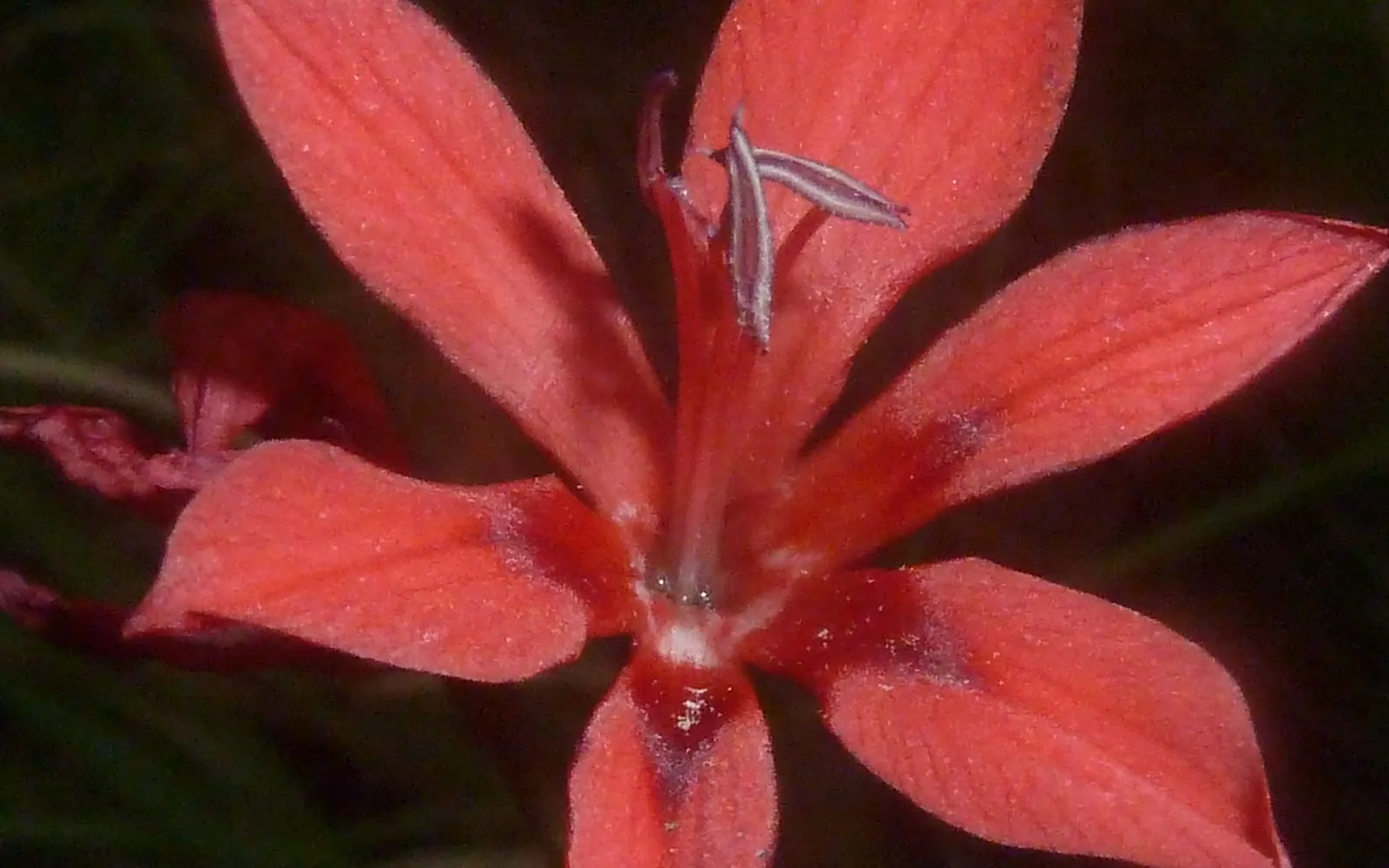
The crimson flag lily flowers in autumn, often into November, when almost every other perennial has finished for the year, which earns it a place in any border on its own. Wiry stems carry open, star-shaped blooms in vivid crimson above grassy foliage, closer in habit to an iris or a crocosmia than to any true lily despite the common name.
It grows fast in the right spot and spreads readily by rhizome, building a substantial clump within a couple of seasons from a handful of divided pieces. The one thing it will not tolerate is dry soil, and the whole plant reads as a stream or pond-margin species that also performs well in an ordinary border, provided the ground never dries out completely.
Appearance and character
Flowers are star-shaped and flat-faced rather than trumpet-shaped, 4 to 6 cm across, held on slender branching stems well above the foliage. Crimson is the species colour, though widely grown selections range through soft pink to pure white. The flowers open fully in sun and close partially in dull weather or at night, opening again the following day.
Leaves are narrow, sword-shaped and grassy, arranged in flat, overlapping fans that rise directly from a creeping rhizome, giving the plant a strong resemblance to a small iris well before it flowers.
The rhizome spreads steadily just below the soil surface, sending up new fans at intervals and building a dense colony over two or three seasons in soil that stays consistently moist, considerably faster than most border perennials increase on their own.
Where it is from
Hesperantha coccinea grows wild along streams and in damp grassland in the Drakensberg mountains of South Africa, at altitude where nights turn cold even through summer and the ground rarely dries out fully.
That streamside origin is the whole key to growing it well. The plant tolerates cold better than most South African natives because of the altitude it comes from, and it needs the constant soil moisture of a mountain stream bank rather than the free-draining conditions many garden bulbs prefer.
The plant was reclassified in 1996, when a revision of the iris family moved it into the mostly South African genus Hesperantha from the small genus it had been placed in previously, and both names are still found in nurseries and catalogues, which occasionally causes confusion when buying plants.
How it grows
Plant divisions in spring, into humus-rich soil that stays reliably moist, ideally at the margin of a pond or stream, or in any border bed that does not dry out over summer.
Choose full sun for the strongest flowering, though it tolerates light shade, particularly in a hot climate where some relief from the afternoon sun helps the flowers last longer.
Divide a congested clump every two to three years in spring, lifting sections of rhizome with a fan of leaves attached and replanting promptly, both to maintain vigour and to control a planting that would otherwise spread further than intended.
Mulch generously in a cold garden, particularly where winter temperatures drop much below minus 10 degrees C, since the crown sits close to the soil surface and benefits from extra insulation.
Through the seasons
Winter is mostly dormant in cold climates, though the semi-evergreen foliage persists through a mild one. Mulch where frost is severe.
Spring brings fresh leaf growth and is the best time to divide and plant.
Summer is steady growth, with the clump bulking up ahead of the main display.
Autumn is the flowering season, running later than almost anything else in the garden until the first hard frost cuts it short.
Care difficulty
Easy, provided the soil stays consistently moist. Given that one condition, this is an undemanding, fast-increasing plant that rewards a gardener with a long, late display for very little ongoing effort. In soil that dries out over summer it survives but flowers poorly and spreads much more slowly, which is the single factor that separates a thriving clump from a disappointing one.
Watering
Keep the soil constantly moist throughout the growing season. This is the single most important factor in how well it performs, more than light, feeding or even winter cold.
A pond or stream margin needs no additional watering at all. A border planting, by contrast, needs regular watering through any dry spell, since even a few days of dry soil can check growth and reduce the following autumn’s flowers.
Reduce watering somewhat once the plant becomes dormant in a cold winter, though the soil should never be allowed to dry out completely even then.
Warning signs, diseases and pests
Slugs and snails target the soft new leaves as they emerge in spring, leaving ragged holes before the foliage toughens. Protect young growth where slug pressure is high, particularly in the damp conditions this plant favours.
Spider mite can appear during an unusually dry, hot spell, showing as fine pale speckling on the leaves. It is a sign the soil has been allowed to dry out more than this plant tolerates, and improving soil moisture generally resolves it alongside any direct treatment.
Grey mould affects the flowers in cool, wet autumn weather, showing as fuzzy grey patches on damaged or ageing blooms. Remove affected flowers promptly and thin a dense clump to improve air movement.
Rust shows as small orange pustules on the underside of the leaves, usually in a wet season. Remove and destroy affected foliage and avoid overhead watering, which spreads the spores.
Growing environment
Full sun gives the best flowering, though light shade is tolerated, particularly where summers run hot and some afternoon relief helps the blooms last.
Reliably moist, humus-rich soil is essential rather than merely preferred. A pond or stream margin is the ideal site, and an ordinary border works only if it can be kept consistently damp through summer.
Hardy to around minus 10 degrees C with a protective mulch over the crown; in a colder garden, grow it in a large container that can be moved somewhere sheltered for winter.
Feeding
Feed monthly through the growing season, from spring to late summer, with a balanced or high-potash liquid feed, which supports both the leafy growth and the fullness of the autumn flower display.
Stop feeding once the plant enters winter dormancy in a cold climate, resuming again the following spring as new growth begins.
Troubleshooting
My plant flowers poorly and spreads slowly compared with others I have seen. Almost always dry soil. This species needs consistently moist ground to perform well, and a border that dries out over summer, however otherwise well tended, leaves it stunted.
Is this plant related to true lilies? No. It belongs to the iris family, and its flat, star-shaped flowers and grassy, fan-shaped foliage reflect that relationship far more than anything about a true lily.
When should I divide a spreading clump? Every two to three years in spring, lifting sections with a healthy leaf fan attached and replanting them immediately so the roots do not dry out.
Will it survive a cold winter outdoors? In most gardens, yes, with a mulch over the crown in a hard winter. In a cold climate, grow it in a container that can be moved under cover instead.
Orange spots have appeared on the undersides of the leaves. Rust, more likely in a wet season. Remove affected leaves, avoid wetting the foliage when watering, and improve air movement around the clump.