
Outdoor plant
Snake's head fritillary
Fritillaria meleagris
Also known as Chequered lily, Fritillary, Snake's head
How to grow Fritillaria meleagris. Planting the fragile bulbs on their side, naturalising in damp grass, when to cut, and the lily beetle that strips them.
At a glance
- Difficulty
- Moderate
- Water
- Rarely, provided the soil holds moisture in spring
- Light
- Full sun to light shade
- Temperature
- Very hardy, to -20 deg C
- Hardiness
- USDA 3-8, RHS H6, hardy to -30 C
- Type
- Bulbous perennial, dormant from midsummer to late winter
- Height
- 20-35 cm
- Native to
- Europe, from France and Britain east to the Balkans and Russia
- Best month
- April in the Northern Hemisphere, October in the Southern Hemisphere
It wants ground that is wet in winter and spring and dries out in summer, which is the flood-meadow cycle and the reason it will not settle in an ordinary well-drained border. Bulbs are small, soft and dry out fast in the packet, so plant them the day you buy them. Cold is never the problem.
Hardiness zones describe winter cold alone. Summer heat, humidity, rainfall and the length of the growing season decide as much, so treat the range as the outer limit rather than as a recommendation.
Every month named in this guide is for the temperate Northern Hemisphere. If you garden in the Southern Hemisphere, shift each one by six months, so April becomes October. Closer to the equator the wet and dry seasons matter more than the calendar, and the shift stops being a useful guide.
Toxic if eaten
- Do not eat
- Every part, and the bulb most of all
- Harm from
- Eating it
- Affects
- People, cats and dogs
Poisonous in every part, with the bulb the most concentrated. Fritillaries contain steroidal alkaloids, including imperialine and related compounds, which act on the heart and on the gut. Eating any quantity causes drooling, vomiting, abdominal pain and diarrhoea, with slowed heart rate and breathing difficulty in serious cases. The RHS lists Fritillaria among plants that are harmful if eaten. Poisonings are rare, since the bulbs are small, underground and bitter, and the realistic risk is a dog digging up newly planted bulbs in autumn. Cover fresh plantings with wire mesh until the soil settles, and store bulbs out of reach. Handling the bulbs causes skin irritation in some people, so gloves are sensible when planting a hundred of them. The related crown imperial, Fritillaria imperialis, carries the same compounds along with a strong foxy smell that deters most animals from trying. Neither plant should be treated as a hazard worth avoiding in a garden, and both simply need the ordinary care given to any poisonous bulb.
Sources: RHS potentially harmful garden plants, ASPCA toxic and non-toxic plants
About
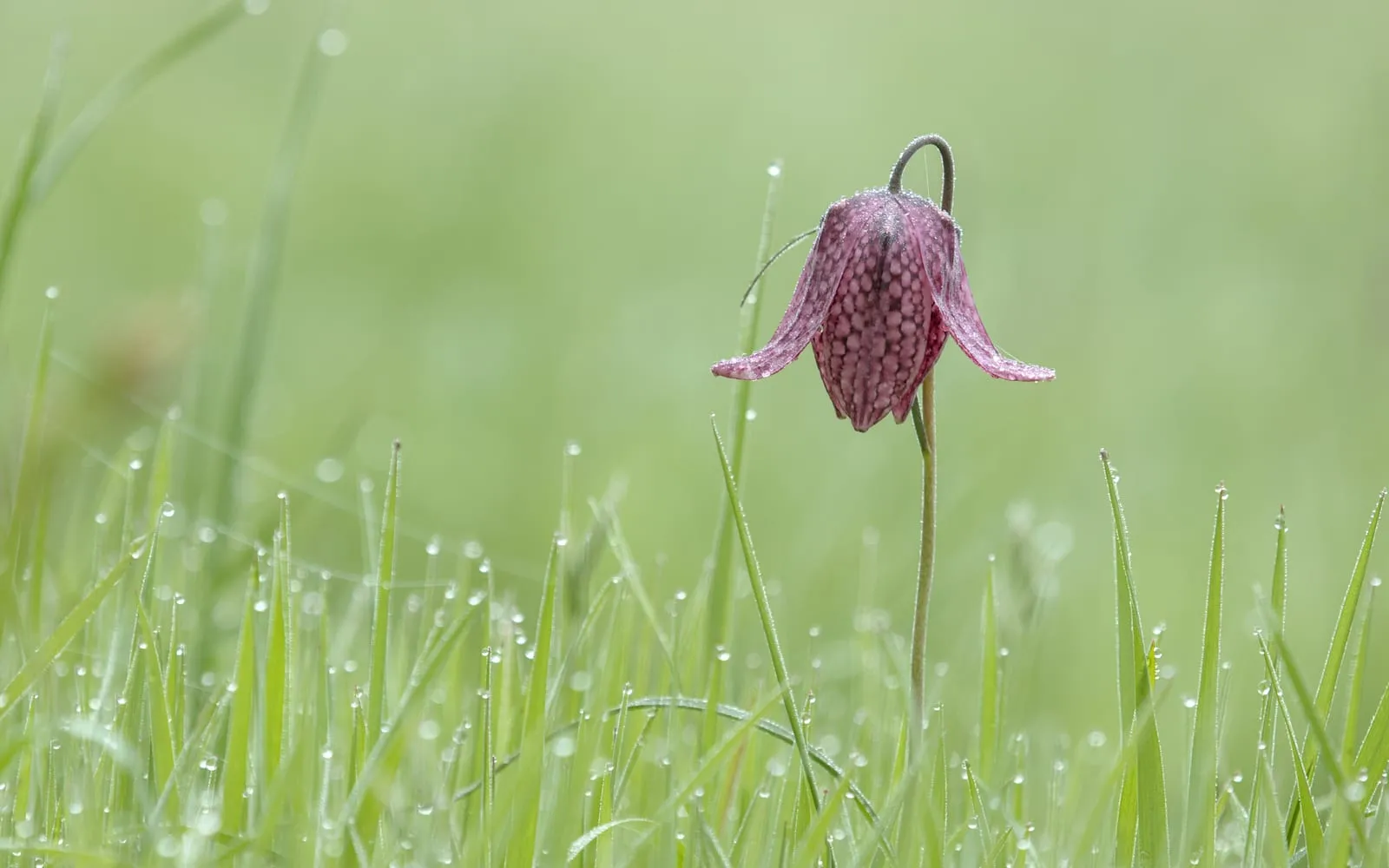
No other hardy plant is patterned like this one. The nodding bell is marked across its whole surface in a fine chequerboard of dark and pale purple, regular enough that people assume it has been bred that way, and the species name meleagris compares it to the spotted plumage of a guinea fowl.
It belongs in damp grass. Snake’s head fritillaries evolved in flood meadows, ground that lies wet through winter, floods in spring and dries out by midsummer, and they are one of the very few bulbs that will naturalise in a lawn that stays damp.
Britain has lost most of its wild population to drainage and ploughing, and the famous surviving meadows at Cricklade and Iffley are now visited in April the way gardens are.
Appearance and character
A slender bulbous perennial, 20 to 35 cm tall, with a fine arching stem carrying one or occasionally two flowers.
The flower is a broad nodding bell, 3 to 4 cm long, hanging downward and held on a stem that curves over at the top.
Chequering is the identifying feature. The petals are marked in a tessellated grid of deep maroon-purple and pale pink, sharply defined and remarkably regular.
A white form occurs naturally and appears in most seed-raised populations, faintly chequered in green rather than purple, and it is worth having alongside the type.
Leaves are narrow, grey-green and grass-like, carried alternately up the stem and easily missed among real grass.
The bulb is small, white, soft and made of two or three fleshy scales with a hollow at the crown. It has no protective tunic, which is why it dries out so readily.
Seed pods stand upright after flowering, three-sided and papery, splitting to release flat brown seeds.
Where it is from
Europe, from France and southern England east through Germany and the Balkans into Russia, growing in damp lowland meadows on river floodplains.
Whether it is native to Britain is unsettled. The first wild record is from 1736, which is late for a native plant, and it may have arrived as a garden escape in the sixteenth century. It behaves like a native and is treated as one.
Its habitat is the whole explanation for how to grow it. Flood meadows are wet from autumn through spring and dry in summer, they are grazed or cut for hay in midsummer rather than earlier, and the soil is deep and rich in silt.
British populations collapsed in the twentieth century as meadows were drained, ploughed and treated with fertiliser. The plant survives at a handful of protected sites, of which North Meadow at Cricklade holds perhaps 80 per cent of what is left.
It is the county flower of Oxfordshire, where the meadow at Magdalen College is one of the best-known stands.
How it grows
Plant bulbs in September or early October, and plant them the day they arrive. Fritillary bulbs have no tunic, they dry out within a week or two, and a shrivelled bulb never recovers.
Plant 10 to 12 cm deep and about 10 cm apart, laying each bulb on its side. The hollow crown collects water if the bulb sits upright, and that is what rots them.
Choose ground that holds moisture in spring. Heavy loam, a damp meadow, the edge of a pond or a border that never dries out in April all suit.
Naturalise them in grass wherever possible. They look wrong in a tidy border and completely at home in rough turf.
Leave the grass uncut until the seed pods have ripened and split, usually late June or July. Cutting earlier stops the colony spreading and starves the bulbs. You cut a wildflower meadow of spring flowers on the same timing, leaving the grass long through the display and taking the hay off once the seed has dropped.
Let them self-seed. This is how a planting becomes a colony, and seedlings take four to six years to flower.
Alternatively buy plants in the green in spring, which establishes more reliably than dry bulbs, though it costs considerably more.
Do not lift or divide them. They resent disturbance and are best left alone once settled.
Through the seasons
Autumn is planting. Order early, plant the day the bulbs arrive, and lay them on their sides.
Winter is dormant. The shoots appear in late February or March.
Spring is the display, with flowers through April and into early May. Leave everything alone.
Early summer is seed ripening and die-back. Wait until the pods have split and the foliage yellowed, usually late June, before cutting the grass.
Care difficulty
Moderate, and the difficulties are all about the bulb and the timing.
Dry bulbs are the commonest cause of failure. They deteriorate in the packet, and a bag bought late in the season from a garden centre display is often already dead.
Getting the moisture right matters. Ground that dries out in spring gives short stems and few flowers, and stagnant waterlogging rots the bulbs.
Lily beetle is a serious pest and will strip a small colony completely.
Patience is the last requirement. A planting looks sparse for several years before self-seeding thickens it.
Watering
Established plants need no watering where the soil holds spring moisture.
Water new plantings through their first spring if the weather is dry.
Never let the ground dry out between March and June, which is when the plant is growing and setting seed.
Keep them drier through summer dormancy, which reproduces the flood meadow cycle.
Containers are difficult. The compost dries during dormancy and the bulbs shrivel, so the ground is much better.
Warning signs, diseases and pests
Lily beetle is the pest that matters. The adults are brilliant scarlet, about 8 mm long, and easy to see. The larvae are worse, orange grubs that cover themselves in their own black excrement and eat the leaves, stems and flowers, and they can strip a plant in a few days. Check from late March, pick off adults and larvae by hand, and look on the ground beneath, since a disturbed adult drops and lands on its black back where it is nearly invisible.
Bulbs that never appear were almost always dry when planted. Buy early, plant immediately, and reject anything soft or shrivelled.
Rotted bulbs follow either waterlogged stagnant ground or planting with the hollow crown facing up so it fills with water. Lay the bulbs on their side.
Short-stemmed flowers or none at all usually mean the ground dried out in spring.
A colony that never spreads has usually had the grass cut before the seed ripened. Wait until July.
Squirrels and mice dig up newly planted bulbs in autumn. Cover the area with wire mesh until the ground settles.
Growing environment
Full sun to light shade. Open damp meadow conditions are the model.
Moisture-retentive soil that stays damp through spring, rich in organic matter. Heavy loam and clay both suit it well.
Avoid stagnant waterlogging, which is different from seasonal dampness. The ground should be wet rather than sour.
Grass is the natural home, and a lawn that can be left uncut until July is the ideal position. A damp orchard floor is close to perfect.
The edge of a pond or a bog garden margin works, as does a border that never bakes in April.
Avoid dry sandy soil, hot sunny banks and anywhere under a hedge that dries out.
Plant in quantity if the budget allows, since fifty look like something and ten look like an accident.
Feeding
Mulch with leaf mould or garden compost in autumn.
Avoid fertiliser, especially nitrogen, which feeds the surrounding grass and lets it outcompete the bulbs. Meadow species need poor ground.
Leaving the hay cuttings to lie for a few days before removing them lets the seed drop, and taking them away afterwards keeps the fertility low.
A colony that is thinning is more likely being outcompeted by vigorous grass than going hungry.
Troubleshooting
The bulbs never came up. They were dry when planted. Fritillary bulbs have no protective tunic and shrivel within a week or two. Buy early, plant immediately, and reject soft or shrunken bulbs.
Which way up do I plant them? On their side. The crown has a hollow that collects water and rots the bulb if it faces upwards.
Scarlet beetles and orange grubs covered in black mess. Lily beetle. Check from late March and pick off adults and larvae by hand. They can strip a plant in days.
When can I cut the grass? Once the seed pods have split and the leaves have yellowed, usually late June or July. Cutting earlier stops the colony spreading.
They flowered once and never again. Usually the grass was cut too early, or the ground dries out in spring. Both starve the bulb.
Can I grow them in a pot? Poorly. The compost dries out during summer dormancy and the bulbs shrivel. Damp grass is a far better home.
Will they spread? Yes, by seed, given damp ground and grass left uncut until July. Seedlings take four to six years to flower, so a colony builds slowly.
Are they poisonous? Yes, in every part and the bulb most of all. Cover fresh autumn plantings so dogs cannot dig them up.