
Outdoor plant
Tiger lily
Lilium lancifolium
Also known as Devil lily, Leopard lily
How to grow tiger lily, Lilium lancifolium. Growing lilies from the bulbils in the leaf axils, beating the lily beetle, and the danger to cats.
At a glance
- Difficulty
- Moderate
- Water
- Regular through the growing season
- Light
- Full sun to light shade, with the base of the stem shaded
- Temperature
- Fully hardy, to about -30 deg C
- Hardiness
- USDA 3-9, RHS H6, hardy to -30 C
- Type
- Bulbous perennial, long lived and dying back each winter
- Height
- 100-150 cm
- Native to
- China, Japan, Korea and eastern Russia
- Best month
- August in the Northern Hemisphere, February in the Southern Hemisphere
It is one of the toughest lilies and tolerates a wider range of soil than most, including some lime. The catch is that it carries lily viruses without showing symptoms and passes them to other lilies nearby, so keep it well away from a collection. Scarlet lily beetle is the other problem and it has spread across Europe and north-east North America, defoliating a plant within days.
Hardiness zones describe winter cold alone. Summer heat, humidity, rainfall and the length of the growing season decide as much, so treat the range as the outer limit rather than as a recommendation.
Every month named in this guide is for the temperate Northern Hemisphere. If you garden in the Southern Hemisphere, shift each one by six months, so August becomes February. Closer to the equator the wet and dry seasons matter more than the calendar, and the shift stops being a useful guide.
Poisonous to cats if eaten
- Do not eat
- Every part, including the pollen and the water from a vase
- Harm from
- Eating it
- Affects
- Cats
True lilies are lethal to cats and this is the most important thing to know about the plant. Every part of Lilium is involved, including the leaves, the stem, the flowers, the pollen and the water a cut stem has stood in, and the poisoning causes acute kidney failure. A cat that brushes past the flowers and grooms pollen off its fur has taken a dose. Symptoms begin with vomiting and lethargy within a few hours, appear to improve, and then progress to kidney failure over the next two or three days, at which point survival is poor. There is no home treatment. Any suspected exposure is an emergency and the cat needs a vet the same day, because intravenous fluids started within the first few hours are what determines the outcome. Do not grow lilies in a garden used by cats and do not bring cut lilies into a house with one, and ask the florist to leave them out of a bouquet. Dogs are far less sensitive and eating lilies causes stomach upset rather than kidney damage. For people lilies are a mild irritant, the pollen stains badly, and eating the bulbs causes stomach upset, and Lilium lancifolium bulbs are eaten as a vegetable in China and Japan after cooking.
Sources: RHS potentially harmful garden plants, ASPCA toxic and non-toxic plants
About
The tiger lily is the one that makes little black bulbs in the leaf joints, which is the easiest way anybody can propagate a lily.
Look along the stem in late summer and there are dark purple-black beads sitting where each leaf meets the stem. Each is a bulbil, a complete miniature plant. Pick them off, push them into a pot of gritty compost, and you have flowering-size lilies in two or three years, dozens of them, for nothing.
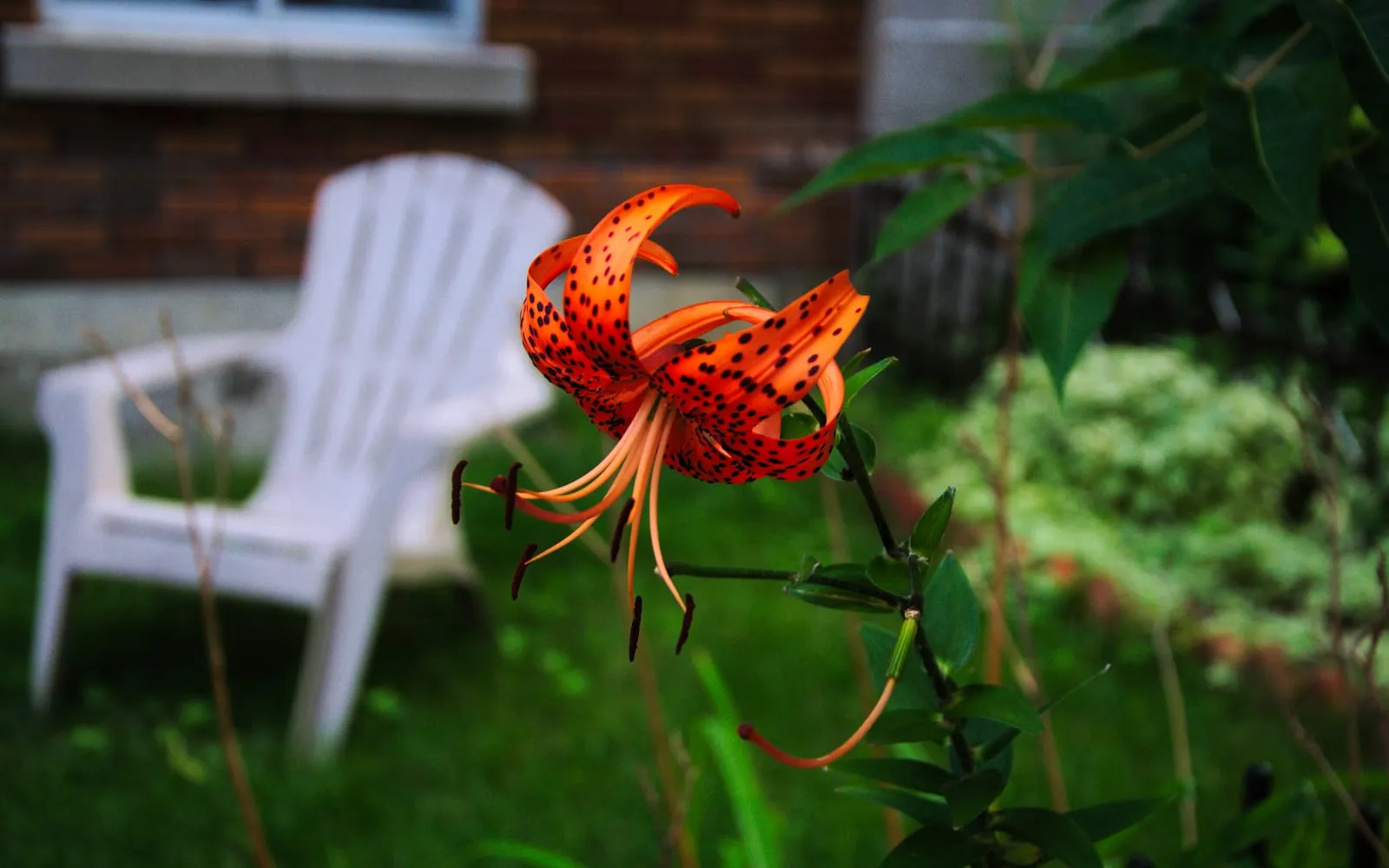
The flowers themselves are bright orange, heavily spotted with black-purple, with the petals curled all the way back on themselves into a turk’s cap. A stem carries ten or twenty of them in August, and they are unscented, which some people count as a mercy.
Two problems attach to it. The scarlet lily beetle reached Britain in the 1940s and North America by way of Montreal at about the same time, and it has spread across Europe and the north-eastern United States since. It will reduce a lily to bare stems in under a week. The other is that this species commonly carries lily viruses without showing symptoms, and it can pass them to more susceptible lilies growing nearby.
The overriding warning is about cats. Every part of a true lily causes fatal kidney failure in cats, including the pollen, and this is not a plant for a garden or a house where a cat lives.
Appearance and character
A bulbous perennial reaching 100 to 150 cm, with a single unbranched stem from an underground bulb.
Stems are dark purple-black, ridged and covered in fine white woolly hairs.
Leaves are narrow and lance-shaped, 10 to 20 cm long, held alternately up the stem, and each carries a bulbil in its axil in the upper half of the plant.
Bulbils are the identification. Round, 5 to 8 mm, dark purple-black, sitting where the leaf joins the stem, and often sprouting a root and a leaf while still attached.
Flowers open in August, 8 to 12 cm across, nodding on long stalks, in bright orange to orange-red, heavily spotted with dark purple-black.
The petals are strongly recurved, rolling right back to touch behind the flower, which is the turk’s cap form, and the long stamens hang forward carrying rust-red pollen.
There is no scent, which distinguishes it from the oriental and trumpet lilies.
The bulb is scaly, white and about 5 to 8 cm across, and it is stem-rooting, meaning it puts out roots from the stem above the bulb as well as below it.
Where it is from
China, Japan, Korea and eastern Russia, growing on grassy slopes and in open woodland.
It has been cultivated in China and Japan for centuries as a food crop, and the bulbs are still sold as a vegetable there, cooked and used in soups and stir-fries.
It reached Britain in 1804 through William Kerr, who collected it in Canton for Kew, and it became one of the commonest garden lilies of the nineteenth century.
The plant grown in gardens is usually triploid, which makes it sterile, so it sets no seed and reproduces entirely by bulbils and offsets. That is why the bulbils are so prolific.
Its tolerance of lily virus without showing symptoms has been recognised since the nineteenth century, and it is the reason old lily manuals advise growing it away from other species.
The scarlet lily beetle, Lilioceris lilii, is native to continental Europe and Asia, was first found breeding in Britain in Surrey in 1939, and spread across the country from the 1980s onwards.
Lilium lancifolium is the correct name and Lilium tigrinum is the older one still widely used in the trade.
How it grows
Plant bulbs in autumn or early spring, 15 to 20 cm deep, which is deeper than most bulbs and necessary because it roots from the stem above the bulb.
Choose free-draining soil above everything. Lily bulbs have no protective tunic and rot readily in wet ground. Add grit to heavy soil or plant on a raised bed.
Give it full sun or light shade at the top with the base of the stem shaded by other planting, which keeps the roots cool.
Neutral to slightly acid soil suits it, and it tolerates a wider range than the oriental lilies.
Feed with a high-potash liquid feed every two weeks from the moment shoots appear until about six weeks after flowering, which is when the bulb is building next year’s flower.
Check for lily beetle from April onwards. Look on the leaves, the stems and the undersides, and check daily in the growing season. Pick off the bright red adults, which drop and land on their black undersides when disturbed, so cup a hand beneath before you reach.
Scrape off the larvae, which cover themselves in their own excrement and look like wet brown blobs on the leaves.
Deadhead as the flowers fade and leave the stem and leaves standing, since the foliage is feeding the bulb.
Cut the stem down in late autumn once it has yellowed.
Collect the bulbils in late summer when they come away easily. Press them into gritty compost, barely covered, keep them cool and damp, and expect flowering plants in two to three years.
Grow it away from other lilies if you value them, since it carries viruses without showing them.
Grow it in pots if the soil is heavy, using a gritty loam-based compost, and repot every two years.
Through the seasons
Winter is dormant, and the risk is the bulb rotting in wet soil rather than freezing.
Spring brings the shoots up in April, which is when slug protection begins, lily beetle checks start, and feeding begins.
Summer grows fast, flowers in August, and produces the bulbils in the leaf axils towards the end of the season.
Autumn is bulbil collecting time, and the stem is cut down once it yellows. This is also planting season.
Care difficulty
Moderate, and the difficulty is the lily beetle rather than the plant.
Tiger lily is one of the tougher and easier lilies to grow, tolerating a wider range of soil than most and increasing readily.
The beetle changes everything. Without daily checking through spring and summer a lily is stripped to bare stems, and the treatment is hand picking rather than anything simpler.
Bulb rot in wet soil is the other common failure, and it is solved with grit and depth.
Where a cat lives in the household this plant should not be grown at all.
Watering
Water regularly through the growing season, keeping the soil damp without waterlogging.
Container plants need watering all summer and should be kept just damp in winter rather than wet.
Water at the base rather than over the flowers, which spoils them and washes pollen about.
Free drainage in winter matters more than summer water. A lily bulb sitting in cold wet soil rots.
Mulch in spring with compost to keep the roots cool, which is what the plant wants.
Warning signs, diseases and pests
Bright scarlet beetles 8 mm long on the leaves and stems from April onwards is the lily beetle. They drop when disturbed and land upside down showing their black undersides, which makes them hard to find on soil. Cup a hand underneath before picking them off, and check daily.
Wet brown blobs on the leaves that look like bird droppings are lily beetle larvae under a coating of their own excrement, and they do most of the damage. Scrape them off and squash them.
Streaked, mottled or twisted leaves with distorted flowers is lily virus, spread by aphids. There is no cure. Destroy affected plants, and be aware that tiger lily often carries virus without showing it.
The bulb failing to appear in spring is rot from wet soil. Add grit and plant deeper on a raised bed.
Shoots eaten off at ground level in spring is slugs and snails.
Orange-brown spots and blotches on the leaves spreading upwards in wet weather is lily disease, caused by Botrytis elliptica. Remove affected foliage, improve air movement, and clear all debris in autumn.
Fewer flowers each year is usually a congested clump or a bulb that was cut down before the foliage yellowed. Lift and divide in autumn, and let the leaves die back naturally.
Aphids on the buds spread virus, so they matter more on lilies than on most plants.
Growing environment
Full sun to light shade at the top of the plant, with the base of the stem shaded by lower planting.
Deep, free-draining, humus-rich soil, neutral to slightly acid. Add grit to heavy ground.
Fully hardy to about -30 deg C.
Allow 20 to 30 cm per bulb and plant in groups of three or five for effect.
It suits a herbaceous border, a mixed border, a cottage garden or a large container.
Do not grow it where cats have access, and do not cut it for the house if there is a cat. This is the single most important siting decision with any lily.
Grow it away from other lilies where you have valuable ones, since it carries virus symptomlessly.
Plant something low in front to shade the base of the stem, such as hardy geranium or a low grass.
Its wildlife value is fair. Bees and butterflies work the flowers, and the plant is not a significant nectar source in a temperate garden.
Feeding
Feed with a high-potash liquid feed such as tomato food every two weeks from the moment the shoots appear until about six weeks after flowering.
That post-flowering period matters most, since the bulb is building next year’s flower during it.
Mulch in spring with compost to keep the roots cool.
Avoid high-nitrogen feeds, which give soft growth that the beetle and botrytis both prefer.
Container plants need feeding throughout the season and repotting into fresh compost every two years.
Troubleshooting
Are lilies dangerous to cats? Fatally. Every part causes acute kidney failure in cats, including the pollen and the water from a vase. A cat that grooms pollen off its fur has taken a dose. Do not grow lilies where cats go and do not bring them into the house. Any exposure is a same-day emergency for a vet.
Bright red beetles are eating the leaves. Scarlet lily beetle. Check daily from April, and cup a hand under the leaf before picking them off because they drop and land black side up.
There are wet brown blobs on the leaves. Lily beetle larvae under a coating of their own excrement. They do most of the damage. Scrape them off.
What are the black beads on the stem? Bulbils, which are complete miniature plants. Pick them off in late summer, press them into gritty compost, and you have flowering lilies in two or three years.
Why did the bulb never come up? Rot from wet soil. Lily bulbs have no protective skin and need free drainage. Add grit, plant 15 to 20 cm deep, and use a raised bed on clay.
The leaves are streaked and the flowers are distorted. Lily virus, spread by aphids. There is no cure. Destroy the plant. Tiger lily often carries virus without symptoms, so grow it away from other lilies.
Can I cut the stems down after flowering? No. Leave the foliage until it yellows in autumn, because it is feeding next year’s bulb. Deadhead the spent flowers only.
Are the bulbs edible? Lilium lancifolium bulbs are eaten as a vegetable in China and Japan after cooking. That does not make lilies safe around cats, which is a separate and serious matter.
How do I get more plants? Collect the bulbils, or lift and separate the bulb offsets in autumn. It is one of the easiest lilies to increase.