
Outdoor plant
Crown Imperial
Fritillaria imperialis
Also known as Kaiser's Crown
How to grow crown imperial, Fritillaria imperialis. Why its strong, musky, foxlike smell keeps rodents away from bulbs planted nearby, why the bulb has to go in on its side rather than upright, and why a mild winter with no real cold can leave it leafy but flowerless.
At a glance
- Difficulty
- Moderate
- Water
- Regularly while in leaf and flower, then withheld completely once dormant
- Light
- Full sun to light shade
- Temperature
- Fully hardy
- Hardiness
- USDA 5-9, RHS H6, hardy to -20 C
- Type
- Bulbous perennial, dying back completely after flowering
- Height
- 0.8-1.2 m
- Native to
- western Asia, the Himalaya
Winter cold is rarely what limits this bulb; wet ground is. It needs a real period of cold to flower well the following spring, so a climate with a mild, damp winter and no hard frost at all can leave it growing leaves without ever producing a strong flower stem. Once the leaves die back in early summer the bulb needs to stay dry through its dormancy, since the combination of summer warmth and wet soil rots it faster than winter cold ever threatens to.
Hardiness zones describe winter cold alone. Summer heat, humidity, rainfall and the length of the growing season decide as much, so treat the range as the outer limit rather than as a recommendation.
Toxic if eaten
- Do not eat
- The bulb, which also causes skin irritation when handled
- Harm from
- Eating it and handling it
- Affects
- People, cats and dogs
Crown imperial bulbs contain alkaloids that cause vomiting and stomach upset if eaten by people, cats or dogs, and the bulb's sap is a recognised skin irritant on contact, which is useful to know before handling the bulbs bare-handed at planting time. Unlike true lilies of the genus Lilium, which cause acute kidney failure in cats from even a small exposure, Fritillaria is not documented as carrying that same severe, specifically renal risk, and the ASPCA's general toxic plant listings do not single this species out for the emergency-level warning given to true lilies. The RHS lists Fritillaria among plants that can cause mild skin irritation. The whole plant, and particularly the bulb, gives off a strong, musky, almost foxlike odour that most people find unpleasant at close range, which in practice does a good deal of the work of keeping children, pets and grazing animals from sampling it in the first place.
Sources: RHS potentially harmful garden plants, ASPCA toxic and non-toxic plants
About
Crown imperial announces itself before it is seen. Brush against the leaves or disturb the bulb while planting and a strong, musky, distinctly foxlike smell follows, unlike almost anything else grown in a garden border. Gardeners have used that smell for centuries as a deterrent, planting crown imperial among other bulbs on the theory, borne out well enough in practice, that rodents leave a bed alone where this plant grows among the more appealing bulbs they would otherwise dig up.
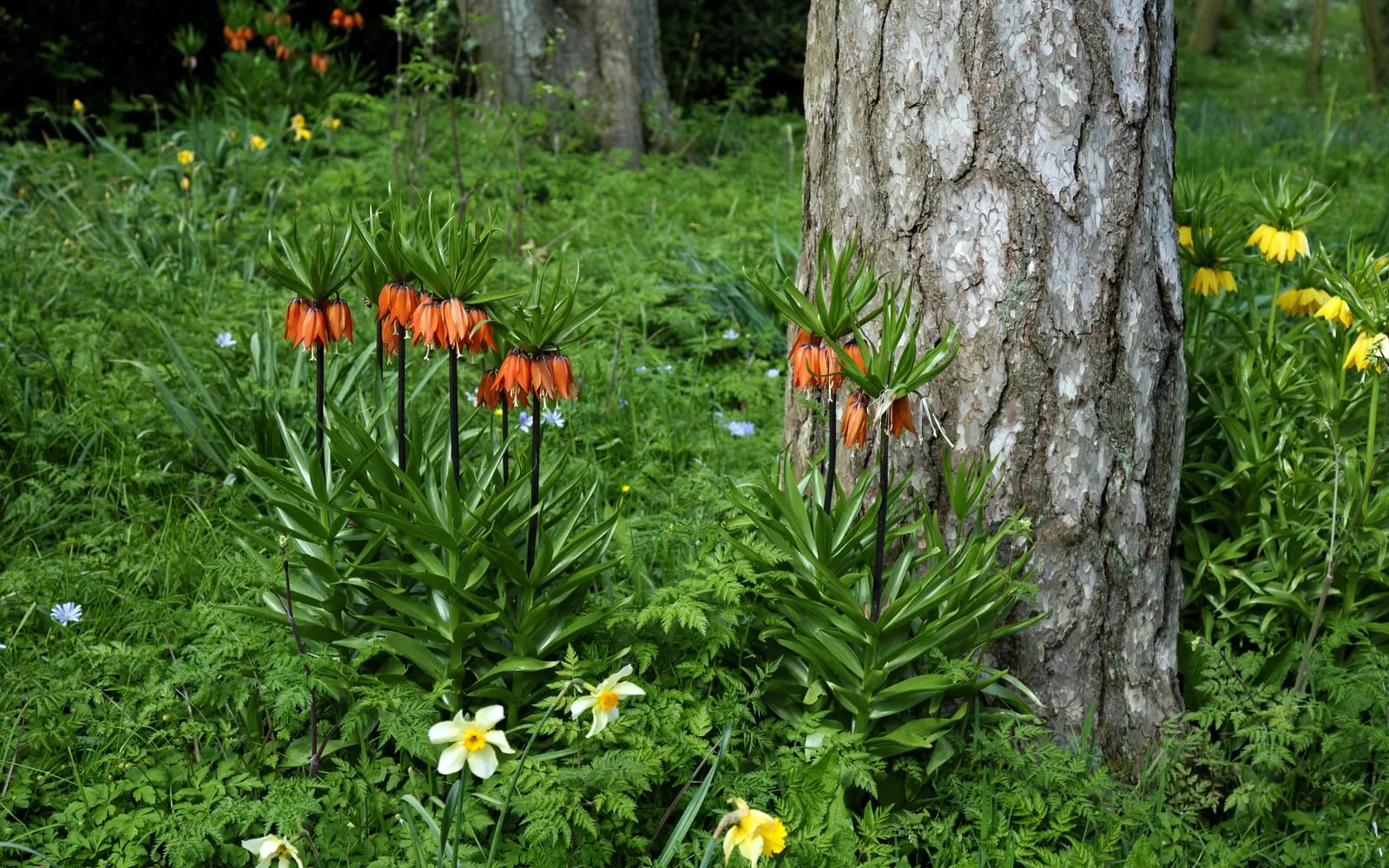
The flower stem is the plant’s real display: a single tall, leafy stalk topped with a whorl of large, pendant, bell-shaped flowers hanging below a tuft of leaf-like bracts, the “crown” that gives the plant its name. Few spring bulbs reach this scale or carry themselves with quite this much presence in a border.
The bulb itself needs a little more thought at planting time than most spring bulbs, since it carries a natural hollow in its crown that collects water and encourages rot if the bulb is set upright the way most bulbs are planted.
Appearance and character
A bulbous perennial sending up a single stout, unbranched stem, 80 cm to 1.2 m tall, clothed for most of its length in glossy, strap-shaped leaves that give way to bare stem below the flower head.
Flowers open in mid to late spring, up to eight large, bell-shaped blooms hanging in a ring beneath a topknot of small, leafy bracts, in shades of orange, red or yellow depending on the cultivar. Each flower typically holds a drop of nectar visible at the base, which beads and glistens rather than being hidden inside the bloom.
The whole plant carries a strong, musky, distinctly foxlike scent, strongest from the bulb itself but noticeable from the leaves and stem too, especially on a warm day or when the plant is disturbed.
The bulb is large, yellowish and made of thick fleshy scales, with a noticeable hollow depression in the crown where the old flower stem has died back, a feature unique enough among garden bulbs that it directly shapes how the bulb should be planted.
Foliage dies back completely by early to midsummer, leaving no trace of the plant above ground until the following spring.
Where it is from
Fritillaria imperialis is native to a broad swathe of western Asia and the Himalaya, from Turkey and Iran through Afghanistan and into the foothills of the Himalaya, where it grows on rocky, sun-baked slopes and in scrub at moderate elevation.
That origin explains the bulb’s two strongest preferences. Free-draining rocky ground gives the demand for sharp drainage, particularly through the hot, dry summer dormancy the bulb experiences in the wild, and a real winter chill sets the trigger the bulb needs to flower strongly the following spring.
The plant has an old history in cultivation, reaching gardens in western Europe by the sixteenth century and becoming a fixture of the grand formal bulb displays of that era, prized then as now for its unusual scale and its equally unusual, faintly unsettling scent.
How it grows
Plant bulbs in early autumn, as soon as they become available, since they dry out and lose vigour if left out of the ground for long.
Plant on their side rather than upright, in a hole about 20 to 25 cm deep with a layer of sharp sand or grit beneath the bulb. Planting on its side stops water collecting in the natural hollow at the crown, which is the single most useful tip for avoiding the rot that spoils more crown imperial bulbs than any pest does.
Choose a free-draining position in full sun to light shade, working grit into heavy soil at planting time if drainage is at all in doubt.
Space bulbs at least 25 to 30 cm apart, since each grows into a substantial clump of foliage and a single tall flower stem that needs room to be appreciated without crowding its neighbours.
Leave the foliage to die back naturally after flowering rather than cutting or tying it, since the leaves are feeding the bulb for next year’s display right up until they yellow completely.
Once dormant in summer, the bulb needs to stay dry. Avoid watering the area or planting anything nearby that will need regular summer irrigation, since wet soil during dormancy is the commonest cause of a bulb failing to reappear.
Divide congested clumps only occasionally, since the bulbs resent disturbance and settle best when left undisturbed for several years at a stretch.
Through the seasons
Spring brings the full display, from emerging leaves through to the flowering stem and its ring of pendant bells, over a period of several weeks.
Early summer is die-back, as the foliage yellows and disappears completely, marking the start of the bulb’s dry summer dormancy.
Summer is complete dormancy below ground. The bulb needs dry conditions through this period regardless of what is happening elsewhere in the border.
Autumn is the planting season for new bulbs, set on their side in free-draining, gritty soil before the ground turns cold.
Care difficulty
Moderate, and the difficulty is concentrated almost entirely at planting time rather than in any ongoing routine. Getting the bulb planted on its side with good drainage beneath it, and choosing a spot that will stay reasonably dry through summer, are the two decisions that determine whether a crown imperial thrives for years or rots within one season. Once correctly planted and left undisturbed, it needs very little further attention beyond feeding and the occasional watch for lily beetle.
Watering
Water regularly while the plant is in leaf and flower during spring, to support the stem and the developing blooms through what is often a fairly dry season in its native range but can be wetter in a temperate garden.
Stop watering completely once the foliage has died back in early summer, and avoid planting the bulb where irrigation intended for neighbouring plants will reach it through the dry season, since a wet summer dormancy is the single most common way to lose this bulb.
Good drainage matters as much as the watering routine itself, and a bulb in heavy clay benefits from a raised position or a generous quantity of grit worked into the planting hole.
Warning signs, diseases and pests
Lily beetle, the same bright scarlet beetle that troubles true lilies, also attacks fritillaries, and its orange larvae can strip foliage quickly once they hatch. Check plants regularly from early spring and remove adults and larvae by hand as soon as they are spotted.
Bulb rot follows wet soil, particularly during summer dormancy or in ground that drains poorly over winter. A bulb that fails to produce a stem, or produces one that collapses, has usually rotted below ground; lift and discard it, and improve drainage before replanting in that spot.
Slugs and snails can damage the soft emerging shoots in early spring, before the foliage has toughened. Protect young growth as it appears, particularly in a damp spring.
Squirrels and mice occasionally disturb newly planted bulbs, though the strong smell that makes crown imperial unpopular with some gardeners works in its favour here, generally deterring the same rodents that happily dig up tulips and crocuses planted nearby.
Growing environment
Full sun to light shade both suit it, with the strongest flower stems generally produced in a sunnier position.
Free-draining soil is essential, and a heavy or poorly drained site should be improved with grit or raised before planting rather than planted as it stands.
A real winter chill helps trigger strong flowering the following spring, so a mild climate with little or no frost can produce disappointing results even where the bulb otherwise survives.
Plant it towards the back of a border or among later-emerging perennials that will grow up and mask the bare gap left once the foliage dies back in early summer.
Its natural rodent-deterrent effect makes it a useful bulb to plant alongside more vulnerable spring bulbs such as tulips and crocuses.
Feeding
Apply a high-potassium bulb feed as growth emerges in spring, and again once flowering has finished, to support both the current display and the bulb’s recovery for the following year.
Avoid high-nitrogen feeds, which encourage soft leafy growth rather than strong flowering and offer no benefit to a bulb that is largely self-sufficient once established in the right conditions.
A light annual mulch of well-rotted compost in autumn, kept clear of where the bulb itself sits, supports the surrounding soil without adding excess moisture directly around the bulb.
Troubleshooting
The bulb rotted after planting. Almost always wet soil, either from poor drainage or from planting upright rather than on its side, which allows water to collect in the natural hollow at the crown. Replant on the side with grit beneath, and improve drainage generally if the site is heavy.
It grew leaves but never flowered. Often a lack of real winter chill, a bulb planted too shallow, or one that is still too young or too small to flower yet. Established bulbs in a climate with a proper cold winter flower reliably once settled.
What is that smell? The plant itself. Crown imperial gives off a strong, musky, foxlike scent from the bulb and, more faintly, from the leaves and stem, which is normal and helps keep rodents away from nearby bulbs.
Scarlet beetles are eating the leaves. Lily beetle, which also attacks fritillaries. Check regularly from early spring and remove adults and larvae by hand as soon as you see them.
Can I move an established clump? It is possible but best kept to a minimum, since the bulbs resent disturbance and can take a year or two to flower well again after being moved. Autumn, once the bulb is fully dormant, is the best time if a move is necessary.