
Pest
Scarlet lily beetle
Lilioceris lilii
Also called Lily beetle, Red lily beetle, Lily leaf beetle
Lily beetles are bright red adults with orange grubs hidden under their own droppings. Hand-pick from March and check lilies and fritillaries before eggs and larvae build up.
At a glance
- Type
- Pest
- Cause
- Insect
- Severity
- Destroys the crop or display
- Affects
- Garden plants
- Active
- March to September
- Established in
- Europe, Asia, Africa and North America
What you are seeing
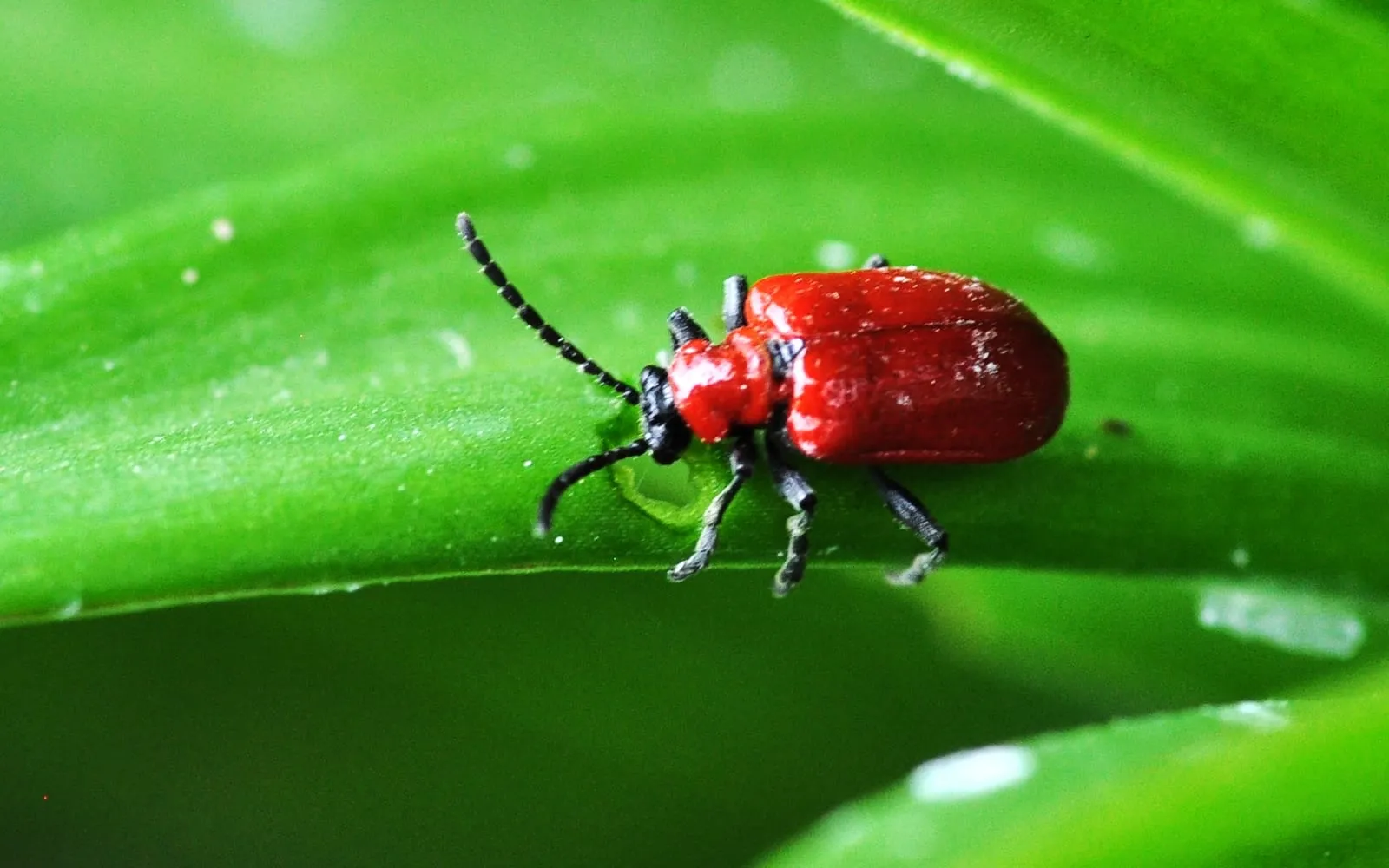
- A bright scarlet beetle about 8 mm long, with a black head, legs and antennae, sitting openly on a leaf or a bud
- Ragged holes chewed through leaves, buds and flowers
- Rows of small orange eggs laid along the veins on the underside of leaves
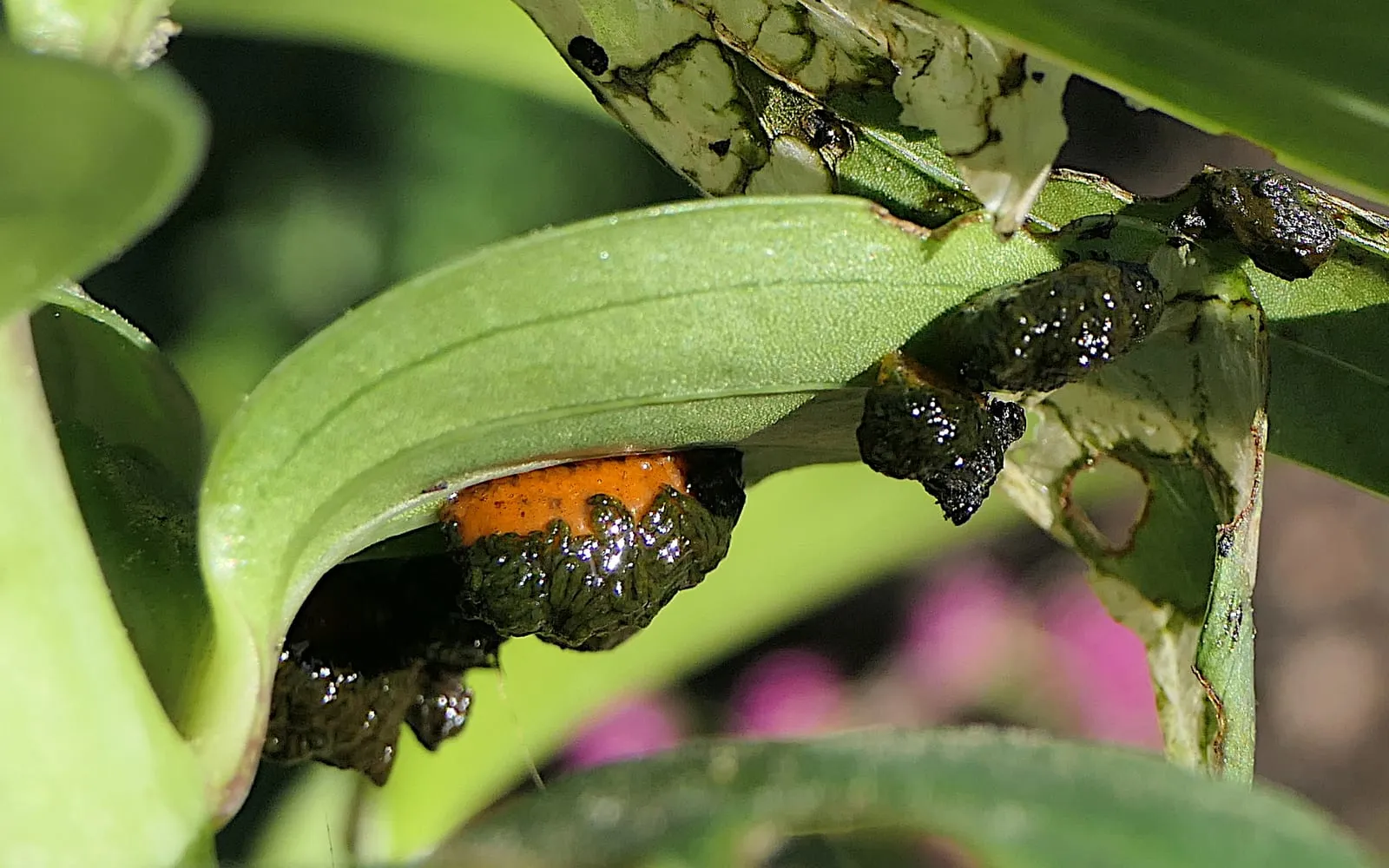
- Wet brown or black blobs stuck to the undersides of leaves, each covering an orange grub
- Stems stripped of foliage from the top down, with the bare stem left standing
- The beetle dropping and vanishing the moment a hand approaches
Before you treat anything
The beetle is harmless to handle and squeaks when held, which is air being forced between two body segments. Wear a glove for the larvae if you would rather.
What you are looking at
A beetle the colour of a pillar box, around 8 mm long, with a black head, black legs and black clubbed antennae. It sits in plain view on the upper surface of a lily leaf and makes no attempt to hide, which is unusual enough to be diagnostic on its own.
Reach for it and it drops. On the way down it turns over, so it lands on its back with its black underside upwards, and against dark soil it disappears. Hold one and it squeaks, a thin creak made by rubbing two body segments together.
Turn the leaves over. Short rows of orange eggs along the veins are the next generation. Wet brown or black blobs stuck to the underside are larvae, each one an orange grub carrying its own droppings on its back.
The grubs do most of the harm
Adults chew holes through leaves, buds and open flowers, and a few beetles over a fortnight leave a plant looking pecked rather than ruined.
The larvae are the ones that take a lily down. They feed in groups, work from the top of the stem downwards, and can strip a plant to a bare green stick in under a week. Because they are on the undersides and dressed in excrement, a gardener looking at the plant from above sees leaves vanishing with nothing apparently eating them.
The excrement coat is a defence and it works. Birds that would take a naked orange grub off a leaf leave these alone, which is why no amount of feeding the garden birds reduces the population.
Two waves, March to September
Adults come out of the soil from late March and feed for a week or two before mating. A female then lays in batches on the leaf undersides through spring, several hundred eggs over her life. The larvae feed for two to three weeks, drop into the soil, and pupate there.
New adults emerge from midsummer, feed through late summer and autumn on whatever lily foliage is left, and then go back into the soil, leaf litter or the crown of a nearby plant for the winter. They can spend the winter well away from the lilies, so clearing the bed does not clear the problem.
The beetle established itself in Surrey around 1940 and stayed local for decades. It moved through most of England and Wales from the 1980s onwards and has been recorded in Scotland since. Gardeners who never saw it before 2000 now meet it every April.
What to do about it
Check the plants every few days from the moment shoots appear. Fifteen minutes a week from late March, spent turning leaves over, holds a bed of lilies without anything else.
Cup a hand under the beetle before you touch it, or hold a jar of soapy water beneath and knock it in. Wipe the egg rows off the leaf undersides with a thumb. Take the larvae off with a gloved hand or a damp cloth.
Keep going after the flowers are over. The midsummer generation is the one that overwinters, and every adult removed in August is a plant not attacked next April.
Grow them in pots if the beds have defeated you. A pot turns for inspection and stands on a surface the larvae cannot pupate in.
Leave the sprays alone. Lily flowers are full of bees, the beetle drops off the plant before the spray lands, and the wasps that have started to parasitise the larvae in southern England are killed by the same product.
What it gets mistaken for
Cardinal beetles are also red, longer and flatter, with a red head rather than a black one, and they hunt other insects on flowers and dead wood rather than eating leaves. Leave them alone.
Ladybirds are domed and spotted, and lily beetle is oblong with no spots at all.
Slug damage on lilies starts at ground level and moves up, with rasped edges and slime trails on the soil and stems. Lily beetle works down from the top.
Vine weevil notches the leaf margins of many plants in small clean semicircles and does its real damage underground to the roots. The adults are dull matt black and slow, with an obvious snout.
Damage to day lilies, hostas or lily of the valley is something else. Those are not lilies in the sense this beetle recognises, and it does not breed on them.
Not established in Australia and New Zealand
Do not prune, spray or otherwise treat a suspected case. Doing so risks spreading an organism the country has kept out, and it disturbs the evidence needed to identify it. Photograph what you can see, leave the plant alone, and contact your national or state plant health authority. The control advice further down this page is written for regions where this problem is already established.
Lilioceris lilii is Eurasian and has travelled a long way from home. It reached North America in 1943, turned up in Massachusetts in 1992 and is now across nine Canadian provinces and fourteen US states. Damage tends to be worse where it has arrived recently, because the parasitoid wasps that hold it down in Eurasia did not travel with it, and releases of those wasps in North America are what the biological tier below is built on. Australia and New Zealand hold none of the seventy thousand occurrence records logged worldwide.
What to do, in order
The steps below apply where this problem is already established.
Start here
Prevention, and the changes that stop the problem returning. Most of these pages should end at this tier.
- Start looking in late March, before there is damage to see
- Overwintered adults emerge as soon as the ground warms and feed for a week or two before laying. Every beetle caught in that window is several hundred eggs that never get laid, which is worth more than an hour of picking in June. Check the moment the first lily shoots break the surface.
- Grow lilies in pots where the problem is bad
- A pot can be turned to check the leaf undersides in seconds, moved to where you pass it daily, and stood on a hard surface where the pupating larvae have nowhere to drop into. Beds of lilies planted among other perennials are where the beetle goes unnoticed longest.
- Clear leaf litter around lilies in autumn
- The adults spend the winter in soil, litter and the crowns of nearby plants, sometimes several metres from the lilies they will attack. Clearing the ground removes some of them and makes the ones that remain easier to spot on bare soil in spring.
- Know what it will and will not breed on
- Lilies and fritillaries are the two things it lays eggs on. Adults will nibble at Solomon's seal, hollyhock, potato foliage and lily of the valley, and none of those supports a generation. A shredded hosta or day lily is something else, whatever colour beetle happens to be sitting on it. Day lilies are not lilies and this beetle ignores them.
- Leave the spray in the shed
- Lilies are visited heavily by bees and moths and a broad-spectrum contact spray on an open flower kills them along with the beetle. The adults also drop off the plant as you approach, so a good share of the spray never reaches them anyway. Hand picking outperforms it.
Then reach for a barrier
Netting, hand removal and water. Nothing here harms anything except the target.
- Pick the adults off, with a hand cupped underneath
- The beetle drops at the first movement and lands upside down, showing its black underside against the soil, at which point it is close to invisible. Bring a cupped palm up under the leaf first, then knock the beetle into it. A jar of soapy water held below the plant works as well.
- Rub the eggs off the leaf undersides
- Orange eggs in short rows along the veins, on the underside, usually low on the plant. A thumb wiped along the vein destroys a hundred at a time and is the cheapest ten minutes in the whole lily year.
- Wipe off the grubs, blobs and all
- The wet mess on the underside of a leaf is a larva wearing its own droppings as a coat, which is what keeps birds from eating it. A gloved hand or a damp cloth takes them off. Squeamishness costs the flowers, because larvae do more damage than the adults.
- Keep checking every few days through to September
- A new generation of adults emerges from the soil in midsummer and feeds into the autumn, building the reserves that get it through winter. Gardeners who stop looking after flowering starts pay for it the following spring.
Then bring in the predators
Encourage what already lives in the garden, and buy predators in where the problem is under glass and nothing will arrive on its own.
- Leave the parasitic wasps that have followed the beetle here alone
- Small parasitoid wasps that develop inside lily beetle larvae are established in parts of southern England and are spreading. Nothing can be bought and nothing needs doing to encourage them beyond not spraying insecticide over the plants they hunt on.
Biological controls are live organisms and their sale and release are regulated country by country. An agent sold freely in one place may be unapproved in another, so buy from a licensed supplier where you live and never import or move one yourself.
In pictures
Plants affected
Guides that name it among the problems to watch for. The list is the plants it is characteristic of rather than everything it will feed on.