
Houseplant
Amazonian Zebra Plant
Aechmea chantinii
Also known as Zebra Bromeliad, Chantinii
How to grow Aechmea chantinii. The silver-banded rainforest tank bromeliad whose cup shelters tree frogs in the wild, and needs warmth, humidity and care with its spines at home.
At a glance
- Difficulty
- Difficult
- Water
- Keep the deep central tank filled with water and flush it completely every two weeks
- Light
- Bright, filtered light. Some morning sun deepens the banding, but midday sun scorches it
- Temperature
- 18-29 deg C. Never below 13 deg C
- Humidity
- High, 60-80 percent. The most humidity-demanding of the commonly grown tank bromeliads
- Hardiness
- USDA 11-12, RHS H1a, hardy to 15 C
- Type
- Tender evergreen perennial, flowering once and then producing offsets
- Height
- 45-75 cm tall including the flower spike
- Native to
- Peru, Ecuador, Colombia, Venezuela, Brazil, Amazon Basin
Equatorial Amazon rainforest with no real dry season and humidity that rarely drops far below 80 percent. The zone number is a warmth floor only, and it understates how demanding this species is: many tank bromeliads tolerate an ordinary living room, and this one generally does not without deliberate humidity control.
Hardiness zones describe winter cold alone. Summer heat, humidity, rainfall and the length of the growing season decide as much, so treat the range as the outer limit rather than as a recommendation.
Not known to be toxic
Non-toxic. Aechmea does not appear on the ASPCA's toxic plant list, and commonly cultivated bromeliad genera are recorded on the ASPCA's non-toxic register for cats and dogs. The RHS list of potentially harmful garden plants does not include it either. The real hazard with this species is entirely mechanical rather than chemical. Its leaf margins carry stiff, hooked, backward-pointing spines considerably sharper than those on a Neoregelia or a Guzmania, capable of scratching skin or catching fur, and repotting or handling a mature plant is best done in thick gloves. Keep it somewhere a pet cannot brush against it repeatedly, and site it out of easy reach of a small child rather than at floor or coffee-table height.
Sources: ASPCA (Toxic and Non-toxic Plants, general bromeliad genera), RHS potentially harmful garden plants
About
In the wild, the water held in an Amazonian Zebra Plant’s central tank is not just a reservoir for the plant itself. Studies of tank bromeliads in the Amazon basin have found the cups of large species like this one hosting mosquito larvae, other aquatic insects, and in some cases the tadpoles of tree frogs that complete their whole early life cycle without ever touching a pond or a stream, using the plant’s tank as a tiny, elevated pool. The bromeliad gains nothing directly from the animals living there, but the decaying matter and waste they leave behind adds nutrients to water the plant is already drawing on.
At home, the plant still revolves around that central tank. A stiff, upright rosette of broad leaves carries horizontal silver-grey bands over a dark green background, giving the plant its zebra-striped common name. The leaves funnel water and debris into the cup at the centre, just as they do high in a rainforest tree.
Among the ten species covered here, it is one of the more demanding. Equatorial rainforest humidity is hard to reproduce indoors, especially compared with the milder conditions a Guzmania or a Neoregelia tolerates. The sharp leaf spines also make handling more awkward.
Appearance and character
A stiff, upright, vase-shaped rosette of broad, strap-like leaves, reaching 45 to 60 cm across and considerably taller once the flower spike develops.
The leaves carry irregular, horizontal bands of silvery-grey scurf across a deep green base, sometimes flushed with maroon. Those bands give the plant its zebra comparison. The banding is made of the same trichome scales every Tillandsia and bromeliad uses to absorb water, arranged here in stripes rather than an even coat.
Leaf margins carry stiff, curved, backward-pointing spines, noticeably sharper and more rigid than the soft teeth on a Neoregelia, and handling a mature plant without gloves usually draws blood.
The central tank is deep and holds a substantial volume of water compared with the shallower cup of a Neoregelia or the narrow tube of a Billbergia, which is part of why it can support the kind of miniature aquatic life its wild counterparts do.
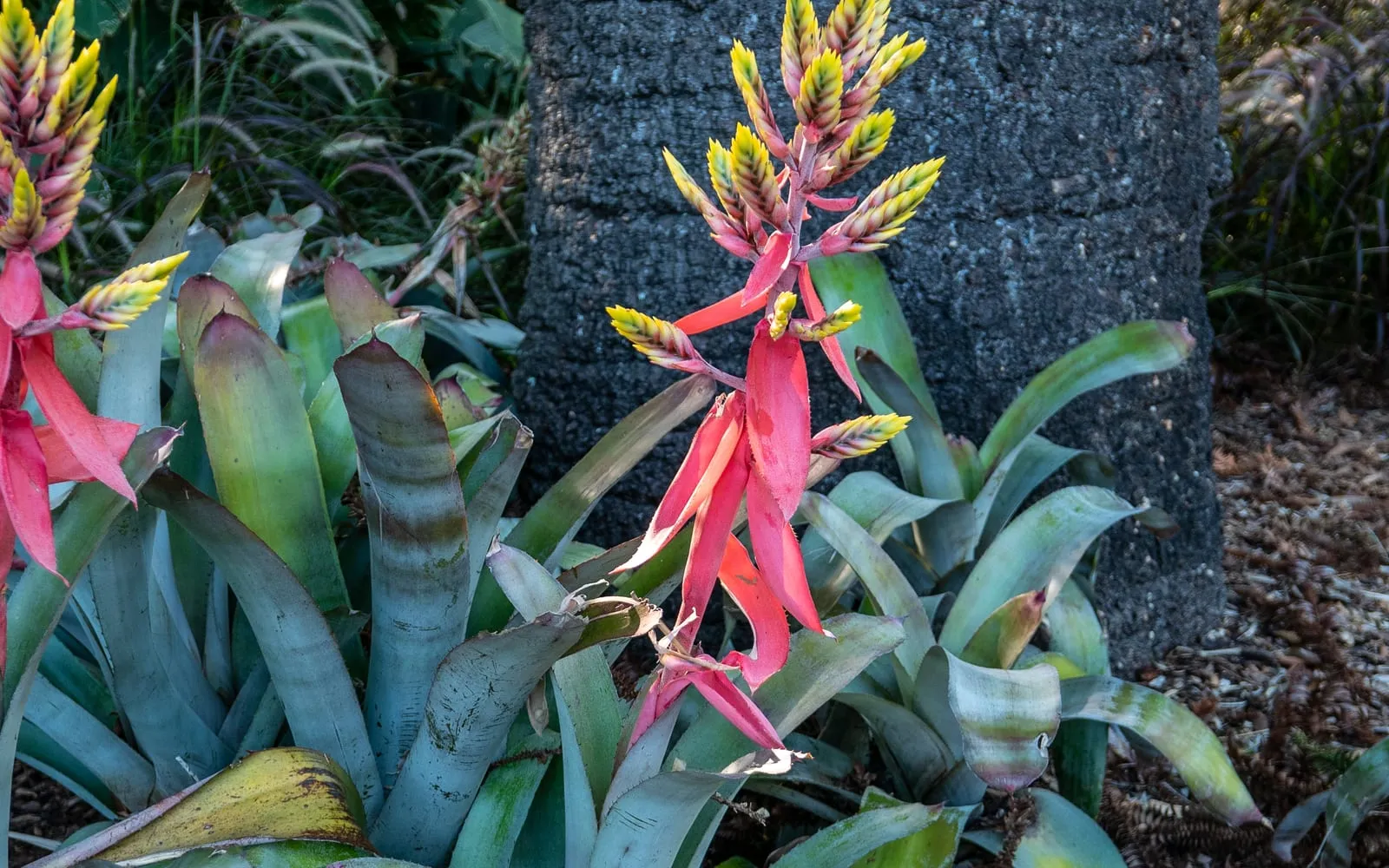
The flower spike is dramatic, a branched, pyramidal structure carrying red or orange bracts and small yellow flowers tipped in blue, rising well above the rosette and lasting for weeks. It typically takes two to four years of growth for a plant to reach flowering size.
Like every bromeliad covered here, Aechmea chantinii is monocarpic. The rosette that flowers declines slowly afterwards, over the better part of a year, while offsets form at its base to continue the plant.
Where it is from
Aechmea chantinii is native to the Amazon basin, recorded across Peru, Ecuador, Colombia, Venezuela and Brazil, growing as an epiphyte on trees in lowland rainforest.
It sits, typically, in the middle to upper canopy, where light is dappled and moving rather than direct, and where the air holds close to full saturation for most of the year with no pronounced dry season to speak of.
Its native habitat is constantly, almost completely humid, and ordinary homes rarely match it. A rainforest canopy in the Amazon seldom drops below 70 to 80 percent relative humidity, even during the driest weeks of the year. Few houses maintain that level without a dedicated humidifier or a greenhouse.
Its size and the substantial water volume its tank holds are also products of that habitat. A cup this large only makes sense where rainfall is frequent enough to keep refilling it and where the surrounding air is humid enough that it does not evaporate between showers, which is exactly the balance an indoor grower has to recreate by hand.
How it grows
Pot it in an open bark or orchid-style mix, since the roots exist chiefly to anchor a plant of considerable size and weight rather than to draw up most of its water.
Keep the central tank filled with 4 to 5 cm of water, using rainwater or filtered water, since this species shows mineral scale on its banded leaves as clearly as it shows a scorch mark.
Flush the tank completely every two weeks. Because it holds more water for longer than a shallow Neoregelia cup or a narrow Billbergia tube, standing water here has more time to sour, and a tank left unflushed for a month or more is a common way a mature plant declines without an obvious cause.
Raise humidity deliberately and substantially, since this is the species where an ordinary living room falls short. A large humidifier, a dedicated humid cabinet, or a well-lit bathroom used consistently as a growing spot are all more realistic options than a small pebble tray, which rarely raises humidity enough on its own for a plant this demanding.
Handle it in thick gloves when repotting or moving it, since the leaf spines are sharp enough to cut skin, and position it where people and pets will not brush against it repeatedly.
Position it in bright, filtered light with a little gentle morning sun, which deepens the silver banding, while keeping it out of harsh midday sun, which scorches the leaves and fades the pattern.
Feed lightly through the growing season, and expect two to four years before a young offset reaches flowering size, considerably longer than the easier tank bromeliads in this collection.
Through the seasons
Spring restarts active growth. Resume feeding every four to six weeks, check the tank more often as warmer air speeds evaporation, and reassess humidity provision as heating systems switch off.
Summer is peak growth and, on a mature plant, the likeliest season for the flower spike to appear. Flush the tank every two weeks, maintain high humidity even as windows are opened for ventilation, and protect the plant from strong midday sun through south-facing glass.
Autumn brings cooling air that can catch this species out faster than the more tolerant bromeliads in this collection. Watch temperatures as they drop below 18 deg C, ease off feeding, and keep humidity provision running as central heating starts to dry the air.
Winter is the hardest season for an Amazonian Zebra Plant indoors. Maintain warmth above 13 deg C at an absolute minimum, keep humidity as high as practical, reduce the water depth in the tank slightly since evaporation slows, and stop feeding until growth resumes in spring.
Care difficulty
Difficult, and the most demanding of the ten species in this collection, mainly because of humidity rather than any single dramatic requirement.
Where a Guzmania or a Neoregelia tolerates the humidity of an ordinary centrally heated room reasonably well, an Amazonian Zebra Plant struggles in it over time, showing browning leaf tips and poor colouring rather than outright failure, which can make the cause hard to diagnose without knowing to look for it.
The spines add a second layer of difficulty that is more about handling than about the plant’s actual needs, since gloves and careful placement solve it, but a grower unprepared for them can be caught out the first time they go to repot a mature specimen.
Given consistently high humidity, warmth and a flushed tank, it is no harder to keep alive than any other tank bromeliad. The difficulty comes down to whether the room can supply what it needs, not to any particular skill.
Watering
Keep the central tank filled with 4 to 5 cm of water at all times, checking weekly and topping up as needed.
Flush the tank completely every two weeks rather than only topping it up, tipping it out and refilling with fresh rainwater or filtered water, since its larger volume gives standing water more time to sour than in a shallower cup.
Water the bark mix lightly and only once the surface has dried, since the roots are more vulnerable to rot in a constantly wet mix than the plant’s overall toughness might suggest.
In a cool room over winter, reduce the tank’s water depth slightly rather than keeping it brimming, as evaporation slows and the same volume takes longer to need changing.
Signs of overwatering are a soft, dark base and a musty smell from the tank. Signs of underwatering, or more often low humidity, are browning leaf tips and dulled banding on the foliage.
Warning signs, diseases and pests
A soft, foul-smelling base with leaves detaching easily is rot, usually from a tank left unflushed for too long or a bark mix kept constantly wet. Trim affected tissue, repot into fresh mix, and flush the tank more regularly.
Browning leaf tips with the base otherwise healthy point to humidity that is too low rather than a watering problem. Increase humidity substantially before adjusting the watering routine.
Faded, washed-out banding on leaves that were recently moved into strong light is scorch. Move the plant back or filter the light, and expect new growth to show the pattern more clearly than scorched older leaves do.
Scale insects appear as small, flat, brownish bumps, often along the midribs on the underside of the leaves, where the spines make them harder to reach. Treat with horticultural oil applied carefully, using gloves.
Mealybugs cluster as white cottony tufts in the leaf axils near the tank. A cotton bud dipped in isopropyl alcohol removes them, with a follow-up check after a week.
Spider mites can appear in a hot, dry spot, particularly where humidity has fallen well short of what the species needs, showing as fine stippling across the leaves. Raise humidity and rinse the foliage under tepid water.
A rosette that stops producing new leaves after its spike fades is normal rather than failing, and its energy has already shifted into the offsets forming at its base.
Growing environment
Bright, filtered light with a little gentle morning sun, avoiding the harsh midday sun that scorches the banded leaves.
Consistent warmth between 18 and 29 deg C, with real risk of damage below 13 deg C, a higher floor than most tank bromeliads in this collection tolerate.
High humidity of 60 to 80 percent, the species’ defining requirement. A dedicated humidifier, a humid cabinet or a consistently warm, steamy bathroom used as a growing space are realistic options where a simple pebble tray falls short.
An open bark or orchid mix, never a dense, water-retentive compost.
Good air movement alongside the high humidity, since still, saturated air without circulation encourages fungal problems even in a species built for wet conditions.
Placement out of casual reach, given the spines, and away from cold draughts and single-glazed windowsills in winter.
Feeding
Feed every four to six weeks from spring to early autumn with a balanced liquid fertiliser at a quarter of the strength recommended on the label, or a specialist bromeliad formula at label strength.
Add the feed to the water going into the tank, since this species absorbs nutrients through its leaf bases in the same way its relatives do.
Stop feeding entirely over winter, when growth slows and unused fertiliser is more likely to accumulate as salts in the tank.
A plant that is never fed will still grow and eventually flower, though considerably more slowly, and given how long this species already takes to reach flowering size, a light, consistent feeding routine is worth keeping up through the growing season.
Avoid full-strength houseplant fertiliser. The banded leaves show scorch from concentrated feed clearly, as pale or brown patches breaking up the silver pattern.
Troubleshooting
Why does my plant need so much more humidity than other bromeliads I’ve grown? Aechmea chantinii comes from equatorial Amazon rainforest with close to constant high humidity and no real dry season, a wetter and more consistent habitat than the subtropical or seasonally dry forests many easier tank bromeliads come from.
The leaf tips keep browning even though I water regularly. That is almost always low humidity rather than underwatering. Raise humidity substantially, since this species needs more than a light misting or a small pebble tray provides.
How do I safely repot it? Wear thick gloves and handle the rosette by the base of the leaves rather than gripping the blades themselves. The margin spines are sharp enough to cut skin easily.
The banding on the leaves looks pale and washed out. Too much direct sun is the usual cause. Move the plant back from the window or filter the light, and expect the next flush of leaves to show the pattern more clearly.
How long until it flowers? Typically two to four years from a young offset, longer than most other tank bromeliads in this collection, which is a normal pace for this species rather than a sign of poor care.
The base has gone soft and smells bad. That is rot, usually from a tank left unflushed too long or bark mix kept constantly wet. Trim the affected tissue, repot into fresh, open mix, and flush the tank every two weeks going forward.
Is the water in the tank a health risk with mosquitoes around? Only if it is left completely undisturbed for weeks at a time. Flushing the tank every two weeks, as recommended for the plant’s own health, also removes any mosquito larvae well before they could mature.
Amazonian Zebra Plant problem guides
Not sure what is wrong? See the common houseplant pests guide.