
Outdoor plant
Rosemary Grevillea
Grevillea rosmarinifolia
Also known as Rosemary spider flower
How to grow rosemary grevillea outdoors. Its needle-like foliage, red and cream spider flowers, and why it tolerates cold better than most Grevillea species.
At a glance
- Difficulty
- Moderate
- Water
- Regular watering while establishing, drought-tolerant once mature
- Light
- Full sun
- Hardiness
- USDA 8-10, RHS H4, hardy to -10 C
- Type
- Evergreen shrub
- Height
- 1-2.5 m
- Native to
- Southeastern Australia
More cold-tolerant than many other Grevillea species, surviving real winter frost once established, which has made it one of the more widely grown grevilleas in temperate gardens outside Australia. It still needs sharp drainage and dislikes rich, fertile or phosphorus-heavy soil, the two conditions that matter more to its success than winter cold does.
Hardiness zones describe winter cold alone. Summer heat, humidity, rainfall and the length of the growing season decide as much, so treat the range as the outer limit rather than as a recommendation.
Skin irritant
- Do not eat
- The foliage and flowers, on contact
- Harm from
- Handling it
- Affects
- People
Grevillea species, including this one, are a well-documented cause of contact dermatitis in sensitive individuals, thought to be linked to compounds related to those found in poison ivy. Reactions range from mild irritation to a more significant rash with repeated exposure, and gardeners who prune or handle Grevillea regularly sometimes develop increasing sensitivity over time. Wearing gloves and long sleeves when pruning is a sensible precaution, particularly for anyone who has reacted before.
Source: RHS
About
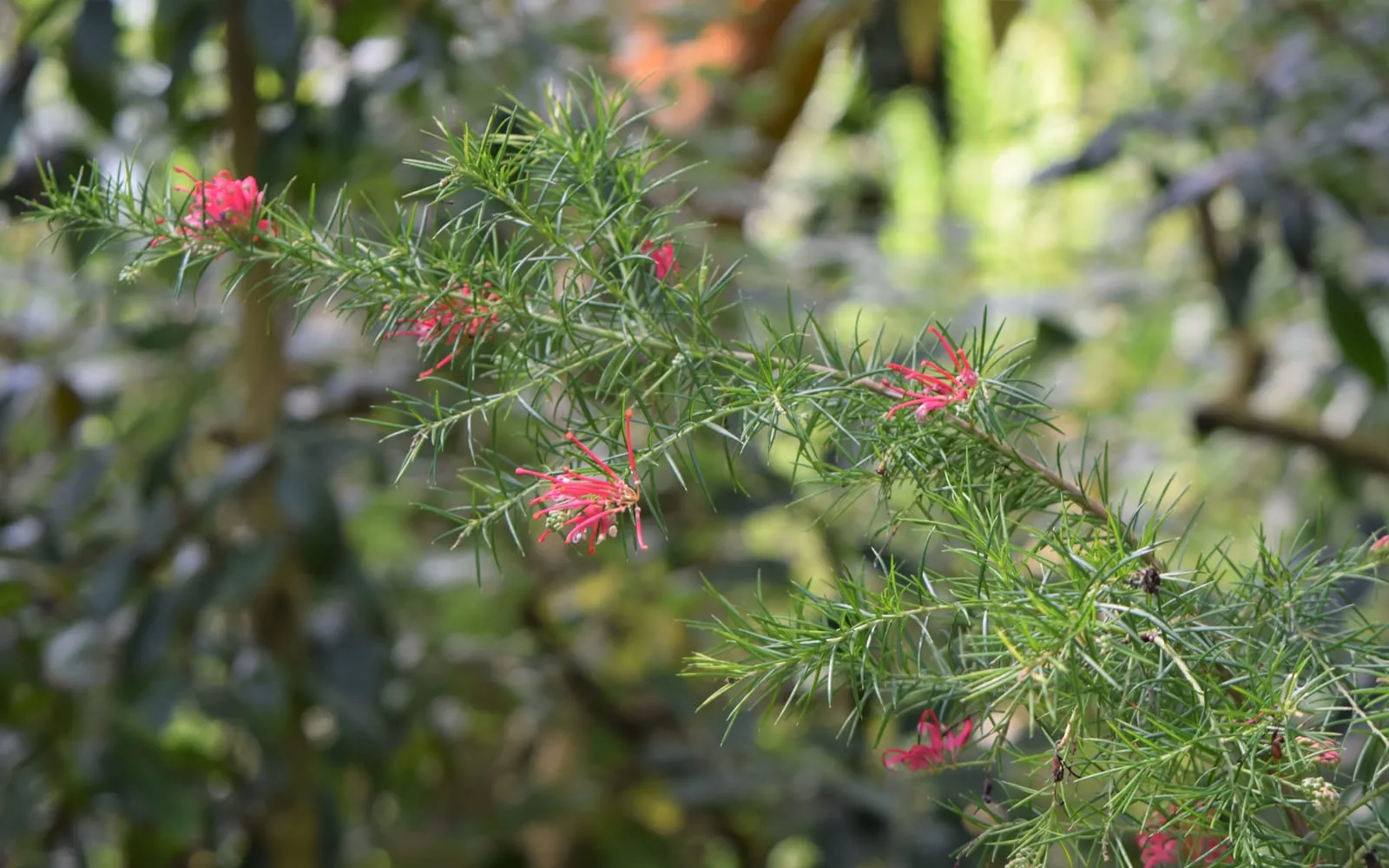
Rosemary grevillea is grown for its dense, needle-like foliage, strongly reminiscent of culinary rosemary at a glance, and its distinctive spider-shaped flowers, typically a striking combination of red and cream, produced over a long season and attractive to nectar- feeding birds in its native Australia. It is one of the more cold-hardy members of a genus otherwise associated mainly with frost-free climates, which has made it a popular choice for a Mediterranean-style or drought-tolerant planting scheme well beyond Australia.
Like several other Grevillea species, it has a documented risk of causing contact dermatitis in some people, an important practical consideration for a shrub often chosen specifically because it is otherwise so easy and rewarding to grow.
Appearance and character
Narrow, needle-like leaves densely clothe a mounding, evergreen shrub, closely resembling rosemary in texture and giving the plant a fine, soft-looking silhouette that belies its actual toughness. Distinctive spider-shaped flowers, with narrow, curled petals in combinations of red, pink and cream, appear over a long season, often from autumn through spring in a mild climate, and provide a reliable nectar source for birds when little else is flowering.
The dense, mounding growth habit makes it useful as an informal hedge or screening shrub as well as a specimen plant, and regular light trimming after flowering keeps it compact and well-furnished rather than becoming sparse or leggy with age.
Where it is from
Rocky, well-drained slopes in southeastern Australia, in a climate with distinct seasonal variation and enough winter cold to have selected for better frost tolerance than many other Grevillea species from milder, more northern parts of Australia.
That relatively cooler native range explains why this particular species has become one of the standard choices for temperate gardens outside Australia wanting to grow a grevillea, where many other more tropical or subtropical species in the genus cannot survive outdoors year round without significant winter protection.
How it grows
An evergreen shrub that builds a dense, mounding form over a few years, flowering over an extended season on both new and slightly older growth. Growth is moderately fast given full sun and sharp drainage, and established plants tolerate real drought well, reflecting their origin on exposed, well-drained Australian slopes.
Light, regular trimming after flowering flushes encourages denser, bushier growth and helps prevent the somewhat leggy, open habit older, unpruned specimens can develop, particularly in a spot with less than full sun.
Through the seasons
Spring flowering often continues from the previous season in a mild climate, alongside strong new growth as temperatures rise.
Summer growth continues given adequate establishment; established plants tolerate real drought and need little supplemental watering.
Autumn a fresh flush of flowers often begins as temperatures cool, continuing into winter in a mild climate.
Winter established plants tolerate real frost, and flowering often continues through mild winter weather in a suitable climate.
Care difficulty
Moderate. The plant is especially tough once established, tolerating cold, drought and poor soil better than many other flowering shrubs, but it needs the right start, sharp drainage and no rich feeding, to establish well in the first place.
Watering
Regular watering supports strong establishment in the first year or two. Once settled, this species tolerates real drought, and deep, infrequent watering suits it far better than frequent light watering, which encourages shallow rooting and poorer overall resilience during a dry summer.
Warning signs, diseases and pests
Root rot from soil that is too rich, wet or poorly drained is the main serious risk, and prevention through correct siting matters more than treatment once it has taken hold, since a badly affected plant rarely recovers. Few significant pests trouble this species in most gardens.
Skin irritation after pruning or handling the plant is a real and well-documented risk with this genus. Anyone who has reacted before, or who is pruning it for the first time, should wear gloves and long sleeves as a matter of course rather than waiting to find out whether they are sensitive.
Growing environment
Full sun gives the best flowering and the most compact growth. Poor to moderately fertile, sharply free-draining, acidic to neutral soil suits it well, and this species performs poorly in heavy clay or waterlogged ground regardless of how much sun it receives.
Feeding
None to minimal, and any fertiliser used should be low in phosphorus, since this species, like other members of the Proteaceae family, can be harmed rather than helped by the phosphorus levels found in many standard garden fertilisers.
Troubleshooting
Growth is leggy and sparse rather than dense. Usually too little light or a lack of regular trimming. Move to a sunnier spot if possible and prune lightly after flowering flushes to encourage bushier regrowth.
Skin irritation has developed after handling the plant. This is a known risk with Grevillea species. Wear gloves and long sleeves for future pruning and handling, and wash any affected skin promptly rather than waiting to see if the reaction fades on its own.
The base of the plant is soft or the plant is declining without clear cause. Suspect root rot from soil that is too rich, wet or poorly drained. Improve drainage for any future planting in the same spot and avoid overwatering established plants, since this species recovers poorly once significant rot has set in.
Leaves have yellowed after feeding with a general garden fertiliser. Suspect phosphorus sensitivity, common across this plant family. Switch to a low-phosphorus native plant feed, or stop feeding altogether, since established plants often need none at all and generally look better for being left unfed.
You want to use this shrub as an informal hedge. Space plants at a distance that allows their mature spread to knit together without excessive overlap, and begin light trimming early in the plant’s life to encourage dense growth from the base rather than waiting until gaps have already formed lower down and are much harder to fill in once the hedge is established.