
Outdoor plant
Wall Bellflower
Campanula portenschlagiana
Also known as Dalmatian bellflower, Wall harebell
How to grow wall bellflower, Campanula portenschlagiana. How it roots into lime mortar joints with almost no soil at all, why it self-seeds into paving cracks readily, and keeping an enthusiastic coloniser in bounds.
At a glance
- Difficulty
- Easy
- Water
- Regular watering while establishing; drought-tolerant once rooted into a wall or crevice
- Light
- Full sun to partial shade
- Temperature
- Cool to warm temperate
- Hardiness
- USDA 4-8, RHS H5, hardy to -15 C
- Type
- Hardy evergreen to semi-evergreen perennial
- Height
- 10-15 cm, trailing to 50 cm
- Native to
- Europe
Hardy through most temperate winters without protection, and the zone number captures cold tolerance accurately. It says nothing about the plant's capacity to spread by self-seeding into every available crack and crevice nearby, which in a mild, damp climate can turn a single deliberate planting into a colony covering an entire wall within a few years, a behaviour driven by climate and surface availability rather than by winter temperature at all.
Hardiness zones describe winter cold alone. Summer heat, humidity, rainfall and the length of the growing season decide as much, so treat the range as the outer limit rather than as a recommendation.
Not known to be toxic
Wall bellflower carries no toxicity listing from the RHS or the ASPCA and has no documented history of causing harm to people or common pets if handled or eaten. It is frequently grown at ground level and on low walls in gardens with unrestricted access for children and animals.
About
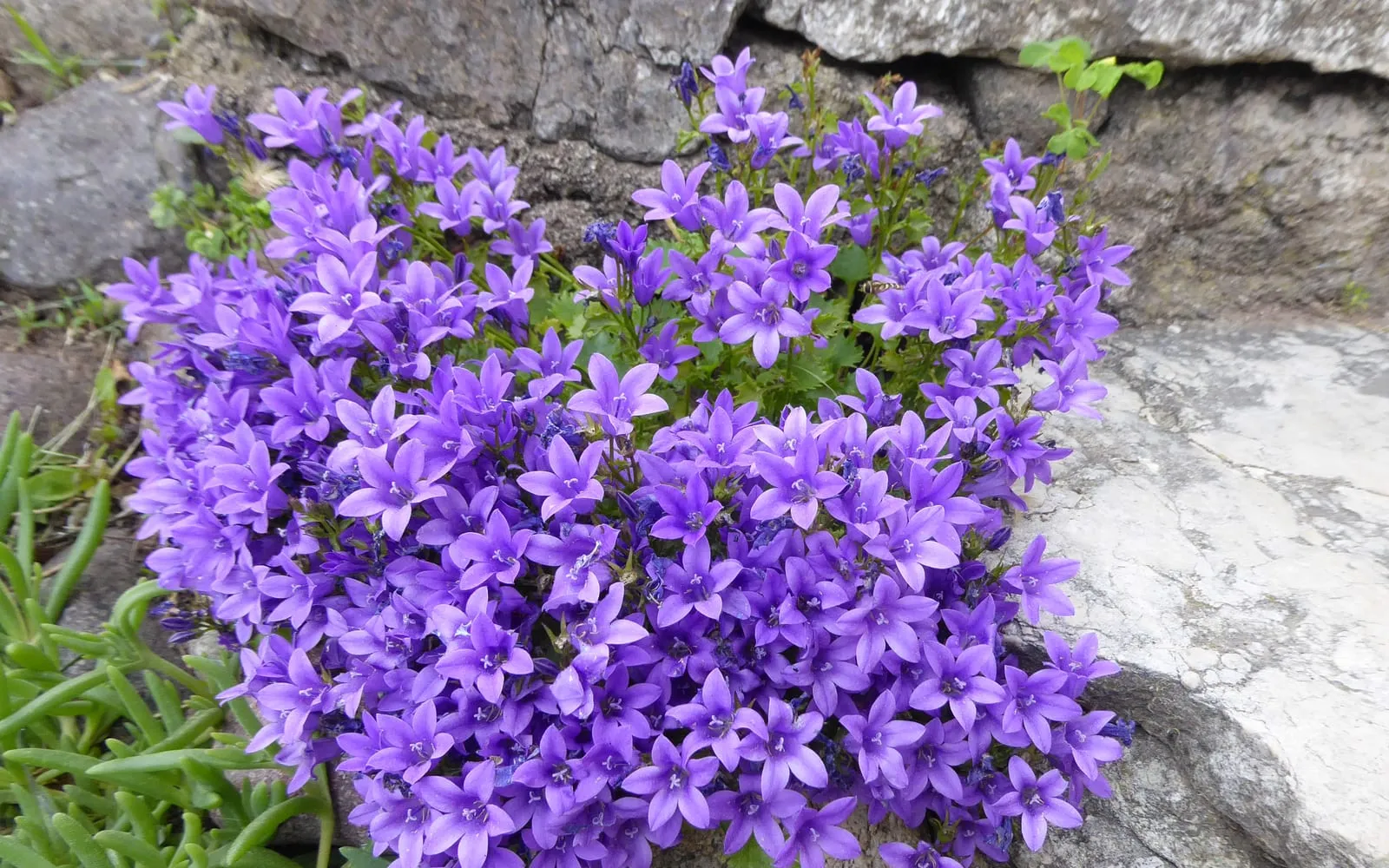
Wall bellflower produces a low, spreading mat of small, heart-shaped leaves covered through summer in a dense scattering of small, bell-shaped purple-blue flowers, and it is grown less often for a single dramatic display than for its unusual ability to grow directly out of a dry stone wall, a retaining wall, or the gaps between paving slabs with barely any visible soil at all. Where most plants in this collection are judged on how well a gardener replicates their native soil conditions, wall bellflower is notable for how little soil it needs.
Its common failure mode is closer to being too successful than too fussy. Given a mild climate and a nearby wall or path with gaps to colonise, it self-seeds readily and can spread well beyond its original planting position within a few seasons, which makes it one of the few plants in this rockery collection that a gardener may need to actively restrain rather than coax along.
Appearance and character
Small, rounded, slightly toothed leaves grow densely along thin, wiry, trailing stems that root readily wherever they find a foothold, building a low mat that cascades attractively over the edge of a wall or raised bed. The foliage stays green through mild winters and dies back only in hard frost, giving it a longer season of visible presence than many other rockery plants.
From early to late summer, the mat is scattered with small, star-mouthed bell flowers in shades of violet-blue, each held on a thin stem just above the foliage. The flowering period is longer and more relaxed than the concentrated spring flush of aubrieta or basket-of-gold, with new flowers opening steadily over many weeks rather than in one dense burst.
Where it is from
Campanula portenschlagiana is native to the Dalmatian coast of Croatia and the surrounding western Balkans, where it grows rooted into limestone rock faces and crevices in a Mediterranean climate of hot, dry summers and mild, wetter winters. Rooting into bare rock with almost no soil is not an adaptation this species developed for garden walls specifically; it is the habitat the plant has always occupied, and a British or northern European dry stone wall, built from similar limestone rubble and lime mortar, closely resembles the crevices the species evolved to exploit.
The plant reached British gardens in the nineteenth century and became one of the most widely planted wall and crevice perennials of Victorian rockery design, a popularity that persists today largely because it does the one thing few other ornamental plants manage: it turns a bare, structural wall into a flowering surface without requiring any soil bed to be built for it.
How it grows
Growth spreads from the original planting point via a network of fine, wiry underground and surface stems that seek out gaps, cracks and pockets of loose material to root into, whether that is garden soil, a pocket of mortar dust in a wall joint, or the sand bedding under a paving slab. Once rooted, even a tiny pocket of material is enough to sustain a patch of growth, since the plant’s water and nutrient needs are modest.
Self-seeding is the other major route of spread, and in a mild, damp climate a single plant can produce seedlings in nearby cracks and crevices for several metres around within a few years. This is a different spreading mechanism from the vegetative rooting stems of aubrieta or creeping phlox, and it means removing unwanted growth requires attention to both the spreading stems and any seedlings that have already established independently nearby.
Through the seasons
Spring brings renewed growth from the semi-evergreen mat, and it is the best season for planting new wall bellflower, either directly into a prepared crevice or into a bed where it can be encouraged toward a nearby wall.
Summer is the main flowering period, with new flowers opening steadily over many weeks from June into September in a favourable climate. This is also the season when self-seeding is most obvious, and any unwanted seedlings in cracks or paving joints are easiest to remove while still small, before they root deeply into the surrounding masonry.
Autumn is a suitable time to trim back any growth that has spread further than wanted, cutting the trailing stems back to a manageable extent before winter.
Winter is handled without difficulty by established plants down to around minus 15 deg C, and in a mild climate the foliage often stays evergreen through the coldest months, only cutting back properly in a hard, prolonged frost.
Care difficulty
Wall bellflower is easy once established, tolerating poor soil, drought and minimal soil volume better than nearly anything else grown for flower colour. The care challenge it presents is the opposite of most plants in this collection: rather than coaxing a reluctant plant into growing, the task is often restraining an enthusiastic one from spreading further than wanted, particularly in a climate mild and damp enough to favour heavy self-seeding.
A gardener planting it deliberately into a wall or crevice, rather than letting it arrive there by accident from a nearby border, has more control over where the colonisation happens, since removing an established patch from deep within a wall joint is considerably harder than preventing it from establishing there in the first place.
Watering
New plantings benefit from regular watering while roots establish, particularly where planted directly into a wall crevice with limited moisture reserves nearby. Once rooted, an established plant, whether in ordinary soil or lodged in a wall joint, needs very little supplemental watering and tolerates drought better than almost any other flowering plant in this collection.
Plants growing in open garden soil rather than a wall or crevice appreciate somewhat more regular watering during hot, dry spells than those established directly in masonry, since the soil volume around their roots dries out faster in full exposure.
Warning signs, diseases and pests
Slugs and snails graze on soft new growth and young seedlings, particularly in damp conditions, though established plants growing in a wall are less accessible to them than plants at ground level. Rust occasionally affects the foliage, appearing as small orange pustules, usually in humid conditions with poor air movement.
Vine weevil grubs can attack the roots of plants growing in ordinary garden soil, though plants rooted directly into a wall crevice with minimal soil volume are somewhat less vulnerable to root-feeding pests than those in a conventional bed.
Growing environment
Full sun to partial shade both suit wall bellflower, and it is more tolerant of shade than most other flowering plants in this collection, which makes it a useful choice for a north-facing wall or a shaded corner of a rockery where sun-loving alpines would fail to flower well. An exposed south-facing wall gives the densest flowering, but a shadier position still produces a reasonable display.
Soil, where it is present at all, should be free-draining, but the plant’s real environmental requirement is a crack, crevice or pocket to root into, whether that is a dry stone wall, a gap in paving, or ordinary rockery soil. It performs less well in heavy, waterlogged clay than in almost any other setting, including a bare wall joint with only dust and mortar debris for a rooting medium.
Feeding
Wall bellflower needs no feeding, and in most of its typical growing positions, a wall joint or a paving crack, there is no practical way to feed it even if it were wanted. Plants growing in ordinary garden soil similarly need nothing beyond what the soil already provides, and rich feeding is more likely to produce soft, floppy growth than to improve the plant’s naturally dense, wiry habit.
Troubleshooting
The plant has spread well beyond where it was originally planted. This is normal, expected behaviour for this species in a mild, damp climate rather than a sign of poor care. Trim back unwanted trailing stems in autumn, and remove self-sown seedlings from cracks and paving while they are still small if the spread has become unwelcome.
New seedlings keep appearing in nearby paving joints. These are self-sown from an established plant flowering and setting seed nearby. Deadheading spent flowers before they set seed reduces the number of new seedlings considerably if ongoing spread is not wanted.
A plant established in a wall crevice has struggled compared with one in open soil. This is unusual for the species but can happen in a very shallow or exposed joint with minimal rooting material. Packing a small amount of gritty compost into the crevice at planting time gives new roots a slightly better start without changing the plant’s overall tolerance for minimal soil.
Small orange pustules have appeared on the leaves. This is rust, more likely in humid, still conditions. Remove affected foliage and improve air circulation around dense plantings if it recurs.
Slug damage has appeared on soft new growth after rain. This is most likely on ground-level plantings in open soil rather than on plants established directly in a wall. Clearing nearby hiding places and watering in the morning rather than the evening both help.
Flowering has been sparse in a shaded position. While wall bellflower tolerates more shade than most flowering rockery plants, a very deeply shaded spot will still reduce flowering noticeably compared with a sunnier one. Moving the plant, or accepting reduced flowering, are the two practical options.
Removing an established patch from a wall has proven difficult. The fine, wiry roots anchor firmly into mortar joints and rubble, and pulling growth out can damage the pointing of an older wall. Cutting growth back repeatedly at the base over a season, rather than pulling it out by force, weakens the plant gradually with less risk to the wall itself.