
Outdoor plant
Old Man Banksia
Banksia serrata
Also known as Saw banksia
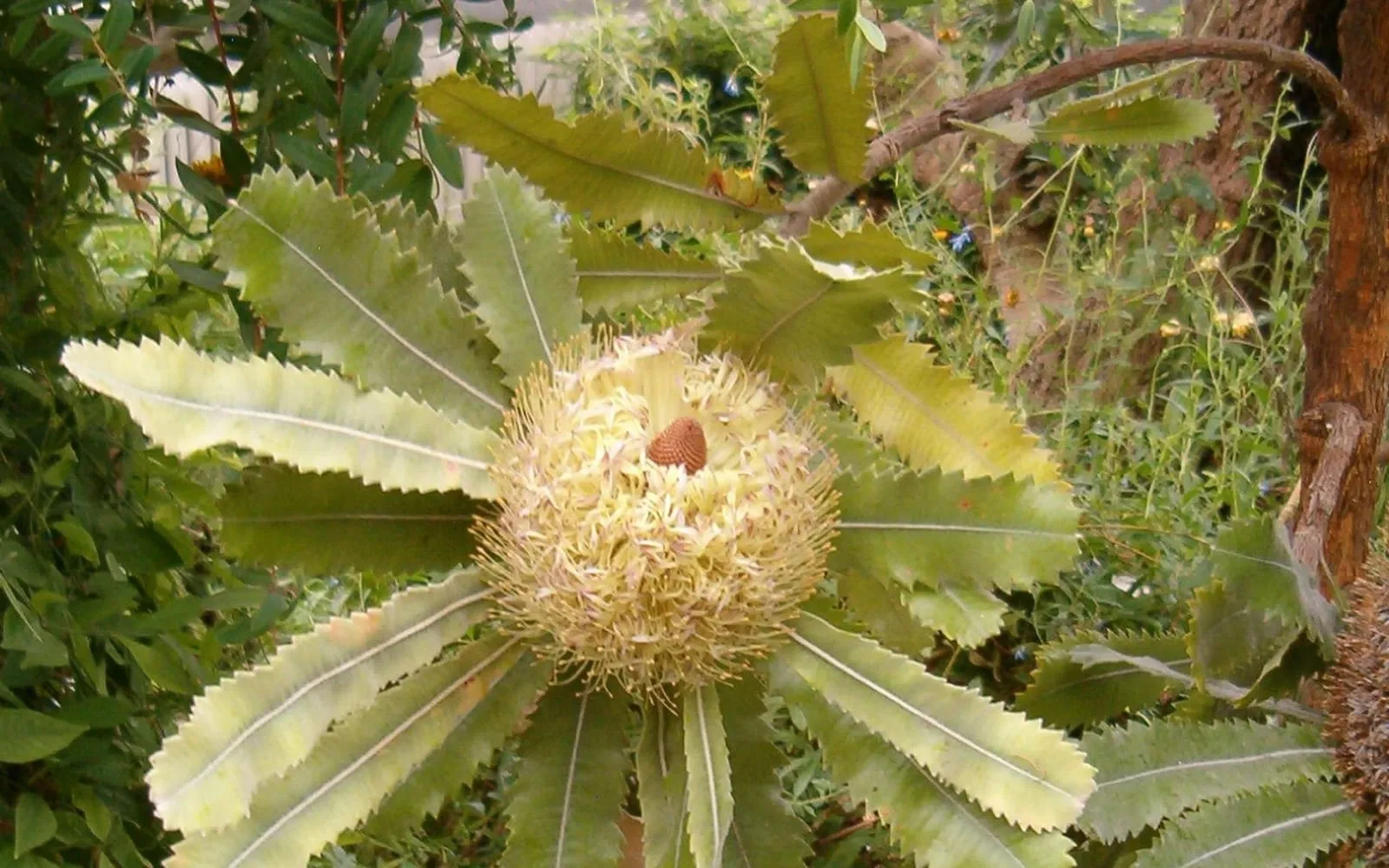
How to grow old man banksia outdoors. Its rough, saw-toothed leaves, cylindrical flower spikes, and the woody seed cones that only open after fire or heat.
At a glance
- Difficulty
- Difficult
- Water
- Regular watering while establishing, drought-tolerant once mature
- Light
- Full sun
- Hardiness
- USDA 9-10, RHS H3, hardy to -3 C
- Type
- Evergreen shrub or small tree
- Height
- 5-15 m
- Native to
- Eastern Australia
Adapted to a mild, coastal Australian climate with poor sandy soil and periodic wildfire, tolerating only a light frost once established and performing poorly in a persistently cold or heavy-soil climate regardless of protection. It needs sharp drainage and low fertility more than it needs any specific temperature range, and rich or poorly drained soil is a far greater threat to it than an occasional light frost.
Hardiness zones describe winter cold alone. Summer heat, humidity, rainfall and the length of the growing season decide as much, so treat the range as the outer limit rather than as a recommendation.
Not known to be toxic
Old man banksia has no toxicity listing from the RHS or the ASPCA and is considered safe around pets and children. There is no documented history of poisoning associated with this species.
Source: RHS
About
Old man banksia takes its evocative common name from its gnarled, rough, grey bark and characteristically twisted, weathered growth habit, giving even a relatively young tree an aged, characterful appearance. Its stiff, saw-toothed leaves and large, cylindrical, cream-yellow flower spikes, followed by distinctive knobbly, woody seed cones, make it one of the most recognisable members of the banksia genus, and it has a long association with Australian folklore and children’s literature, where its old, weathered seed cones inspired the gumnut babies of a well-known early twentieth-century story collection.
Its woody seed cones are adapted to open and release seed specifically in response to the heat of wildfire, a striking adaptation to a fire-prone native habitat that also explains why cones can persist, tightly closed, on the tree for years without releasing their seed under ordinary garden conditions.
Appearance and character
Rough, deeply furrowed grey bark covers gnarled, often twisted branches, holding stiff, leathery leaves with a distinctly saw-toothed edge along each margin, tough enough to explain the alternative name saw banksia. Large, cylindrical flower spikes, densely packed with small individual flowers, open a soft cream to yellow-green and are a significant nectar source for birds and other wildlife in the tree’s native range.
Following flowering, the spike develops into a distinctive, knobbly, woody seed cone, grey-brown and covered in small, beak-like follicles that remain tightly closed under normal conditions, opening only when triggered by the intense heat of fire, a mechanism that can leave old, unopened cones persisting on the tree for many years.
Where it is from
Coastal and near-coastal areas of eastern Australia, on poor, sandy, acidic soil in a climate with mild, wet winters and warm, dry summers, regularly exposed to wildfire as a natural part of the ecosystem.
That fire-adapted coastal origin explains both the tree’s tolerance of poor, sandy, low-nutrient soil and its seed cones’ unusual reliance on fire to open, and it also underlies the species’ general intolerance of rich, fertile or heavy garden soil, which bears little resemblance to its native growing conditions.
How it grows
A slow to moderately growing tree that develops its characteristic gnarled, weathered form over many years, flowering on mature growth once it reaches a suitable age and size. Growth is much slower than many faster garden trees, and a striking, aged appearance is something this species develops naturally over a long timeframe rather than something that can be hurried along.
Seed cones, once formed, typically remain closed on the tree indefinitely under ordinary garden conditions, since the intense heat needed to trigger their opening is rarely present outside an actual fire; gardeners wanting to collect seed sometimes remove cones and apply direct heat, such as a domestic oven at a controlled temperature, to encourage them to open.
Through the seasons
Spring growth resumes as temperatures rise, with new growth developing on established plants.
Summer flower spikes typically open during the warmer months, providing a significant nectar source for birds and other wildlife.
Autumn growth slows as temperatures drop; spent flower spikes begin developing into the following woody seed cones.
Winter established plants tolerate mild, wet winter conditions well, reflecting their coastal Australian origin, though real cold beyond a light frost is a real risk.
Care difficulty
Difficult. This species needs a specific combination of mild climate, poor sandy soil and sharp drainage that many gardens cannot easily provide, and its slow growth means mistakes in siting or care take a long time to become apparent and even longer to correct.
Watering
Regular watering supports establishment in the first year or two. Once settled, this species tolerates real drought well, reflecting its adaptation to a dry Australian summer, and generally performs poorly with regular watering once established, which favours root rot over healthy growth.
Warning signs, diseases and pests
Root rot from soil that is too rich, wet or poorly drained is the most significant risk, and prevention through correct siting and minimal watering once established matters far more than any treatment after the fact. Few significant pests trouble this species in a climate and soil type that suits it.
A tree that has stopped growing or looks generally unhealthy without an obvious specific cause is worth checking against soil type and drainage first, since this species is much less forgiving of unsuitable growing conditions than many other garden trees, even where the general climate is broadly appropriate.
Growing environment
Full sun is essential, and poor, sandy, sharply free-draining, acidic soil matters just as much, closely mirroring the coastal Australian ground this species comes from. Avoid rich garden soil, heavy clay, or any spot prone to standing water, all of which work against this species regardless of how mild the overall climate is.
Feeding
None to minimal, and phosphorus should be avoided specifically, since members of the Proteaceae family, including this one, are especially intolerant of phosphorus levels that are unremarkable for most other garden plants and can show toxicity symptoms rather than any benefit from feeds containing it.
Troubleshooting
Growth is very slow even in apparently suitable conditions. This is largely normal for the species, which develops its characteristic gnarled form over a long timeframe. Consistent, appropriate care over many years, rather than any quick fix, is the right approach.
Seed cones remain closed and never seem to release seed. This is expected under ordinary garden conditions, since the cones need the intense heat of fire to open. Collecting and applying controlled direct heat is the usual way to open cones deliberately for seed collection.
Leaves have yellowed after feeding with a general garden fertiliser. Suspect phosphorus sensitivity, common across this plant family. Avoid feeding, or use only a fertiliser specifically formulated as low-phosphorus for proteas, banksias and their relatives.
A tree has declined in heavy or poorly drained soil. This points to unsuitable growing conditions rather than a specific disease. Improve drainage significantly for any future planting of this species, or choose a different, more tolerant tree for a heavier-soil site.