
Edible
Chokecherry
Prunus virginiana
How to grow chokecherry, Prunus virginiana. Why the ripe fruit still puckers the mouth raw, the suckering habit that turns one plant into a thicket, and the cyanide risk in wilted leaves and chewed pits.
At a glance
- Difficulty
- Easy
- Water
- Water while young; established plants tolerate normal dry spells
- Light
- Full sun to part shade
- Temperature
- Fully hardy
- Hardiness
- USDA 2-7, RHS H7, hardy to -35 C
- Type
- Hardy deciduous shrub or small tree, often suckering into thickets
- Height
- 3-8 m
- Native to
- North America
Native as far north as the boreal edge of the Canadian prairies, one of the most cold-tolerant fruiting shrubs grown anywhere, and a severe winter is rarely a concern once it is established. What its range does not promise is heat tolerance: it is a plant of cool and temperate summers, and in the hottest, most humid climates it grows poorly and struggles with disease compared with a garden further north or at higher elevation.
Hardiness zones describe winter cold alone. Summer heat, humidity, rainfall and the length of the growing season decide as much, so treat the range as the outer limit rather than as a recommendation.
Poisonous if eaten
- Safe to eat
- Ripe fruit flesh, cooked into jelly, syrup and wine once the pits are removed
- Do not eat
- Leaves, twigs, bark and seed kernels, especially wilted foliage
- Harm from
- Eating it
- Affects
- People, cats, dogs and horses
Chokecherry fruit is a genuine, long-used food once fully ripe and cooked, central to pemmican and other preserved foods among many Indigenous nations across its range and still gathered today for jelly and syrup, since cooking and straining out the pits removes the part that carries the risk. The leaves, bark and seed kernels contain cyanogenic glycosides that release cyanide when the tissue is crushed, chewed or wilted, and wilted leaves on a broken or freshly pruned branch are considerably more dangerous than intact green foliage because wilting accelerates the chemical breakdown. Chokecherry poisoning is a well-recognised hazard for cattle and horses across the Great Plains and prairie provinces, usually following storm damage or careless pruning that leaves wilting branches within reach of grazing animals. Raw fruit flesh eaten whole, without chewing the pit, causes at most the intense astringency that gives the plant its name; a pet or child that has chewed or swallowed a quantity of leaves, bark or crushed pits should be treated as a genuine cyanide exposure.
Sources: ASPCA toxic and non-toxic plants, RHS potentially harmful garden plants
About
Chokecherry is a tough, cold-hardy native shrub grown for clusters of small, intensely astringent fruit that turn from red to almost black as they ripen, and for a resilience that carries it further north than almost any other fruiting Prunus. Left alone, it suckers from the roots into a spreading thicket rather than staying as a single clean stem, a habit worth planning for before it is planted.
The fruit has fed people across its enormous native range for a very long time, always after cooking or drying rather than eaten raw off the branch. The leaves, bark and seed kernels are a different matter, and the same cyanide-releasing chemistry that makes wilted branches dangerous to livestock is useful to understand before growing it near grazing animals.
Appearance and character
Leaves are oval, finely toothed and a duller green than many ornamental cherries, turning yellow to orange in autumn. The overall growth habit is shrubby and multi-stemmed far more often than tree-like, with new shoots regularly rising from the roots some distance from the original planting point.
Flowers open in dense, upright to slightly arching spikes in late spring, a more erect arrangement than the drooping clusters typical of some related cherries, and cover the shrub thickly enough to be conspicuous from a distance for a couple of weeks each year.
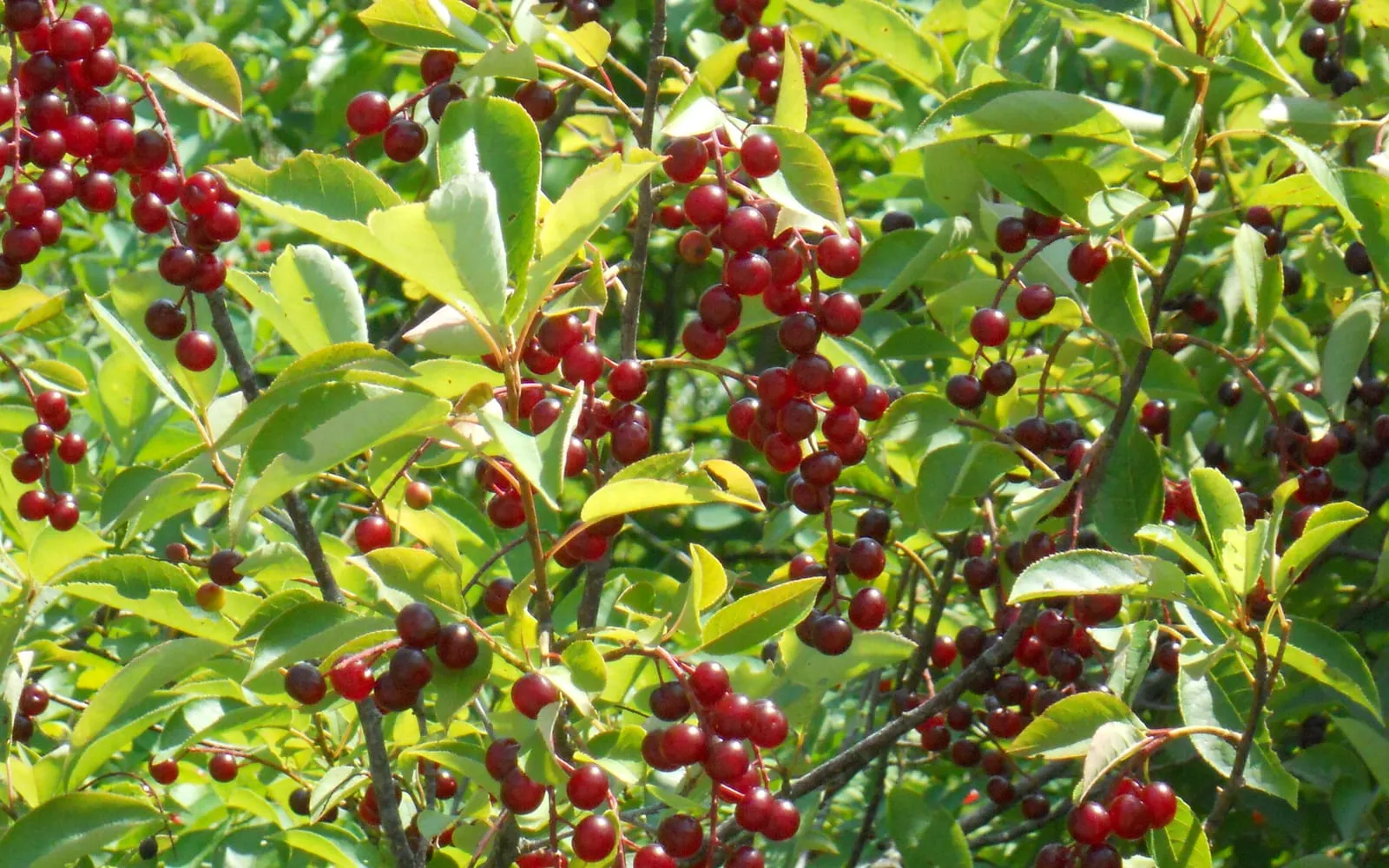
Fruit ripens through summer in tight clusters, changing from bright red through deep red to a near-black purple at full ripeness. Even fully ripe, the flesh is markedly astringent eaten raw, puckering the mouth in a way that gives the plant its common name, though the same fruit cooked with sugar loses most of that harshness and makes excellent jelly and syrup.
Where it is from
Prunus virginiana has one of the broadest native ranges of any North American fruiting shrub, spanning from the boreal forest edge in Canada south through most of the United States and into parts of Mexico, growing in a wide range of habitats from dry prairie draws to streambanks and open woodland edges. That breadth of range is reflected in its remarkable cold tolerance, among the toughest of any commonly grown fruit plant.
Its fruit has a long history as a food and medicine plant among many Indigenous nations across that range, dried and pounded whole, pit and all, into pemmican alongside dried meat and fat, a preparation that made a concentrated, storable food central to survival through harsh winters.
How it grows
Plant in full sun to part shade in almost any soil that is not permanently waterlogged; chokecherry tolerates dry, poor upland ground about as well as it tolerates damper streamside soil, and is not demanding about fertility.
Expect it to sucker from the roots and spread outward over time unless that growth is actively managed. Where a single-stemmed specimen is wanted, remove suckers regularly at ground level as they appear; where a naturalistic thicket suits the space, leave it to develop on its own, which is closer to how it grows in the wild.
Keep grazing animals away from any pruned or storm-damaged branches left lying nearby, since wilting foliage on cut or broken wood carries considerably more cyanide risk than the same leaves while still green and turgid on the plant.
Prune in summer rather than during dormancy where silver leaf disease is a known local problem, since pruning wounds are most vulnerable to infection in cool, damp conditions.
Through the seasons
Spring brings leaf growth and, by late spring, the upright spikes of white flowers that cover the shrub for a couple of weeks.
Summer carries fruit development, from green through red to the final near-black colour at full ripeness by late summer.
Autumn brings yellow to orange leaf colour and is a workable time to plant a new shrub where winters are not too severe.
Winter is complete dormancy, and this is the season chokecherry handles better than almost any other fruiting plant, tolerating extreme cold without protection.
Care difficulty
Easy, in the sense that it grows readily in poor soil and tolerates cold that would damage most other fruiting shrubs. The genuine work is managing its suckering habit, since a chokecherry left entirely to its own devices spreads well beyond its original planting spot within a few years. A gardener who wants a single tidy shrub needs to remove suckers regularly; one happy with a thicket can leave it alone entirely.
Watering
Water a young plant through its first one to two growing seasons while roots establish, particularly during dry weather.
Once established, it tolerates normal seasonal dry spells well across most of its range and rarely needs supplemental watering except in an unusually severe or prolonged drought.
Warning signs, diseases and pests
Tent caterpillars can defoliate significant portions of a shrub in spring, feeding in groups from silk tents built in branch forks. Removing tents while small limits the damage on a manageable-sized plant.
Aphids cluster on soft new growth, curling and distorting young leaves. Populations are usually kept in check by natural predators without needing treatment.
Powdery mildew coats leaves with a pale, dusty film in humid, still conditions, particularly where air movement is poor. Thinning crowded stems to improve airflow reduces the problem more reliably than any treatment applied afterwards.
Silver leaf disease enters through pruning wounds made in cool, damp weather, dulling affected foliage to a silvery sheen and causing dieback. There is no cure for an infected branch beyond removing it, and pruning only in summer reduces the risk of infection taking hold.
Growing environment
Full sun produces the heaviest flowering and fruiting, though it tolerates part shade reasonably well, particularly at the woodland edges where it often grows naturally.
Soil tolerance is broad, from dry, poor upland ground to damp streamside soil, and this adaptability is a large part of why it grows across such an enormous native range. What it does not tolerate well is permanently waterlogged ground.
Give it room to sucker outward if a thicket is the intended look, or plan for regular sucker removal from the start if a single clean stem is preferred, since retrofitting that decision on an established plant is far harder than starting with it in mind.
Feeding
Feeding is rarely necessary. Chokecherry grows well in soils too poor for many other fruiting shrubs and generally needs no supplemental fertiliser once established.
On very infertile ground, a light application of a balanced fertiliser in spring during the plant’s first couple of years can help it establish faster, though this is a minor refinement rather than a requirement.
Troubleshooting
Livestock have access to a hedge where I have chokecherry growing. Check the hedge regularly for storm-broken or freshly pruned branches and remove them promptly, since wilting leaves on damaged wood are the main source of the poisoning risk this species carries for grazing animals. Fencing animals away from any recent pruning debris until it is cleared is the safer approach.
The fruit is far too sour and astringent to eat. This is normal for raw chokecherry, even at full ripeness, and it is a plant made for cooking rather than eating out of hand. Simmered with sugar and strained to remove the pits, the same fruit makes good jelly and syrup.
New shoots keep appearing well away from the original plant. Root suckering is entirely normal for this species and is how it forms thickets in the wild. Regular removal at ground level keeps a single specimen contained; leaving suckers alone lets it develop into a wider, more naturalistic planting.
Leaves have developed a pale, dusty coating in late summer. This is powdery mildew, common in humid weather and crowded growth. Improving air circulation by thinning stems reduces future outbreaks more effectively than treating an established infection.
Can children eat chokecherries straight from the shrub? The astringency alone usually discourages more than a taste, but any raw seeds should not be chewed or swallowed in quantity, since the pits carry the same cyanide-releasing compounds as the leaves and bark. Cooked, strained fruit with the pits removed is the safer and far more palatable way to eat it.