
Edible
Rukam
Flacourtia rukam
Also known as Indian prune, Rukem, Governor's plum
How to grow rukam, Flacourtia rukam. The Indian prune with a fiercely spined trunk, and the trick of rolling the fruit between your palms before you eat it.
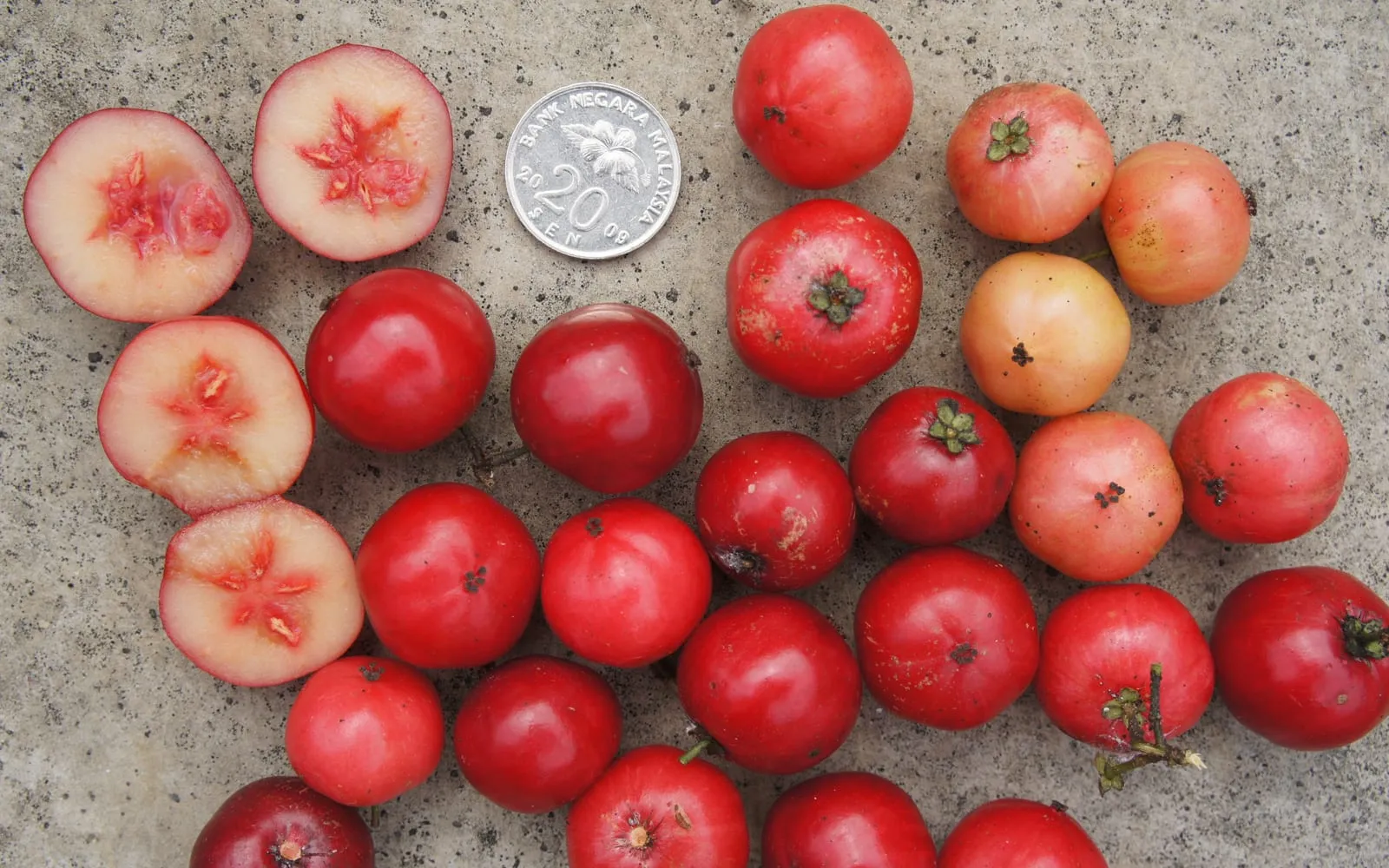
At a glance
- Difficulty
- Moderate
- Water
- Weekly in growth, sparingly in winter
- Light
- Full sun to light shade
- Temperature
- Minimum 10 deg C. Less hardy than governor's plum
- Humidity
- Moderate to high
- Hardiness
- USDA 10-12, RHS H1b, hardy to 12 C
- Type
- Tender evergreen shrub or small tree
- Height
- 5-15 m in the open, 1.5 m in a pot
- Native to
- the Philippines, Malesia
- Best month
- June, July and August in the Northern Hemisphere, December, January and February in the Southern Hemisphere
Wet lowland south-east Asia. It takes humidity and heat and has no frost tolerance.
Hardiness zones describe winter cold alone. Summer heat, humidity, rainfall and the length of the growing season decide as much, so treat the range as the outer limit rather than as a recommendation.
Every month named in this guide is for the temperate Northern Hemisphere. If you garden in the Southern Hemisphere, shift each one by six months, so June becomes December. Closer to the equator the wet and dry seasons matter more than the calendar, and the shift stops being a useful guide.
Skin irritant
- Safe to eat
- The ripe fruit, rolled between the palms first
- Do not eat
- Unripe fruit, which is strongly astringent
- Harm from
- Eating it and handling it
- Affects
- People
Rukam is not toxic and nothing in it is listed as harmful to people or to cats and dogs. The fruit is astringent even when ripe, and the standard practice across South East Asia is to roll it firmly between the palms before eating, which bruises the flesh and takes the pucker out of it. Unripe fruit is astringent enough to be unpleasant and is constipating in quantity. The trunk carries long stiff spines, longer and more numerous than those of the governor's plum, and puncture wounds from them are painful and slow to heal. The small hard seeds are swallowed with the fruit without harm.
Sources: ASPCA toxic and non-toxic plants, RHS potentially harmful garden plants
About
Rukam comes with an instruction. The ripe fruit is astringent enough to dry the mouth, and the fix across South East Asia is to roll each one firmly between the palms before eating, which bruises the flesh, breaks down the tannins and turns a puckering fruit into a pleasant one.
The fruit itself is small, round and dark red to purple, sweet and acid, and it is eaten fresh, stewed or pickled.
The trunk is the other thing to know about. Long stiff spines cover it, more numerous and more forbidding than those of its relative the governor’s plum, and they make the plant awkward to work around.
Appearance and character
A dense spreading evergreen shrub or small tree, 5 to 15 m in the open and easily kept to a metre and a half in a pot.
The trunk carries long stiff simple or branched spines, often crowded near the base, and they are the identifying feature.
Bark is grey-brown and rough.
Leaves are alternate, oval to elliptic, 5 to 18 cm, with a toothed margin, leathery, glossy dark green, and flushed pink or bronze when young.
Flowers have no petals at all. Each is a tuft of greenish white stamens or a small green ovary, gathered a few at a time where a leaf meets the stem, and the sexes are usually on separate plants. Petal-less flowers in short axillary tufts are what put this genus in the Salicaceae, alongside the willows and poplars, once the old family Flacourtiaceae was broken up.
Fruit is round, 2 to 2.5 cm, ripening from green through red to a deep purple-red, with a thin glossy skin and a slightly flattened top.
Flesh is white to pink, juicy, sweet and acid, and astringent until rolled.
Four to seven small flat hard seeds sit at the centre.
Where it is from
Rukam is native to the Philippines and the Malesian region, across Malaysia, Indonesia and New Guinea, where it grows in lowland forest.
It has been cultivated across South East Asia for centuries as a village fruit tree and remains one.
The Philippines, Indonesia and Malaysia grow it in gardens and small orchards, and it is sold in local markets rather than exported.
India and Sri Lanka have it as an introduction, which is where the name Indian prune comes from, and the same name is used for its African relative.
Colonial botanic gardens carried it to the Caribbean and tropical America, where a few trees still stand in collections without having become a crop anywhere.
No fruit reaches a temperate market, and a plant is hard to come by even from specialists.
How it grows
Clean the seeds out of a ripe fruit and sow them fresh. Four to seven come out of each, they are flat and hard, and they come up over three to six weeks at 22 to 28 deg C.
Root a cutting or air-layer a branch from a tree known to fruit, if you can find one. Seedlings are the long way round, since roughly half will turn out male and none of them declares itself for years.
Any free-draining compost of moderate fertility will do. Rukam is not fussy about soil.
Full sun or light shade, and a floor of 10 deg C. That is twice what governor’s plum asks for, and it is the practical difference between the two species.
Moderate to high humidity, and no cold draughts.
A weekly soak through the growing months, and very little over winter.
Feed monthly from April to September.
Prune with the spines in mind. Take out anything growing towards a path while it is thin enough to cut easily, because a mature trunk is armoured with stiff branched spines crowded near the base and every later job becomes slow and bloody.
Gloves to the elbow, and long sleeves.
Fruit follows three to five years after a cutting has rooted.
Through the seasons
Winter is a warm rest with the leaves still on. Hold above 10 deg C, water just enough to keep the compost from drying, and feed nothing.
Late winter is when to prune, while the plant is quiet and you can see the framework.
Spring pushes bronze new leaves and the small petal-less flower tufts together.
Early summer sets fruit along the previous year’s wood.
Midsummer to late summer ripens it, green to red to a deep purple-red, over several weeks rather than all at once.
Autumn ends the feeding and the watering eases back with the light.
Care difficulty
Moderate, with one demand and one nuisance.
The demand is warmth. Rukam stays in leaf all year and wants 10 deg C under it, where its African cousin the governor’s plum drops its leaves and sits out a winter at 5 deg C. A conservatory that suits one will not suit the other.
The nuisance is the armament. Stiff spines up to several centimetres long, some of them branched, crowd the lower trunk and make repotting, pruning and picking into jobs that need gloves and forethought.
Soil is undemanding and a pot suits the plant, which takes cutting back readily and can be held at a metre and a half indefinitely.
Sex is the third consideration. A cutting from a fruiting tree removes the question, and a batch of seedlings leaves you waiting years to find out.
Sourcing the plant remains the obstacle that stops most people.
Watering
A thorough weekly soak through the growing months, letting the surface dry before the next one.
Barely damp through the winter, which the evergreen leaves will tolerate provided the plant is warm.
Free drainage always, since root rot in cold wet compost is what kills these under glass.
A steady supply while the fruit is swelling, because a check at that point leaves you with small hard fruit that no amount of rolling will improve.
Tap water is fine, hard or soft. This is not a species that frets about lime.
Moderate to high humidity, which the plant appreciates without demanding.
A mulch on the pot surface over summer, which saves a good deal of watering and keeps the roots cool.
Warning signs, diseases and pests
A mouth-drying fruit that is fully coloured has not been rolled. Roll each fruit between the palms before eating.
Astringency in a fruit that is still red rather than purple-red means it was picked early.
Wilting in damp compost is root rot.
Brown limpets on the stems are scale.
White fluff in the leaf axils is mealybug.
Leaf drop after a cold night is chill damage below 10 deg C.
A plant that flowers and never fruits is male.
Fruit with holes and brown patches is fruit fly, a tropical field problem.
Growing environment
A frost-free greenhouse or conservatory, with the pot stood outdoors through a warm summer.
A floor of 10 deg C, and 22 to 30 deg C for growth and fruit.
Full sun to light shade, both of which it takes.
Moderate to high humidity.
Free-draining compost of moderate fertility, anywhere from pH 5.5 to 7.0.
A pot of 30 to 40 cm, which is enough for a fruiting plant held at a metre and a half.
Elbow room. Site it where nobody brushes past the trunk, and keep a pair of thick gloves with the plant rather than in the shed.
Feeding
A balanced liquid feed monthly from April to September.
High potash from fruit set, which improves the sweetness under the astringency.
Nothing from the end of September, and nothing through the winter.
A top-dressing or a repot each spring, done in gloves and before the new growth softens.
Magnesium where the older leaves yellow between the veins, which is the usual shortage on a plant that has been in the same compost for a few years.
A moderate hand overall. Rukam fruits better on a lean regime than a generous one.
Troubleshooting
Why do I have to roll the fruit? Ripe rukam is still astringent. Rolling each fruit firmly between the palms bruises the flesh, breaks down the tannins and takes the pucker out. It is standard practice across South East Asia.
How is it different from governor’s plum? Rukam is evergreen, needs 10 deg C rather than 5, has larger leaves and longer spines, and its fruit needs rolling where governor’s plum’s does not.
It flowers and never fruits. It is probably male. The species is usually dioecious, so take a cutting from a known female.
How bad are the spines? Long, stiff and crowded on the trunk, and worse than governor’s plum’s. Wear thick gloves and site the plant away from where people pass.
How soon will it fruit? Three to five years from a cutting.
Where do I get one? With difficulty. There is no European trade in the plant or the fruit, and a specialist tropical nursery is the only route.
What does it taste like? Sweet and acid, similar to a small plum, once the astringency has been rolled out of it.
Is Indian prune the same thing? The name is used for both this and the African governor’s plum, which is why the Latin matters.
Rukam problem guides
Not sure what is wrong? See the common vegetable pests guide.