
Edible
Governor's Plum
Flacourtia indica
Also known as Madagascar plum, Ramontchi, Batoko plum, Indian plum
How to grow governor's plum, Flacourtia indica. The spiny African shrub with small dark fruit, the thorns on its trunk, and why it is planted as a hedge across two continents.
At a glance
- Difficulty
- Easy
- Water
- Weekly in growth, sparingly in winter
- Light
- Full sun
- Temperature
- Minimum 5 deg C. Takes a light frost when established
- Humidity
- Low to moderate
- Hardiness
- USDA 10-11, RHS H1b, hardy to 5 C
- Type
- Tender to half-hardy deciduous or semi-evergreen shrub or small tree
- Height
- 2-10 m in the open, 1-1.5 m in a pot
- Native to
- tropical Africa, Madagascar
- Best month
- June, July and August in the Northern Hemisphere, December, January and February in the Southern Hemisphere
Dry tropical Africa and Asia, and tough with it, taking drought, poor soil and heat. That toughness has made it a naturalised weed on several Pacific and Indian Ocean islands, so check local advice before planting one out.
Hardiness zones describe winter cold alone. Summer heat, humidity, rainfall and the length of the growing season decide as much, so treat the range as the outer limit rather than as a recommendation.
Every month named in this guide is for the temperate Northern Hemisphere. If you garden in the Southern Hemisphere, shift each one by six months, so June becomes December. Closer to the equator the wet and dry seasons matter more than the calendar, and the shift stops being a useful guide.
Skin irritant
- Safe to eat
- The ripe fruit
- Do not eat
- Unripe fruit, which is strongly astringent
- Harm from
- Eating it and handling it
- Affects
- People
Governor's plum is not toxic and nothing in it is listed as harmful to people or to cats and dogs. Unripe fruit is heavily astringent and puckers the mouth, which is unpleasant rather than dangerous, and a quantity of it is constipating. The hazard in practice is mechanical. The trunk and older branches carry stout branched thorns several centimetres long, which is precisely why the shrub is planted as a stock-proof hedge, and puncture wounds from them are painful. The seeds are small, hard and swallowed with the fruit without harm.
Sources: ASPCA toxic and non-toxic plants, RHS potentially harmful garden plants
About
Governor’s plum is a hedge that happens to fruit. The shrub is dense, twiggy and armed with branched thorns on the trunk and older wood, and it is planted as a stock-proof boundary across Africa and South Asia.
The fruit is small, round and dark red to purple-black, sweet and acid at once with a marked astringency until it is fully ripe, and it is eaten fresh, stewed or made into jelly.
Of everything in this collection it is among the easiest for a temperate grower. It takes a light frost, tolerates poor soil, stays small in a pot, and fruits within three or four years.
Appearance and character
A dense twiggy deciduous or semi-evergreen shrub or small tree, 2 to 10 m in the open and easily held to a metre in a pot.
The trunk and older branches carry stout branched thorns 2 to 8 cm long, which is the identifying feature and the reason for the hedging use. Young growth is often thornless.
Bark is grey-brown and rather rough.
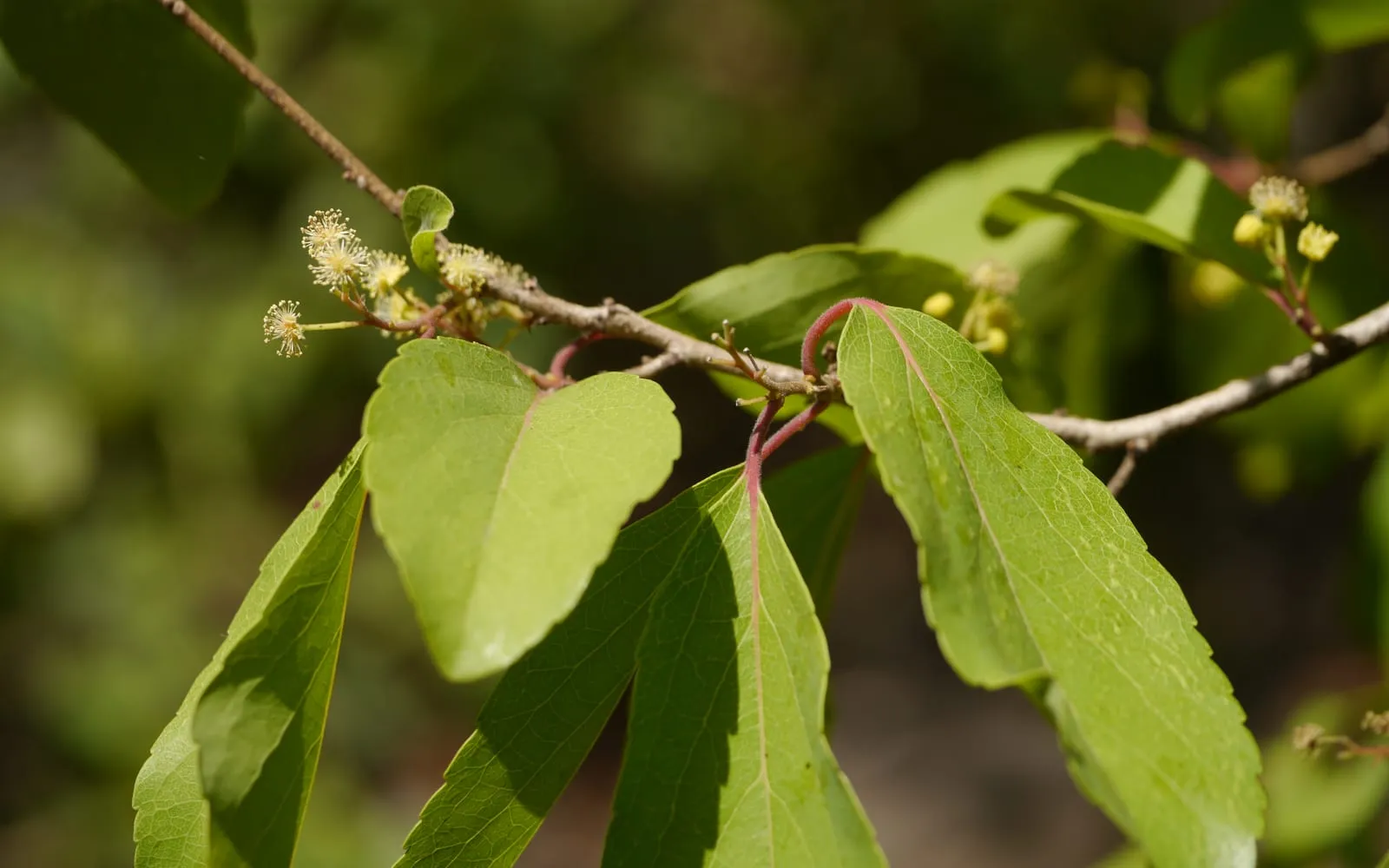
Leaves are alternate, oval to obovate, 2 to 10 cm, with a toothed margin, glossy mid-green, and often flushed red when young.
Flowers are small, greenish yellow and without petals, in short clusters in the leaf axils. The species is usually dioecious.
Fruit is round, 1 to 2.5 cm, ripening from green through red to a deep purple- black, with a thin glossy skin.
Flesh is yellow to white, juicy, sweet and acid, and astringent until fully ripe.
Five to ten small hard seeds sit at the centre and are swallowed with the fruit.
Where it is from
Governor’s plum is native to tropical and southern Africa and to Madagascar, where it grows in dry woodland and bush.
It spread early to India, Sri Lanka and South East Asia, carried by traders, and the alternative names Indian plum and batoko plum come from those introductions.
Africa uses it as a hedge, a fruit and a medicinal plant, and it is a familiar bush across the savanna zone.
The Portuguese and later colonial botanic gardens moved it to the Caribbean, Central America and the Pacific.
It has become an invasive weed in some places, including parts of Florida, Hawaii and several Pacific islands, where birds spread the seed and thorny thickets form.
Temperate markets do not see the fruit, which is a market and garden crop rather than an export one.
How it grows
Sow seed from a ripe fruit. It germinates readily at 20 to 25 deg C in three to six weeks and keeps for some months.
Take cuttings or air-layer for a known female, since seedlings are half male and will not fruit.
Grow in free-draining compost. The species tolerates poor, sandy and stony ground.
Give full sun and a minimum of 5 deg C. An established plant takes a light frost.
Water weekly in growth and sparingly in winter.
Feed monthly from April to September at moderate strength.
Prune to shape. It takes hard cutting and thickens up, which is what makes it a hedge.
Wear thick gloves. The thorns on the trunk and older wood are stout and branched.
Expect fruit in three or four years, and grow more than one plant unless you have a known female.
Keep it in a pot rather than planting it out in any frost-free climate.
Through the seasons
Winter is a cool rest above 5 deg C, watered sparingly and unfed. The plant may drop some or all of its leaves.
Late winter is the pruning window.
Spring brings new leaves and flowering.
Early summer is fruit set.
Midsummer to late summer is harvest, and the fruit ripens over several weeks.
Autumn is when to stop feeding and reduce watering.
Care difficulty
Easy, and one of the two or three most achievable fruits in this collection.
Cold tolerance is good. A minimum of 5 deg C is ample and an established plant takes a light frost.
Soil is undemanding, including poor and stony ground.
Size suits a pot, since the shrub takes hard pruning and stays dense.
Fruit comes in three or four years.
Sex is the one real complication. The species is usually dioecious, so a seedling may never fruit, and a cutting from a known female solves it.
The thorns make every operation slower and need thick gloves.
Watering
Water weekly in growth, giving a thorough soak and letting the compost dry well down.
Reduce to occasional watering in winter.
Drain fully.
Water steadily during fruit swell.
Tap water is fine, including hard water.
Keep humidity low to moderate.
An established plant tolerates a dry spell well.
Warning signs, diseases and pests
Mouth-puckering fruit means it was picked before full colour. Wait for deep purple-black.
Leaf drop in a cool winter is normal for a semi-evergreen shrub.
Wilting in damp compost is root rot.
Brown limpets on the stems are scale.
White fluff in the leaf axils is mealybug.
Blackened tips after a hard frost are cold damage. Cut back to live wood in spring.
A plant that flowers and never fruits is male.
Seedlings appearing nearby means fruit fell and germinated. Remove them.
Growing environment
A cool greenhouse or conservatory, standing outdoors for the summer.
Minimum 5 deg C, with 20 to 30 deg C for growth and fruit.
Full sun.
Low to moderate humidity.
Free-draining compost of moderate fertility.
pH from 5.5 to 7.5.
A pot of 30 to 40 cm.
Space to work around the thorns, and thick gloves.
Feeding
Feed monthly from April to September with a balanced liquid feed at moderate strength.
Switch to high potash as fruit swells.
Stop feeding at the end of September.
Give nothing through winter.
Top-dress or repot each spring.
Keep feeding light, since this is a plant of poor ground.
Add magnesium if older leaves yellow between the veins.
Troubleshooting
Why is it so thorny? The trunk and older branches carry stout branched thorns, which is why it is planted as a stock-proof hedge across Africa and South Asia. Young growth is often thornless.
My fruit puckered my mouth. It was picked early. Governor’s plum is astringent until it turns fully deep purple-black.
It flowers and never fruits. It is probably male. The species is usually dioecious. Take a cutting from a known female or grow several seedlings.
How hardy is it? One of the hardiest in this collection. An established plant takes a light frost and a minimum of 5 deg C is enough.
How soon will it fruit? Three or four years.
Should I plant it out somewhere warm? No. It has become an invasive weed in parts of Florida, Hawaii and the Pacific, where birds spread the seed and thorny thickets form.
What is it called elsewhere? Ramontchi and Madagascar plum in Africa, batoko plum and Indian plum in Asia. All are Flacourtia indica.
Can I use it as a hedge here? Only under glass. It is not hardy enough for a temperate boundary.
Governor's Plum problem guides
Not sure what is wrong? See the common vegetable pests guide.