
Outdoor plant
Regal lily
Lilium regale
Also known as Royal lily, Christmas lily
How to grow Lilium regale. Planting deep for the stem roots, growing it on chalk, controlling lily beetle, and why every lily is lethal to cats.
At a glance
- Difficulty
- Easy
- Water
- Regularly through the growing season
- Light
- Full sun, with the base of the stem in shade
- Temperature
- Very hardy, to -20 deg C
- Hardiness
- USDA 3-8, RHS H6, hardy to -30 C
- Type
- Bulbous perennial, long-lived and increasing steadily
- Height
- 1.2-1.8 m
- Native to
- The Min river valley in Sichuan, western China
- Best month
- July in the Northern Hemisphere, January in the Southern Hemisphere
It takes alkaline soil, which almost no other lily will do, and it takes cold to -30 C. Drainage is the requirement, since the bulb has no tunic and rots in ground that stays wet. Scarlet lily beetle has spread from Europe across north-east North America since the 1990s and strips a plant in days, so hand-picking from the moment growth starts is the only reliable control in a garden.
Hardiness zones describe winter cold alone. Summer heat, humidity, rainfall and the length of the growing season decide as much, so treat the range as the outer limit rather than as a recommendation.
Every month named in this guide is for the temperate Northern Hemisphere. If you garden in the Southern Hemisphere, shift each one by six months, so July becomes January. Closer to the equator the wet and dry seasons matter more than the calendar, and the shift stops being a useful guide.
Poisonous if eaten
- Do not eat
- Every part, and to cats the pollen and vase water as well
- Harm from
- Eating it
- Affects
- People, cats and dogs
True lilies kill cats, and this is one of the most serious plant hazards in any garden. Every part of Lilium regale causes acute kidney failure in cats, and the dose required is tiny. A cat that eats two or three petals, chews a leaf, drinks water from a vase that has held lilies, or grooms pollen off its own fur can go into renal failure within one to three days. Vomiting and lethargy appear first, followed by a period of apparent recovery, then kidney failure. The ASPCA classes lilies as a top emergency for cats, and treatment must begin within six hours to be reliably effective, so any suspected exposure is an immediate veterinary emergency rather than something to watch. Do not keep lilies in a house with a cat, do not accept them in a bouquet, and think carefully before planting them in a garden where cats roam. Dogs are far less susceptible and get gastric upset rather than kidney damage, although the bulbs will make a dog quite unwell. In people the plant causes vomiting and diarrhoea if eaten and is not a serious poisoning risk, and the pollen stains clothing permanently, which is why florists remove the anthers. Note that daylilies, Hemerocallis, are equally lethal to cats despite not being true lilies, while peace lilies and arum lilies are a different and much less dangerous problem.
Sources: ASPCA (Lily), RHS potentially harmful garden plants
About
The regal lily is the easiest of the big trumpet lilies and the one to start with. It grows on chalk, which almost no other lily will do, it stands up to wind and rain, it increases steadily rather than fading away, and it comes true and quickly from seed.
Ernest Wilson found it in 1903 in a narrow valley of the Min river in western Sichuan, growing in the thousands on dry stony slopes. He returned in 1910 to collect bulbs in quantity and was caught in a landslide on the way out, breaking his leg so badly that it left him with a permanent limp he called his lily limp.
In July a group of them will scent a whole garden after dark, which is the point of the plant and the reason it is worth the space.
Appearance and character
A bulbous perennial with a single unbranched upright stem, 1.2 to 1.8 m tall, carrying its flowers in a head at the top.
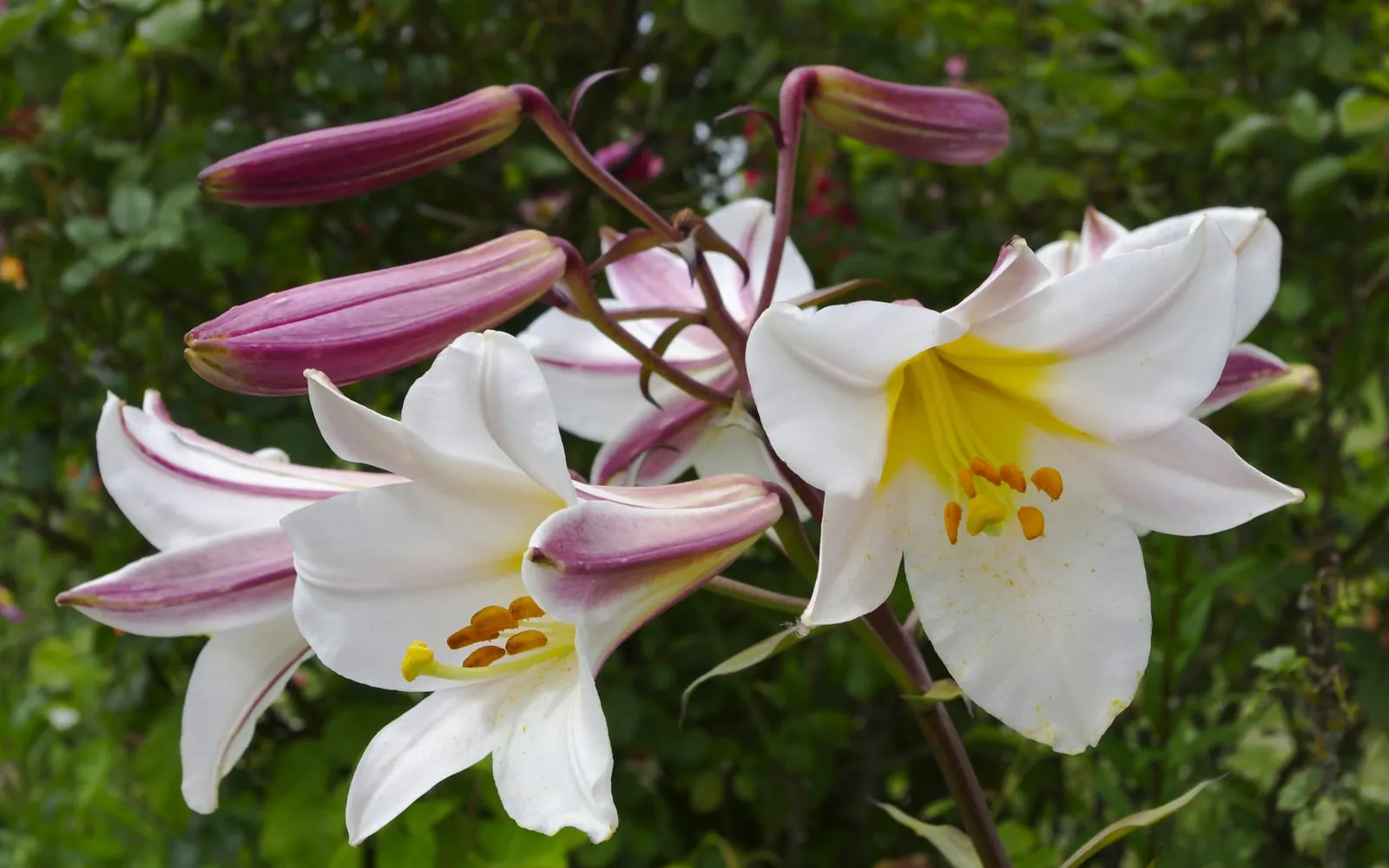
Flowers open in July, up to fifteen or twenty on an established stem, each a broad outward-facing trumpet 12 to 15 cm long.
The colouring is the plant’s signature. Petals are pure white inside with a sulphur-yellow throat, and the outside of each is heavily streaked and washed in wine purple, so the unopened buds look like a different plant from the open flowers.
Anthers are large and golden-orange, carried on long filaments, and they shed pollen that stains anything it touches.
Scent is powerful, sweet and carrying, and strongest in the evening.
Leaves are narrow, dark green, glossy and numerous, carried thickly all the way up the stem.
The bulb is made of loose overlapping scales with no protective tunic, and roots grow both from the base of the bulb and from the stem above it.
Where it is from
The valley of the Min river in Sichuan, western China, at 800 to 2,500 m, where it grows on dry, stony, sun-baked slopes and in rock crevices among scrub.
Its range in the wild is remarkably small, essentially one river system, and the whole of the vast garden population descends from Wilson’s collections.
The habitat explains the requirements. Stony free-draining ground gives the need for drainage, alkaline rock gives the tolerance of lime that sets this species apart, and full exposure gives the demand for sun.
Stem rooting is the other thing the habitat produced. Roots emerge from the stem above the bulb as well as from beneath it, which is why the bulb must be planted deep enough to leave room for them.
Wilson thought it the finest plant he ever introduced, and it reached British gardens within a few years of his 1910 collection.
How it grows
Plant bulbs in autumn or early spring, 20 to 25 cm deep, which is roughly three times the height of the bulb. Depth matters because the plant makes stem roots above the bulb.
Add grit to the planting hole on any soil that holds water. Lilies rot in wet ground and the bulbs have no tunic to protect them.
Choose full sun for the flowers, with the base of the stem shaded by other planting. Lilies like their heads in the sun and their feet in the shade.
Space bulbs 25 to 30 cm apart, and plant in threes or fives rather than singly.
Stake tall stems in an exposed position, since a stem loaded with fifteen trumpets catches the wind badly.
Feed fortnightly with a high-potassium tomato feed from the time the shoots appear until flowering finishes.
Deadhead as the flowers fade, removing the developing seed pod but leaving as much stem and leaf as possible to feed the bulb.
Cut the stem down only when it has yellowed completely in autumn.
Grow from seed if you want quantity. Regal lily germinates readily, seedlings flower in two to three years, and a packet of seed produces more plants than a bag of bulbs for a fraction of the price.
Through the seasons
Winter is dormancy and planting. Bulbs go in from October, and container plantings need protection from sitting wet.
Spring brings the shoots through from March. Watch for late frost on early growth, and start feeding and lily beetle patrols as soon as the shoots show.
Summer is the display. Flowers open in July, and the scent peaks in the evening. Keep feeding, keep watering, and keep checking for beetle larvae.
Autumn is die-back and seed. Let the stems yellow before cutting them, collect seed if you want more plants, and mulch the ground.
Care difficulty
Easy for a lily, and the reputation lilies have for being difficult belongs mainly to other species.
Lily beetle is the only serious problem, and it is a matter of vigilance rather than skill.
Drainage is the requirement that kills bulbs when ignored. Heavy wet clay rots them within a season.
Lime tolerance removes the difficulty most lilies bring, since regal lily grows happily on chalk where the Oriental hybrids will not.
The plants are long-lived, increase steadily, and come from seed easily, which makes this a generous plant to grow.
Watering
Water regularly through the growing season, keeping the soil damp rather than wet.
Container plants need frequent watering in summer and must never sit in a saucer.
Reduce watering as the stems yellow in autumn, and keep the bulbs on the dry side through winter.
Avoid overhead watering in humid weather, which encourages botrytis on the leaves.
Mulch in spring to hold moisture and to keep the base of the stem cool and shaded.
Warning signs, diseases and pests
Lily beetle is the pest that decides whether you grow lilies successfully. Adults are 8 mm long and brilliant scarlet with black legs, easy to spot and impossible to mistake. They emerge from late March. The larvae do the real damage, orange grubs that coat themselves in their own wet black excrement and eat leaves, buds and flowers, capable of stripping a stem in under a week. Check every plant every few days from March to August. Pick off adults and larvae by hand, and hold a hand underneath first, since a disturbed adult drops and lands upside down where the black underside makes it almost invisible on soil.
Rotted bulbs follow heavy wet soil or planting too shallow in ground that puddles. Add grit and plant deep.
Botrytis produces brown spots on leaves that spread into blotches in a wet summer, working up the stem. Remove affected leaves and improve airflow.
Frost damage to early shoots blackens the tips in a late spring. The plant usually grows on, and fleece over the emerging shoots prevents it.
Stems toppling under the weight of flowers means they needed staking.
Yellowing lower leaves in midsummer often means the plant is hungry or the bulb is in ground that is too wet.
A stem that comes up blind, with no flower buds, usually means a bulb that is too small, too shallow, or was stripped by beetle the previous year.
Growing environment
Full sun for the flowers, with the base of the stem shaded by lower planting.
Free-draining, fertile soil. Add grit generously to clay, or grow in a raised bed.
Alkaline soil is acceptable, which is unusual among lilies and makes this the species for chalk gardens.
Shelter from strong wind, or stake the stems.
Containers suit it well. Use a deep pot of at least 30 cm, plant three bulbs deep in gritty compost, and stand the pot where the scent carries in the evening.
Plant it near a door, a seat or an open window. The evening scent is the reason to grow it and it should be somewhere people sit.
Think hard before planting lilies in a garden used by cats, and never bring them into a house where a cat lives.
Feeding
Feed fortnightly with a high-potassium tomato fertiliser from the emergence of the shoots until the flowers have finished.
Avoid high-nitrogen feeds, which produce soft growth that flops and rots.
Mulch with garden compost in spring, keeping it clear of the emerging shoots.
Container plants need feeding throughout the growing season and repotting into fresh gritty compost every second year.
Continue feeding for a few weeks after flowering, since the bulb is rebuilding for next year during that period.
Troubleshooting
Scarlet beetles and orange grubs covered in black slime. Lily beetle. Check every few days from late March, pick off adults and larvae by hand, and catch the adults from beneath because they drop when disturbed.
How deep do I plant the bulbs? Twenty to twenty-five centimetres. The plant makes roots from the stem above the bulb, so shallow planting weakens it.
The bulbs rotted. The soil is too wet or too heavy. Add plenty of grit, plant deep, or grow them in a pot of gritty compost.
Can I grow lilies on chalk? Regal lily, yes. It tolerates lime, which most lilies do not, and that is one of the main reasons to choose this species.
Are lilies dangerous to cats? Extremely. Every part, including pollen and vase water, causes acute kidney failure. Any exposure is a veterinary emergency and treatment needs to start within six hours.
The stem fell over. A head of fifteen trumpets catches the wind. Stake tall stems in an exposed position.
Can I grow it from seed? Yes, easily. Seed germinates well and seedlings flower in two to three years, which is the cheapest way to get a large group.
When do I cut the stems down? After they have yellowed completely in autumn. The leaves feed the bulb for next year.