
Outdoor plant
Easter Lily
Lilium longiflorum
Also known as Bermuda Lily, White Trumpet Lily
How to grow Easter lily, Lilium longiflorum. Why the forced pot plant sold every spring is a genuine garden lily that can be planted outside and will flower again, at its own pace, the following summer, and the fatal risk every part poses to a cat.
At a glance
- Difficulty
- Moderate
- Water
- Keep the compost or soil evenly moist through growth and flowering
- Light
- Full sun to light shade outdoors; bright, indirect light while forced indoors
- Temperature
- Tender in a cold winter without protection
- Hardiness
- USDA 7-10, RHS H3, hardy to -9 C
- Type
- Bulbous perennial, commonly forced for one indoor display and then planted outside
- Height
- 60-100 cm
- Native to
- Japan, Taiwan
It comes from subtropical coastal cliffs with mild winters, and that origin sets a lower cold ceiling than most garden lilies carry. A sharp frost on unprotected ground can kill the bulb outright rather than merely blackening the top growth, so gardeners outside its comfortable range grow it in a container that can be moved under cover, or plant it deep with a heavy autumn mulch and accept some winter losses.
Hardiness zones describe winter cold alone. Summer heat, humidity, rainfall and the length of the growing season decide as much, so treat the range as the outer limit rather than as a recommendation.
Poisonous to cats if eaten
- Do not eat
- Every part, including the pollen and the water a cut stem stood in
- Harm from
- Eating it
- Affects
- Cats
Every true lily is lethal to cats, and the Easter lily is the species most often responsible, because it arrives in houses as a cut flower or a forced pot plant at exactly the time of year cats are most likely to meet one indoors. A cat that eats a petal or two, chews a leaf, drinks from a vase that has held the stems, or grooms pollen off its own coat can develop acute kidney failure. Vomiting and lethargy appear within hours, followed by a period that can look like recovery before the kidneys fail over the next one to three days. There is no safe amount and no home treatment. A cat with any suspected exposure needs a vet the same day, since starting fluids within the first few hours is what determines the outcome. Keep this plant, cut or potted, out of any house with a cat, and tell a florist to leave it out of a bouquet. Dogs get gastric upset rather than kidney damage. In people the pollen stains stubbornly and the bulb causes stomach upset if eaten in quantity, and neither is dangerous the way the cat poisoning is.
Sources: ASPCA (Lily), RHS potentially harmful garden plants
About
The Easter lily is the pot plant sold by the million every spring, a stem of large white trumpets forced to open around a date that moves by a month from one year to the next. Commercial growers manipulate light and temperature through the previous summer and autumn to hit that window, which is a harder trick than it looks given that Easter itself has no fixed relationship to the calendar.
Most of the plants sold this way spend one season as a houseplant and then get thrown out once the flowers fade. That is a waste of a perfectly hardy garden lily in a mild climate. Planted outside after flowering, the same bulb settles in and flowers again the following summer, at its natural time rather than a forced one, and keeps doing so for years.
Appearance and character
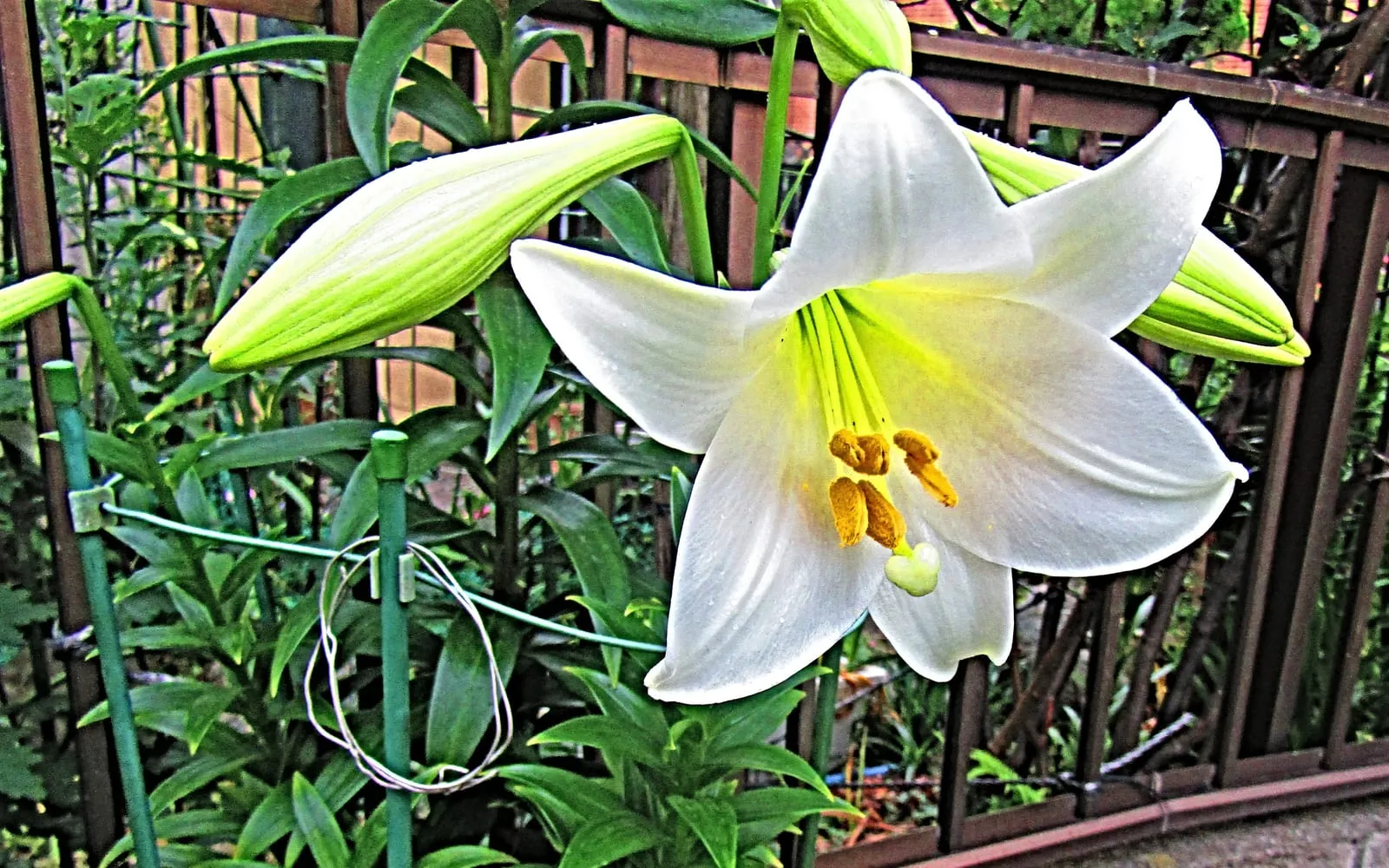
Flowers are large white trumpets, 15 to 18 cm long, flaring wide at the mouth and carried in small clusters of three to six at the top of the stem. Each is strongly and sweetly scented, heavier in the evening, with golden anthers that shed a rust-coloured pollen able to stain skin, clothing and petals alike.
Leaves are narrow, glossy and dark green, set closely up the whole length of the stem rather than clustered near the top. A forced pot plant is usually kept short and stocky by the grower; a bulb planted in open ground and left to its own habit grows taller and somewhat looser.
The bulb itself is a loose stack of white scales with no protective skin, the same soft-tissued structure every true lily bulb has, which is why it dries out fast out of the ground and rots fast in the wrong one.
Where it is from
Lilium longiflorum is native to the Ryukyu Islands of southern Japan and to Taiwan, growing on coastal cliffs and rocky, sun-exposed slopes in a subtropical maritime climate with short, mild winters.
Commercial production shifted to Bermuda in the nineteenth century, which gave the plant its other common name, and later moved again to the Pacific coast of the United States, where most of the pot plants sold worldwide are still grown from bulbs raised in a narrow strip of California and Oregon. Growers there chill the bulbs and control day length precisely enough to bring a crop into flower for a date that shifts year to year, a piece of horticultural engineering built entirely around one religious festival.
The maritime, frost-light origin explains why this lily takes a harder winter worse than the mountain and steppe species that make up most of the genus, and why forcing it indoors, rather than expecting it to flower outdoors on schedule, became the standard way to grow it at all.
How it grows
Plant a bulb, whether newly bought or moved outdoors after forcing, 15 to 20 cm deep in free-draining, humus-rich soil. Depth matters because, like other lilies, it roots from the stem above the bulb as well as from the base, and shallow planting starves that upper root system of anchorage.
Choose full sun or light shade, with the base of the stem shaded by underplanting to keep the roots cool while the flowers get the light.
A forced pot plant coming from a florist or garden centre can go straight into the ground once flowering finishes and the weather has warmed, though it will not repeat the same early display until it has re-established on its own natural cycle, usually flowering in midsummer from then on.
Feed fortnightly with a high-potash liquid feed from the moment new shoots appear until flowering ends, and deadhead spent flowers while leaving the stem and leaves standing to build next year’s bulb.
Through the seasons
Winter is dormancy for an outdoor bulb, and the season a hard frost does the most damage. Mulch heavily where winters are cold.
Spring brings new shoots and, for forced plants, the timed display itself. Watch for lily beetle from the moment growth shows.
Summer is the natural flowering season for an established garden plant, usually a good two months later than a forced Easter display.
Autumn is for planting new bulbs and cutting down stems once they have yellowed completely.
Care difficulty
Moderate. Forcing a bulb to flower on a fixed date is a grower’s job, done before you ever see the plant, and none of that difficulty falls on you. What is left is ordinary lily care. Give it free drainage to stop the bulb rotting, a sheltered site or a mulch where winters bite, and a lily beetle watch through the growing season. Treated as a permanent garden plant rather than a one-season pot display, it is no harder than most other lilies and considerably showier for the effort.
Watering
Keep a forced pot plant evenly moist while it is in flower, never letting it dry out completely or sit with wet feet in a saucer, both of which shorten the display.
Once the flowers fade and the leaves begin to yellow, cut back sharply on water and let the compost dry between waterings as the bulb moves towards dormancy.
Planted outdoors, water during dry spells through the growing season and rely on rainfall the rest of the year, since free-draining soil that holds too little water is a smaller risk to this lily than heavy ground that holds too much.
Warning signs, diseases and pests
Fusarium wilt causes a soft brown rot at the base of the bulb that works upward, yellowing and collapsing the stem from the bottom before the plant has finished flowering. There is no cure once it takes hold. Buy firm, disease-free bulbs, plant in soil that has not grown lilies recently, and destroy an affected plant rather than composting it.
Scarlet lily beetle strips leaves, buds and flowers within days if left unchecked. Check plants from spring onwards, and pick off both the bright red adults and the excrement-covered larvae by hand.
Grey mould shows as fuzzy grey growth on flowers and stems, worst in the humid air of a greenhouse or a crowded display of pot plants. Improve air movement and remove affected growth promptly.
Aphids cluster on buds and new shoots and spread mosaic virus as they feed, leaving mottled, distorted growth with no cure. Control the aphids early rather than waiting for virus symptoms to confirm the problem.
Root rot follows a pot that is never allowed to drain, turning roots soft and brown and the top growth limp despite damp compost. Repot into fresh, free-draining mix and water only once it has dried out again.
Growing environment
Full sun to light shade suits it outdoors, and bright, indirect light suits a forced plant indoors, since strong direct sun through glass can scorch flowers already stressed by the forcing process.
Free-draining, humus-rich soil, neutral to slightly acid, is what an outdoor planting needs most. Heavy, waterlogged ground is the single likeliest cause of a bulb failing to reappear.
Where winters fall much below about minus 9 degrees C, grow it in a large container that can be moved into a cold frame or unheated greenhouse for winter, rather than relying on outdoor planting alone.
Feeding
Feed a forced pot plant with a balanced liquid houseplant feed at half strength while it is actively growing and in flower, stopping once the foliage starts to yellow.
An outdoor planting needs a high-potash feed, the kind sold for tomatoes, applied fortnightly from shoot emergence until flowering ends, which builds the bulb for the following year’s display rather than just feeding the current one.
Troubleshooting
Can I plant my Easter lily outside after it finishes flowering? Yes, once the weather has warmed and the last frost has passed. It settles in as an ordinary garden lily and flowers again the following summer, at its natural time rather than the forced one.
Why did my potted lily open early or late for Easter? Commercial forcing schedules are tuned to average conditions, and a warmer or cooler spot at home shifts the timing either way. It is not a sign anything has gone wrong with the plant.
Is it really dangerous to cats? Extremely. Every part, including the pollen and any water the cut stems stood in, can cause fatal kidney failure. Keep it out of any home with a cat and treat suspected exposure as a same-day veterinary emergency.
The base of the bulb went soft and brown. Fusarium basal rot, most likely. There is no treatment once it has set in. Remove and discard the bulb and avoid replanting lilies in the same spot for a few years.
Will it survive outside over winter where I live? That depends on how cold your winters get. Below about minus 9 degrees C it needs a heavy mulch or, better, a container that can be moved somewhere sheltered until spring.