
Outdoor plant
Water Violet
Hottonia palustris
Also known as Featherfoil
How to grow water violet, Hottonia palustris, a lilac-flowered submerged aquatic that only thrives in clean, unpolluted water.
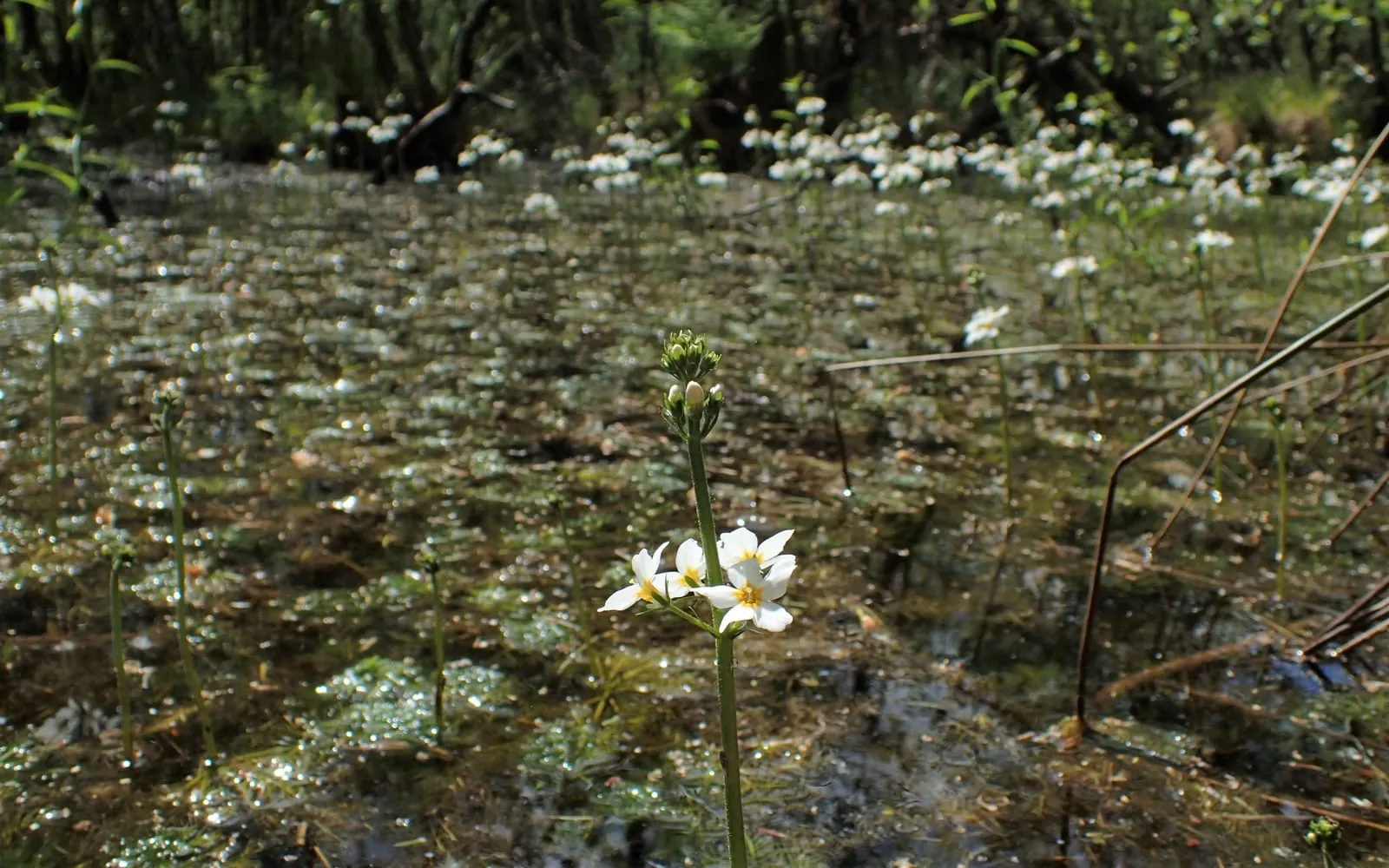
At a glance
- Difficulty
- Moderate
- Water
- Fully submerged in clean, still to gently moving water
- Light
- Full sun to light shade
- Hardiness
- USDA 5-9, RHS H5, hardy to -15 C
- Type
- Hardy submerged perennial
- Height
- Submerged foliage to 60 cm, flower spikes 15-40 cm above water
- Native to
- Europe, Western Asia
Hardy through a normal cold winter, surviving as a dormant, leafless shoot resting just below the surface or on the pond floor. Water quality decides whether it thrives far more than temperature does: a hard winter rarely troubles an established colony, while nutrient pollution and murky water can eliminate it within a season regardless of climate.
Hardiness zones describe winter cold alone. Summer heat, humidity, rainfall and the length of the growing season decide as much, so treat the range as the outer limit rather than as a recommendation.
Not known to be toxic
Water violet has no toxicity listing from the RHS and no record of causing harm to people, pets or fish. Despite the name, it is not related to true violets; it belongs to the primrose family, and nothing in its tissue needs guarding against at a pond visited by children or animals.
Source: RHS
About
Water violet is a submerged aquatic grown for two things that rarely come from the same plant: finely cut, almost fern-like foliage below the surface, and short spikes of pale lilac flowers that rise cleanly above the water in early summer. Few submerged oxygenators flower at all in any way a gardener would notice, which makes water violet unusual among the plants on this site as much for its above-water display as for what it does below.
It is also one of the more reliable living indicators of water quality available to a pond keeper. The species is markedly sensitive to pollution and nutrient overload, and a colony that once grew well but fades away without any obvious cause is often reporting a change in water quality before any other sign becomes visible.
Appearance and character
Underwater, the foliage is finely divided into narrow, feathery segments arranged in whorls along a slender stem, giving the whole plant a soft, almost mossy texture quite different from the strap-shaped or paddle-like leaves of most other submerged plants. In late spring the plant sends up leafless flowering stems that rise 15 to 40cm above the surface, each carrying several whorls of pale lilac, occasionally white, flowers with a yellow centre.
Despite its common name and superficial resemblance to a small flower spike, it belongs to the primrose family rather than to the violets, and the resemblance is closer to a miniature verbascum spike than to any true violet. Below the waterline, fine white roots anchor loosely into soft silt, though the plant can also drift for a time as a loose, rootless mass before settling again.
That family placement is itself worth remarking on, since the primrose family is overwhelmingly a family of dry-land plants. Cowslips, primroses, cyclamen and the garden polyanthus are all close relatives, and almost none of them will tolerate wet roots for long, let alone a life spent entirely underwater. Water violet and a small handful of related species are the family’s only real departure into aquatic habitats, which makes its finely cut, fern-like foliage an odd inheritance from a family better known for rounded leaves in a basal rosette on dry soil.
Where it is from
Water violet grows across still and slow-moving fresh water in Europe and western Asia, favouring shallow ponds, ditches and the calmer margins of lakes and canals. It is markedly intolerant of pollution, and its decline across much of its former range has closely tracked the nutrient enrichment of lowland waterways from agricultural run-off and other sources, to the point that its presence in the wild is now used by ecologists as a working indicator of relatively unspoilt water.
That sensitivity carries directly into the garden. A pond that supports a thriving colony is running clean, well-balanced water, and a colony that fails to establish or slowly dwindles often signals rising nutrient levels, well before algae or other more obvious symptoms appear.
How it grows
Stems branch and lengthen through the growing season, forming a loose underwater tangle of feathery foliage that can either root lightly into soft silt or drift as a free-floating mass, switching between the two without apparent difficulty. New shoots form readily from stem fragments, so a colony can be started, or restarted after a setback, from a handful of cuttings dropped into suitable water.
Flowering stems are produced once the plant is well established, usually from its second season onward, rising above the surface only for the few weeks needed to flower and set seed before dying back and leaving the submerged foliage to carry on growing for the rest of the year.
Through the seasons
Spring growth resumes from overwintered shoots, and flowering stems begin rising towards the surface as the water warms through April and May.
Summer is the main flowering period, with pale lilac spikes standing clear of the water through June, followed by continued vegetative growth of the submerged foliage.
Autumn growth slows and the plant begins shedding some of its finer summer foliage, consolidating into denser, more compact shoots as temperatures fall.
Winter the plant persists as a dormant shoot resting just below the surface or on the pond floor, protected from hard frost by the water above it, ready to resume growth the following spring.
Care difficulty
Moderate, and the challenge is entirely about water quality rather than about any complicated routine. In clean, unpolluted water it grows and flowers with very little input, but it declines quickly in a pond running high in nutrients from overfeeding, fish overstocking or leaf litter left to rot, conditions that barely trouble many of the tougher marginals grown alongside it.
Watering
Fully submerged, rooted loosely into soft silt or left to drift freely at a depth of roughly 15 to 45cm, in still or only gently moving water. Strong current or turbulent, splashing water tends to damage the delicate foliage and is best avoided; a calm corner of the pond suits it far better than a spot close to a fountain or waterfall.
Warning signs, diseases and pests
Snails graze the soft, finely divided foliage occasionally, though damage rarely threatens an established colony’s overall health. Waterlily aphid can settle on any part of the plant that reaches the surface, in the same way it colonises true water lilies nearby, and a firm jet of water usually clears light infestations without harming the delicate leaves.
The clearest warning sign with this species is a colony thinning out or disappearing without any pest or obvious physical cause, which points towards declining water quality rather than disease. Testing for excess nutrients, reducing fish stocking density or feeding, and removing accumulated organic debris from the pond floor are the usual fixes, rather than any treatment aimed at the plant itself.
Growing environment
Full sun to light shade both suit water violet, and it flowers reasonably well in either. Clean, unpolluted water matters more than any other single factor, and a pond that already supports other pollution-sensitive plants or a healthy population of freshwater invertebrates is a good sign that conditions will suit it.
Still or only gently moving water is best; avoid siting it directly in a strong filter outflow or close to a fountain, where turbulence disturbs the fine foliage more than it can comfortably tolerate.
Feeding
None needed, and feeding is actively counterproductive with this species. Added fertiliser raises the nutrient levels that water violet is specifically sensitive to, and a colony given rich feeding conditions tends to decline rather than thrive, often outcompeted by faster-growing plants and algae that respond more readily to the extra nutrients.
Troubleshooting
A previously healthy colony is thinning out for no obvious reason. Check water quality first. Rising nutrient levels, from overfeeding fish, overstocking, or accumulated organic debris, are the most likely cause and usually the fix as well.
Foliage looks damaged or shredded. Check for strong current or turbulence from a fountain or filter outflow. Move the planting to a calmer part of the pond if this is the cause.
Small green or black insects cover the emergent stems. Waterlily aphid, most likely. A firm jet of water from a hose usually clears light infestations.
No flowers appear even though the foliage looks healthy. Young colonies often need a full season to establish before flowering. Patience is usually the answer rather than any change of care.
Leaves have small ragged patches missing. Check for grazing snails, though damage is rarely severe enough to threaten an established colony.
Is it safe to introduce alongside a well-stocked fish pond. Only if the water stays clean. Heavy fish stocking tends to raise nutrient levels beyond what this species tolerates, so it suits a lightly stocked or wildlife-focused pond better than an intensively fed ornamental one.
A newly bought colony has arrived looking sparse and unimpressive. Normal for this species in transit and immediately after planting, since the fine foliage bruises and thins easily when handled. Growth usually picks up within a few weeks once the plant has settled into clean, still water.