
Outdoor plant
Queen Palm
Syagrus romanzoffiana
Also known as Cocos Palm
Practical guidance for growing queen palm, Syagrus romanzoffiana, including fast feather-palm growth, nutrient deficiency, fusarium decline, frost tenderness, and heavy fruit drop.
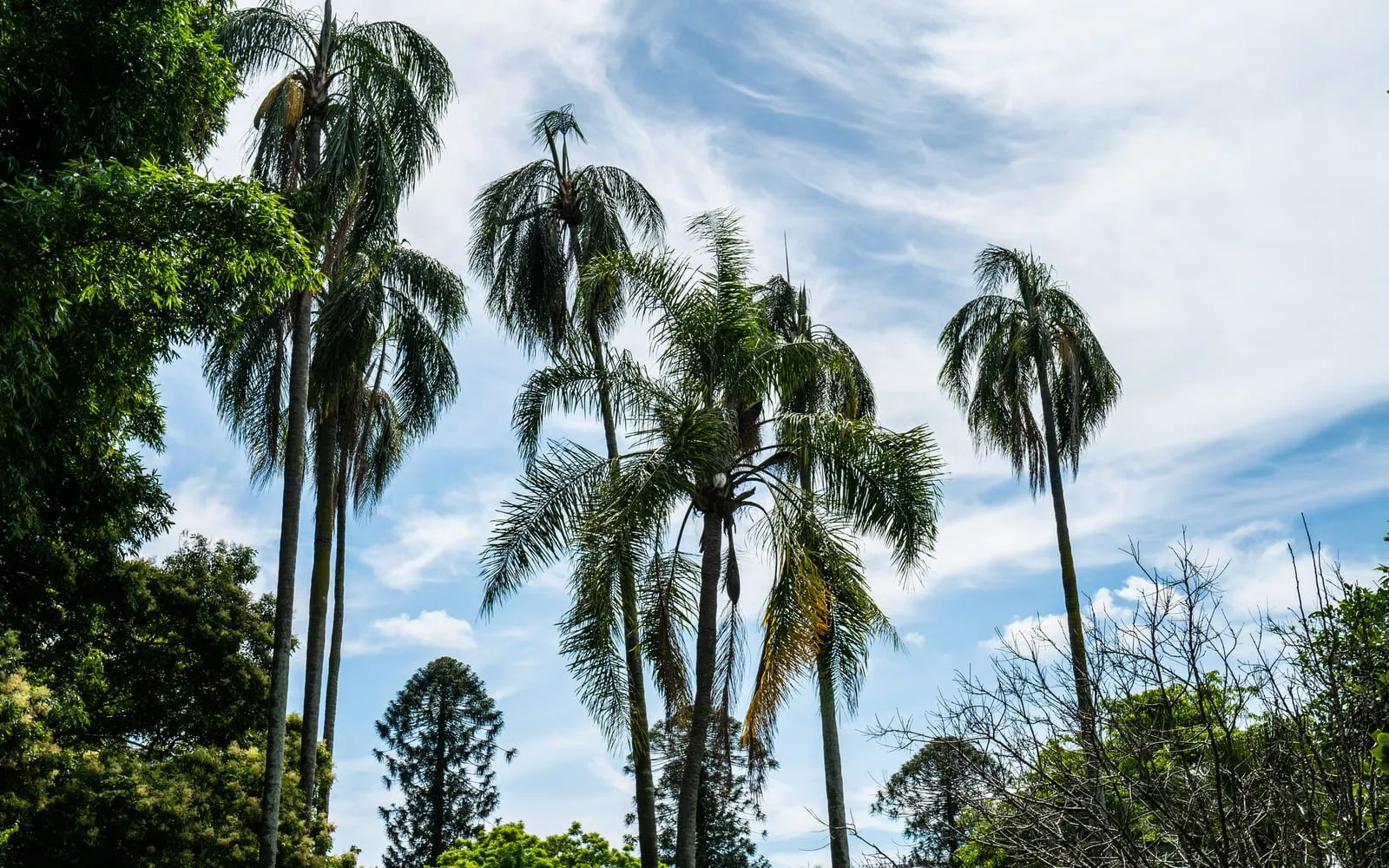
At a glance
- Difficulty
- Moderate
- Water
- Regularly through the growing season, less in a cool or wet winter
- Light
- Full sun
- Temperature
- Frost-tender; leaf damage begins around -4 C
- Hardiness
- USDA 9b-11, RHS H2-H3, hardy to -4 C
- Type
- Evergreen feather palm, fast-growing and comparatively short-lived
- Height
- 10-15 m, occasionally more
- Native to
- South America
A subtropical species with no real dry season in its native range, used to warm, humid summers and mild winters rather than a hard freeze. It survives a brief light frost with foliage damage, but a harder or more prolonged freeze kills the single growing point outright, and unlike a resprouting shrub, a queen palm with a destroyed crown does not recover.
Hardiness zones describe winter cold alone. Summer heat, humidity, rainfall and the length of the growing season decide as much, so treat the range as the outer limit rather than as a recommendation.
Not known to be toxic
The ASPCA lists queen palm by name as non-toxic to cats and dogs, and it does not appear on the RHS potentially harmful plants index either. The clusters of orange fruit that ripen through summer are not documented as harmful if eaten by a pet, though the woody seed inside each one is a choking and blockage risk for a dog that swallows it whole, which is a mechanical concern rather than a toxicity one. Heavy fruit drop under a mature tree is more often a nuisance for mess and slip hazard than for any poisoning risk.
Sources: ASPCA toxic and non-toxic plants, RHS potentially harmful garden plants
About
Queen palm is one of the fastest routes to a full-sized, classically tropical-looking palm in a warm garden, capable of reaching flowering size within a decade from seed. Its smooth grey trunk and dense, arching crown of feathery fronds have made it one of the most widely planted street and landscape palms in Florida, California and other warm regions well outside its native South America.
That speed comes at a cost. Queen palm is comparatively short-lived and weaker-wooded than a slower-growing palm, and it is prone to nutrient problems and a specific vascular disease that shorten its useful life in cultivation more often than age alone does.
Appearance and character
The trunk is smooth, pale grey and gently swollen towards the base, ringed with the scars of old leaf bases, and carries no fibrous covering the way many other palms do.
The fronds are pinnate, feather-shaped rather than fan-shaped, arching gracefully outward in a dense crown that can carry fifteen to twenty fronds at once on a healthy tree. Large branched flower clusters emerge from among the fronds and develop into heavy hanging bunches of small, round, orange fruit that ripen through summer and drop in quantity beneath the crown.
Where it is from
Syagrus romanzoffiana is native to subtropical South America, found wild across Brazil, Paraguay, Argentina and Uruguay, typically along riverbanks and in open woodland with warm, humid summers and no pronounced dry season.
That climate, warm and reliably moist through the growing season rather than seasonally dry, explains why the species grows so fast where it is planted with enough water and heat, and equally why it struggles in a climate with either a real winter freeze or a prolonged summer drought, neither of which it meets in its native range.
How it grows
Plant in full sun in fertile, well-drained soil, watering regularly through the establishment period and the growing season afterward. Poor or sandy soil that cannot supply potassium and magnesium in sufficient quantity is the most common cause of a queen palm that looks unwell despite otherwise good care.
Growth is fast for a palm, often half a metre or more of trunk height a year in good conditions, and that speed is part of why the species is so widely planted for quick landscape effect. It is single-trunked with one growing point, so any damage to the crown, whether from cold, disease or mechanical injury, cannot be resprouted from lower down the way a suckering palm can recover.
Clean pruning tools between trees, or between cuts on the same tree if a tool has touched infected tissue, since the fungus behind fusarium decline spreads readily on contaminated blades.
Through the seasons
Spring brings the start of the main growing season and, on a mature tree, new flower clusters among the crown.
Summer is peak growth and fruiting, with heavy clusters of orange fruit ripening and dropping beneath the tree.
Autumn slows growth gradually as temperatures and day length decrease.
Winter is the season of greatest risk in a marginal climate. Watch for frost forecasts and be ready to protect the crown, since a hard freeze there is the one kind of damage this palm cannot recover from.
Care difficulty
Moderate. Feeding and disease prevention matter more than daily care. In poor soil, a queen palm develops chronic nutrient deficiency that shows up as yellowing, banded or frizzled older fronds. A regular, correctly balanced feeding programme is necessary rather than optional in most soils.
Fusarium decline spreads on pruning tools between trees, and there is no cure once a tree is infected. Clean tools and careful pruning practice are cheap insurance against a disease with no treatment.
Watering
Water regularly through the growing season, particularly in a hot climate where the species is drawing heavily on soil moisture to support its fast growth.
Reduce watering in a cool or wet winter, when the plant is using far less, and avoid soil that stays waterlogged for any length of time, which stresses the roots and makes nutrient uptake problems worse.
Warning signs, diseases and pests
Nutrient deficiency is the single most common problem in cultivation, showing as yellow or orange banding on older fronds from a lack of potassium, or a stunted, frizzled new frond from a lack of manganese. Both respond to a proper palm fertiliser containing the deficient nutrient, applied consistently rather than as a one-off fix.
Fusarium wilt, called fusarium decline in this species, blocks the vascular tissue and causes fronds to die progressively from one side of the crown, often starting with a distinctive reddish-brown stripe along the frond stalk. There is no cure, and infected trees should be removed and pruning tools sterilised before use on any other palm.
Scale insects appear as small bumps on the fronds and trunk, sapping vigour over time. Horticultural oil during the growing season controls a light infestation.
Mealybug hides at the base of the fronds where they meet the trunk. Treat with horticultural soap, reaching into the leaf bases rather than just the visible foliage.
Growing environment
Full sun brings the fastest, densest growth this species is known for.
Fertile, well-drained soil matters more here than for most other palms, since queen palm is prone to nutrient deficiency in poor or sandy ground that other, slower species tolerate.
Shelter from the hardest frost is essential in a marginal climate, since the single growing point has no way to recover if it is destroyed by cold.
Feeding
Feed with a balanced palm fertiliser containing potassium and magnesium three to four times through the growing season. This species is demanding on nutrition compared with most other palms, and skipping regular feeding is the single most common cause of a poor, yellowing crown.
Look for a slow-release palm-specific product rather than a general garden fertiliser, since the ratio of nutrients matters more here than the total quantity applied.
Troubleshooting
Older fronds are yellow or orange with green tips. This is the classic pattern of potassium deficiency, common in poor or sandy soil. Switch to a balanced palm fertiliser containing potassium and continue feeding regularly, since the deficiency corrects gradually rather than overnight.
New fronds are stunted, weak and frizzled looking. This points to manganese deficiency, sometimes called frizzle top, often in soil with a high pH that locks the nutrient up. A palm fertiliser containing manganese, applied consistently, is the fix.
Fronds are dying one side of the crown at a time, with a reddish stripe on the stalk. This is the pattern of fusarium decline, for which there is no cure. Remove the tree and disinfect any tools that touched it before using them on another palm.
A hard frost damaged the crown badly. Wait before removing anything; some crowns recover if the central growing point survived. If the newest, innermost frond pulls away easily and smells rotten, the growing point has died and the palm will not recover.
The fruit drop under the tree is a constant mess. This is normal for a heavily fruiting mature tree in summer. Removing the flower clusters before they set fruit, where reachable, is the only way to reduce it significantly.