
Outdoor plant
Royal Palm
Roystonea regia
Also known as Cuban Royal Palm, Florida Royal Palm
How to grow royal palm, Roystonea regia. It shows nutrient deficiency in its fronds without a dedicated feeding programme, the landscape-scale space a mature specimen needs, and the slow early growth before the trunk shoots up.
At a glance
- Difficulty
- Moderate
- Water
- Regularly while young; deep, less frequent watering once established
- Light
- Full sun
- Temperature
- Needs a warm, humid, tropical or near-tropical climate
- Humidity
- High humidity strongly preferred
- Hardiness
- USDA 10-11, RHS H1c, hardy to -3 C
- Type
- Evergreen tropical palm
- Height
- 15-25 m, exceptionally to 30 m
- Native to
- the Caribbean
A true lowland tropical palm, native across Cuba and the wider Caribbean at low elevation where frost never occurs. A mature trunk can tolerate a very brief, light touch of cold that would kill a young plant outright, but neither age nor size buys real cold tolerance the way it does for some subtropical palms, and sustained cold weakens even an established specimen well before the thermometer reaches its stated minimum.
Hardiness zones describe winter cold alone. Summer heat, humidity, rainfall and the length of the growing season decide as much, so treat the range as the outer limit rather than as a recommendation.
Not known to be toxic
Roystonea regia is not documented as toxic to people, cats, dogs or horses, and does not appear on the RHS list of harmful garden plants. Its fruit, a small dark drupe, is eaten by wildlife and is not known to cause harm if a pet or child samples one, though the size and scale of a mature tree mean any real risk here is mechanical rather than chemical: falling fronds and fruit from a tall specimen are heavy enough to matter for where the tree is planted, whatever its toxicity.
Sources: RHS potentially harmful garden plants, ASPCA toxic and non-toxic plants
About
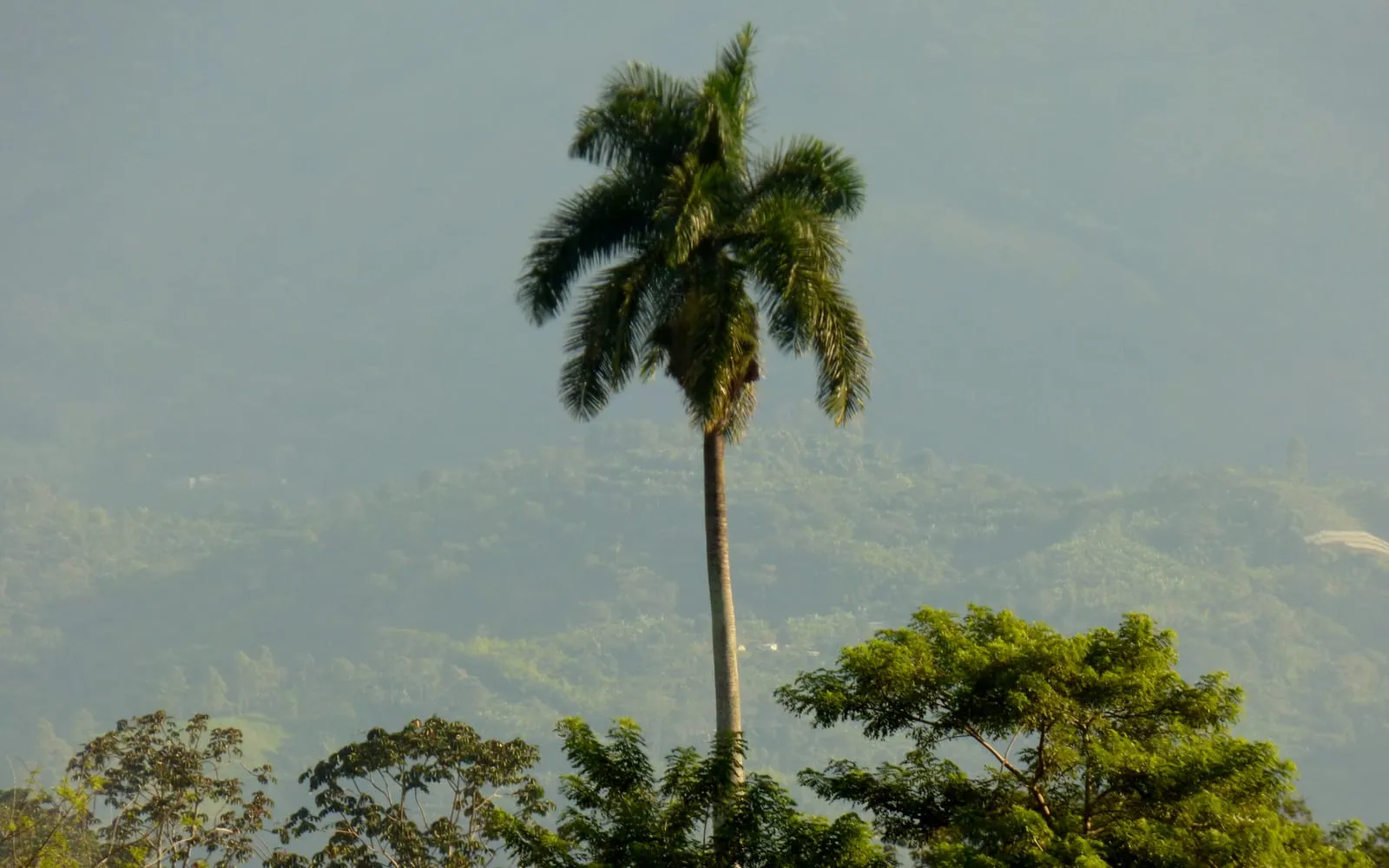
Royal palm is the palm most people picture when they imagine a grand tropical avenue: a perfectly smooth, pale grey trunk rising straight for metres before flaring gently and giving way to a glossy green crownshaft, topped by a full, symmetrical crown of arching fronds. It is planted in lines along streets and driveways across Cuba, Florida and much of the wider tropics for exactly that architectural effect.
This is a plant for a tropical or near-tropical climate and plenty of open ground, not a container or a marginal position. It grows fast for a palm once established, needs strong feeding to avoid nutrient deficiencies that show clearly in its foliage, and eventually reaches a height that puts it well beyond garden scale into landscape scale.
Appearance and character
The trunk is the plant’s signature feature: pale grey, ringed faintly with old leaf scars, perfectly smooth and, on many specimens, noticeably swollen partway up before narrowing again towards the crownshaft. It grows dead straight, without the visible lean or taper some other tall palms show, which is much of why it reads as so formal and architectural in a landscape setting.
Above the trunk, a smooth, bright green crownshaft, formed from the tightly wrapped bases of the newest fronds, gives way to a dense, rounded crown of long, arching, feather-shaped fronds, each one several metres long on a mature tree. Small cream flowers form in branched clusters below the crownshaft, followed by abundant small, dark purple to black fruit that birds and other wildlife feed on.
Growth is fast by palm standards once the trunk begins to form, and a well-sited royal palm can add well over a metre of trunk height in a single strong growing season.
Where it is from
Roystonea regia is native to Cuba and found more widely across the Caribbean and into southern Florida, growing on low-lying, fertile ground in a climate with no real winter to speak of, warm and humid throughout the year with rainfall concentrated into a wet season.
Cuba in particular treats it as a national symbol, and the long, straight avenues of royal palms found there and across much of the historic Caribbean plantation landscape reflect centuries of deliberate planting rather than a wild growth habit; left alone, it still grows as a solitary specimen rather than in the tightly spaced rows people associate it with.
How it grows
Plant it in deep, fertile, well-draining soil in full sun, with enough open space around it to accommodate both the eventual height of the trunk and the spread of a mature crown, which can reach several metres across. This is not a palm for a small garden or a spot near buildings and overhead wires.
Water regularly while the plant is young and its root system is developing, then move to deep, less frequent watering once established, matching the wet-and-dry rhythm of its native climate rather than keeping the soil constantly damp.
Feed through the growing season with a fertiliser formulated for palms, carrying extra manganese, potassium and boron. This species is particularly prone to visible nutrient deficiencies in cultivation, and consistent feeding from an early age does more to keep the crown looking full and healthy than almost any other single factor.
Growth from seed to a trunk of real height takes many years, so most landscape plantings use container-grown specimens with a metre or more of trunk already formed, moving them with a large root ball to minimise transplant stress.
Through the seasons
The dry season, where the climate has one, is the slower growth period. Water deeply but less often, and hold back on heavy feeding.
The wet season is the main growth period, when trunk elongation and frond production are fastest and feeding has the most effect.
Outside the tropics, in the warmer subtropical parts of its range, spring and summer bring the most active growth, while autumn and winter slow it and bring the only real risk of cold stress the plant is likely to face.
Care difficulty
Moderate, mostly because of what the plant demands from its site rather than from ongoing labour. Given a tropical or warm subtropical climate, full sun and enough space, a royal palm is a relatively undemanding tree once its root system is established. The recurring work is feeding: this species shows nutrient deficiency in its foliage more readily than many palms, and a feeding programme with the right micronutrients from early on prevents problems that are otherwise slow and difficult to correct once the crown already looks patchy or frizzled.
Watering
Water young plants regularly, enough to keep the root zone consistently moist without becoming waterlogged, since the developing root system has little reserve of its own to draw on.
Once established, deep, less frequent watering suits it better than frequent light watering, encouraging roots to grow down rather than stay shallow. A mature specimen in the ground tolerates a genuine dry season well, provided it is not also cold at the same time.
Warning signs, diseases and pests
Red palm weevil is a serious and often fatal pest wherever it has established, boring into the crown and trunk in a way that can go unnoticed until the damage is severe. A wilting or collapsing crown on an otherwise healthy-looking trunk should be reported to a local agricultural authority rather than treated as routine.
Potassium and manganese deficiency are common in this species, particularly in soil those nutrients have been depleted from, showing as yellow-orange spotting or frizzled, weak new fronds while older growth looks comparatively normal. Consistent feeding with a palm-specific fertiliser corrects it over several growing seasons, though already damaged fronds will not recover their normal form.
Scale insects appear as small, flat, brownish bumps on the fronds and crownshaft, sapping the plant and sometimes leaving a sticky residue behind. Horticultural oil applied to affected areas is the standard treatment.
Root rot develops in soil that drains poorly, most often a risk while the plant is young and before its root system has spread widely enough to tolerate occasional waterlogging. Improve site drainage before planting rather than trying to correct it afterwards around an established tree.
Growing environment
Full sun is essential for good form and steady growth; a plant grown in shade stretches and thins rather than developing the full, symmetrical crown this species is grown for.
Genuine warmth and humidity, without a real winter, suit it best. Growth slows noticeably below about 15 deg C, and any real cold, even short of frost, stresses the plant and can leave it more vulnerable to pests and disease afterwards.
Deep, fertile soil with reliable drainage supports the fast growth rate this palm is capable of in the right conditions, while poor or compacted soil holds it back regardless of how warm and sunny the site is.
Feeding
Apply a fertiliser formulated for palms, carrying manganese, potassium and boron in addition to the standard nutrients, three to four times through the growing season.
Consistency matters more here than any single heavy application. A regular feeding schedule from early in the plant’s life prevents the nutrient deficiencies this species is prone to, which are far easier to avoid than to correct once the crown already shows visible damage.
Troubleshooting
New fronds are coming in small, yellow and frizzled. Nutrient deficiency, most likely potassium or manganese, is the common cause. Switch to a palm-specific fertiliser and expect improvement over several growing seasons rather than immediately, since already damaged fronds will not return to normal.
The crown suddenly looks wilted or has collapsed. This can indicate a serious pest or disease affecting the growing point, including red palm weevil where it occurs. Get an urgent expert assessment rather than taking a wait-and-see approach, since damage to the single growing point of a palm is often fatal.
Can I grow this palm outside the tropics? Only in the warmest, most sheltered, frost-free or near-frost-free parts of the subtropics, and even there it grows more slowly and is more vulnerable to any cold snap than it would be in an unambiguously tropical climate.
How much space does a mature specimen need? More than most gardens have. A full-grown royal palm can exceed 20 m in height with a crown several metres across, so it suits an avenue, a large open landscape or a spacious property rather than a domestic garden bed.
Why is growth so slow in the first few years? Young royal palms spend their early growth establishing a strong root system before trunk elongation becomes visible, so a period of apparently modest growth early on is normal and is usually followed by a much faster growth rate once the trunk begins forming in earnest.