
Outdoor plant
Mediterranean Fan Palm
Chamaerops humilis
Also known as European Fan Palm
Practical guidance for growing Mediterranean fan palm, Chamaerops humilis, including its clumping suckering habit, spiny petioles, drought tolerance, alkaline soil, and slow growth.
At a glance
- Difficulty
- Easy
- Water
- Regularly while young, then drought tolerant once established
- Light
- Full sun for the densest, most compact growth
- Temperature
- Tolerates brief hard frost once established
- Hardiness
- USDA 8-11, RHS H4, hardy to -12 C
- Type
- Evergreen fan palm, slow-growing and very long-lived
- Height
- 2-5 m, often kept lower and shrubbier by the suckering habit
- Native to
- the western Mediterranean
This is the only palm native to continental Europe, and its hardiness reflects a true Mediterranean climate rather than the tropical warmth most palms expect: a hot, dry summer and a cool, wet winter with occasional hard frost. It handles the cold better than it handles constantly damp roots, and a garden that reverses that rhythm, wet in winter and dry in summer, tests it more than the zone number alone suggests.
Hardiness zones describe winter cold alone. Summer heat, humidity, rainfall and the length of the growing season decide as much, so treat the range as the outer limit rather than as a recommendation.
Not known to be toxic
Mediterranean fan palm does not appear on the RHS potentially harmful plants index or the ASPCA toxic plant database, and no toxic compound is documented in its fronds or small black fruit. The real hazard is mechanical rather than chemical: the leaf stalks carry sharp, forward-pointing spines along their edges, capable of a painful puncture wound on contact, which is worth planning for when siting the plant near a path or a play area even though it carries no poisoning risk at all.
Sources: RHS potentially harmful garden plants, ASPCA toxic and non-toxic plants
About
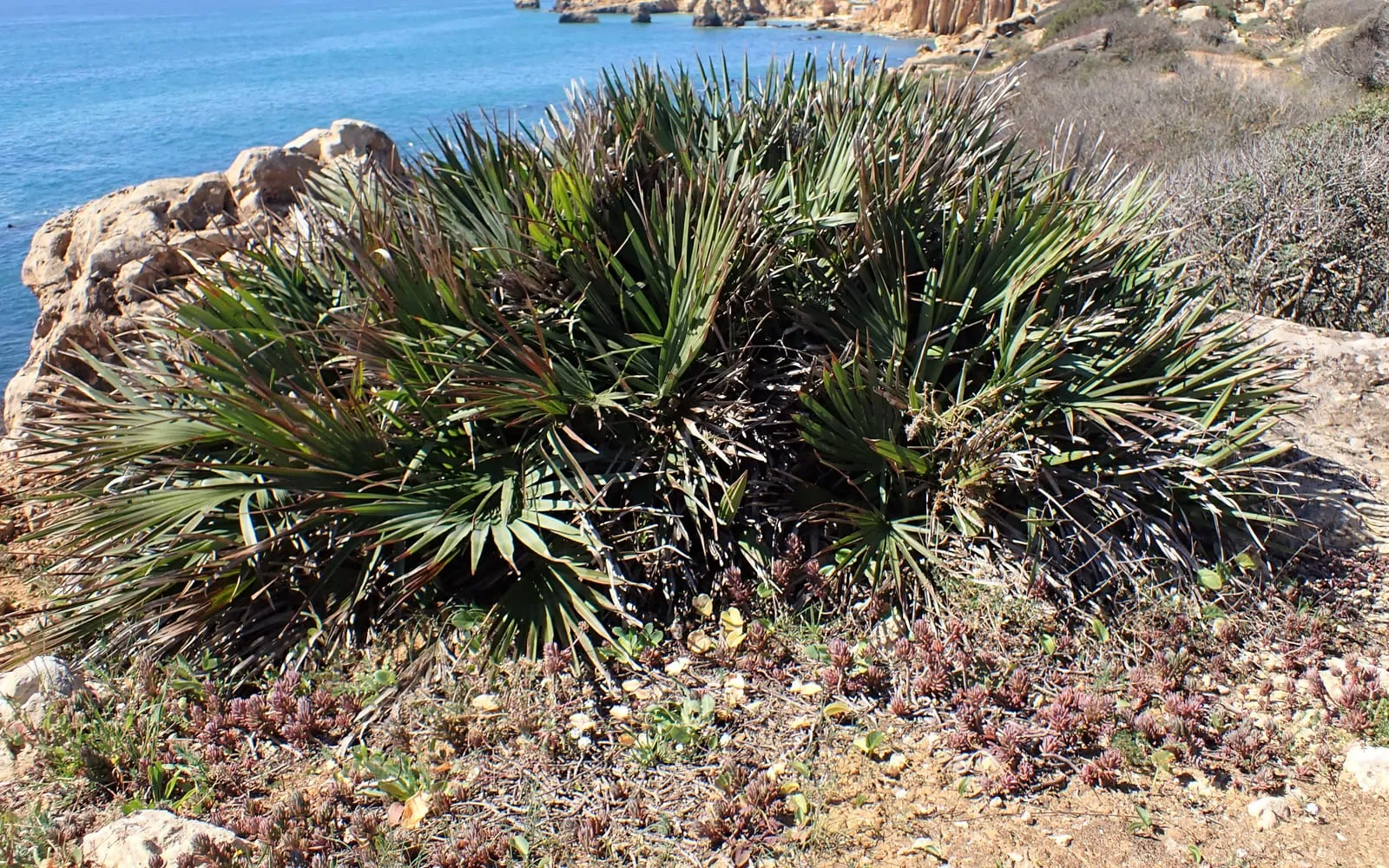
Mediterranean fan palm grows as a dense, multi-stemmed clump rather than the single tall trunk most people picture when they hear the word palm. New suckers rise steadily from the base over the years, so a young plant bought as a single small clump can become a wide, shrubby mass of several stems within a decade or two.
It is the only palm native to continental Europe, and it carries a real Mediterranean toughness: drought, poor rocky soil, coastal wind and brief hard frost all trouble it far less than they trouble most other palm species offered for the same climate.
Appearance and character
The fronds are stiff, deeply divided fans, blue-green to silvery grey depending on the form, held on petioles armed with sharp, forward-facing spines along both edges, a feature that makes the plant awkward to work around at close range but also gives it a strongly architectural presence.
Small yellow flower clusters appear among the fronds in spring, followed on female plants by clusters of small round fruit that ripen from green to yellow-brown. Left unpruned, the clump thickens with age as new suckers push up around the older stems, each one eventually developing its own short, fibre-covered trunk.
Where it is from
Chamaerops humilis is native to the western Mediterranean, found wild across coastal Spain, Portugal, southern France, Italy, Morocco and Algeria, typically on dry, rocky slopes and scrubland close to the coast.
That habitat sets the plant’s whole character: a long, hot, dry summer, a cool, wet winter with occasional frost, and soil that is often thin, alkaline and stony rather than deep or fertile. Being the only palm to have evolved that far into Europe’s winter cold is exactly why it copes with a temperate garden better than almost any other palm on offer.
How it grows
Plant in full sun in any well-drained soil, including poor, alkaline or rocky ground that would trouble many other ornamentals. It is slow-growing, and a young plant should be watered regularly through its first two or three years while the root system establishes.
Growth above ground is modest even once established, typically a few centimetres of trunk height a year, and the plant puts much of its energy into producing new basal suckers rather than height. Suckers can be left to form a wide natural clump or removed while young to keep a single, more upright stem, though removal is easiest done early before a sucker develops its own substantial root system.
Wear thick gloves when working close to the plant. The spined petioles are sharp enough to puncture skin easily on a careless pass, and pruning or dividing an established clump is a task best done deliberately rather than in a rush.
Through the seasons
Spring brings new frond growth and small flower clusters among the crown of each stem.
Summer is the plant’s natural season, tolerating heat and drought with ease once established.
Autumn suits planting, giving the roots a season to settle before winter’s cold and rain arrive.
Winter brings the plant’s main test in a cooler climate. An established clump takes a hard frost well, though standing water around the roots through a wet winter is a bigger risk than the cold itself.
Care difficulty
Easy, and one of the most forgiving palms available for a dry, sunny garden. It tolerates poor soil, drought, wind and cold with equal ease once established, and needs little beyond an occasional feed and, if a tidier single-stemmed look is wanted, the removal of unwanted suckers.
The sharp spines make close work uncomfortable, and a mature clump sited too close to a path or a seating area becomes an ongoing hazard to brush past.
Watering
Water regularly through the first two or three growing seasons while the root system establishes, then rely on rainfall in all but the driest extended spell.
An established plant handles real drought comfortably, drawing on a deep root system suited to its dry Mediterranean summers. Waterlogged soil, particularly through a cold, wet winter, is a far greater risk than underwatering ever is.
Warning signs, diseases and pests
Red palm weevil is a serious pest of this and several other palm genera in parts of southern Europe and the Mediterranean, boring into the growing points and often going unnoticed until real damage has been done. There is no reliable home cure once a clump is badly infested, and local advisory bodies should be consulted where the pest is present.
Scale insects show as small bumps on the fronds and stems, sapping vigour gradually. Horticultural oil during the growing season controls a light infestation.
Mealybug hides among the fibrous material at the base of the leaf stalks, where it can be easy to miss. Treat with horticultural soap, working the spray into the fibre rather than just the visible fronds.
Waterlogging in winter shows as yellowing fronds and a general decline that can be mistaken for cold damage. Improving drainage, particularly around the crown of each stem, is the only real fix.
Growing environment
Full sun brings the densest, most compact growth and the best flowering and fruiting.
Well-drained soil is essential, though the species tolerates poor, rocky or alkaline ground that would trouble most other ornamentals well. It also tolerates coastal wind and salt spray comfortably, reflecting its native coastal habitat.
Avoid a site that collects standing water in winter, since that is the condition most likely to cause real problems, far more so than cold alone.
Feeding
Feed with a balanced palm fertiliser once or twice through the growing season. Given its slow growth rate and its tolerance of poor native soil, this species needs less feeding overall than most fast-growing garden plants of comparable size.
A plant showing pale or yellowing older fronds usually benefits more from a proper palm feed containing magnesium and manganese than from a general garden fertiliser.
Troubleshooting
New suckers keep appearing around the base. This is normal and part of how the species naturally grows into a wide clump. Remove unwanted suckers while young if a tidier, more single-stemmed shape is preferred, or leave them for the fuller natural form.
Fronds have yellowed after a wet winter. Waterlogged soil around the roots is the likely cause. Check drainage and consider raising the planting position slightly if the site regularly holds water in winter.
I was scratched badly while pruning it. The spined petioles are sharp enough to draw blood on a careless pass. Wear thick gloves and long sleeves for any close work, and consider siting a new plant well back from paths and seating areas.
Growth seems extremely slow compared with other palms I have grown. This is normal for the species rather than a sign of a problem. It is one of the slower-growing palms in general cultivation, and steady, undramatic growth over many years is what to expect.
Can I grow it in a container? Yes, and it is one of the better palms for container growing given its slow growth and drought tolerance, though a large clump eventually needs a substantial pot and will grow and sucker more slowly than one in open ground.