
Outdoor plant
Quaking Grass
Briza media
Also known as Common Quaking Grass, Totter Grass
Practical guidance for growing quaking grass, Briza media, including its trembling heart-shaped spikelets, poor thin soil, self-seeding, dried flower arrangements, and its lack of barbed awns.
At a glance
- Difficulty
- Easy
- Water
- Rarely, once established
- Light
- Full sun for the best flowering
- Temperature
- Fully hardy
- Hardiness
- USDA 4-8, RHS H7, hardy to -25 C
- Type
- Deciduous herbaceous perennial grass, cool-season
- Height
- 30-60 cm in flower
- Native to
- Europe, western Asia
A grass of unimproved European meadow, adapted to thin, low-fertility soil rather than to a particular summer heat or cold. Winter cold is rarely the limit on where it grows well. Rich, damp ground is the real constraint, since a fertile border feeds it into soft, floppy growth that quakes far less and rots more readily than the same plant on lean chalk or sand.
Hardiness zones describe winter cold alone. Summer heat, humidity, rainfall and the length of the growing season decide as much, so treat the range as the outer limit rather than as a recommendation.
Not known to be toxic
Quaking grass carries nothing the ASPCA or the RHS list as harmful, and its papery, rounded spikelets are unlike the barbed, arrow-shaped awns of foxtail grasses that are the genuine hazard in this family. A foxtail awn works its way into a dog's paw, ear or nose and can migrate through tissue, which is a mechanical injury rather than a poisoning. That is why vets warn about grasses at all. Briza spikelets have no barb to catch and do not do this. A dog or cat that chews the seed heads gets nothing worse than a mouthful of dry husk, and a garden grown for its trembling flower heads carries no hazard for pets that a lawn does not.
Sources: ASPCA toxic and non-toxic plants, RHS potentially harmful garden plants
About
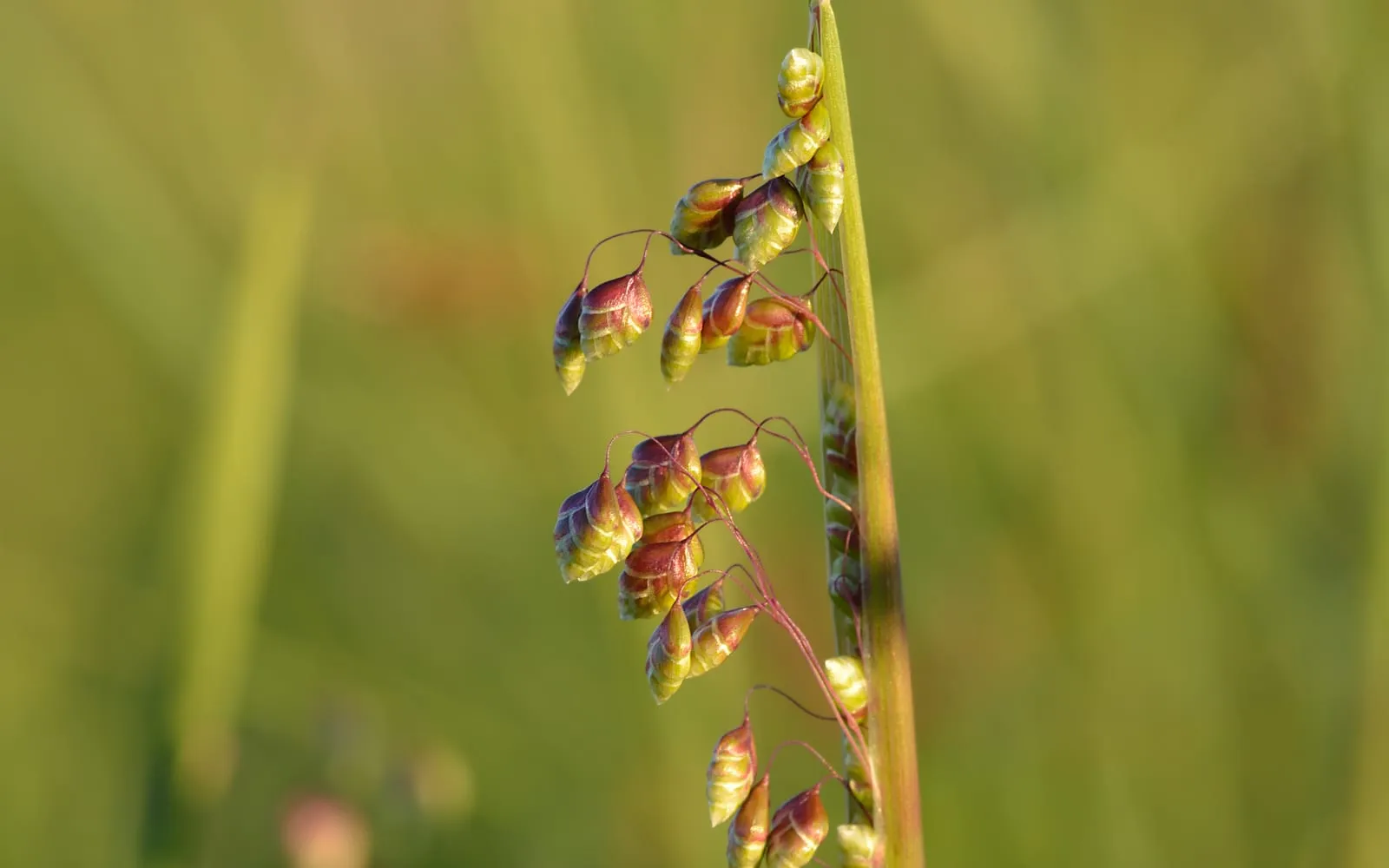
Quaking grass earns its name from the flower heads, small, papery, heart-shaped spikelets that hang from thread-fine stalks and tremble in the lightest breeze, long after sturdier grasses nearby stay still. The motion is the whole appeal, and it works at any scale from a single pot to a wildflower meadow.
It is a grass of old, unimproved grassland, thriving on soil too poor and thin to interest most border plants, which makes it one of the easiest meadow grasses to establish and one of the hardest to overfeed by accident, since there is rarely a temptation to feed it at all.
Appearance and character
Narrow, grey-green leaves form a low, loose tuft rarely more than 20 cm tall, easy to overlook until the flower stems rise well above it in early summer.
The flower heads are the plant’s whole reason for being grown. Each spikelet is small, flattened and roughly heart-shaped, purplish-green ageing to straw, hanging from a hair-fine stalk so that the whole cluster nods and quivers independently of the stiffer stem beneath it. A patch in flower moves visibly in still air that leaves everything else in the bed motionless.
Seed heads dry well without losing their shape or their papery quality, which is why quaking grass has been a mainstay of dried flower arrangements for as long as anyone has been cutting garden flowers to bring indoors.
Where it is from
Briza media is native across most of Europe and into western Asia, growing wild on unimproved grassland, chalk downland and old meadow, almost always on soil too thin and low in nutrients for more vigorous grasses to dominate it.
Its native habitat explains why it struggles in an ordinary fertile border. On rich soil, coarser grasses and border perennials outgrow and shade it out within a season or two. The same competitive pressure keeps it confined to poor ground in the wild. Chalk downland across southern England, the limestone pastures of central Europe and similar low-fertility grassland further east are all typical wild settings for it.
It has been grown as a garden and cut-flower plant for centuries and has naturalised well beyond its native range wherever gardeners have grown it near open ground, without becoming the kind of aggressive coloniser that some other ornamental grasses have.
How it grows
Plant in full sun on free-draining soil, and resist the urge to improve the ground first. Poor, thin soil, including chalk and lime, suits it better than a border recently dug over with compost or manure.
It establishes readily from seed sown direct in autumn or spring, or from small plants set out in spring, and flowers within its first full growing season.
Once settled, an established clump seeds itself gently around the immediate area, more so on bare or gravelly ground than in a densely planted border where seedlings have no room to establish. This gentle self-seeding is usually welcome rather than a problem, since a spreading drift of quaking grass through a gravel garden or meadow planting is generally the effect being aimed for.
No staking, deadheading or routine division is needed. A clump that has become congested or is flowering poorly after several years can be lifted and replaced with self-sown seedlings from around it.
Through the seasons
Spring brings fresh growth from the low winter tuft and the season’s first seedlings germinating from the previous year’s seed.
Summer is flowering, from late spring into midsummer, with the trembling heads at their best in the earlier part of that window before they dry and fade to straw.
Autumn is when most seed disperses, setting up the following year’s self-sown plants, and a good time to sow fresh seed direct if starting a new patch.
Winter leaves a low, unremarkable tuft of foliage that needs no attention and waits out the cold before spring growth resumes.
Care difficulty
Easy, especially with a light hand. Poor soil, no feeding and minimal watering all suit it better than attentive border care. Choose a thin, free-draining spot and leave it alone once planted.
Watering
Water new plants or freshly sown seed until they establish, then step back almost entirely. An established clump on suitable soil rarely needs watering even in a dry summer, since it is adapted to the free-draining, moisture-scarce conditions of thin downland turf.
Watering an established clump generously, especially alongside feeding, tends to produce soft, less floral growth rather than a healthier plant.
Warning signs, diseases and pests
Slugs and snails can take seedlings before they establish, particularly on damp ground in a wet spring, though established plants are rarely troubled once past that vulnerable stage.
Rust occasionally shows as orange pustules on the leaves in a wet season, without doing serious harm to a plant this undemanding.
Leaf spot appears now and then on older foliage and is cosmetic rather than a real threat.
Avoid waterlogging. A spot that holds winter wet, especially combined with rich soil, is where an otherwise trouble-free grass rots at the base and fails to reappear in spring, in contrast to the same plant thriving for years on lean, free-draining chalk.
Growing environment
Full sun brings out the best flowering and the most visible quaking motion. It tolerates light shade but flowers more sparsely there.
Poor to average, free-draining soil suits it best, including chalk and lime, which many border plants dislike. Avoid recently enriched ground.
It works equally well as a single feature in a gravel garden, scattered through a wildflower meadow mix, or massed in a border edge where its low, airy habit does not compete for space with taller neighbours.
Feeding
None is needed on ordinary or poor soil, and feeding is more likely to harm the display than help it, producing lush leaf growth at the expense of the trembling flower heads the plant is grown for.
On unusually rich soil, no additional feeding should ever be applied, and if flowering is consistently poor, moving the plant to leaner ground is a better fix than any fertiliser.
Troubleshooting
The flower heads are not trembling much. Check the site is sheltered enough for the motion to register but not fully enclosed, since a very still, wind-free corner produces the same flower heads without the visible quiver that gives the plant its name.
It has seeded itself all through the gravel path. Normal behaviour on open, free-draining ground. Pull unwanted seedlings while small, or leave them, since a self-sown drift is usually the effect gardeners growing this plant are hoping for.
Growth is lush and green but there are few flowers. The soil is too rich. Stop feeding, and if the bed was recently improved with compost or manure, expect flowering to improve as that fertility declines over a season or two.
The base of the clump has gone soft and brown. Waterlogging, almost always from wet ground over winter. Lift what remains, improve drainage before replanting, or move it to naturally free-draining soil instead.
Is it invasive? No. It self-seeds gently around an existing planting on suitable ground but does not spread aggressively or displace other plants the way some ornamental grasses do.