
Outdoor plant
Pendulous Sedge
Carex pendula
Also known as Drooping Sedge, Weeping Sedge
How to grow pendulous sedge, Carex pendula. Why one clump can seed itself into a colony within a couple of seasons, telling a sedge from a grass by its triangular stems, and the boggy shade it thrives in where little else grows.
At a glance
- Difficulty
- Easy
- Water
- Keep the soil consistently moist; water in dry spells once established
- Light
- Partial to full shade; tolerates some sun where the soil stays moist
- Temperature
- Fully hardy
- Hardiness
- USDA 5-9, RHS H6, hardy to -20 C
- Type
- Evergreen to semi-evergreen clump-forming perennial sedge
- Height
- 1-1.5 m in flower
- Native to
- Europe, western Asia
Hardy through most temperate winters without protection, since the foliage and roots take hard frost without dying back to the ground the way a herbaceous perennial does. What determines whether it thrives rather than merely survives is moisture, not cold: a summer dry spell that dries the soil out checks growth and browns the leaf tips faster than any winter does.
Hardiness zones describe winter cold alone. Summer heat, humidity, rainfall and the length of the growing season decide as much, so treat the range as the outer limit rather than as a recommendation.
Not known to be toxic
Carex pendula carries no documented toxic compounds and does not appear on the RHS list of potentially harmful garden plants or the ASPCA's toxic plant database. The leaves are tough and fibrous rather than palatable, so neither pets nor grazing animals show much interest in eating it, and no poisoning cases are recorded against the genus. The sharp, sometimes serrated leaf edges can nick bare skin if handled carelessly while dividing a clump, which is a cut rather than a toxicity, but is useful to know before reaching in with bare hands.
Sources: RHS potentially harmful garden plants, ASPCA toxic and non-toxic plants
About
Pendulous sedge forms a large, fountain-shaped clump of broad, dark green leaves that arch outward from a central crown. In late spring, tall flowering stems rise well above the foliage and carry long, slender spikes that hang down under their own weight, which is where both the common name and the Latin epithet come from.
It needs shade and moisture more than any other single factor, and given both it needs almost no attention once established. Left to its own devices in a bed it likes, it seeds around freely, so gardeners who want a tidy single clump usually cut the flower spikes off before the seed sets.
Appearance and character
The leaves are broad for a sedge, strap-shaped and keeled, dark glossy green, and arch gracefully from the base to form a rounded mound up to a metre or more across. They stay green through most winters in a sheltered spot, only browning at the tips in a hard frost or a prolonged dry spell.
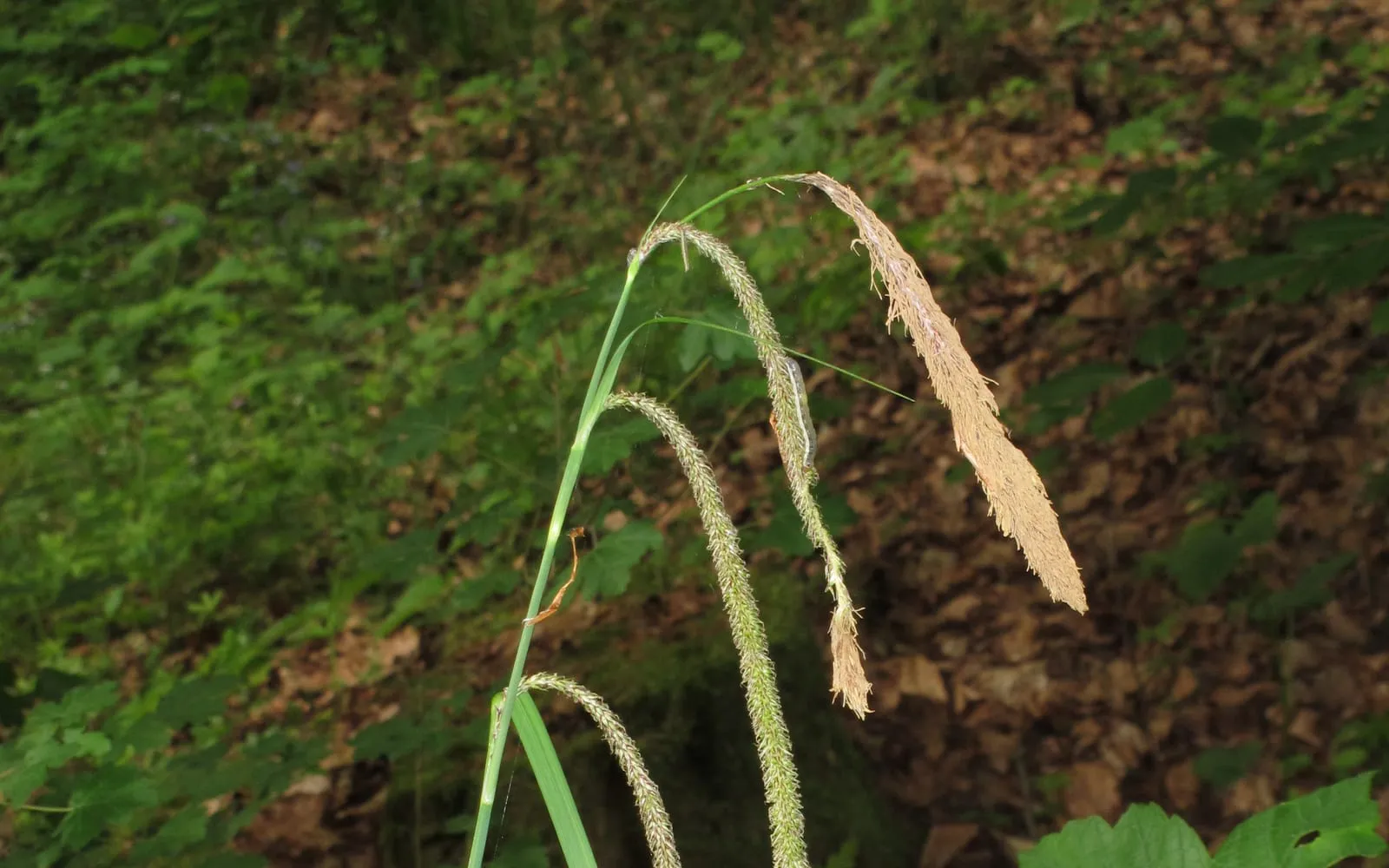
The flowering stems are triangular in cross-section, the giveaway of a true sedge rather than a grass, and rise well clear of the leaves in late spring. Each carries a cluster of narrow, catkin-like spikes: a shorter, upright male spike at the top and several longer, pendulous female spikes below it, brownish-green ripening to pale brown, that sway and bob in the lightest breeze.
Established clumps have real presence, with a loose, informal outline that works well beside water or under trees where tidier plants struggle.
Where it is from
Carex pendula is native across much of Europe, into western Asia and North Africa, where it grows in damp woodland, along streambanks and in ditches and other permanently or seasonally wet shaded ground. It is one of the larger native European sedges and often the dominant plant in the damp, shaded corners where it occurs naturally.
That native habitat explains almost everything about how to grow it well. It comes from ground that rarely dries out and light that rarely reaches full sun, and a garden position that mimics both gets the strongest growth and the least trouble.
How it grows
Plant in humus-rich, moisture-retentive soil in partial to full shade. It tolerates boggy ground that would rot most other perennials and copes with deep shade under trees where little else will grow, though it also manages reasonable sun if the soil never dries out for long.
Little routine care is needed beyond keeping the soil moist while a new plant establishes its root system through the first growing season. After that, an established clump largely looks after itself.
Cut back old, tatty foliage in late winter before new growth starts, using shears rather than trying to pick over individual leaves, which is faster and leaves a neater clump. Remove flower spikes before they set seed if self-sowing is not wanted, since a single clump can produce a great many seedlings in a season.
Divide congested clumps in spring, lifting the whole plant and splitting it into sections with a spade, each with some root and several shoots, then replanting at the same depth.
Through the seasons
Spring brings fresh leaf growth and, by late spring, the tall flowering stems with their pendulous spikes. Divide congested clumps once new growth is visible.
Summer is when the flower spikes ripen and, if left, set seed. Water during any dry spell, since this is when moisture stress shows fastest.
Autumn is a quiet period of continued growth in mild weather. Clear fallen leaves from around the base if they collect and smother the crown.
Winter leaves the evergreen foliage in place through most winters, though a hard frost or cold wind can brown the leaf tips. Cut back tired old growth towards the end of winter, ahead of the spring flush.
Care difficulty
Easy, and among the most trouble-free plants for a damp, shady corner where many other perennials sulk. It needs no feeding in reasonable soil, no staking, and no protection from cold. The one thing that takes watching is its enthusiasm for self-seeding: left unchecked in a bed it likes, it can turn from one clump into a colony within a couple of seasons, so the only real maintenance decision is whether to let that happen or to cut the seed heads off each summer.
Watering
Keep the soil consistently moist, particularly through the first growing season while roots are establishing. In boggy or streamside ground, no watering is needed at all beyond what falls as rain.
Once established in reasonably retentive soil, water during any extended dry spell. A plant that dries out repeatedly through summer survives but looks tired, with browning leaf tips and a general loss of the lush, arching habit that makes it worth growing.
Warning signs, diseases and pests
Rust appears as small orange pustules on the underside of the leaf blades, usually in a wet season, and is mostly cosmetic on an otherwise healthy plant. Remove the worst-affected leaves and improve air movement around the clump if it recurs.
Leaf spot shows as small brown or black spots on the foliage, most often where clumps are crowded together with poor airflow between them. Dividing an overgrown clump usually resolves it.
Slugs and snails graze on the soft new shoots as they emerge in spring, occasionally reducing a young plant’s early growth, though an established clump generally outgrows the damage.
Aphids sometimes cluster on the young flowering stems in spring. Numbers are rarely high enough to need treatment, and natural predators usually keep them in check.
Growing environment
Shade suits it best, from the light dappled shade under a high canopy to the deep shade at the base of a north-facing wall, and it tolerates more sun than most shade plants provided the soil stays reliably moist.
Wet or boggy soil suits it rather than harming it. Pendulous sedge is one of the few plants that thrives with its roots in permanently damp ground, alongside a pond margin or in a low spot that collects water after rain.
It also copes with periods of drier soil once established, though the foliage looks its best where moisture is dependable rather than occasional.
Feeding
Feeding is rarely necessary in reasonable garden soil. An annual mulch of well-rotted compost or leaf mould around the base in spring supplies enough fertility for most clumps and helps the soil hold moisture through the following summer.
On very poor or sandy soil, a light application of a balanced general fertiliser in spring can help a struggling clump gain size, though this is the exception rather than the rule for a plant that evolved to grow in naturally fertile, damp woodland soil.
Troubleshooting
It has seeded itself all over the border. This is the plant’s most common complaint and the easiest to prevent. Cut the flowering stems off at the base once they finish blooming and before the seed ripens, and pull any seedlings that do appear while they are small and easy to lift.
The leaves are browning at the tips. Usually dry soil, sometimes a hard frost or a cold, drying wind. Check the soil moisture first, since this is the more common cause in summer, and water thoroughly if it is dry. Winter browning on established plants is largely cosmetic and new growth replaces it in spring.
The clump has gone bare and open in the middle. A sign that it needs dividing. Lift the whole plant in spring, discard the old, woody centre, and replant vigorous sections from around the outer edge.
Can I grow it in full sun? Only where the soil stays consistently moist. In drier soil, full sun scorches the leaves and stresses the plant badly; shade is the safer choice unless watering can be kept up through summer.
Is it invasive? It self-seeds freely in moist garden soil more often than it spreads into wild habitat, though it has naturalised in some damp areas outside its native range. Removing spent flower spikes before seed set is the simplest way to keep it contained to where you planted it.