
Outdoor plant
Giant Reed
Arundo donax
Also known as Spanish Cane, Giant Cane
Practical guidance for growing giant reed, Arundo donax, including its rapid rhizome spread, screening and biomass use, invasive status in some regions, containment, and low toxicity.
At a glance
- Difficulty
- Easy
- Water
- Ample water while establishing and through the growing season
- Light
- Full sun
- Temperature
- Top growth is killed by frost; the rhizome survives considerably colder conditions than the canes do
- Hardiness
- USDA 6-10, RHS H5, hardy to -15 C
- Type
- Fast-growing perennial grass, with herbaceous canes rising each year from a persistent underground rhizome
- Height
- 3-6 m, occasionally taller in a long, warm growing season
- Native to
- the Mediterranean, western Asia
The rhizome takes a hard frost that kills every cane above ground, then resprouts from below the soil once the weather warms, which is why the zone range looks generous next to how tender the canes themselves seem. What the zone numbers do not capture is how much a long, warm growing season changes this plant's behaviour: in a climate with no real winter check, it grows faster, spreads harder and reaches its full height in a single season, which is exactly the combination that has made it difficult to control where it has escaped cultivation.
Hardiness zones describe winter cold alone. Summer heat, humidity, rainfall and the length of the growing season decide as much, so treat the range as the outer limit rather than as a recommendation.
Not known to be toxic
Giant reed is not listed as harmful by the RHS or the ASPCA and poses no realistic poisoning risk to people or household pets. It is not chemically inert, though. The canes contain indole alkaloids such as gramine and bufotenine, enough to affect livestock that graze it heavily and part of why most animals leave it alone. The everyday hazard to a gardener is mechanical rather than chemical. The leaf margins carry enough silica to cut skin on contact, similar to pampas grass or a sedge, and the stiff canes can leave a nasty scratch if pushed through carelessly.
Sources: RHS potentially harmful garden plants, ASPCA toxic and non-toxic plants
About
Giant reed is a bamboo-like grass, though it is not a bamboo at all, that throws up thick, jointed canes from a spreading underground rhizome and can reach the height of a small tree within a single warm growing season. It has been grown for millennia for screening, erosion control and material for reed instruments, and it remains one of the fastest, most reliable ways to put up a tall green wall where nothing else will grow as quickly.
That same speed and toughness has made it a serious invasive weed along watercourses in parts of the world with a warm, frost-free climate. Before planting it, check how it is classed where you garden.
Appearance and character
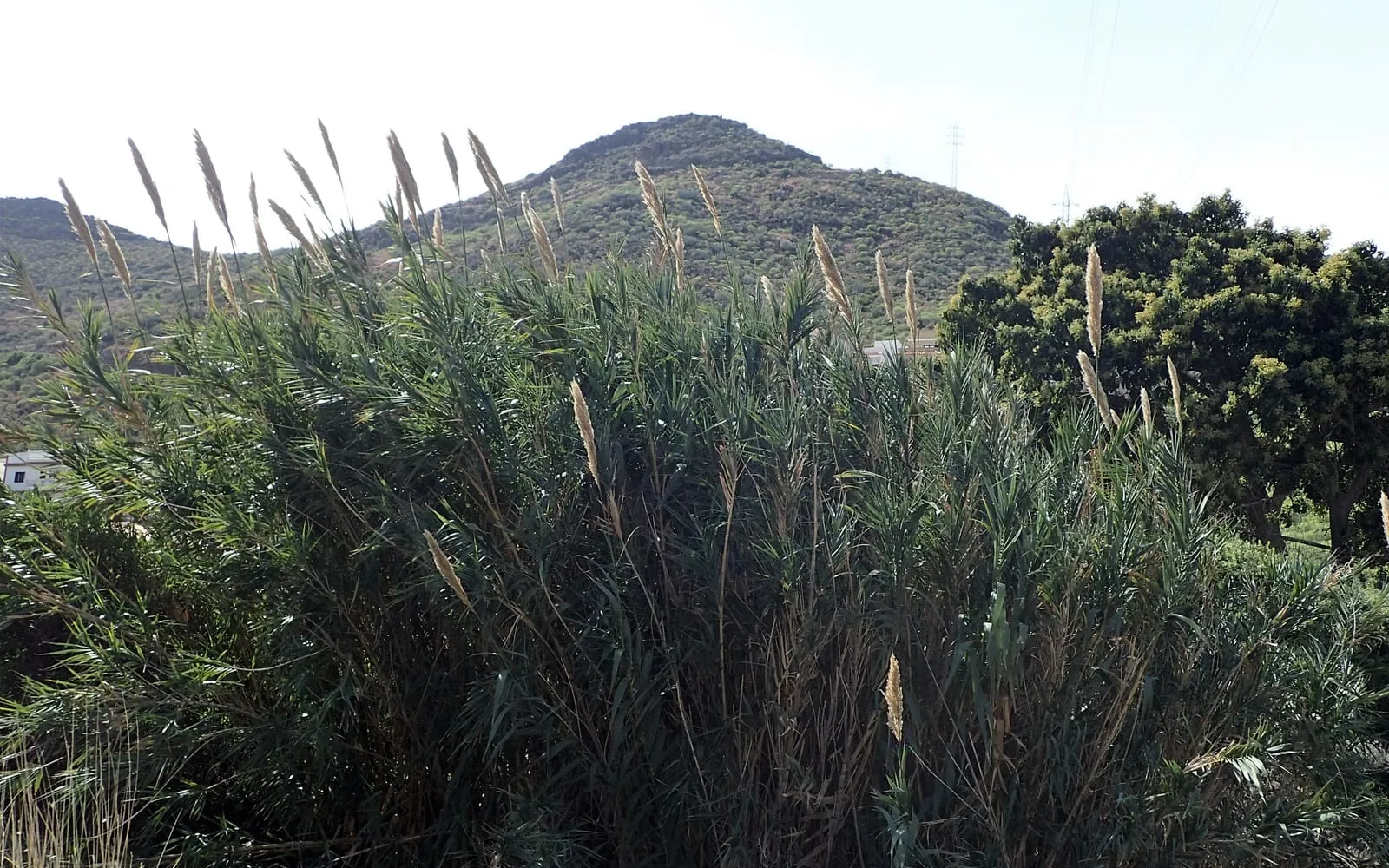
The canes are thick, hollow and jointed like bamboo, rising straight and largely unbranched from the base, blue-green through the growing season and fading to tan as they mature and, in a cold climate, die back after the first hard frost. Broad, strap-shaped leaves alternate up each cane in two ranks, arching gracefully outward and giving the whole clump a soft, almost tropical texture despite its toughness.
Flowering is a plume-like panicle at the top of a mature cane, silvery to purplish and reminiscent of pampas grass on a smaller scale, though many plants in cultivation, particularly in cooler climates, rarely flower at all, spreading instead entirely by rhizome. Where it does flower and set seed, most of that seed is not viable, and vegetative spread from rhizome fragments is by far the main way it establishes and moves.
A single clump thickens year on year into a dense, impenetrable stand of canes, and even a hard winter that kills every cane to the ground rarely sets the plant back for more than a season before it resprouts.
Where it is from
Arundo donax is native to the Mediterranean basin and western Asia, growing naturally along riverbanks, irrigation channels and other consistently damp ground. It has been carried far beyond that native range for thousands of years, valued in turn for basket weaving, thatch, erosion control on canal banks, and as the source of the cane used in reed instrument mouthpieces, a use it still supplies commercially today.
That long history of deliberate planting along watercourses is also the reason it has become established, and in places seriously invasive, outside its native range. In parts of the southwestern United States, including California and along the Rio Grande in Texas, and across large stretches of Australia, it has spread aggressively along rivers and floodplains, outcompeting native streamside vegetation, raising fire risk in dry stands, and consuming water at a rate that has drawn government- backed control programmes, including biological control agents released specifically to weaken it. The UK and much of northern Europe see a different picture. Winters cold enough to check growth and a general lack of viable seed set mean it is grown there as a garden and biomass plant without that same history of escape. A gardener anywhere near a watercourse is still better off checking local guidance first rather than assuming either extreme applies by default.
How it grows
Plant rhizome divisions or container-grown plants in spring, in full sun, in moist, fertile soil for the fastest results, though it tolerates poorer, drier ground once its root system is established. Give it real space from the outset: a single clump can spread several metres wide within a few years if nothing checks the rhizome.
Where containment matters, whether because of local invasive species guidance or to stop it swamping a border, plant it inside a buried root barrier at least 60 cm deep, or grow it in a large container sunk into the ground, since the rhizome spreads readily through ordinary soil and rhizome fragments carried downstream by flooding can root and establish a new stand well away from the parent plant.
Cut all canes back hard to ground level at the end of the growing season in a climate where frost kills the top growth anyway, which tidies the clump and makes fresh, vigorous growth easier to manage the following spring. In a frost-free climate, canes persist and can be thinned instead of cut to the ground, removing the oldest, woodiest canes each year to keep the clump from becoming congested.
Through the seasons
Spring brings vigorous new cane growth from the rhizome, fastest once the soil has properly warmed.
Summer is the main growing season, with canes reaching their full height and, in a long warm climate, flowering toward the end of it.
Autumn slows growth as temperatures drop, and canes begin to fade from blue-green toward tan.
Winter kills the top growth outright wherever frost reaches it, leaving the rhizome to rest below ground until spring; in a frost-free climate the canes persist through winter with comparatively little change.
Care difficulty
Easy to keep alive and hard to contain. Giant reed establishes readily in ordinary garden soil, needs no feeding once settled, and tolerates drought, poor soil and hard cutting back alike. Left unchecked, a clump spreads wider each year. Plant it in a barrier or a large container, or expect to spend more time controlling its spread than enjoying it.
Watering
Water generously while a new planting establishes its rhizome system, particularly through its first summer. Once settled, it tolerates real drought, though growth slows and canes stay shorter in dry conditions compared with a reliably moist site.
It also tolerates occasional flooding and waterlogged ground far better than most garden grasses, which is part of why it has thrived along riverbanks and irrigation channels wherever it has been introduced.
Warning signs, diseases and pests
Scale insects occasionally colonise the canes, appearing as small, rounded bumps that sap the plant’s vigour over time. One species in particular, deployed deliberately as a biological control against wild stands of giant reed in parts of the United States, weakens the plant by feeding on the rhizome itself; a garden specimen near an area where control programmes are active may pick up the same insect.
Rust shows as small orange pustules on the leaves, usually after a wet growing season, and rarely does more than cosmetic damage to an otherwise vigorous plant.
Leaf spot appears occasionally as small discoloured patches on older leaves, seldom serious enough to need any treatment beyond removing the worst-affected foliage.
Growing environment
Full sun gives the strongest, most upright growth; in shade, canes grow thinner and more sparse and rarely reach full height.
Moist, fertile soil produces the fastest results, though this species tolerates poor, dry or heavy soil once its root system has established, which is part of what makes it so difficult to eradicate once it has spread somewhere it is not wanted.
Wind shelter is rarely necessary for an established clump, since the canes, while tall, are flexible enough to bend rather than snap in all but the most severe storms.
Feeding
Feeding is rarely necessary in reasonably fertile soil, where the plant’s vigorous natural growth already outpaces most garden grasses without any help. In poor soil, a single balanced feed in spring supports faster establishment in the first year or two.
Avoid regular or heavy feeding beyond that, since it does nothing but accelerate growth that is usually already the thing a gardener is managing rather than encouraging.
Troubleshooting
Is this plant invasive where I live? Check your local or national invasive species list before planting, particularly if you garden near a river, canal or other watercourse. It is classed as a noxious or invasive weed in parts of the southwestern United States and across large parts of Australia, while it is grown without that same concern in much of temperate Europe. When in doubt, treat it as though it were, and contain it accordingly.
How do I stop it spreading into the rest of the garden? A buried root barrier at least 60 cm deep, or growing it in a large sunken container, are both effective. Regular inspection of the barrier’s edge for rhizome that has grown up and over it should be done at least once a year.
All the canes turned brown after the first frost. Is it dead? No, almost certainly not. The top growth is killed by frost in any climate cold enough to produce one, while the rhizome survives underground and resprouts vigorously the following spring. Cut the dead canes back to ground level over winter.
Can I grow it in a large container instead of the ground? Yes, and this is often the safest way to enjoy its height and screening effect without risking it spreading, particularly in a region where it is known to be invasive. Expect to divide and repot it every couple of years as the rhizome fills the container.
Is it safe around pets that chew on plants? There is no record of it being toxic, and it carries no listing as a harmful plant. The leaf edges are sharp enough to cut skin on contact. Around small children and pets, the main risk is mechanical injury rather than poisoning.