
Outdoor plant
Greater Quaking Grass
Briza maxima
Also known as Big quaking grass, Rattlesnake grass
How to grow greater quaking grass from seed. Its papery, rattling seed heads, cottage garden and dried flower uses, and its self-seeding habit.
At a glance
- Difficulty
- Easy
- Water
- Moderate watering while establishing, drought-tolerant once growing
- Light
- Full sun
- Hardiness
- USDA 5-9, RHS H4, hardy to -15 C
- Type
- Hardy annual grass
- Height
- 30-60 cm
- Native to
- Mediterranean Europe, North Africa
Grown as a hardy annual across most temperate climates, completing its life cycle from seed to flower to seed within a single growing season, so winter hardiness of the mature plant is largely irrelevant; what matters is that seed sown or self-sown in autumn or spring can germinate and establish before the growing season's main flowering and seed-set period.
Hardiness zones describe winter cold alone. Summer heat, humidity, rainfall and the length of the growing season decide as much, so treat the range as the outer limit rather than as a recommendation.
Not known to be toxic
Greater quaking grass has no toxicity listing from the RHS or the ASPCA and is considered safe around pets and children. It has no documented history of poisoning.
Source: RHS
About
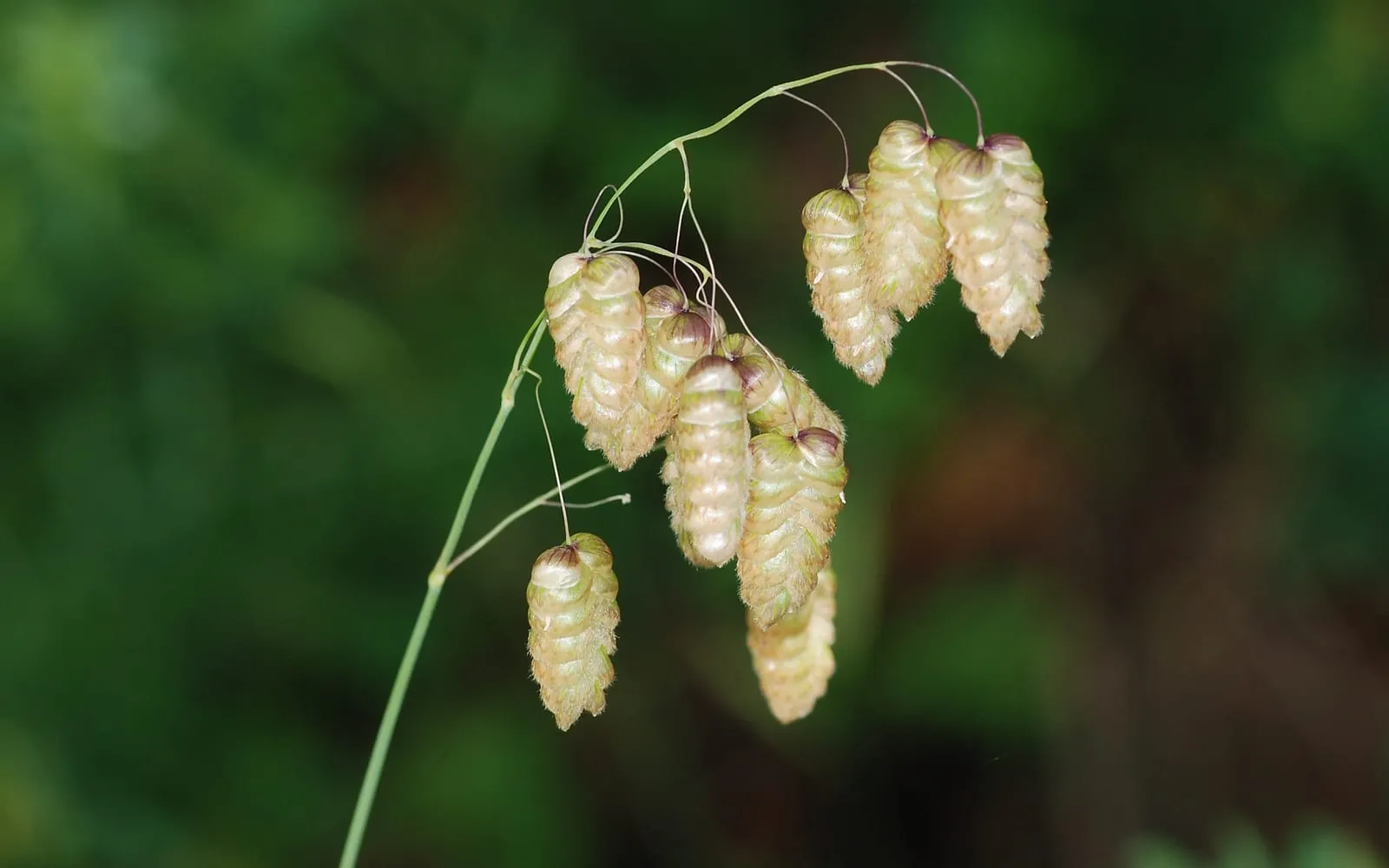
Greater quaking grass is grown almost entirely for its seed heads: plump, papery, drooping spikelets that dangle from fine, wiry stems and tremble and rattle in the lightest breeze, a movement that gives the whole plant its common name and much of its charm in a cottage garden or naturalistic border. The seed heads dry beautifully and hold their shape and pale straw colour for a long time, making this one of the most popular grasses grown specifically for cutting and drying for indoor arrangements.
As a hardy annual, it completes its entire life cycle within a single season, from germination through flowering to seed set, and it self- seeds readily where conditions suit it, often reappearing in the same spot or nearby year after year without any need for deliberate resowing once established in a garden.
Appearance and character
Slender, upright stems carry narrow leaves and rise to a modest height, topped with a loose, open spray of drooping, oval seed heads, each one made up of tightly overlapping, papery scales in shades of pale green ageing to straw gold as they mature. The seed heads are noticeably larger and more rounded than those of the related, more diminutive Briza media, which is where the name greater in this species’ common name comes from.
The constant light movement of the seed heads in even a gentle breeze is the plant’s most distinctive visual feature, giving a border real kinetic interest that few other small annual grasses provide to the same degree.
Where it is from
Open, sunny grassland and disturbed ground across Mediterranean Europe and North Africa, in a climate with warm, dry summers and generally mild winters, though it has naturalised well beyond this native range as a garden escape in many temperate countries.
That Mediterranean origin suits its behaviour as a hardy annual well: it germinates readily with the return of moisture after a dry spell and completes flowering and seeding relatively quickly, a pattern that translates comfortably into most temperate garden climates within a single growing season.
How it grows
A hardy annual germinating from seed, growing quickly to flowering size within a matter of weeks given reasonable warmth, and completing its life cycle by producing and dispersing seed before the plant itself dies off at the end of the season. Self-sown seedlings commonly appear the following spring wherever seed has fallen and found suitable open ground.
Because the whole plant’s life cycle is compressed into a single season, there is no ongoing perennial care to speak of. Management comes down to sowing time, seedling thinning if sown thickly, and deciding whether to allow self-seeding for future years or to deadhead and control its spread instead.
Through the seasons
Spring is the main sowing and germination period for a spring-sown crop, or the point at which autumn-sown or self-sown seedlings resume active growth.
Summer is the main flowering and seed-head display period, with the distinctive papery seed heads developing and drying on the plant.
Autumn seed disperses, either deliberately collected for dried arrangements or left to self-seed for the following year, after which the parent plant dies off.
Winter nothing remains above ground from that season’s plants, though self-sown seed or seed sown the previous autumn may already be germinating as small seedlings in a mild winter.
Care difficulty
Easy. As a hardy annual it needs little: reasonably free- draining soil, sun and, if desired, a decision about whether to let it self-seed freely or to manage its spread by deadheading before seed disperses.
Watering
Regular watering supports good germination and establishment of young seedlings. Once growing strongly, established plants tolerate drier conditions reasonably well, needing supplemental watering mainly during an extended dry spell.
Warning signs, diseases and pests
This is an unusually trouble-free annual grass, with aphids the main pest occasionally reported, generally in low numbers that rarely need direct treatment beyond a jet of water if a colony becomes noticeable.
Floppy, weak growth typically reflects soil that is too rich for this species, which performs best and stands most upright on leaner ground; avoiding fertiliser is the straightforward fix rather than treating it as a disease or pest issue.
Excessive self-seeding, with seedlings appearing in unwanted parts of the garden, is a management question rather than a plant health problem, and is controlled by deadheading spent seed heads before they fully disperse, ideally cutting them for drying before that point, which serves the dual purpose of harvesting the display and limiting unwanted spread.
Growing environment
Full sun gives the strongest, most upright growth and the best seed-head display. Free-draining, even fairly poor soil suits this species well, and overly rich, fertile ground tends to produce weaker, floppier plants than the lean conditions it naturally favours.
Feeding
Little to none is appropriate. This species performs best on lean, free-draining soil, and fertiliser tends to produce softer, less upright growth that shows the seed heads to less advantage than a plant grown hard on poorer ground.
Troubleshooting
Growth is floppy and weak rather than upright. Usually soil that is too rich. Avoid fertiliser and consider growing future sowings in a leaner part of the garden.
The plant is seeding itself into unwanted areas. Deadhead spent seed heads before they fully disperse, ideally cutting them for drying, which both controls spread and provides material for indoor arrangements.
Seedlings have not appeared from a previous year’s self-seeding. Check that the area was not disturbed, weeded heavily or mulched deeply before germination, since fairly undisturbed open soil suits the seed best, and consider resowing directly if natural self-seeding has failed.
You want to dry the seed heads for indoor arrangements. Cut the stems once the seed heads have fully developed but before they begin shedding seed, and hang them upside down in a dry, airy, shaded spot; they hold their shape and colour well once dried this way.