
Outdoor plant
Winter aconite
Eranthis hyemalis
Also known as Eranthis, Winter wolfsbane
How to grow winter aconite, Eranthis hyemalis. Yellow cups in February, why dry tubers rarely establish, and planting it in the green instead.
At a glance
- Difficulty
- Moderate
- Water
- Rarely, and it wants soil that does not bake in summer
- Light
- Full sun in winter and dappled shade in summer, which is what a deciduous tree gives
- Temperature
- Fully hardy, and it flowers through frost and snow
- Hardiness
- USDA 4-7, RHS H6, hardy to -25 C
- Type
- Tuberous perennial, long lived and dying back by late spring
- Height
- 8-15 cm
- Native to
- Southern Europe, from France and Italy through the Balkans to Bulgaria
- Best month
- February in the Northern Hemisphere, August in the Southern Hemisphere
It flowers in the depths of winter and then dies back by late spring, so it needs a cold winter and does nothing where winters are mild. Dry tubers establish badly and are better bought in the green, like snowdrops. It naturalises freely on heavy alkaline soil under deciduous trees and does poorly on dry sand.
Hardiness zones describe winter cold alone. Summer heat, humidity, rainfall and the length of the growing season decide as much, so treat the range as the outer limit rather than as a recommendation.
Every month named in this guide is for the temperate Northern Hemisphere. If you garden in the Southern Hemisphere, shift each one by six months, so February becomes August. Closer to the equator the wet and dry seasons matter more than the calendar, and the shift stops being a useful guide.
Poisonous if eaten
- Do not eat
- All parts, and the tubers most of all
- Harm from
- Eating it and handling it
- Affects
- People, cats and dogs
Winter aconite contains cardiac glycosides along with the protoanemonin common across Ranunculaceae, and it is genuinely poisonous rather than merely an irritant. Eating any part causes burning of the mouth, salivation, vomiting, abdominal pain, visual disturbance and a slowed or irregular heartbeat, and serious cases have involved cardiac effects requiring hospital treatment. The tubers carry the highest concentration and are the real hazard, since they are small, brown and look like something a child might dig up, and cases of poisoning have followed tubers being mistaken for other bulbs. The RHS lists Eranthis as harmful if eaten and as a skin irritant. The sap irritates skin, so wear gloves when handling the tubers. The name winter wolfsbane records the family relationship with Aconitum, which is among the most poisonous plants in Europe, and although Eranthis is less dangerous than that the association is a fair warning. Treat any ingestion by a person or an animal as a call to a doctor or vet rather than something to watch.
Sources: RHS potentially harmful garden plants, ASPCA toxic and non-toxic plants
About
Winter aconite flowers in February, often through snow, and a good colony is a sheet of buttercup yellow under bare trees before anything else is out.
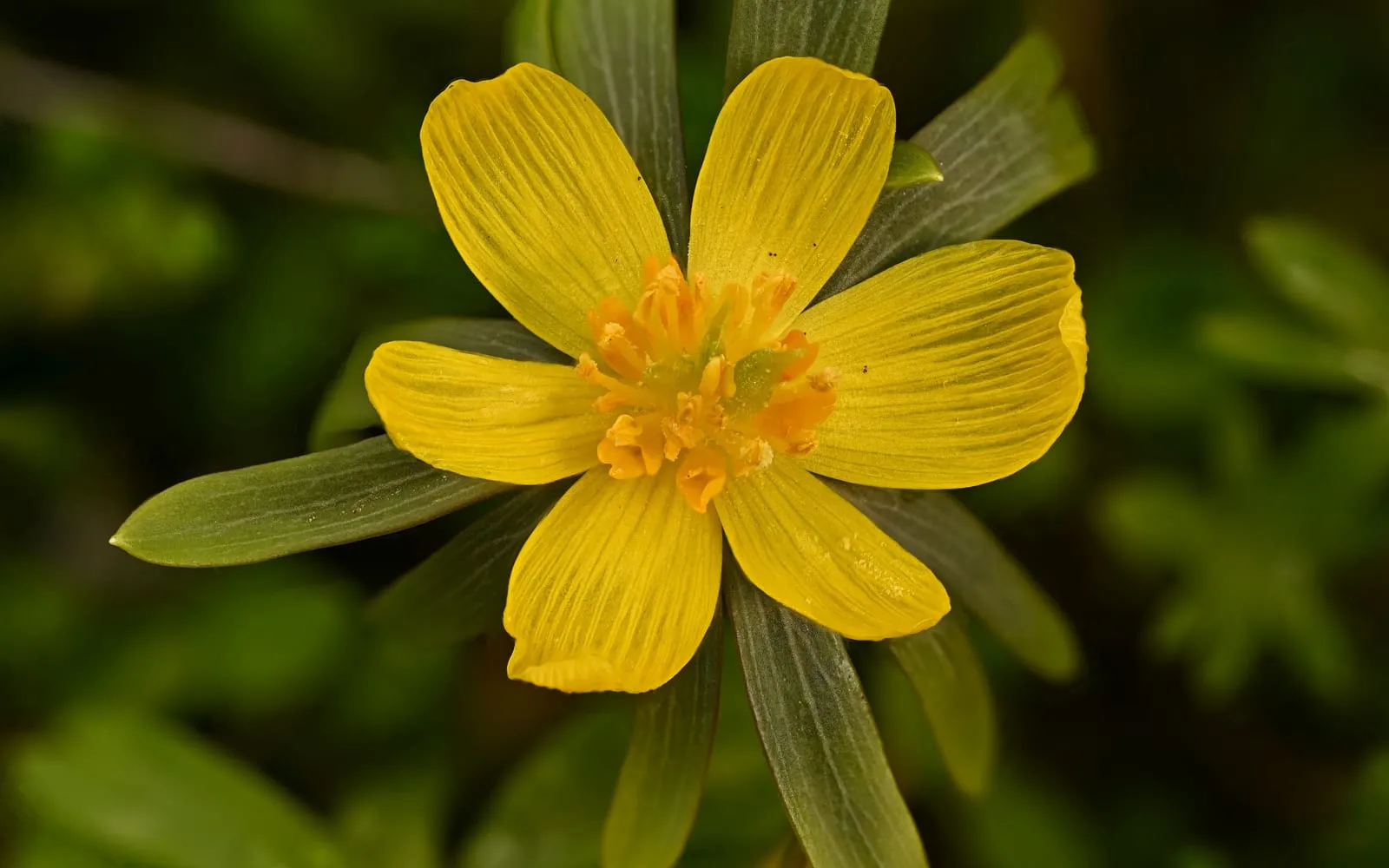
Each flower is a shallow cup about 2 cm across sitting directly on a ruff of deeply cut green bracts, with no visible stem, so the whole thing looks like a small yellow egg in a green nest. They open in sun and close in dull weather and at night.
It is one of the first nectar sources of the year, and on a mild February afternoon a colony has bumblebee queens and early flies working it when nothing else in the garden does.
The reason more gardens do not have it is the way it is sold. Dry tubers bought in autumn are notoriously unreliable, since they desiccate in the packet and a large proportion never grow. Two or three out of ten establishing is a common experience.
The way round it is to buy plants in the green in late winter, in the same way people do with snowdrops, or to soak dry tubers overnight before planting and accept the losses.
Once a colony is going it seeds itself and spreads, and after five or six years it forms a carpet that comes back for decades.
Appearance and character
A tuberous perennial reaching 8 to 15 cm, in leaf and flower from January to April and fully dormant from late May.
Flowers open from late January through February and into March, 2 to 3 cm across, bright buttercup yellow, cup-shaped with six petal-like sepals.
Each flower sits on a ruff of three deeply divided bright green bracts that form a collar immediately below it, which is the identification.
The flowers open flat in sun and close up in dull weather, and they hold up under frost and snow without damage.
Basal leaves appear as the flowers fade, deeply cut into narrow lobes, forming a low mat of fresh green that lasts until May.
The whole plant dies back completely by early summer and leaves no trace.
Tubers are small, brown, knobbly and irregular, 1 to 2 cm across.
Eranthis hyemalis Cilicica Group and the hybrid ‘Guinea Gold’ are larger-flowered and have bronze-tinted foliage.
Where it is from
Southern Europe, from southern France and Italy through the Balkans to Bulgaria, growing in deciduous woodland and on limestone slopes.
That habitat is the key to growing it. A deciduous wood gives full winter sun through bare branches, exactly when the plant is growing, and shade and leaf litter through the summer when it is dormant.
It reached Britain by 1596 and naturalised widely, particularly around old estates and churchyards, and it is now well established in parts of eastern and southern England.
British colonies are often centuries old and mark the sites of former gardens, in the same way naturalised snowdrops do.
The genus name means spring flower, from Greek, and hyemalis means of winter, which between them describe a plant that flowers in the gap.
It is in Ranunculaceae alongside buttercup, hellebore, clematis and monkshood, which accounts for the toxicity.
The related Eranthis cilicica from Turkey and Eranthis pinnatifida from Japan are both grown in gardens and the common species is the one that naturalises.
How it grows
Buy plants in the green in late winter if you can, which is by far the most reliable way to establish it. Nurseries and specialist bulb suppliers sell it alongside snowdrops in February and March.
Plant dry tubers in early autumn if that is what you have, soaking them overnight in water first, and expect a proportion to fail.
Plant 5 cm deep and 8 cm apart, in groups rather than singly.
Choose a position under deciduous trees or shrubs, which gives winter sun and summer shade.
Moist, humus-rich soil suits it, and it does particularly well on chalk and on clay, which is unusual among woodland bulbs.
Avoid anywhere that bakes dry in summer, such as the foot of a south wall or a hot open border.
Mulch with leaf mould in autumn, which imitates the woodland floor.
Leave the foliage to die back naturally, and never mow or cut it while it is green.
Let it seed. A colony spreads by self-sown seed and takes five or six years to build into a carpet, so avoid disturbing the ground around it.
Divide an established clump in the green immediately after flowering, lifting and replanting straight away without letting the tubers dry.
Naturalise it in grass under trees where the grass can be left uncut until June.
Wear gloves when handling the tubers, since the sap irritates skin.
Plant it with snowdrops, which flower at the same time and want the same conditions, and the yellow and white together is the classic February combination.
Through the seasons
Winter is the season. Flowers open from late January and run through February, holding up under frost and snow.
Spring finishes the flowering in March, and the basal leaves take over and feed the tubers into May.
Summer is fully dormant, and the plant needs soil that stays cool rather than baking.
Autumn is planting season for dry tubers, and the time to mulch with leaf mould.
Care difficulty
Moderate, and the difficulty is establishing it rather than keeping it.
Dry tubers are unreliable and this is the single reason most attempts fail. Buying plants in the green removes the problem almost entirely.
Once established in the right position it is permanent, spreading by seed, needing no feeding, no watering and no attention beyond leaving it alone.
Getting the position right matters. Winter sun, summer shade and soil that does not bake are what a deciduous tree provides, and a hot dry border is not.
Watering
None needed once established.
The requirement is soil that stays cool and slightly moist through the summer rather than watering, which is why a position under deciduous trees works so well.
Water new plantings in a dry spring while the foliage is still green.
Mulch with leaf mould in autumn, which does the job better than any watering.
Avoid waterlogged ground, where the tubers rot.
Warning signs, diseases and pests
Tubers planted in autumn that never appear is the standard problem, caused by desiccation before sale. Soak dry tubers overnight before planting, and buy in the green instead where possible.
A colony that dwindles over several years is usually a position that bakes in summer, or ground that is dug and disturbed regularly.
Flower buds grazed off at ground level in February is slugs, which are active in mild weather.
Black sooty masses on the leaves and flower stalks is smut, caused by Urocystis, which is uncommon. Remove and destroy affected plants.
Foliage yellowing in May is normal die-back rather than a problem.
No spread after several years usually means the seed is being removed by tidying, or the ground is being disturbed. Leave the seed heads and stop cultivating around them.
Mice and voles occasionally take the tubers.
Growing environment
Full winter sun with summer shade, which is what a deciduous tree or shrub provides. Under a large deciduous tree, in a shrub border or at a woodland edge are the classic positions.
Moist, humus-rich soil, and it grows particularly well on chalk and on heavy clay.
Fully hardy to about -25 deg C, and it flowers through frost and snow without damage.
Allow 8 cm between tubers and plant in generous drifts, since the effect comes entirely from the mass.
It suits a woodland garden, the base of a deciduous tree, a shrub border, grass under trees that is not cut until June, or a churchyard-style naturalised planting.
Do not plant it in a hot dry border or at the foot of a south-facing wall.
Grow it with snowdrops, which share the season and the conditions exactly, and with hellebores, cyclamen, pulmonaria and early crocus for a February planting.
Its wildlife value at that time of year is out of proportion to its size. Bumblebee queens emerging on mild days, honeybees and early flies all work it when almost nothing else is available.
Keep it away from where a small child digs, since the tubers are the most poisonous part and look like something to pick up.
Feeding
None needed.
Mulch with leaf mould in autumn, which supplies what it wants and imitates the woodland floor it comes from.
Avoid fertiliser, which does nothing useful for a woodland bulb.
Avoid mushroom compost near it on already chalky soil, and it tolerates lime well so this matters less than for most woodlanders.
A colony that fails to thrive has a position problem rather than a nutrient one.
Troubleshooting
I planted tubers and nothing came up. The usual outcome with dry tubers, which desiccate before sale. Soak them overnight before planting, and buy plants in the green in late winter instead, which establishes far more reliably.
What does in the green mean? Plants lifted and sold in leaf immediately after flowering, in February or March, rather than as dry dormant tubers. It is the same practice used for snowdrops and it works for the same reason.
Where should I plant it? Under deciduous trees or shrubs, which gives full sun in winter when it is growing and shade in summer when it is dormant. Avoid anywhere that bakes.
Will it grow on chalk? Yes, and it does particularly well there. It also grows well on heavy clay.
It has not spread in five years. Either the seed heads are being tidied away, the ground is being disturbed, or the position bakes in summer. Leave the seed to fall and stop cultivating around the colony.
When can I divide it? In the green, immediately after flowering. Lift, split and replant straight away without letting the tubers dry out.
How poisonous is it? Seriously. All parts contain cardiac glycosides and the tubers carry the most. Eating them causes vomiting and heart rhythm disturbance. Wear gloves when handling them and treat any ingestion as a call to a doctor or vet.
What flowers with it? Snowdrops, which want the same conditions and flower at the same time. Hellebores, Cyclamen coum, pulmonaria and early crocus all extend the picture.
Can I naturalise it in grass? Yes, under deciduous trees, provided the grass is left uncut until the foliage has died back in June.