
Outdoor plant
Italian leather flower
Clematis viticella
Also known as Viticella clematis, Purple clematis, Virgin's bower
How to grow Clematis viticella. The group that resists clematis wilt, why pruning it is the simplest job in the garden, and growing it through a shrub.
At a glance
- Difficulty
- Easy
- Water
- Regular in dry spells, especially in the first three years
- Light
- Full sun to partial shade, with the roots shaded and cool
- Temperature
- Fully hardy, to about -30 deg C
- Hardiness
- USDA 4-9, RHS H6, hardy to -30 C
- Type
- Deciduous climber, long lived and cut to the ground each year
- Height
- 3-4 m in a season
- Native to
- Southern Europe and western Asia, from Spain and Italy to Iran
- Best month
- July in the Northern Hemisphere, January in the Southern Hemisphere
It is the group to plant where clematis wilt has been a problem, because this species and its hybrids are almost never affected while the large-flowered Clematis lanuginosa hybrids are. It flowers on this year growth, so cut the whole plant to about 30 cm in late winter. Cold is no obstacle and it is hardier than any of the large-flowered kinds.
Hardiness zones describe winter cold alone. Summer heat, humidity, rainfall and the length of the growing season decide as much, so treat the range as the outer limit rather than as a recommendation.
Every month named in this guide is for the temperate Northern Hemisphere. If you garden in the Southern Hemisphere, shift each one by six months, so July becomes January. Closer to the equator the wet and dry seasons matter more than the calendar, and the shift stops being a useful guide.
Toxic if eaten
- Do not eat
- All parts, and the sap most of all
- Harm from
- Handling it and eating it
- Affects
- People, cats, dogs and horses
Clematis contains protoanemonin, released when the tissue is crushed or chewed, which is the irritant compound found across Ranunculaceae including buttercup, hellebore and monkshood. Contact with the sap causes redness, itching and sometimes blistering, and the reaction is worse in bright sun and for people who handle the plant repeatedly, so wear gloves when pruning and wash your hands afterwards. Eating any part causes burning and ulceration of the mouth, salivation, vomiting and abdominal pain. The taste is acrid enough that most animals stop after a mouthful, which limits real poisoning, and the ASPCA lists Clematis as toxic to cats, dogs and horses. The RHS lists it as harmful if eaten and as a skin irritant. Protoanemonin breaks down on drying, so dried plant material is far less irritant than fresh, which matters when clearing prunings. Treat ingestion by a child or an animal as a call to a doctor or vet, and treat the sap on skin as something to wash off promptly.
Sources: RHS potentially harmful garden plants, ASPCA toxic and non-toxic plants
About
The viticella clematis are the ones to grow if the large-flowered hybrids have let you down.
Clematis wilt is what usually causes that disappointment. A plant covered in buds collapses overnight, the stems blacken from a point near the base, and the whole thing looks dead within a day. It is a fungal disease and it affects the big early-flowering hybrids far more than any other group.
Clematis viticella and its cultivars resist it. They are also easier in every other respect. The pruning is one cut a year in February, taking everything down to 30 cm, which removes the entire question of which group you have and when to prune it.
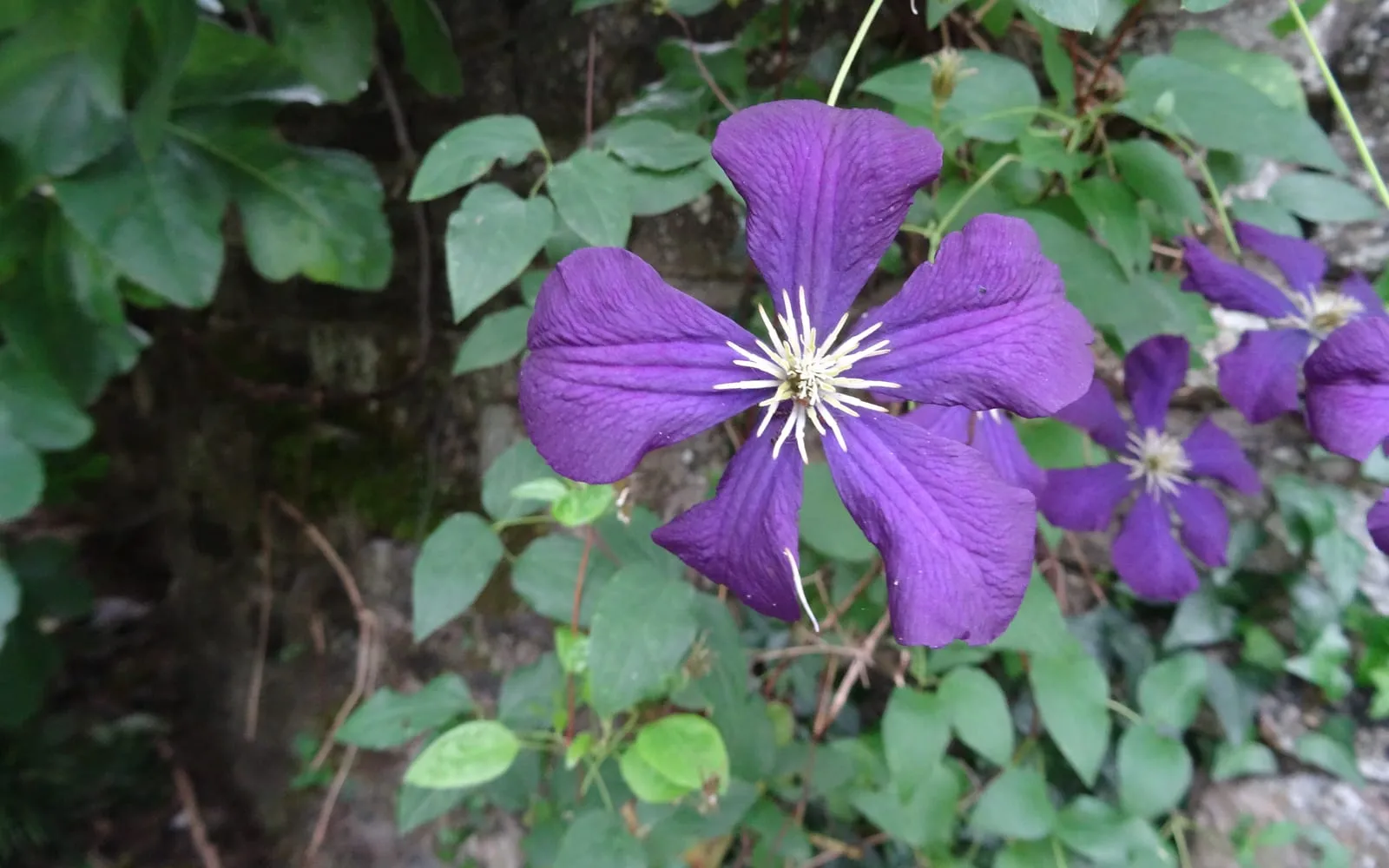
The flowers are smaller than the hybrids, 5 to 9 cm across, nodding, in purple, wine red, magenta, violet and white, and a plant carries hundreds of them from July to September.
They grow well on chalk, they tolerate more shade than most clematis, and they are ideal for scrambling through a shrub or a rose rather than needing a wall of their own.
‘Etoile Violette’, ‘Polish Spirit’, ‘Madame Julia Correvon’ and ‘Alba Luxurians’ are the cultivars that turn up in every good garden that grows them.
Appearance and character
A deciduous climber reaching 3 to 4 m in a season, dying back to a low framework each winter.
It climbs by twisting its leaf stalks around thin supports rather than by tendrils or suckers, so it needs netting, wires, twiggy growth or another plant to grip.
Leaves are pinnate, divided into several oval leaflets, mid-green and slightly leathery.
Flowers open from July to September, 5 to 9 cm across, nodding or half-nodding, with four to six pointed sepals that are often slightly twisted or recurved.
Colours run through deep purple, wine red, magenta, violet-blue, pink and white, most with a boss of contrasting stamens.
Flowering is prolific and long. A well-grown plant carries flowers continuously for two to three months.
Seed heads are silky and persist into autumn on some cultivars.
Growth is slender rather than heavy, which is why it sits well over a shrub without crushing it.
Where it is from
Southern Europe and western Asia, from Spain and Italy east through the Balkans to Iran, growing in scrub, on woodland edges and among rocks.
It reached Britain in 1569 and is one of the earliest clematis in cultivation here, recorded in Elizabethan gardens.
The Mediterranean origin explains two things. It tolerates chalk and alkaline soil readily, and it is later-flowering than the spring clematis because it flowers on growth made in the current year.
Viticella means little vine, describing the slender growth.
Nineteenth-century French and Polish breeding produced most of the named cultivars still grown. ‘Madame Julia Correvon’ dates from 1900 and ‘Etoile Violette’ from 1885.
The group’s resistance to clematis wilt, caused by Calophoma clematidina, has made it increasingly popular as gardeners have lost large-flowered hybrids to the disease.
Clematis vitalba, old man’s beard, is the native British relative found on chalk and limestone, and it is far too vigorous for a garden.
How it grows
Plant in autumn or spring into deep, fertile, moisture-retentive soil.
Plant it deep. Set the crown 8 to 10 cm below the soil surface, which is deeper than looks right. This is the insurance against clematis wilt, since buried dormant buds below the soil line can regenerate the plant if the top collapses.
Dig a generous hole and work in plenty of compost or well-rotted manure.
Shade the roots and give the top light. Place a slab, a low shrub or a group of perennials over the root area, and keep the flowering growth in sun or light shade.
Plant 45 cm out from a wall or a tree trunk, and lead the shoots to the support on a cane.
Provide netting, wires or twiggy support at a scale it can grip. Clematis holds on by twisting its leaf stalks and cannot grip a thick post or a bare wall.
Water generously for the first three years, which is what establishes a plant that performs.
Mulch thickly every spring with compost, keeping it clear of the stems.
Prune in February, cutting every stem down to 30 cm above the ground. That is the whole of it. Viticella clematis are pruning group three, they flower on the current year’s growth, and there is nothing to remember beyond one hard cut a year.
Cut back to a pair of strong buds and remove all the old growth above.
Protect the emerging spring shoots from slugs and snails, which is the one pest that matters.
Grow it through a shrub, a rose, a hedge or a small tree, which is what it does best. The February cut makes it a good companion because it is off the host plant for half the year.
Propagate by layering in spring or from internodal cuttings in early summer.
Through the seasons
Winter is bare, and February is the single pruning date, cutting everything to 30 cm.
Spring shoots away fast from the cut stems, and this is slug season and mulching time.
Summer builds through June and starts flowering in July.
Autumn carries the flowering into September, followed by silky seed heads on some cultivars.
Care difficulty
Easy, and much easier than the large-flowered hybrids.
The pruning is a single cut in February. There is no group to remember, no old wood to preserve and no risk of cutting off the flowers.
It resists clematis wilt, grows on chalk, tolerates partial shade and flowers for months.
The two requirements are deep planting and moisture. A clematis with dry roots underperforms in every way, and mulching and watering are what make the difference between an adequate plant and a spectacular one.
Watering
Water generously through dry spells, particularly for the first three years and always at the base of a wall.
Clematis is a thirsty plant with deep roots, and dry soil is the commonest reason one disappoints.
Soak thoroughly rather than sprinkling, and water at the base rather than over the foliage.
Mulch thickly every spring with compost, which conserves more moisture than watering adds and keeps the roots cool.
The dry strip at the foot of a wall or under a tree needs the most attention.
Warning signs, diseases and pests
A shoot or the whole plant wilting and blackening from a point near the base, within a day or two, is clematis wilt. It is uncommon in viticella clematis and does happen. Cut the affected stems out below the damaged point, right to ground level if necessary, water and feed, and a deeply planted specimen usually reshoots from below the soil.
Shoots eaten off at ground level in spring is slugs and snails, which is the main pest. Protect the crown as growth emerges.
Ragged holes in the flowers and buds is earwigs, which feed at night. Trap them in a pot of straw on a cane if it bothers you.
Yellowing lower leaves in summer is usually drought at the roots. Water and mulch.
White powdery coating on the leaves is powdery mildew following dry roots.
Sparse growth with few flowers is generally dry soil, deep shade or a plant that is still young. Clematis takes three years to get going.
Green flowers with distorted growth is clematis slime flux or a virus, both uncommon.
Growing environment
Full sun to partial shade for the top growth, with the roots shaded and cool. Viticella cultivars tolerate more shade than most clematis, and the dark-flowered ones hold colour better out of hot sun.
Deep, fertile, moisture-retentive but free-draining soil. It grows well on chalk and alkaline ground, which many plants do not.
Fully hardy to about -30 deg C.
Allow 2 to 3 m of run and give it something fine enough to grip.
It suits a fence with netting, an obelisk, a pergola, an arch, a hedge, a large shrub, a rose or a small tree.
Growing it through another plant is where it excels. Plant it at the base of a shrub 45 cm out, lead it in, and cut it to 30 cm every February so the host has the spring to itself.
Grow it with a rose, which is the traditional pairing and works because the February cut falls at the same time as the rose pruning.
Its wildlife value is fair. Bees work the flowers for pollen, and the seed heads and old stems give overwintering shelter.
Choose ‘Etoile Violette’ for deep purple, ‘Polish Spirit’ for violet-blue, ‘Madame Julia Correvon’ for wine red, and ‘Alba Luxurians’ for white with green tips.
Feeding
Feed in spring after pruning with a balanced general fertiliser, and again in early summer with a high-potash feed to support the flowering.
Mulch thickly every spring with compost or well-rotted manure, kept clear of the stems.
Feed a plant growing at the foot of a wall or through a shrub more attentively, since it is competing for both water and nutrients.
Avoid high-nitrogen feeds alone, which give leaf rather than flower.
A plant flowering poorly is usually short of water rather than short of feed.
Troubleshooting
When do I prune it? February, cutting every stem down to 30 cm above the ground. That is the main job. Viticella clematis are group three and flower on the current year’s growth.
Which pruning group is it? Group three, the simplest. One hard cut in late winter and nothing else.
Is it resistant to clematis wilt? Far more so than the large-flowered hybrids, which is the main reason to grow it. It is not immune, and deep planting is the insurance.
How deep should I plant it? With the crown 8 to 10 cm below the surface, which looks too deep and is correct. Buried buds let the plant regenerate if the top collapses.
A stem wilted and went black overnight. Clematis wilt. Cut the affected stems out below the damaged point, to ground level if needed, then water and feed. A deeply planted clematis usually reshoots.
The shoots were eaten off at ground level in spring. Slugs and snails, which is the one pest that matters. Protect the crown as the growth emerges.
Can I grow it on chalk? Yes, and it does well there. Viticella clematis come from Mediterranean limestone country.
Can it climb a bare wall? No. It grips by twisting its leaf stalks around thin supports, so it needs netting, wires or twiggy growth.
Can I grow it through a shrub? That is what it does best. Plant it 45 cm out from the host, lead it in on a cane, and cut it to 30 cm every February so the shrub has the spring to itself.
Is the sap dangerous? It irritates skin and causes blistering in some people. Wear gloves when pruning and wash your hands afterwards.