
Houseplant
Nightblooming Cereus
Selenicereus spinulosus
Also known as Selenicereus spinulosus
How to grow Selenicereus spinulosus, a nightblooming cereus, a vigorous climbing cactus with slender spiny stems and fragrant white night flowers.
At a glance
- Difficulty
- Easy
- Water
- When the top few centimetres have dried
- Light
- Bright light with some direct sun
- Temperature
- Warm; keep above about 10 deg C
- Humidity
- Average to high
- Hardiness
- USDA 10-12, RHS H1c, hardy to 10 C
- Type
- Evergreen climbing epiphytic cactus
- Height
- Stems to 3 m or more, climbing or trailing
- Native to
- Mexico
A slender climbing night-blooming cactus from the warm country of Mexico, clambering over rocks and trees by clinging aerial roots. It needs warmth, bright light and an open root run, with more water than a desert cactus in growth. It has no frost tolerance and slows below about 10 deg C, rotting in cold, wet compost.
Hardiness zones describe winter cold alone. Summer heat, humidity, rainfall and the length of the growing season decide as much, so treat the range as the outer limit rather than as a recommendation.
Not known to be toxic
A safe plant to keep around pets and children. Selenicereus is not listed as toxic by the ASPCA or the RHS, and is not known to contain harmful compounds. Its slender stems carry short spines that can prick, so the caution is physical not chemical, and it is best sited out of a pet's way. There is no poison in it.
Sources: ASPCA toxic and non-toxic plants, RHS potentially harmful garden plants
A climbing cactus, not a desert column
Selenicereus spinulosus is not built like the stout desert columns most people picture. It is a slender, scrambling climber, sending long, thin, ribbed stems up through rocks and over tree branches. Fine aerial roots emerge along the stems and help it cling. Each stem carries four to six sharp ribs, and the epithet spinulosus means finely spined, for the short bristles along them, which range from yellow to nearly black. It belongs to the moonlight-cactus group, whose name joins Selene, the moon goddess, to cereus, for a flower that waits for darkness. Instead of growing on open desert ground, it grows in warmer, lightly shaded parts of eastern Mexico, from Tamaulipas south to Chiapas, mostly below about 20 m in woodland and subtropical forest, rooted in leaf litter and pockets of debris as it climbs towards the light. Old records place it as far north as the lower Rio Grande valley of Texas, at the edge of its range.
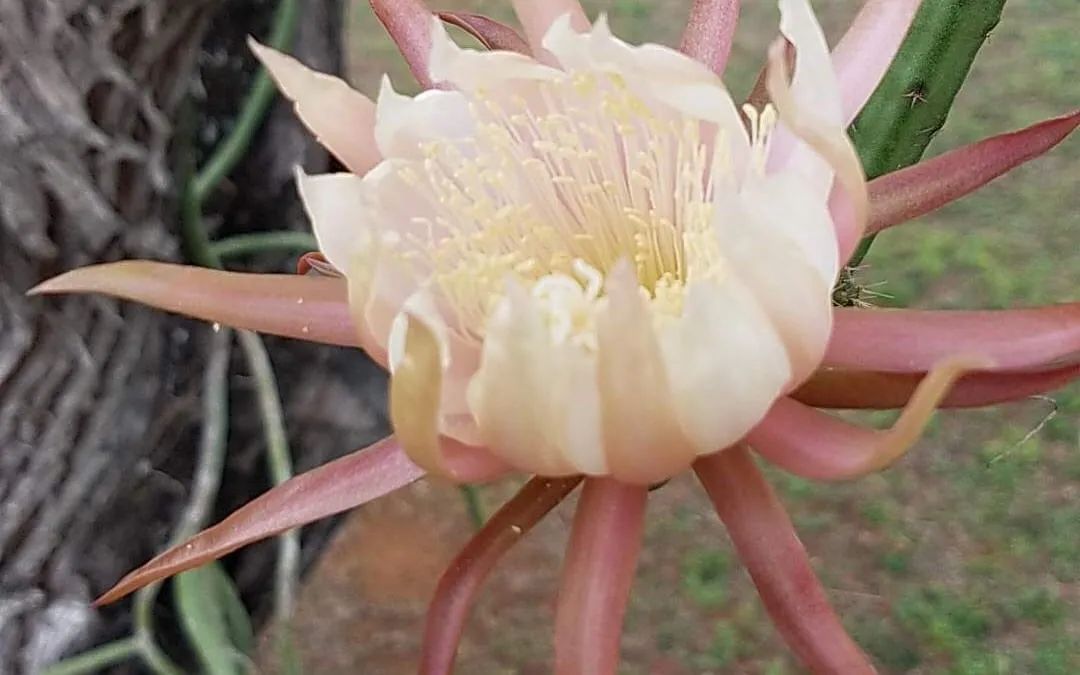
That climbing habit shapes its care. It needs an open, airy root run instead of a heavy pot of soil, bright light without harsh midday sun, and more moisture in growth than a desert cactus would tolerate. Given good care and enough age, it opens large, funnel-shaped flowers about 12 to 14 cm long on summer nights, shading from white to a faint pink. Each flower is strongly scented and lasts for one night.
Warmth, and light without the midday glare
This is a warm-climate plant with no frost tolerance. Keep it above about 10 deg C in winter, warmer than many desert cacti need. Cold checks its growth, and cold with a wet rootball can rot it. For light, choose a bright position with gentle morning or evening sun rather than harsh noon sun. Strong all-day sun on a windowsill can scorch the slim stems, while deep shade makes them thin and can stop flowering. A spot near a bright window, or good dappled light under glass, suits it well.
Watering a climber
Give it steadier moisture than you would give a globe or barrel cactus, but never leave the roots sitting wet. Through the warm growing months, water once the top few centimetres of the mix have dried, let the surplus drain away, and keep the plant lightly moist. As light drops towards winter, water less and let it rest cooler and drier. That rest helps the plant prepare its next buds. It also appreciates some humidity around its stems, so occasional misting in warm, dry spells can help.
An open, quick-draining mix
Root it in an open, airy medium instead of dense soil. A blend of loam-based or peat-free compost with orchid bark, perlite and grit gives the fast drainage and root aeration that a scrambling epiphyte needs. Because the stems climb, give them a moss pole, trellis or wire frame to grip, or let the plant spill from a hanging basket. The aerial roots will fasten on to what they touch. Repot in spring once the plant has filled its container and the stems have begun to crowd.
Feeding
A high-potassium feed of the kind sold for tomatoes, or a dilute cactus feed, given monthly through the growing season, supports both the stems and the flower buds. Keep it well diluted, and stop feeding through the cooler winter rest, when the plant is idle. A newly potted plant needs no feed for its first few weeks while it settles into the fresh mix and finds its roots.
Propagation
Cuttings root easily. Take a length of stem in warm weather, let the cut end dry for a few days until it has sealed, then lay or set it in a just-moist open mix. It can root along its length, helped by the aerial roots already on the stem. Seed is possible but slower, and cuttings keep the parent’s flowering habit, so a piece from a plant known to bloom is the more reliable route to flowers.
Training a vigorous climber
This is a fast grower once warm. If left alone, the slender stems shoot out in long lengths looking for support. Guide them onto a moss pole or frame while they are young and flexible, tying them in loosely until the aerial roots grip. This keeps the plant upright and tidy instead of tangled. A stem that has run too far can be shortened, and the cut piece can be rooted, so pruning and propagation can be done at the same time. Keep the plant slightly potbound rather than moving it into a larger pot too often, since a snug root run seems to help mature plants flower sooner.
Problems
Soft, blackening patches on the stems or at the roots are rot from cold, wet compost, especially through a cool winter. Cut out the affected parts, dry the plant off and keep it warmer and drier. Mealybugs settle as white cottony specks along the ribs and in the areoles; clear them with a swab of dilute alcohol. Thin, weak, over-long stems with wide gaps between growth points mean the plant needs more light. A plant that will not flower is usually still too young, or it has missed the cooler, drier winter rest that helps trigger buds.
Why won’t it flower? The night flowers come only on a mature plant, and usually only after a cooler, drier winter rest. A young plant, or one kept warm all year, tends to grow instead of bloom.
Does it need a pole to climb? It does best with a moss pole, trellis or frame to scramble up, gripping with its aerial roots, though it will also trail from a hanging pot.
How much sun does it want? Bright light with a little soft direct sun, out of the harsh midday scorch, which its slim climbing stems dislike.
Is it safe around pets? It carries no poison; the only caution is physical, since the stems bear short spines that can prick, so site it out of a pet’s way.
Nightblooming Cereus problem guides
Not sure what is wrong? See the common houseplant pests guide.