
Houseplant
Raindrop Peperomia
Peperomia polybotrya
How to grow raindrop peperomia, Peperomia polybotrya. Why its thick, teardrop leaves cope better with a missed watering than with compost left wet, and why it is safe for a home with cats, dogs or a toddler who chews everything.
At a glance
- Difficulty
- Easy
- Water
- When the top half of the compost has dried, roughly every ten days to two weeks
- Light
- Bright, indirect light; tolerates medium light
- Temperature
- Above 12 deg C
- Humidity
- Average room humidity is fine
- Hardiness
- USDA 10-12, RHS H1b, hardy to 12 C
- Type
- Evergreen semi-succulent perennial
- Height
- 25-30 cm
- Native to
- northern South America
A forest-floor plant from the foothills of northern South America, used to filtered light and warmth without extremes. It has no cold tolerance and is grown as a houseplant everywhere outside the wet tropics.
Hardiness zones describe winter cold alone. Summer heat, humidity, rainfall and the length of the growing season decide as much, so treat the range as the outer limit rather than as a recommendation.
Not known to be toxic
Peperomia carries no identified toxic compound and appears on no reputable poisonous plant list. An animal that chews a leaf may be sick afterwards, the same as after eating any quantity of fibrous plant material, and a child who bites one gets nothing more than a mouthful of leaf. There are several hundred species in the genus and they are consistent on this point. Nothing here is encouragement to let a pet graze houseplants freely, since potting compost and any fertiliser granules in it cause more trouble than the foliage does, but it is one of the safer choices for a room with a cat, a dog or a toddler who puts things in their mouth.
Sources: RHS potentially harmful garden plants, ASPCA toxic and non-toxic plants
About
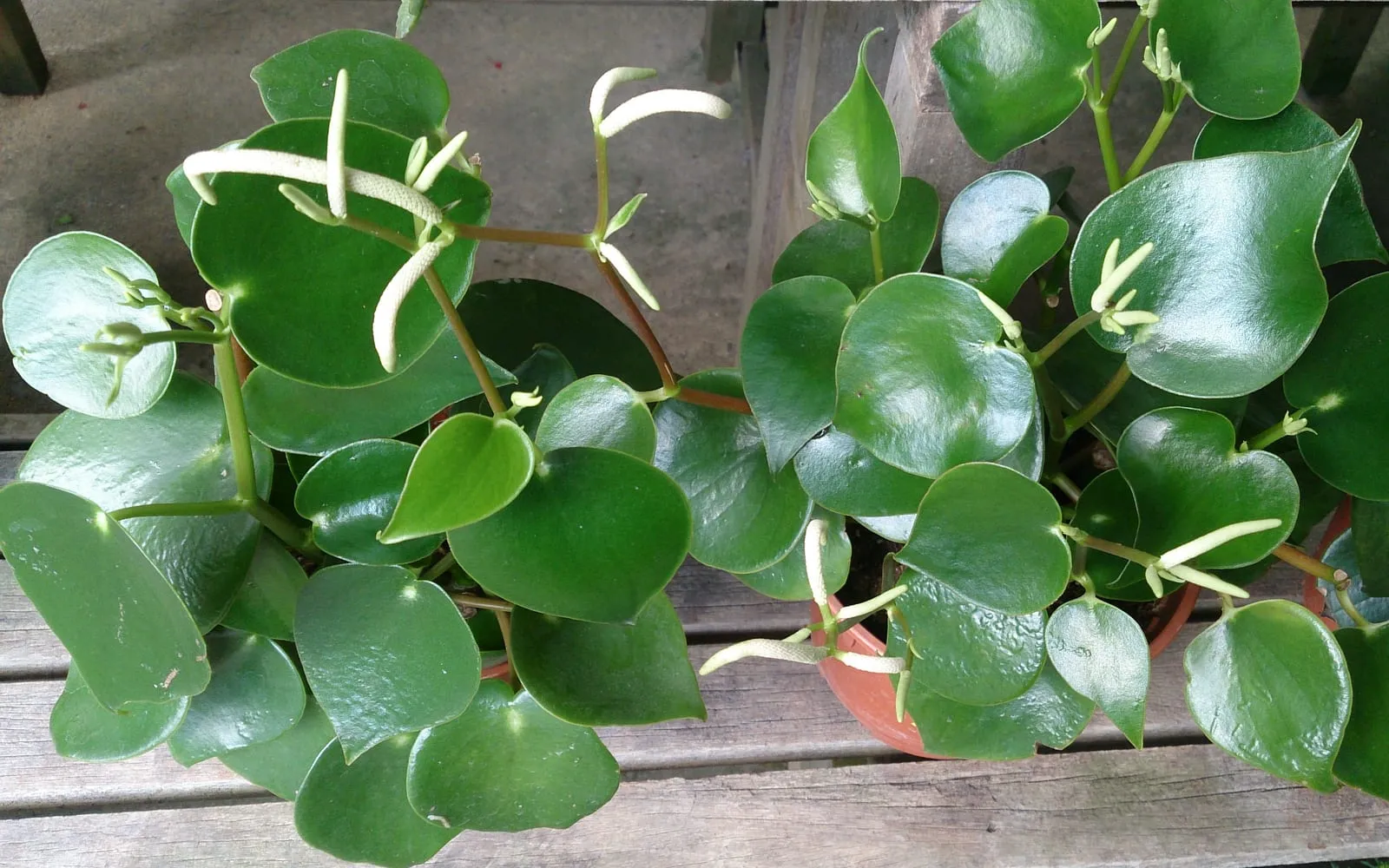
Raindrop peperomia is a compact houseplant with thick, glossy, teardrop- shaped leaves. The leaves store water, so the plant copes better with a missed watering than with compost that stays wet.
It grows best in bright indirect light and a free-draining mix. It is also non-toxic, which makes it a useful choice for rooms shared with cats, dogs or small children.
Appearance and character
Leaves are broad, glossy and shield-shaped, 5 to 8 cm long, a uniform deep green with a lacquered shine that catches the light. They are held on short, thick, fleshy petioles that are almost as succulent as the leaves themselves.
Growth is compact and upright rather than trailing, forming a dense clump of leaves on short stems that rarely exceeds 25 to 30 cm. Given good light it also sends up slender, upright flower spikes, thin green stalks studded with tiny flowers, that add little in the way of colour but are characteristic of the genus.
The overall look is architectural for a small plant, each leaf distinct and glossy rather than blending into a mass of foliage, which is why it reads well as a single specimen on a shelf or desk rather than needing to be grouped with others.
Where it is from
Peperomia polybotrya comes from the forest floor of the Andean foothills in northern South America, where light filters down through a canopy overhead and temperatures stay warm and fairly constant through the year.
That understory origin explains why it copes so well with the dimmer conditions of an ordinary room: it has never needed strong direct sun, only enough filtered light to keep photosynthesising steadily, and its thickened leaves are an adaptation to a forest floor where rainfall arrives inconsistently through the canopy rather than as a constant supply.
How it grows
Pot it in a free-draining houseplant compost with extra perlite mixed in, since the fleshy roots are as prone to rot in heavy, wet compost as the leaves are to store water when conditions are good.
Repot only every two to three years, moving up one pot size, since it is a naturally compact plant that does not need frequent repotting to stay healthy and can stay slightly potbound.
Propagate by leaf or stem cuttings in spring or summer, rooted in water or damp perlite; a leaf cutting with a short piece of petiole attached roots readily and is the easiest way to bulk up or share the plant.
Pinch out leggy growth occasionally to keep the clump dense, though this is rarely needed on a plant with good light, since it naturally stays compact.
Through the seasons
Spring is the best time to repot if needed and to take cuttings, as new growth resumes.
Summer is the main growing season. Water and feed on the regular schedule.
Autumn slows growth gradually. Ease off feeding towards the end of the season.
Winter is a quiet rest. Water less often, since the compost stays damp for longer at lower light and temperature, and stop feeding until spring.
Care difficulty
Easy, and among the more forgiving houseplants generally sold. The succulent-like leaves and stems give it a real buffer against missed waterings, so underwatering rarely causes lasting harm. Overwatering is the one mistake worth avoiding, since the same fleshy tissue that tolerates drought also rots quickly if the roots sit wet for long stretches.
Watering
Water when the top half of the compost has dried out, which in an average room is roughly every ten days to two weeks, less often in winter. Water moderately rather than heavily, enough to moisten the compost through without leaving the pot sitting wet.
Let the pot drain fully after watering and tip away anything left in a saucer. A peperomia sitting in standing water for more than a short while is at real risk of root rot within a few weeks.
Warning signs, diseases and pests
Mealybug appears as small white, cottony clusters tucked into the leaf joints. Wipe them away with a damp cloth or treat with horticultural soap.
Root rot follows compost that has stayed too wet for too long, and shows as leaves turning soft, translucent and eventually mushy, often with a darkened base to the plant. Unpot it, cut away any brown, mushy roots, let the remainder dry briefly, and repot into fresh, well-draining compost.
Soft, almost water-logged leaves without any visible pest are usually simple overwatering rather than disease, and the fix is the same: let the compost dry out properly before watering again.
Growing environment
Bright, indirect light suits it best and keeps growth compact and the leaf colour rich. It tolerates medium light too, though growth slows and the clump loosens slightly without enough light.
Keep it above 12 deg C. It has no tolerance for cold and shows stress through leaf drop well before any visible cold damage.
Average room humidity is enough; unlike many tropical houseplants, it does not particularly benefit from a pebble tray or extra misting, which mostly just wets leaves that would rather stay dry.
Keep it out of direct midday sun, which can scorch the glossy leaf surface, though gentler morning or evening sun through a window is fine.
Feeding
Feed with a balanced liquid houseplant fertiliser at half the strength on the label, once a month through spring and summer.
Stop feeding in autumn and winter. A plant growing this slowly at low light has little use for extra nutrients, and unused fertiliser accumulates as salts in the compost rather than being taken up.
Troubleshooting
The leaves feel soft and squishy rather than firm. Overwatering, almost always. Check the roots; if they are brown and mushy, repot into fresh, dry compost and water less often afterwards.
The plant has gone leggy with gaps between leaves. Not enough light. Move it somewhere brighter and pinch out the leggiest stems to encourage a bushier shape from lower down the plant.
Leaves are dropping with no other symptoms. Usually a sudden change in conditions, such as cold, a draught, or a big shift in light after moving the pot. It generally recovers once conditions settle.
Is it safe with cats that chew everything? Yes. Peperomia is one of the few houseplants that carries no toxin at all, so it is a sensible choice to replace something a pet keeps chewing.
Why has it not flowered? It flowers most readily in good light; a plant kept in a dim corner may skip the thin flower spikes altogether, though this has no effect on the plant’s health either way.
Raindrop Peperomia problem guides
Not sure what is wrong? See the common houseplant pests guide.