
Houseplant
Crown of thorns
Euphorbia milii
Also known as Christ plant, Christ thorn, Euphorbia milii
How to grow crown of thorns, Euphorbia milii. The caustic milky sap, flowering almost all year in good light, and the spines that make it a poor choice near children.
At a glance
- Difficulty
- Easy
- Water
- When the top half of the compost has dried, and less in winter
- Light
- Full sun to bright light, and it flowers in proportion to the light
- Temperature
- 15 to 27 deg C, and never below 10 deg C
- Hardiness
- USDA 10-12, RHS H1b, hardy to 10 C
- Type
- Evergreen succulent shrub, long lived and slow growing
- Height
- 60 cm to 1.5 m
- Native to
- Madagascar, in dry scrub and rocky ground
- Best month
- October in the Northern Hemisphere, April in the Southern Hemisphere
Madagascar. It flowers almost continuously in good light and needs no seasonal trigger, which is unusual among the succulent euphorbias. Outdoors year round in USDA 10 and warmer, where it makes a spiny informal hedge.
Hardiness zones describe winter cold alone. Summer heat, humidity, rainfall and the length of the growing season decide as much, so treat the range as the outer limit rather than as a recommendation.
Every month named in this guide is for the temperate Northern Hemisphere. If you garden in the Southern Hemisphere, shift each one by six months, so October becomes April. Closer to the equator the wet and dry seasons matter more than the calendar, and the shift stops being a useful guide.
Poisonous if eaten
- Do not eat
- The milky sap in all parts
- Harm from
- Handling it and eating it
- Affects
- People, cats and dogs
Crown of thorns is a Euphorbia, and every member of that genus bleeds a milky latex containing diterpene esters that are strongly irritant and inflammatory. The sap causes immediate burning, redness and blistering on skin, and contact with the eyes causes severe pain, swelling and in documented cases temporary or lasting damage to vision, which is the most serious risk from this plant. Rinse eyes immediately with copious water and get urgent medical care. Eating any part causes intense burning of the mouth and throat, vomiting and diarrhoea. The ASPCA lists Euphorbia milii as toxic to cats and dogs, and the RHS lists Euphorbia as a severe skin and eye irritant and as harmful if eaten. The sap also has tumour-promoting properties in laboratory studies, which is a reason for gloves rather than alarm. Always wear gloves and eye protection when pruning or repotting, wash your hands afterwards, and never rub your eyes while handling it. The spines are a separate hazard, up to 3 cm long and sharp, so this is a poor choice for a household with small children or for a position anybody passes closely.
Sources: RHS potentially harmful garden plants, ASPCA toxic and non-toxic plants
About
Crown of thorns flowers for most of the year, which very few houseplants manage, and it is armed and caustic.
Given a bright windowsill it produces small paired bracts in scarlet, pink, yellow, cream or orange more or less continuously, pausing only in the darkest weeks of winter. It tolerates dry air, central heating and neglect, and it lives for decades.
The stems are covered in sharp grey spines up to 3 cm long, and every part bleeds a milky latex that burns skin and can damage eyes. That combination makes it a poor choice on a windowsill people reach past, in a household with small children, or anywhere a cat jumps.
Handled with gloves and sited sensibly it is one of the best flowering houseplants available for a sunny position.
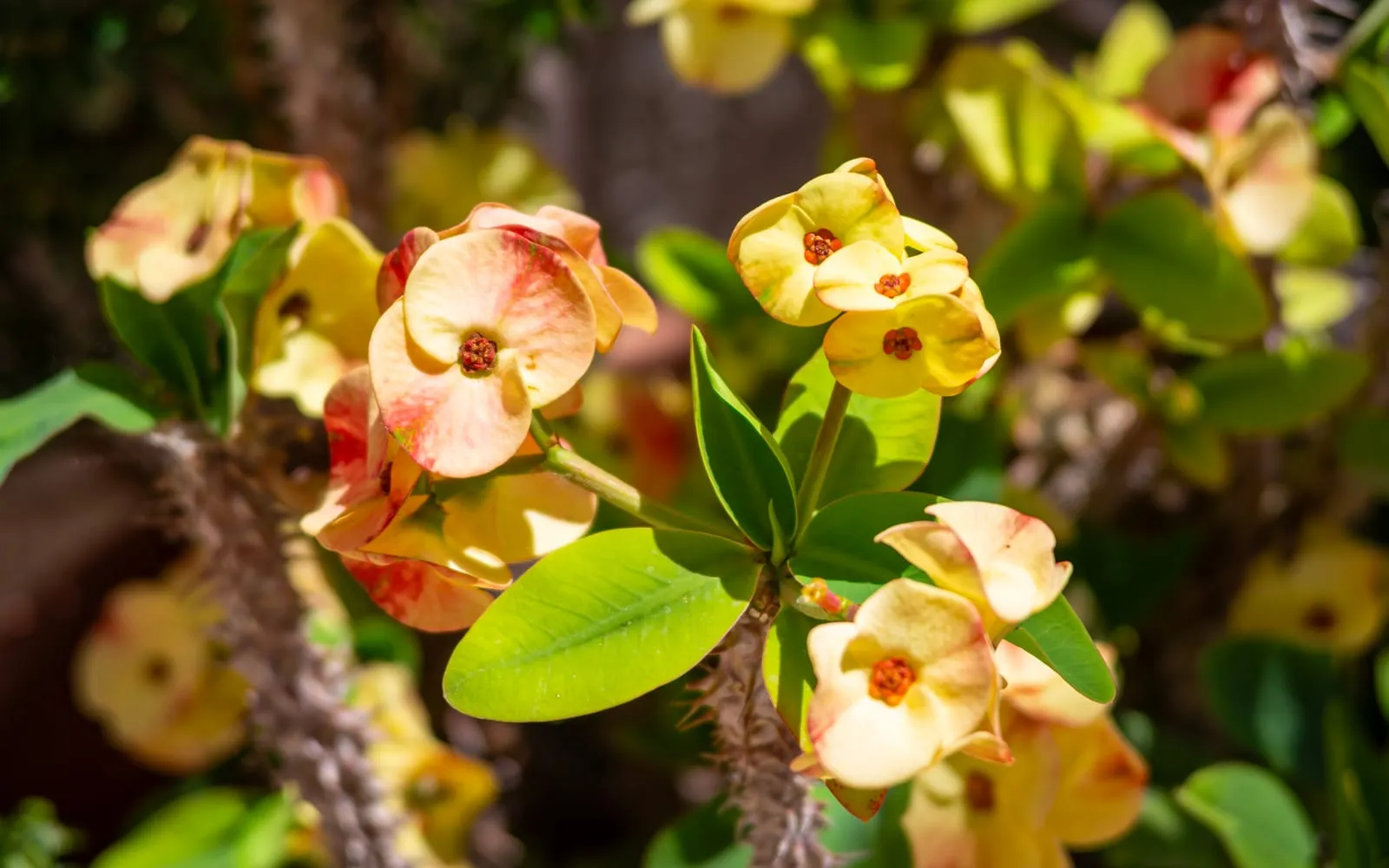
The showy parts are not petals. They are bracts, modified leaves, in pairs around the tiny true flowers, which is the same arrangement poinsettia uses and the two are close relatives.
Leaf drop is the behaviour that alarms people most. A crown of thorns sheds its leaves after any change of position, temperature, watering or season, and it grows a new set within weeks. It is not dying.
Appearance and character
An evergreen succulent shrub reaching 60 cm to 1.5 m indoors, slow growing and long lived.
Stems are grey-brown, ridged, semi-woody and densely covered in stiff sharp spines 1 to 3 cm long.
Leaves are bright green, obovate, 3 to 6 cm long, clustered towards the tips of the stems and shed from the older growth, so the plant is bare and spiny below and leafy at the top.
Flowers are tiny and yellow-green, held in pairs of showy bracts that are the visible part of the display.
Bracts are 1 to 2 cm across, in scarlet, crimson, pink, salmon, yellow, cream and orange depending on cultivar, held in small clusters at the shoot tips.
Flowering is nearly continuous in good light, easing off only in midwinter.
Thai hybrids, sometimes sold as Euphorbia milii var. hislopii or as giant crown of thorns, have much larger bracts and broader leaves.
Every part bleeds a white latex when cut or broken.
Growth is slow, perhaps 10 to 15 cm a year.
Where it is from
Madagascar, growing in dry scrub, on rocky ground and in seasonally dry forest.
It was introduced to France in 1821 by Baron Milius, then governor of Reunion, which is where the species name comes from.
The common names refer to a tradition that the crown of thorns placed on Christ was made from this plant, which is chronologically impossible since the species is Malagasy and was not known outside Madagascar until the nineteenth century.
It is in Euphorbiaceae alongside poinsettia, castor oil plant, cassava and the pencil cactus, and the milky caustic latex is a family characteristic.
The genus Euphorbia is one of the largest in the plant kingdom, with over two thousand species ranging from tiny annual weeds to tree-sized succulents.
Extensive breeding in Thailand from the 1980s produced the large-flowered hybrids now widely sold, with bracts several times the size of the original species.
Madagascar has lost a great deal of its dry forest habitat, and several Euphorbia species from the island are threatened, though milii itself is widely cultivated.
How it grows
Grow it in full sun to bright light. Flowering is directly proportional to the light it gets, and a plant in shade produces leaves and no bracts. A south or west-facing windowsill is ideal.
Use a gritty free-draining cactus or succulent compost, or a loam-based compost with a third added grit.
Pot into a container only slightly larger than the root ball, with generous drainage.
Water when the top half of the compost has dried, giving enough to run through the pot, then draining fully. Never leave it standing in water.
Reduce watering considerably from November to February, giving just enough to stop the stems shrivelling.
Keep it above 10 deg C, away from cold draughts and cold glass.
Low humidity is fine. It needs no misting and dry centrally heated air suits it.
Feed monthly from April to September with a balanced or high-potash feed at half strength.
Wear gloves and eye protection whenever you prune, repot or handle it, and wash your hands afterwards. The sap burns skin and can damage eyes.
Prune in early spring to shape the plant and control its size, cutting stems back to a joint.
Stop the bleeding by dabbing the cut end with a damp cloth or dipping it in cold water, and dispose of the cuttings carefully.
Deadhead spent bract clusters to keep it tidy.
Repot every two or three years in spring.
Propagate from stem cuttings in spring or summer. Cut a shoot 8 to 10 cm long, wearing gloves, rinse the cut end to stop the latex flowing, let it dry and callus for several days, then pot it into gritty compost and water sparingly until it roots.
Site it out of reach and away from anywhere people brush past, because of the spines as much as the sap.
Through the seasons
Winter is a rest period with reduced flowering. Water sparingly, stop feeding, and keep it above 10 deg C in the brightest position available.
Spring starts back into growth and flowering, and this is pruning, repotting and propagating season.
Summer is the main flowering period, needing bright light, regular watering and monthly feeding.
Autumn continues flowering into November, and this is the point to reduce watering and stop feeding.
Care difficulty
Easy to grow and awkward to handle.
The plant itself is undemanding. It tolerates dry air, central heating, a wide temperature range and irregular watering, and it flowers for most of the year in a sunny window.
The difficulty is entirely the sap and the spines, which make every pruning and repotting job a matter for gloves and care, and which make siting it a real decision in a household with children or pets.
Leaf drop after any change is normal and recurs, and knowing that saves a good deal of worry.
Overwatering is the one thing that kills it.
Watering
Water when the top half of the compost has dried, checking with a finger rather than by a schedule.
Water thoroughly so it runs through the pot, let it drain fully, and empty the saucer.
Reduce watering considerably from November to February, giving just enough to stop the stems shrivelling.
Never let it stand in water at any time of year.
Overwatering shows as yellowing leaves, leaf drop and eventually a soft blackening stem base, which is usually fatal.
Underwatering shows as shrivelled stems and leaf drop, and it recovers quickly.
Use tepid water rather than cold.
Warning signs, diseases and pests
Sudden leaf drop after a move, a repot, a cold spell or a change of season is normal for this plant. It grows a new set within a few weeks. Keep it in a stable position and do not overwater in response.
Leaves but no bracts is insufficient light. Move it into full sun, since flowering is proportional to the light.
Yellowing leaves with a soft blackening stem base is root rot from overwatering. Reduce watering, check the drainage, and take cuttings from healthy top growth if the base has gone.
Shrivelled stems is underwatering, which corrects quickly.
Pale scorched patches is sudden exposure to strong sun after a period in low light. Increase the light gradually.
White cottony masses in the leaf clusters and among the spines is mealybug, which is the commonest pest. Wipe them off with a cotton bud dipped in alcohol, wearing gloves.
Brown limpet-like bumps on the stems is scale insect.
Fine mottling with webbing is red spider mite in very dry air.
Flowering stopping entirely in midwinter is normal and it resumes as the light returns.
Growing environment
Full sun to bright light. A south or west-facing windowsill. Flowering falls off sharply in anything less.
A gritty free-draining cactus compost in a pot only slightly larger than the root ball with generous drainage.
15 to 27 deg C, and never below 10 deg C. Keep it away from cold draughts and cold glass.
Low humidity is fine, and dry centrally heated air suits it, which is unusual among flowering houseplants.
Allow 45 to 60 cm of spread on a mature plant.
It suits a sunny windowsill, a conservatory, a bright porch or a south-facing shelf.
Site it out of reach. The spines are sharp and up to 3 cm long, and the sap burns skin and can damage eyes. It is a poor choice on a windowsill people reach past, in a household with small children, or anywhere a cat jumps.
Grow it with other sun-loving succulents that want the same treatment. Cacti, aloe, agave, echeveria and jade plant all share the light and the sparing watering.
Choose a Thai hybrid for much larger bracts, or the plain species for a tougher and smaller-flowered plant.
Feeding
Feed monthly from April to September with a balanced or high-potash liquid feed at half strength.
A high-potash feed such as tomato food supports the flowering better than a general one.
Do not feed from October to March.
Repot every two or three years in spring into fresh gritty compost.
Do not overfeed. The plant grows slowly and extra fertiliser gives soft growth rather than more flowers.
Poor flowering is a light problem before it is a nutrient one.
Troubleshooting
All the leaves fell off. Normal after any change of position, temperature, watering or season. It grows a new set within a few weeks. Do not respond by watering more.
It has leaves but no flowers. Not enough light. Flowering is directly proportional to the light it gets, so move it to a south or west-facing window.
How dangerous is the sap? Seriously irritant. It burns skin, and contact with the eyes causes severe pain and has caused lasting damage to vision. Wear gloves and eye protection when pruning or repotting, wash your hands, and never rub your eyes while handling it. Rinse eyes with copious water and get urgent medical care if any gets in.
Is it safe around pets and children? No. The ASPCA lists it as toxic to cats and dogs, the sap burns, and the spines are up to 3 cm long. Site it out of reach or choose a different plant.
How do I take cuttings? Wearing gloves, cut a shoot 8 to 10 cm long, rinse the cut end to stop the latex flowing, let it dry and callus for several days, then pot it into gritty compost and water sparingly until it roots.
When should I prune it? Early spring. Cut stems back to a joint, and stop the bleeding by dabbing the cut with a damp cloth.
How often should I water it? When the top half of the compost has dried, and considerably less from November to February.
The base has gone soft and black. Root rot from overwatering, and usually fatal. Take cuttings from healthy top growth.
Is it the plant from the crucifixion? No. It is from Madagascar and was unknown outside the island until the nineteenth century. The name is a tradition rather than a history.
Crown of thorns problem guides
Not sure what is wrong? See the common houseplant pests guide.