
Outdoor plant
Grape hyacinth
Muscari armeniacum
Also known as Muscari, Armenian grape hyacinth
How to grow grape hyacinths, Muscari armeniacum. Planting depth, why the leaves appear in autumn and look untidy all winter, and how to stop it taking over.
At a glance
- Difficulty
- Easy
- Water
- Rarely, and never once the leaves have died back
- Light
- Full sun to partial shade
- Temperature
- Very hardy, to -20 deg C
- Hardiness
- USDA 4-8, RHS H6, hardy to -25 C
- Type
- Bulbous perennial, increasing rapidly into large colonies
- Height
- 15-20 cm
- Native to
- South-eastern Europe, Turkey and the Caucasus
- Best month
- October in the Northern Hemisphere, April in the Southern Hemisphere
Leaves appear in autumn and stand all winter, which looks like a mistake and is the plant's normal cycle, so leave them alone. It needs a cold winter and a dry summer rest. Muscari armeniacum seeds and offsets prolifically and is naturalised across much of Europe and North America, so plant it where spreading does not matter.
Hardiness zones describe winter cold alone. Summer heat, humidity, rainfall and the length of the growing season decide as much, so treat the range as the outer limit rather than as a recommendation.
Every month named in this guide is for the temperate Northern Hemisphere. If you garden in the Southern Hemisphere, shift each one by six months, so October becomes April. Closer to the equator the wet and dry seasons matter more than the calendar, and the shift stops being a useful guide.
Harmful if eaten
- Do not eat
- The bulbs, and the rest of the plant to a lesser degree
- Harm from
- Eating it
- Affects
- People, cats and dogs
Mildly poisonous, chiefly the bulbs. Grape hyacinths contain saponins and comisic acid, and eating any quantity causes nausea, vomiting, drooling and diarrhoea in people, cats and dogs. The RHS lists Muscari among plants that are harmful if eaten. The effect is unpleasant rather than dangerous, and the realistic scenario is a dog digging up newly planted bulbs in autumn, which is worth guarding against because a dog will happily eat a dozen. Cover fresh plantings with netting or wire until the soil settles. Bulbs stored in a shed or a garage before planting are another risk worth thinking about, since a bag left within reach is an obvious target. The flowers and leaves contain far less and a mouthful of foliage is not a cause for alarm. Note that the closely related tassel hyacinth, Muscari comosum, is eaten as a vegetable in southern Italy under the name lampascioni, though only after prolonged soaking and boiling, which is not a reason to try the same with garden Muscari.
Sources: RHS potentially harmful garden plants, ASPCA toxic and non-toxic plants
About
Grape hyacinths are the cheapest way to buy a great deal of blue. A hundred bulbs cost very little, they flower in their first spring, and they increase by both offsets and seed until a small planting becomes a river of them.
October is when they go in the ground, and it is also when their oddest habit starts. The leaves appear in autumn, months before the flowers, and then sit through the winter getting longer, floppier and more battered. By March they look thoroughly untidy, and by April the flowers have covered them.
That autumn foliage is the main reason people either love this plant or regret it, and knowing about it in advance settles the question before you plant.
Appearance and character
A small bulbous perennial, 15 to 20 cm in flower, forming dense colonies that thicken quickly.
Leaves emerge in autumn, narrow, strap-shaped and semi-upright at first, then lengthening and flopping outward through winter until they are 20 to 30 cm long and lying about.
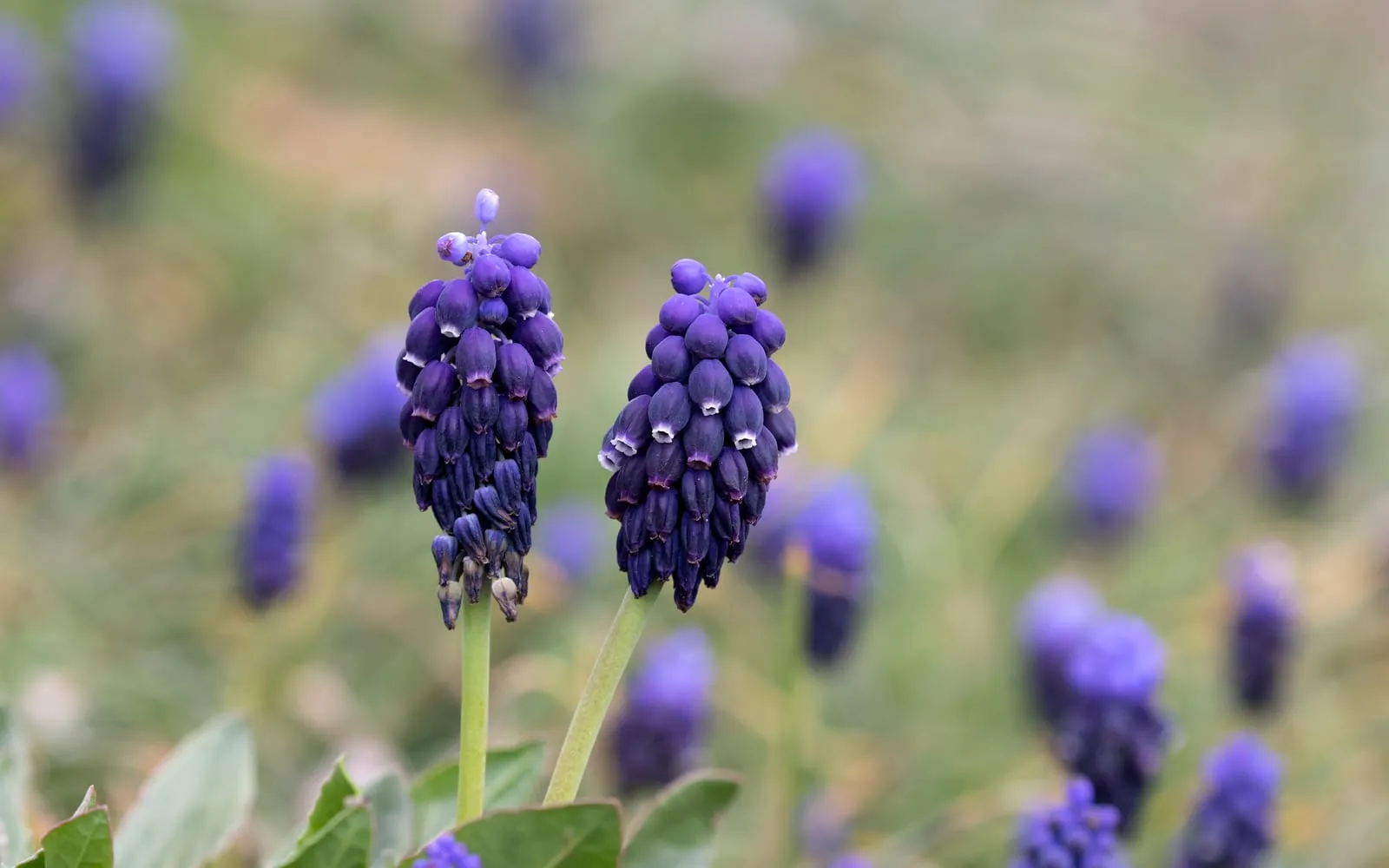
Flower spikes rise in April, dense conical racemes packed with fifty or more tiny urn-shaped bells, each about 5 mm long, in a strong deep blue-violet.
Each bell is constricted at the mouth and rimmed with a fine white edge, which is what gives the spike its beaded look and the plant its common name.
Sterile paler flowers sit at the very top of the spike, which is characteristic of the genus.
The scent is faint and musky. The genus name comes from the Greek for musk.
Common varieties include ‘Valerie Finnis’, a soft ice blue, ‘Album’, white, and Muscari latifolium has a single broad leaf and a two-tone spike of black-purple below and bright blue above.
Where it is from
South-eastern Europe, Turkey, the Caucasus and northern Iran, where it grows on open hillsides, in scrub and on the edges of woodland.
Those places have hot dry summers and cold wet winters, which is a Mediterranean pattern. The bulb sits dry and dormant through the heat and grows through the mild part of the year, which is why the leaves come up in autumn and stand all winter.
Free-draining ground is the requirement that follows. Grape hyacinths rot in heavy wet soil and thrive on thin poor gritty ground.
They were introduced to Britain in the sixteenth century and are now naturalised across much of Europe and North America, spreading along railway banks and roadsides.
The species is one of around forty in the genus, and Muscari armeniacum is the one sold in bulk because it is the most vigorous and the most reliable.
How it grows
Plant bulbs in September or October, 8 to 10 cm deep and 5 to 8 cm apart, in any free-draining soil.
Plant in generous quantity. Grape hyacinths look thin in ones and twos and excellent in fifties.
Choose the position with the spread in mind. They naturalise well in grass, along a path edge, under deciduous shrubs and in gravel, and they become a nuisance in a carefully planted border.
Expect the leaves in autumn. Nothing is wrong, and cutting them off weakens the bulb.
Deadhead after flowering if you want to limit the spread. Grape hyacinths seed themselves freely and the seedlings appear at some distance.
Leave the foliage to die back naturally in early summer, then clear it.
Lift and divide congested clumps in summer once dormant, replanting the offsets immediately.
They flower in their first spring and every one after, which is unusual among cheap bulbs.
Through the seasons
Autumn is planting and the reappearance of the leaves. Get bulbs in during September and October, and expect foliage within weeks.
Winter is the untidy season. The leaves lengthen and flop and look poor. Leave them alone.
Spring is the display. Flowers open in April and last three or four weeks. Deadhead afterwards if the spread concerns you.
Early summer is die-back. The foliage yellows and collapses through June, and the bulbs go dry and dormant.
Care difficulty
Easy to the point of being hard to stop. Grape hyacinths need no attention at all and increase whether you help them or not.
Controlling the spread is the real work. Deadheading before the seed sets is the simplest brake, and even then the bulbs multiply underground.
The autumn leaves are a matter of taste rather than a problem.
Waterlogging is the only condition that kills them.
Non-flowering happens in deep shade or in a badly congested clump, and both are easy to correct.
Watering
Grape hyacinths need no watering in the ground in a temperate climate.
Water new plantings once after planting if the autumn is dry, and then leave them.
Keep the bulbs dry through summer dormancy. Watering a border heavily in July over dormant Muscari encourages rot.
Container plantings need occasional watering while in growth and should be kept dry once the leaves die back.
Waterlogged ground rots the bulbs, so add grit on heavy clay or plant in raised ground.
Warning signs, diseases and pests
Spreading further than intended is the complaint that dominates. Grape hyacinths increase by bulb offsets and self-seed enthusiastically, and a small planting becomes a colony within a few years. Deadhead every spike as the flowers fade to stop the seed, and dig out strays while they are small. Removing an established colony from a border takes several seasons, since every fragment of bulb regrows.
Floppy untidy leaves through winter are normal rather than a fault. Cutting them back weakens the bulb, so plant them where the winter foliage will not offend, and let later perennials grow up through them in spring.
Bulb rot follows waterlogging, showing as soft brown bulbs and leaves that yellow and pull away easily. Improve drainage and add grit.
Slugs graze the emerging flower spikes in early spring.
Few flowers on a healthy clump usually means deep shade or severe congestion. Lift, divide and replant in summer, or move them into more sun.
Leaves with no flowers at all on newly planted bulbs sometimes means the bulbs were too small or planted too shallow.
Growing environment
Full sun gives the densest flowering, and partial shade is tolerated with a lighter display.
Any free-draining soil, including poor thin ground, gravel and sand. Rich soil is unnecessary.
Avoid heavy wet clay, which rots the bulbs, unless you add grit and plant on raised ground.
Give them somewhere they can spread. Naturalised in grass, under deciduous shrubs, along a path or in gravel are all better positions than a mixed border.
Containers work well and have the advantage of containing them completely. Plant densely for a good effect and keep the pot dry in summer.
They combine well with anything flowering at the same time in April, and they are particularly good under tulips and around emerging hostas, which cover the dying leaves.
Grass is a good position provided the mowing waits until the foliage has died back in June.
Feeding
Grape hyacinths need no feeding on ordinary soil.
A general bulb fertiliser in early spring helps only where a long-established colony has thinned.
Avoid rich feeding, which produces more leaf and no more flower.
Congested clumps respond to division rather than to feeding.
Container plantings benefit from fresh compost every second year.
Troubleshooting
The leaves came up in October. That is normal. Grape hyacinths make their foliage in autumn and hold it all winter before flowering in April.
Can I cut the winter leaves back? No. Cutting them weakens the bulb. Plant them where the untidy foliage will not matter, or grow later perennials through them.
They have spread everywhere. They increase by offsets and by seed. Deadhead every spike as it fades, and dig out strays while they are small.
Lots of leaves and no flowers. Usually deep shade or a badly congested clump. Lift and divide in summer, and replant in more sun.
The bulbs went soft and rotted. Waterlogged ground. Add grit, improve drainage, or plant in a raised bed or container.
How deep do I plant them? About 8 to 10 cm, in September or October.
Are they poisonous to dogs? Mildly. The bulbs cause vomiting and diarrhoea, so protect fresh plantings and keep bags of bulbs out of reach.
Which one is least invasive? Muscari latifolium and ‘Valerie Finnis’ both increase more slowly than the standard Muscari armeniacum, which is the one sold in bulk.