
Houseplant
Paddle Plant
Kalanchoe luciae
Also known as Desert Cabbage, Flapjack Plant
Practical guidance for growing paddle plant, Kalanchoe luciae, including flat paddle-shaped leaves, red colour in strong light, flowering stems, drought tolerance, and toxicity to pets.
At a glance
- Difficulty
- Easy
- Water
- Every one to two weeks in summer, monthly or less in winter
- Light
- Full sun to bright light; strong light needed for the red colouring
- Temperature
- 5-30 deg C
- Humidity
- Dry air; avoid misting
- Hardiness
- USDA 9b-11, RHS H2, hardy to -1 C
- Type
- Evergreen succulent perennial rosette, monocarpic after flowering
- Height
- Rosette to 45-60 cm; flower spike to 1-1.2 m
- Native to
- southern Africa
A rocky-slope succulent from southern Africa, where a dry season keeps the roots from ever sitting wet for long. It takes a brief light frost outdoors only if the compost is completely dry, and the red colouring people grow it for depends on strong light and a touch of cool stress rather than on the winter minimum itself. Cold combined with damp compost kills it far faster than cold alone.
Hardiness zones describe winter cold alone. Summer heat, humidity, rainfall and the length of the growing season decide as much, so treat the range as the outer limit rather than as a recommendation.
Toxic to pets if eaten
- Do not eat
- All parts, with the flowers carrying the highest concentration
- Harm from
- Eating it
- Affects
- Cats, dogs and horses
The ASPCA lists Kalanchoe as toxic to cats, dogs and horses. The whole genus, paddle plant included, contains cardiac glycosides called bufadienolides, which cause vomiting and diarrhoea after a modest amount is eaten and, more seriously, can affect heart rhythm if a pet consumes a large quantity, particularly of the flowers, where the compounds are most concentrated. The RHS also lists Kalanchoe among plants that are toxic if eaten. Most reported cases in pets involve gastrointestinal upset rather than cardiac symptoms, but any pet that has eaten more than a token nibble, and especially one that has been at the flower spike, should see a vet promptly rather than being watched at home.
Sources: ASPCA (Kalanchoe), RHS potentially harmful garden plants
About
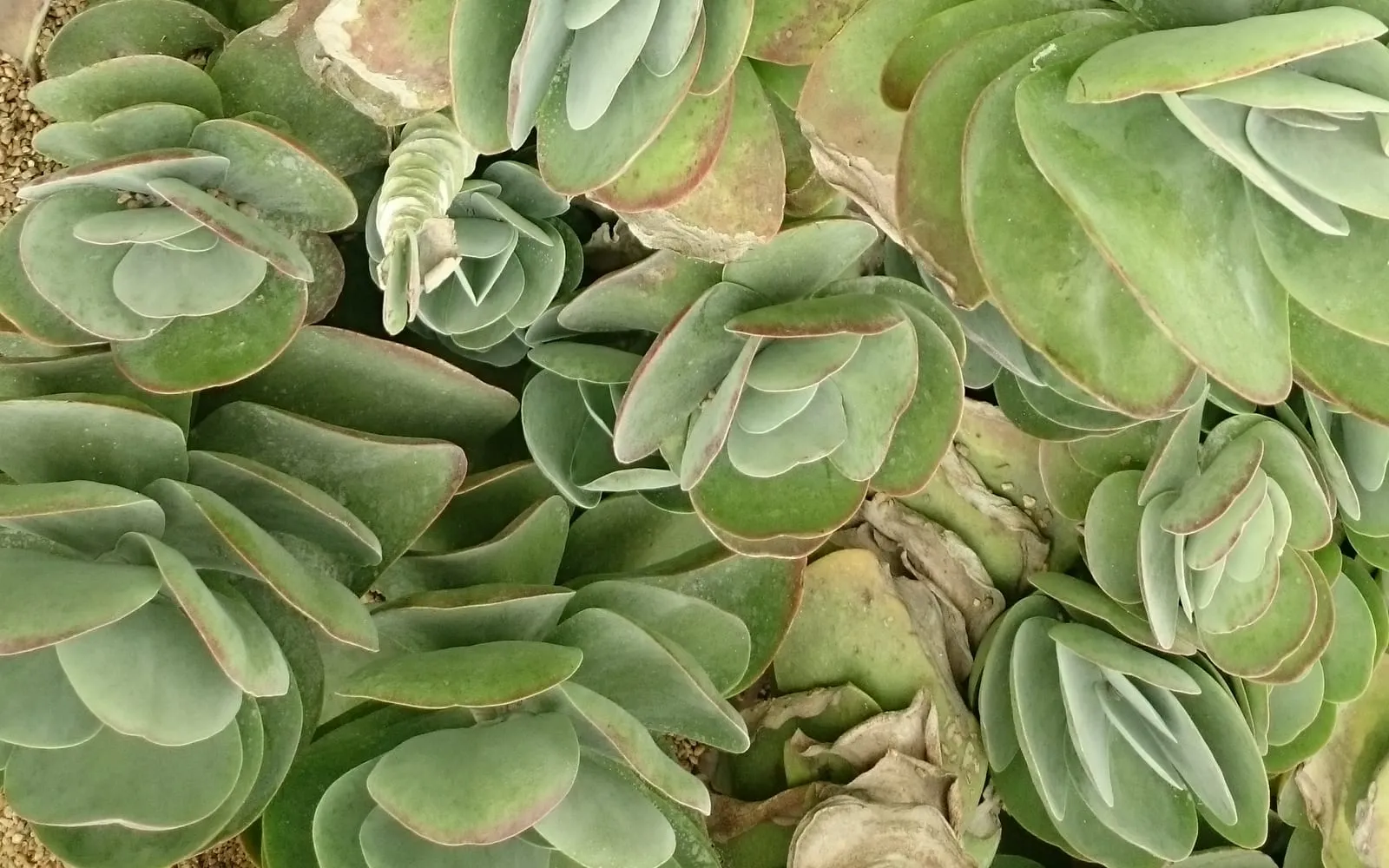
Paddle plant forms a large, striking rosette of broad, flat, spoon-shaped leaves stacked closely around a central point, closer in scale to a small cabbage than to the tight little rosettes most succulents are known for. Strong light and a touch of cool weather turn the leaf margins a deep coral red, a colour change that is the main reason it is grown.
A mature rosette eventually sends up a single tall flowering stem, after which that particular rosette declines. Offsets forming around the base carry the plant forward, so a well-grown clump keeps producing new rosettes even as older ones flower and fade.
Appearance and character
Leaves are broad, flat and paddle-shaped, pale green to grey-green at the centre of the rosette, with the outer, more exposed leaves flushing red along their margins and eventually across most of the surface in strong light and cool conditions. A mature rosette can reach 45 to 60 cm across.
The leaf edges carry a fine, slightly waxy bloom and a subtly scalloped margin, and older outer leaves are noticeably larger and more colourful than the tightly packed young growth at the centre.
A flowering rosette sends up a single tall stem, reaching a metre or more, topped with clusters of small, pale yellowish-white, tubular flowers. It is an impressive but final display for that rosette, which slowly declines once flowering finishes.
Offsets form at the base of a mature plant, sometimes well before flowering and sometimes only after, building a clump of multiple rosettes at different stages over a few years.
Where it is from
Kalanchoe luciae is native to rocky slopes and outcrops in southern Africa, growing in conditions with intense sunlight, sharp drainage and a pronounced dry season.
Strong, largely unfiltered sun across its native range is what produces the vivid red colouring the species is grown for, working alongside cooler night temperatures that intensify the effect further. A plant kept warm and evenly lit indoors year round often stays a plainer green, missing much of the colour a grower outdoors sees as a matter of course.
Rocky, free-draining ground means the roots rarely sit wet, and the thick, water-storing leaves are the plant’s buffer against the long dry stretches between rains that define its native climate.
How it grows
Give a young plant the widest, sunniest spot available rather than worrying over the exact potting mix. Almost any commercial cactus compost, or an ordinary multipurpose compost opened up with grit, pumice or coarse sand, does the job provided water runs straight through it. Light determines how the plant looks over the following year far more than the compost recipe does.
Colour builds slowly and answers to stress as much as to brightness. A plant stood outdoors for summer, meeting cooler nights and full sun together, develops noticeably more red than the same plant kept at a steady indoor temperature under equally strong light, so a season outside does more for its appearance than anything fed to the roots.
Eventually a mature rosette commits to flowering, sending up a single stem that can dwarf the rosette it grew from. Nothing prevents this once a rosette has reached flowering size, and there is no reason to try, since the display is worth having even though that particular rosette spends the following months declining rather than recovering afterwards.
Offsets, not the flowering rosette, are what keep a clump going for years. They form at the base, sometimes only once the parent has flowered and sometimes well before, and left in place they build a spreading group in which a declining rosette is replaced by others coming up around it.
Repotting matters more for stability than for root health on this species, since a mature rosette carries enough weight to tip a light pot. Choose something wide and solid rather than moving up in size often.
Through the seasons
Spring restarts active growth. Increase watering gradually, remove any spent flower stems from the previous season, and give the first feed.
Summer is the main growing period. Water every one to two weeks, and give the plant as much direct sun as the space allows for the strongest colour of the year.
Autumn slows growth, and cooler nights often intensify the red colouring further. Reduce watering as temperatures drop.
Winter is a dry rest. Water monthly at most, keep the plant in the brightest position available, and watch for a flower spike developing on any mature rosette.
Care difficulty
Easy in the sense that neglect rarely kills it. Give it more sun than feels necessary. A rosette that stays a flat, uniform green months after coming home usually needs stronger light than an average room provides.
The hazard differs from most houseplants. Every part contains compounds that can affect heart rhythm in a cat or dog that eats a large amount, concentrated most heavily in the flowers, so a household with a pet that chews foliage needs a plan for where the flower spike goes rather than only where the rosette sits.
Watering
Drench the pot until water runs from the base, then wait for the compost to dry out fully before doing it again, which through summer usually falls somewhere between one and two weeks apart depending on heat and light.
Read the lower leaves rather than counting days. A rosette that has started to feel slightly softer at its base is asking for water; one that still feels firm and full has nothing to gain from an early top-up.
Pull back sharply once autumn arrives. A dry, cool winter causes no lasting harm, whereas compost that stays even lightly moist through a cold spell is the single most common way this plant is lost.
Warning signs, diseases and pests
Mealybug tucks itself between the stacked paddle-shaped leaves, showing as small white, cottony tufts once a colony builds up. Reach into the gaps with surgical spirit on a fine paintbrush.
Aphids cluster on the tall flowering stem, particularly around the developing flower buds, distorting growth and leaving a sticky residue. Rinse them off under a tap or treat with horticultural soap.
Root rot follows compost that never dries out, showing as translucent, mushy leaves and a rosette that collapses at its base. Cut away all affected growth, take healthy offsets as insurance, and start again in fresh, gritty compost.
Powdery mildew can develop on crowded leaves in still, humid air, showing as a white, dusty coating. Improve air circulation around the plant and remove badly affected leaves.
Growing environment
Give it more direct sun than instinct suggests. Several hours of unfiltered light a day, ideally including some cooler hours at dawn or dusk, is what turns the leaf margins from green to the deep coral red the species is grown for. A rosette kept a step back from the window stays plain and tends to grow visibly looser.
Ordinary indoor temperatures suit it for most of the year, and an established plant tolerates a short, light frost outdoors provided the compost around its roots is dry when the cold arrives. Wet compost in cold weather, rather than the cold on its own, is what causes real damage.
Leave humidity out of the equation entirely. This is a plant from open, rocky ground, and still, damp air around a large, densely packed rosette is more likely to encourage mildew than to do the plant any good.
Choose a wide, heavy-based pot over a tall, narrow one. A large rosette in full leaf can be top-heavy, and a broad base filled with a gritty, fast-draining mix keeps both the plant upright and the roots from sitting wet.
Feeding
Feed sparingly. A half-strength cactus fertiliser applied once as growth resumes in spring and once more in midsummer supplies everything a healthy plant needs; more frequent feeding mostly pushes soft growth that colours poorly and holds less of the plant’s characteristic red.
Skip feeding entirely on a plant that has just been divided or repotted, and on any rosette that is in the process of flowering, since a flowering rosette draws on reserves it has already built rather than on anything fresh from the roots.
Troubleshooting
My plant has stayed green rather than turning red. Not enough direct sun, almost always. Move it to the brightest, sunniest spot available, and allow several weeks for the colour to build once light improves.
A tall flower stem has appeared. What happens now? That rosette is flowering for the first and only time and will decline gradually over the following months once flowering finishes. Cut the spent stem out and let any offsets at the base take over.
Leaves have gone soft, translucent and are dropping. Overwatering, most likely leading into root rot. Stop watering, check the roots, and take healthy offsets as insurance if the damage looks extensive.
No offsets have formed and the flowering rosette is declining. This happens occasionally, most often on a plant grown as a single rosette without ever being divided. Take a leaf or a section of stem from the declining rosette while it is still firm enough to callus and root.
Is it safe to grow where a dog might reach the flower spike? Treat it with caution. The flowers carry the highest concentration of the toxic compounds in this genus, so position a flowering plant well out of reach of a dog that chews at foliage or fallen petals.
Paddle Plant problem guides
Not sure what is wrong? See the common houseplant pests guide.