
Houseplant
Mother of thousands
Kalanchoe daigremontiana
Also known as Devil's backbone, Mexican hat plant, Alligator plant
How to grow mother of thousands, Kalanchoe daigremontiana. The plantlets that drop off everywhere, the cardiac glycosides that kill livestock, and containing it.
At a glance
- Difficulty
- Easy
- Water
- When the compost has dried out, and rarely in winter
- Light
- Bright light including some direct sun
- Temperature
- 15 to 27 deg C, and never below 10 deg C
- Hardiness
- USDA 10-11, RHS H1c, hardy to 10 C
- Type
- Evergreen succulent, and the plant dies after flowering
- Height
- 60 cm to 1 m
- Native to
- Southern Madagascar, and widely naturalised in the tropics and subtropics
- Best month
- December in the Northern Hemisphere, June in the Southern Hemisphere
Madagascar. Every plantlet along the leaf margin is a ready-made clone, which makes it an easy houseplant and a problem plant outdoors. It is a declared weed in parts of Queensland and New South Wales and naturalised in Florida, Hawaii and southern Africa, so in USDA 10 and warmer keep it contained and never compost the leaves.
Hardiness zones describe winter cold alone. Summer heat, humidity, rainfall and the length of the growing season decide as much, so treat the range as the outer limit rather than as a recommendation.
Every month named in this guide is for the temperate Northern Hemisphere. If you garden in the Southern Hemisphere, shift each one by six months, so December becomes June. Closer to the equator the wet and dry seasons matter more than the calendar, and the shift stops being a useful guide.
Poisonous if eaten
- Do not eat
- All parts, and the flowers and plantlets most of all
- Harm from
- Eating it
- Affects
- People, cats, dogs and horses
Kalanchoe daigremontiana contains bufadienolides, which are cardiac glycosides acting on the heart in the same way as digitalis from foxglove. This is one of the genuinely dangerous plants sold routinely as an undemanding houseplant. Eating any part causes salivation, vomiting, diarrhoea and abdominal pain, and in larger amounts a slow or irregular heartbeat, weakness, collapse and death. Livestock poisoning is extensively documented in Australia and South Africa, where the plant has naturalised and where it has killed cattle in large numbers, and the flowers carry the highest concentration. The ASPCA lists Kalanchoe as toxic to cats, dogs and horses, and cardiac effects in pets are recorded rather than theoretical. The RHS lists Kalanchoe as harmful if eaten. The plantlets are the practical problem in a house, since they drop constantly, root in every pot within reach, and end up on floors and windowsills at exactly the height a toddler or a cat finds them. Treat any ingestion by a person or an animal as a call to a doctor or vet rather than something to watch, and sweep up dropped plantlets rather than leaving them.
Sources: RHS potentially harmful garden plants, ASPCA toxic and non-toxic plants
About
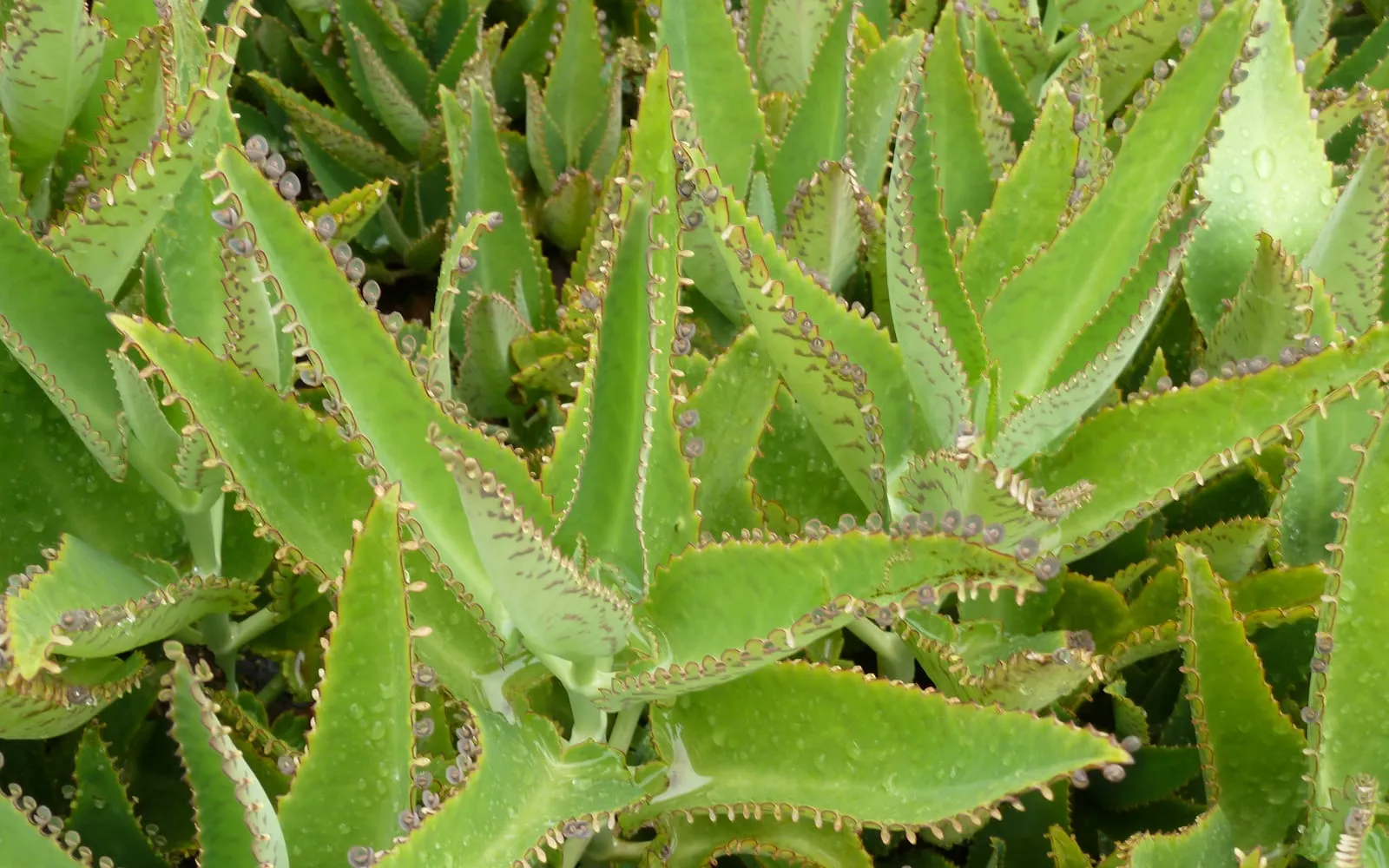
Mother of thousands earns its name by producing perfect miniature plants along the edge of every leaf, each with its own tiny roots, ready to drop off and grow wherever it lands.
That is a remarkable thing to watch and a nuisance to live with. The plantlets fall constantly, they root in the compost of every other pot on the windowsill, they turn up on the carpet and in the gaps between floorboards, and one plant becomes fifty within a couple of years.
It is also seriously poisonous despite being sold as a curiosity to people who assume a succulent must be harmless. The plant contains cardiac glycosides of the same general kind as those in foxglove, it has killed cattle in large numbers in Australia and South Africa, and the ASPCA lists it as toxic to cats, dogs and horses.
The combination of constantly dropping plantlets and genuine cardiac toxicity makes it a poor choice in a household with a toddler or a cat.
Grown knowingly, in a pot on its own, out of reach, with the dropped plantlets swept up, it is a fascinating and extremely easy plant.
The parent dies after flowering, which usually happens in winter after two or three years, and by then you will have plenty of replacements whether you wanted them or not.
Appearance and character
An evergreen succulent reaching 60 cm to 1 m, growing as a single upright unbranched stem.
Leaves are fleshy, narrowly triangular, 10 to 20 cm long, blue-green above with purple-brown blotching and mottling beneath, held in opposite pairs.
The leaf margins are scalloped, and a plantlet develops in every notch along the edge.
Plantlets are perfect miniature plants, 5 to 10 mm across, each with a pair of leaves and a tuft of roots already formed while still attached to the parent.
They detach at the slightest disturbance and root wherever they land, including on a dry surface.
Flowers appear in winter on a mature plant, in a large drooping cluster of tubular grey-pink to orange bells at the top of the stem.
The parent plant dies after flowering, which is normal.
The plant is sometimes sold as Bryophyllum daigremontianum, which is the older name.
Kalanchoe delagoensis, the chandelier plant or mother of millions, is the narrow-leaved relative with the same habit, the same toxicity and the same problems.
Where it is from
Southern Madagascar, growing in dry rocky scrub in the Fiherenana valley.
The plantlet habit is a form of vegetative reproduction called apomixis, and it is an adaptation to an arid environment where seed germination is unreliable.
It has naturalised widely across the tropics and subtropics and is invasive in Australia, South Africa, Hawaii, Florida and parts of South America, where it forms dense stands and poisons grazing animals.
Australian livestock losses from Kalanchoe poisoning run to thousands of cattle, and it is a declared weed in several states.
The bufadienolides it contains are cardiac glycosides, chemically related to those in foxglove and in the skin secretions of toads, which is where the name comes from.
It is in Crassulaceae alongside sedum, sempervivum, echeveria, crassula and aeonium, and it is the one member of that group in general cultivation with serious cardiac toxicity.
Kalanchoe blossfeldiana, the flowering kalanchoe sold in supermarkets, is the same genus, carries the same class of compounds and is far more widely grown.
It reached European cultivation in the early twentieth century and became a novelty houseplant on the strength of the plantlets.
How it grows
Grow it in bright light including some direct sun. It tolerates less at the cost of stretched growth and paler colouring.
Use a gritty free-draining cactus or succulent compost, or a loam-based compost with a third added grit.
Pot into a container only slightly larger than the root ball, with generous drainage.
Water when the compost has dried out, giving enough to run through the pot, then draining fully. Every two to three weeks in summer and every four to six in winter.
Never let it stand in water.
Keep it above 10 deg C, away from cold draughts and cold glass.
Low humidity is fine and it needs no misting.
Feed weakly every six to eight weeks from April to September, and not at all in winter.
Contain the plantlets. Stand the pot on a saucer or a tray well away from other plants, sweep up dropped plantlets rather than leaving them, and check the compost of neighbouring pots regularly.
Bag and bin the plantlets rather than composting them, since they survive a compost heap and root out of it.
Never discard the plant or its plantlets outdoors, and if you are abroad in a warm climate this matters a great deal, since it is a serious invasive weed and a livestock poison in Australia, South Africa and elsewhere. In cool temperate regions the climate stops it establishing outside and there is no reason to test that.
Stake a tall plant, since the single unbranched stem gets top-heavy.
Expect the parent to flower in winter after two or three years and to die afterwards. Keep a plantlet or two if you want to continue.
Propagate by doing nothing at all. A plantlet pushed into damp compost roots within days.
Repot every two years in spring.
Site it out of reach of children and pets.
Through the seasons
Winter is when a mature plant flowers, after which it dies. Water sparingly, stop feeding, and keep it above 10 deg C.
Spring starts into growth, and this is repotting season.
Summer is the main growth period and the peak of plantlet production, needing bright light and watering every two to three weeks.
Autumn slows down, and this is the point to stop feeding and reduce watering.
Care difficulty
Easy to the point of being difficult to stop.
It grows in a wide range of conditions, tolerates neglect, propagates itself without any assistance and needs almost nothing.
Overwatering is the one thing that kills it.
The difficulty is containment and safety rather than cultivation. Keeping the plantlets out of other pots and off the floor is a continuing job, and the cardiac toxicity means the plant needs siting carefully.
The parent dying after flowering is inherent rather than a failure.
Watering
Water when the compost has dried out, giving enough to run through the pot, then draining fully.
Every two to three weeks in summer and every four to six weeks in winter is realistic in a heated house.
Never let it stand in water at any time of year.
Overwatering shows as yellowing leaves, a soft stem base and collapse, and it is usually fatal by the time it is noticed.
Underwatering shows as wrinkled leaves and corrects quickly.
Water the compost rather than over the leaves, since water sitting in the leaf axils causes rot.
Use tepid water rather than cold.
Warning signs, diseases and pests
Plantlets rooting in every pot on the windowsill is normal behaviour rather than a problem with the plant. Stand it away from other pots, sweep up the fallen plantlets, and check neighbouring compost regularly.
A soft blackening stem base is root rot from overwatering. There is usually no recovery, and you will have plenty of plantlets.
Long stretched growth with wide gaps between the leaves is insufficient light.
Leaves losing their purple mottling is insufficient light.
A tall plant falling over is normal on a single unbranched stem. Stake it or repot into a heavier pot.
Flowering in winter followed by decline is the end of the plant’s life. It is monocarpic and dies after flowering. Keep a plantlet.
White cottony masses in the leaf axils is mealybug. Wipe them off with a cotton bud dipped in alcohol.
Fine mottling with webbing is red spider mite in very dry air.
Pale scorched patches is sudden exposure to strong sun after low light.
Growing environment
Bright light including some direct sun. A south, east or west-facing windowsill.
A gritty free-draining cactus compost in a pot only slightly larger than the root ball with generous drainage.
15 to 27 deg C, and never below 10 deg C.
Low humidity is fine and it needs no misting.
Allow 30 cm of spread and the height of the stem.
It suits a sunny windowsill, a conservatory or a bright shelf, and it should be on its own rather than grouped with other pots.
Keep it out of reach of children and pets. It contains cardiac glycosides, the ASPCA lists it as toxic to cats, dogs and horses, and the plantlets end up on floors and windowsills where they are easily picked up. It is a poor choice in a household with a toddler or a cat.
Never discard it or its plantlets outdoors, and especially not in a warm climate where it is a serious invasive weed.
Grow it with other succulents if you must, and stand it well clear so the plantlets do not colonise their pots.
Consider Kalanchoe blossfeldiana, the flowering kalanchoe, if you want the genus without the plantlets, remembering that it carries the same class of compounds and is equally unsuitable around pets.
Feeding
Feed weakly every six to eight weeks from April to September with a balanced or cactus feed at half strength.
Do not feed from October to March.
Do not overfeed. The plant grows readily without help and rich conditions give soft stretched growth.
Repot every two years in spring into fresh gritty compost.
Loss of leaf colour is a light problem before it is a nutrient one.
Troubleshooting
Plantlets are rooting in all my other pots. Normal behaviour, and the reason for the name. Stand the plant on its own tray well away from other pots, sweep up dropped plantlets, and check neighbouring compost regularly. Bag and bin them rather than composting them.
How poisonous is it? Seriously. It contains cardiac glycosides related to those in foxglove, it has killed cattle in large numbers in Australia and South Africa, and the ASPCA lists it as toxic to cats, dogs and horses. Treat any ingestion as a call to a doctor or vet.
Is it safe around a cat? No. The plantlets end up on floors and windowsills at exactly the height a cat finds them, and the cardiac effects are documented rather than theoretical. Choose a different plant.
The parent plant flowered and is dying. Normal. It is monocarpic and dies after flowering, usually in winter after two or three years. Keep a plantlet or two to continue.
How do I propagate it? You do not need to. A plantlet pushed into damp compost roots within days, and most root without any help at all.
It has stretched and gone pale. Not enough light. Move it into a brighter position with some direct sun.
How often should I water it? When the compost has dried out, roughly every two to three weeks in summer and every four to six in winter.
The base has gone soft. Root rot from overwatering, and usually fatal. Start again from a plantlet.
Can I plant it outside? No, and never discard it or its plantlets outdoors anywhere. It is a serious invasive weed and a livestock poison in Australia, South Africa and other warm countries.
Mother of thousands problem guides
Not sure what is wrong? See the common houseplant pests guide.