
Houseplant
Chandelier Plant
Kalanchoe delagoensis
Also known as Mother of Millions, Kalanchoe delagoensis, Bryophyllum delagoense
How to grow Kalanchoe delagoensis, the chandelier plant or mother of millions, with plantlet-fringed leaves. It is toxic and invasive.
At a glance
- Difficulty
- Easy
- Water
- Once the mix has dried through
- Light
- Bright light with some direct sun
- Temperature
- Warm; keep above about 7 deg C
- Humidity
- Low
- Hardiness
- USDA 9-11, RHS H2, hardy to 5 C
- Type
- Evergreen succulent, often short-lived after flowering
- Height
- 30 to 100 cm
- Native to
- Madagascar
A drought-hardy succulent from the dry south of Madagascar, storing water in narrow, tubular leaves. It needs bright light and sharp drainage, has little frost tolerance and is safest above about 5 deg C. It withstands heat and long drought and rots only in cold, wet compost. Where winters are frost- free it can become an invasive weed, so it should never be planted out or its plantlets discarded outdoors.
Hardiness zones describe winter cold alone. Summer heat, humidity, rainfall and the length of the growing season decide as much, so treat the range as the outer limit rather than as a recommendation.
Poisonous if eaten
- Do not eat
- All parts, especially the flowers, which contain cardiac glycosides
- Harm from
- Eating it
- Affects
- People, cats and dogs
Every part of this plant contains bufadienolides, cardiac glycosides that disturb the heart, and the flowers are the most potent of all. It is among the most toxic Kalanchoe, and in Australia and southern Africa it has killed grazing cattle, in one case 125 head after a single feeding on a stock reserve. The ASPCA lists Kalanchoe as toxic to cats and dogs, which may vomit, drool, and in serious cases develop a dangerously abnormal heartbeat after eating it. People are at risk too, and a child who chews a plantlet or flower needs urgent medical advice. Keep it away from pets, children and any animals, and be aware that its many dropped plantlets spread the risk around the home.
Sources: ASPCA toxic and non-toxic plants, RHS potentially harmful garden plants, North Carolina Extension plant toxicity database
About
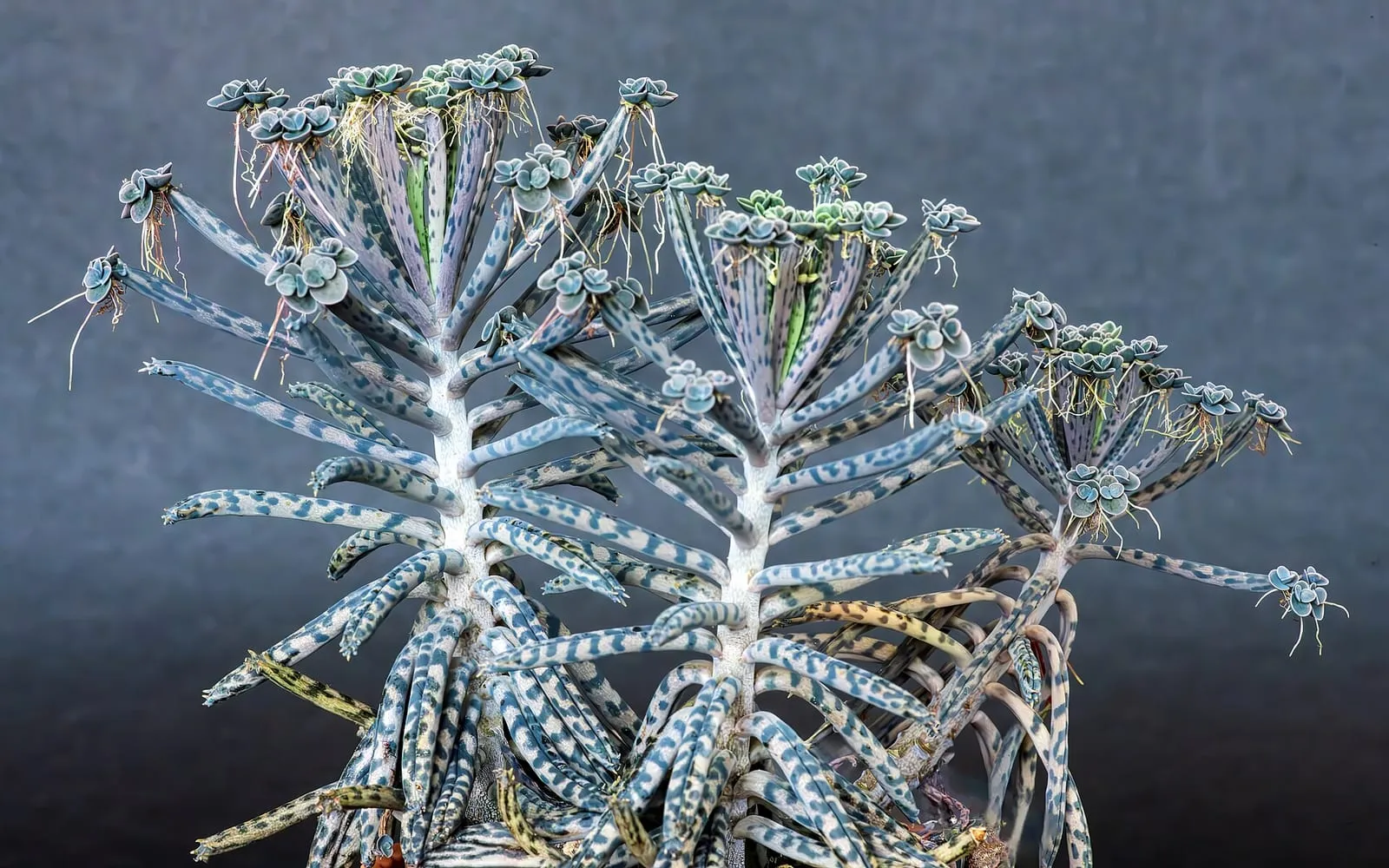
Chandelier plant produces large numbers of plantlets. Its narrow, pencil-like leaves are almost tubular, grey-green mottled with darker marks, and along the notched tip of each one sits a neat row of tiny perfect plantlets, complete with roots, ready to drop and grow wherever they land. A single plant sheds hundreds of them, which is how it earns the name mother of millions, and why it can carpet the ground beneath itself with new plants.
It is easy to grow, and can become weedy. In frost-free climates the dropped plantlets colonise gardens and bushland so aggressively that it is a listed invasive in several countries, so it must never be planted out or have its plantlets thrown outdoors. As a curiosity on a windowsill it is fascinating; loose in a warm garden it is a serious weed.
It comes from the dry south of Madagascar and needs bright light, gritty soil and long dry spells. Beyond that, the two things to know are its toxicity, since every part carries heart-active compounds, and its constant self-propagation, which means plantlets turn up in every nearby pot.
Appearance and character
The leaves are narrow, cylindrical and almost tubular, grey-green with purplish-brown mottling, held upright along a mostly unbranched stem, quite unlike the broad flat leaves of the other mothers of thousands.
Along the notched tip of each leaf grows a row of tiny plantlets, each a miniature of the parent with its own roots, which drop at a touch and root instantly wherever they fall.
It grows tall and narrow, often on a single stem, and after flowering the main stem tends to die, though by then it has scattered many plantlets to replace itself.
Its flowers hang in clusters of orange to reddish tubular bells at the stem top in winter, giving the plant its chandelier name, and they are the most toxic part.
Where it is from
Kalanchoe delagoensis comes from the dry, rocky south of Madagascar, growing in hot, arid scrub and storing water in its tubular leaves against long drought. It is adapted to heat and aridity.
That habitat makes it tough and drought-hardy. It needs bright light and sharp drainage, and it rots only in cold, wet compost. Its heavy plantlet production is a survival strategy for colonising bare, dry ground, which is exactly what turns it invasive where winters are mild.
How it grows
It grows fast and easily through the warm months, sending up its narrow leafy stem and shedding plantlets all the while. It flowers in winter, and often dies back after flowering, leaving its plantlets to carry on. Warmth and bright light suit it, and it rots only if kept cold and wet.
Grow it in a free-draining, gritty cactus mix in a pot, and water when the mix has dried through. It needs little water. The main task is keeping its plantlets from colonising every other pot in the house rather than keeping the plant itself alive.
It needs sun on the narrow leaves, a minimum near 7 deg C, and a pot that dries out fully between drinks. Remove and bin the dropped plantlets instead of letting them root around the home, and never discard them or the plant outdoors in a frost-free climate.
Propagation is automatic, since a single dropped plantlet becomes a new plant; the task is usually to stop it propagating, not to encourage it.
Through the seasons
Spring starts fast growth as the light returns. Start watering again, and remove stray plantlets that have rooted in neighbouring pots.
Summer is the strongest growing season. Let the grit dry through between soakings, give one weak feed, and keep it in strong light.
Autumn slows growth and sets the flower buds. Reduce watering.
Winter brings the orange flowers. Keep it bright and cool but frost-free, water sparingly, and expect the main stem to decline after flowering.
Care difficulty
Easy, but containment matters. It is a tough, drought-hardy plant that grows and propagates itself with no help, so the difficulty lies in containing it rather than keeping it alive, since its plantlets root everywhere. It rots only in cold, wet compost. Its toxicity and its invasiveness are the two reasons for caution, both calling for tidy disposal of the plantlets and care around pets and children.
Watering
Water when the gritty mix has dried through, then soak it and let it drain. Each pencil-thin leaf stores water, so the plant can go for weeks without attention and is ready for water only once the grit has gone bone dry.
Cut right back over winter, the season when a cold, sodden pot does the most damage, and while the plant is in flower and winding down. Leaves that soften and yellow at the base are the sign of rot from too much water; this plant is far likelier to drown than to go thirsty.
Warning signs, diseases and pests
Plantlets rooting in every nearby pot are the most common nuisance, not a disease. Pick them off the parent before they drop, remove any that have rooted elsewhere, and bin them instead of composting or discarding them outdoors.
Root rot sets in when the pot stays cold and sodden, the lower leaves softening and yellowing and the base turning mushy, so sharpen the drainage and hold off the water. Mealybugs and aphids cluster on the stems and the flower trusses, where a wipe of dilute alcohol or a spray of oil clears them.
The main stem dying after flowering is normal, since the plant is often short-lived, and it will already have scattered plantlets to replace itself.
Growing environment
Bright light with some direct sun keeps the plant firm and compact and brings out the mottling and the winter flowers. In poor light it grows soft, pale and leggy.
It grows well anywhere above roughly 7 deg C in dry air, and does badly in cold, damp, airless compost more than anything else. Low humidity suits it. Keep it as a contained pot plant, never planted out in a frost-free climate where it becomes invasive.
Grow it in a gritty, free-draining mix in a pot in bright light, out of reach of pets and children, and dispose of plantlets responsibly.
Feeding
Feed only once or twice over spring and summer with a dilute, low-nitrogen cactus feed. It needs very little, and grows vigorously enough without much feeding.
Give nothing over winter. Fresh gritty mix supports a newly potted plant through its first weeks.
Troubleshooting
Little plantlets are rooting in all my other pots. This is normal for mother of millions. Pick the plantlets off before they drop, remove any that have rooted elsewhere, and bin them. Never discard them outdoors in a frost-free climate.
The main stem is dying after flowering. Normal, since the plant is often short-lived after it blooms. It will have shed plantlets to replace itself many times over.
The lower leaves are soft and yellow. Root rot from cold, wet compost. Improve drainage and water less. It is far more often overwatered than under.
Is it safe around pets and children? No. Every part carries heart-active compounds, the flowers most of all, and the ASPCA lists Kalanchoe as toxic to cats and dogs. Keep it well out of reach and dispose of plantlets carefully.
Can I plant it in the garden? Not in a frost-free climate, where it is an invasive weed. Keep it as a contained pot plant and dispose of plantlets responsibly.
Chandelier Plant problem guides
Not sure what is wrong? See the common houseplant pests guide.