
Houseplant
Panda Plant
Kalanchoe tomentosa
How to grow panda plant, Kalanchoe tomentosa. Why the rust-brown leaf edges are normal rather than a sign of stress, why it rarely flowers indoors, and the cardiac glycosides that make a flowering plant riskier to pets than its leaves.
At a glance
- Difficulty
- Easy
- Water
- Only once the compost has dried out fully, roughly every two to three weeks
- Light
- Bright light, some direct sun
- Temperature
- Above 10 deg C; ideally kept well clear of that minimum
- Humidity
- Low; average room air is fine
- Hardiness
- USDA 9b-11, RHS H2, hardy to -1 C
- Type
- Evergreen succulent shrub
- Height
- 30-60 cm
- Native to
- Madagascar
A dry-country Madagascan succulent that tolerates a brief, light chill but not a real frost, and does better protected under glass through any cold spell than risked outdoors. Treat minus 1 deg C as the floor of what it survives rather than a temperature to garden around.
Hardiness zones describe winter cold alone. Summer heat, humidity, rainfall and the length of the growing season decide as much, so treat the range as the outer limit rather than as a recommendation.
Toxic if eaten
- Do not eat
- Every part, and the flowers most of all
- Harm from
- Eating it
- Affects
- People, cats and dogs
Kalanchoe contains bufadienolides, cardiac glycosides related to the ones in foxglove, a more serious class of compound than most flowering houseplants carry. A pet that chews a leaf usually gets nothing worse than drooling and vomiting, since the amount eaten is small and the taste discourages more, but quantity changes the picture: flowers hold the highest concentration, and an animal that strips a flowering plant can develop a slow or irregular heartbeat, weakness and collapse hours after the initial stomach upset has settled. Because symptoms can be delayed, call a vet after a pet chews kalanchoe, particularly if flowers were involved. In people, poisoning is rare and usually mild, but the same caution applies to a small child around a flowering plant. This species rarely flowers indoors, which in practice makes it one of the lower-risk kalanchoes to keep, though the leaves themselves are not harmless.
Sources: RHS potentially harmful garden plants, ASPCA toxic and non-toxic plants
About
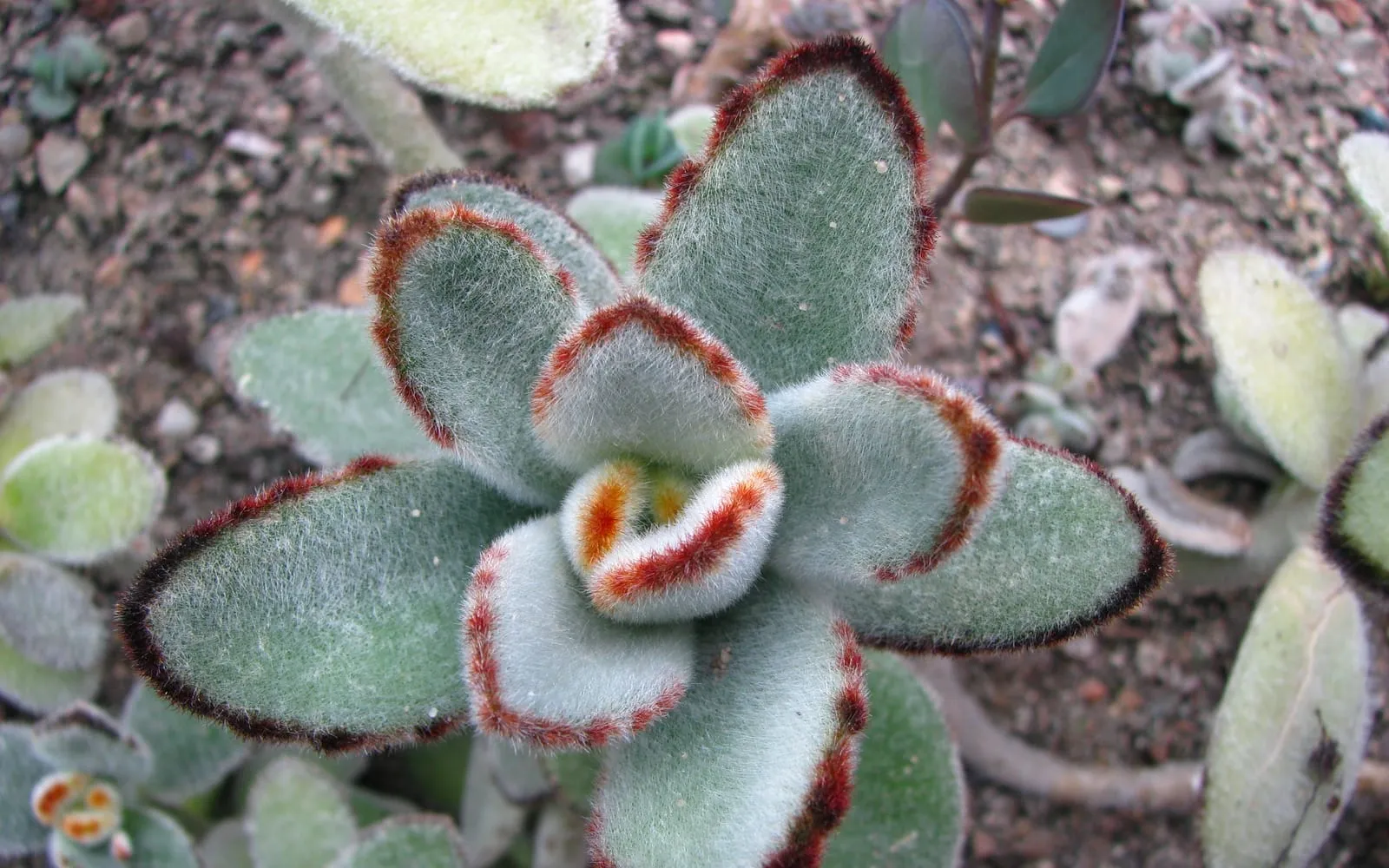
Panda plant is grown for its felted silver-grey leaves with brown markings along the edges. The fine hairs help reflect strong light and slow water loss, which suits a dry-country succulent from Madagascar.
As a houseplant it is mainly a foliage plant. It rarely flowers indoors, but it is easy to keep if it has bright light, gritty compost and time to dry out between waterings.
Appearance and character
Leaves are plump, spoon-shaped and densely felted in pale silvery grey-green, 3 to 6 cm long, arranged in loose rosettes along upright, branching stems. The rust-brown markings sit along the leaf margin and concentrate at the tip, giving each leaf a scorched look at the edges that is entirely normal rather than a sign of stress.
Growth is upright and shrubby rather than rosette-flat, and a mature plant branches from the base to form a small, many-stemmed bush 30 to 60 cm tall over several years, considerably larger and more architectural than the small potted plants usually sold.
Flowers, when they appear at all, are small, tubular and yellow-green, carried on a tall stalk above the foliage. Most plants kept as houseplants never reach the maturity or light levels needed to produce them.
Where it is from
Kalanchoe tomentosa is native to Madagascar, growing on dry, rocky hillsides in full sun with sharp drainage and long dry spells between rains.
That background explains almost everything about how to keep it alive indoors: give it strong light, let the roots dry out completely and often, and do not worry about the low humidity of a centrally heated room that troubles so many other houseplants. Treating it like a typical leafy houseplant, with regular watering and a shadier spot, is the most common way to lose one.
How it grows
Pot it in a gritty, fast-draining cactus and succulent compost rather than ordinary houseplant compost, which holds far more water than these roots tolerate.
Choose a pot with drainage holes without exception. A panda plant in a sealed decorative pot with no way for water to escape is at constant risk of root rot regardless of how carefully you water.
Repot every two to three years, or when the plant has clearly outgrown its pot, moving up only one size and using fresh, dry compost.
Propagate from leaf cuttings: a healthy leaf twisted gently from the stem, left to callus over for a day or two on a dry surface, then laid on top of gritty compost will root and eventually form a new plantlet at its base. Stem cuttings, treated the same way, root faster.
Through the seasons
Spring is the best time to repot and to take leaf or stem cuttings, as growth resumes after winter.
Summer is the main growing season. Water on the regular schedule and give it as much direct sun as the position allows.
Autumn slows growth. Reduce watering frequency as the compost takes longer to dry.
Winter is a rest. Water only sparingly, perhaps once a month, and stop feeding until spring; a panda plant is far more likely to be lost to winter overwatering than to winter cold.
Care difficulty
Easy, and one of the more tolerant houseplant succulents for anyone prone to neglect. Its native background of full sun and sharp drainage means underwatering barely troubles it. The one real risk is a compost that stays wet, particularly in winter when the plant is using very little water and a normal summer schedule will rot it within weeks.
Watering
Water only once the compost has dried out completely, checking with a finger before assuming, and water at the base rather than over the foliage. Water sitting in the felted leaves is slow to evaporate and can encourage rot at the point where a leaf meets the stem.
In summer this typically means watering every two to three weeks; in winter, stretch that to once a month or even longer, since the plant’s water use drops sharply at lower light and temperature.
Always let the pot drain fully and never let it stand in a saucer of water.
Warning signs, diseases and pests
Mealybug can hide within the dense leaf felt, harder to spot here than on a smooth-leaved plant, so check leaf undersides and stem joints carefully. Remove it with a soft brush or cotton swab dipped in alcohol rather than a wet cloth, which mats the felt.
Root rot follows compost that has stayed wet, showing as leaves that turn soft, translucent and eventually black, often starting at the base of the plant. Unpot it, cut away any mushy roots and stem tissue, let the remainder dry for a day, and repot into fresh, dry compost.
Powdery mildew, a white dusty coating on the leaves, occurs where humidity is high and air movement is poor. Improve ventilation around the plant and avoid wetting the foliage when you water.
Growing environment
Bright light suits it best, including some hours of direct sun through a window; a plant kept too dim stretches between leaves, losing the compact form that makes it attractive.
Keep it above 10 deg C and treat that as a genuine floor rather than a target; a plant chilled repeatedly near that mark weakens even if it never shows obvious frost damage.
Low humidity is not a problem. It is one of the few popular houseplants that positively prefers the dry air of a centrally heated room to a damp bathroom.
Give it airflow around the foliage, since still, humid air close to the leaves is what invites powdery mildew and rot at the leaf base.
Feeding
Feed with a cactus and succulent fertiliser, diluted according to the label, once a month through spring and summer.
Stop feeding entirely from autumn through winter, when growth has slowed close to a standstill and unused fertiliser only accumulates as salts in compost that is already drying out between infrequent waterings.
Troubleshooting
The leaves are going soft and translucent. Overwatering and likely early root rot. Check the roots and stem base; if soft or discoloured, repot into fresh, dry compost and cut back watering.
It has grown tall and leggy with gaps between leaves. Not enough light. Move it somewhere brighter; the stretched growth will not reverse, but new growth from that point on will be more compact.
Why has it never flowered? Most panda plants grown as houseplants never do, since flowering needs a maturity and light intensity that indoor conditions rarely provide. Treat it as a foliage plant rather than waiting on a bloom.
A leaf snapped off when I brushed past it. Kalanchoe tomentosa leaves are brittle and detach easily. A fallen leaf is not wasted: let the cut end callus over for a day, then use it to propagate a new plant.
The felt has gone patchy and dull in places. Usually water sitting on the leaves rather than a pest. Water at the base in future and avoid misting, which this species does not need and does not tolerate well.
Panda Plant problem guides
Not sure what is wrong? See the common houseplant pests guide.