
Outdoor plant
Common Box
Buxus sempervirens
Also known as European Box, Boxwood, English Box
How to grow common box, Buxus sempervirens. Why box blight and box tree caterpillar have made a once-easy hedging plant hard work, the extremely slow growth that holds a crisp shape for decades, and why hedge clippings left where livestock can graze have killed horses.
At a glance
- Difficulty
- Difficult
- Water
- Rarely once established
- Light
- Full sun to partial shade
- Temperature
- Very hardy, to about -20 deg C
- Hardiness
- USDA 5-9, RHS H6, hardy to -20 C
- Type
- Evergreen shrub or small tree, extremely slow-growing and long-lived
- Height
- 5-9 m unclipped over many decades; kept at 30 cm to 1.5 m as hedging
- Native to
- Europe, western Asia, North Africa
Cold has never been the real constraint on this species; two imported organisms are. Box blight spreads fastest in warm, humid weather and wherever water sits on the leaf, and common box is generally more susceptible to it than the Asian species, Buxus microphylla, increasingly planted as a swap-in. Box tree caterpillar, a moth introduced from east Asia, eats every kind of box indiscriminately and has pushed many gardeners toward giving up on the genus altogether. A hardiness zone that suits this shrub perfectly is no guarantee it will still be growing there in a decade.
Hardiness zones describe winter cold alone. Summer heat, humidity, rainfall and the length of the growing season decide as much, so treat the range as the outer limit rather than as a recommendation.
Toxic if eaten
- Do not eat
- Every part, and the leaves and bark most of all
- Harm from
- Eating it and handling it
- Affects
- People, cats, dogs and horses
Buxus sempervirens is poisonous in every part, containing more than seventy steroidal alkaloids, principally buxine, at their highest concentration in the leaves and bark. Eating a quantity causes vomiting, abdominal cramping, diarrhoea and, in a severe case, convulsions and respiratory failure, though the leaves taste intensely bitter, which is the main reason recorded human poisonings are rare. Dried box leaves were once used in folk medicine as a bitter tonic and fever remedy, a "poor man's quinine" reached for when the real drug was unavailable, though the margin between a folk dose and a harmful one was never a safe one to guess at. The RHS lists Buxus among plants harmful if eaten and capable of irritating the skin. Livestock face the greatest danger: a horse, cow or sheep can die from eating hedge clippings dumped where they can graze on them, and even a modest quantity of foliage has proved fatal to a horse. Never leave prunings where an animal might reach them. Dogs and cats rarely eat enough to come to serious harm and usually vomit first, while handling a large volume of foliage can irritate the skin of some people, so wear gloves for a big clipping session.
Sources: RHS potentially harmful garden plants, ASPCA toxic and non-toxic plants
About
Common box is the plant behind topiary itself. The Romans clipped it into shapes formal enough to give the practice its Latin name, ars topiaria, and every knot garden, parterre and clipped ball from a Renaissance villa to a suburban front path traces back to this one slow, dense, endlessly patient shrub.
It has had a difficult few decades. Box blight arrived in British gardens in the 1990s and box tree caterpillar reached Europe by 2007, and between them the two have stripped and killed plantings that had stood for generations. Buxus sempervirens is the classic European species used for most old hedges and topiary. More blight-tolerant Asian relatives are now increasingly grown instead.
Growing it well today means growing it with both threats in mind from the start.
Appearance and character
A dense evergreen shrub or, left entirely unclipped, eventually a small tree, though almost nothing grown as common box in a garden is ever allowed to reach that form.
Leaves are small, 1.5 to 3 cm long, oval with a slightly notched tip, glossy dark green above and paler beneath, arranged in opposite pairs along square young stems. Crushed or wetted foliage releases a strong, musky smell that gardeners either love or compare unfavourably to a tomcat’s spray; there is no neutral opinion of it.
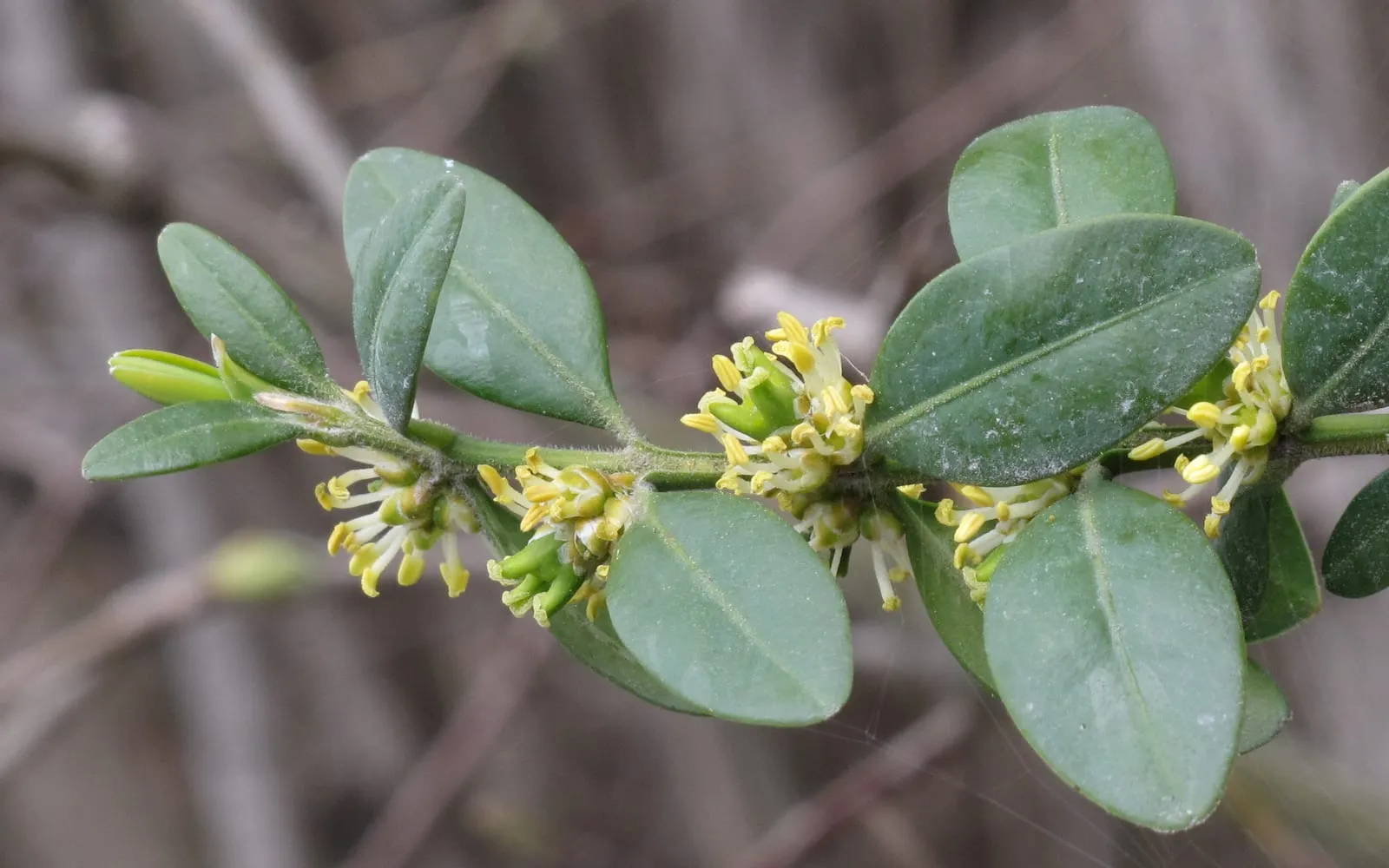
Flowers open in the leaf axils in spring, tiny, petal-less and yellow-green, easy to miss on the plant but not on the bees, which work them hard as one of the earliest reliable nectar sources of the year.
Growth is remarkably slow even by the standards of a slow-growing shrub, often under 15 cm a year unclipped and a fraction of that under regular trimming. That slow growth helps it hold a crisp, fine-textured shape for decades. The wood is dense enough to sink in water and has been prized for centuries for rulers, chess pieces and wind instrument parts, sold under the plant’s own name as boxwood.
Where it is from
Buxus sempervirens grows wild across southern and western Europe, western Asia and North Africa, typically on chalk and limestone slopes and scrub. A scattered native population survives in Britain, most famously the downland at Box Hill in Surrey, which takes its name from exactly this shrub.
Its use in gardens goes back to Roman topiary, and it became the backbone of French and Italian Renaissance parterres before English gardeners adopted it for the intricate knot gardens of the sixteenth and seventeenth centuries. Almost nowhere else in horticulture does a single species carry so much of a garden style’s history on its own.
Box blight is caused by two related fungi, Calonectria pseudonaviculata and Calonectria henricotiae, both needing warm, humid conditions and free water on the leaf to spread. Box tree caterpillar is the larva of a moth native to east Asia that reached European gardens in the mid-2000s and had colonised temperate gardens across the continent within a decade.
How it grows
Plant in free-draining soil, neutral to alkaline, ideally in autumn or spring. Box performs particularly well on chalk.
Space new plants 20 to 25 cm apart for edging and 30 to 40 cm apart for a low hedge, allowing for how little width a young plant adds each year.
Trim once or twice a year, the first cut after the main spring flush has hardened and, if a very crisp finish matters, a second in late summer. Choose dry, still, overcast conditions for clipping and stop by the end of August, since both hot sun and humid, wet weather work against freshly cut foliage in different ways.
Disinfect blades between plants and between sessions. Clearing every clipping and fallen leaf from in and under the plant removes material that would otherwise hold spores or shelter overwintering caterpillars.
An old, leggy plant can be renovated by cutting hard into old wood in spring, since box reshoots reliably from bare stems in a way few other evergreens manage.
Through the seasons
Winter is quiet, and some winter bronzing of the foliage on an exposed plant is normal, greening again as growth resumes.
Spring brings the small yellow-green flowers and the year’s main growth flush. Feed now, and check regularly from April for the first generation of box tree caterpillar.
Summer is clipping season and the period of highest vigilance for both major threats, humid spells favouring blight and warm weather supporting two or three caterpillar generations through to autumn.
Autumn is for tidying. Stop clipping, clear every scrap of fallen debris, and plant new stock while the soil is still warm.
Care difficulty
Difficult, and considerably more so today than it was a generation ago. The plant itself needs little: it tolerates shade, poor soil and hard renovation pruning better than almost anything else grown for hedging.
What has changed is the pressure from outside. Box blight and box tree caterpillar both need regular inspection and a fast response to control, and a garden that cannot commit to that level of attention through spring and summer will likely lose an unmanaged planting to one or the other eventually. Choosing a resistant Asian relative or an unrelated look-alike is a reasonable alternative for anyone unwilling to take that on.
Watering
Water new plantings through their first two summers to establish a root system capable of coping with drought later.
Established box needs watering only in a prolonged dry spell, and it is more drought-tolerant than its fine foliage suggests.
Water at the base rather than over the leaves. Wet foliage is exactly the condition box blight spores need to infect a plant, so overhead watering works directly against disease control.
Avoid waterlogged ground at all costs, which rots the roots regardless of how well the top growth is otherwise managed.
Warning signs, diseases and pests
Box blight shows as bare brown patches spreading through an apparently healthy plant, dark streaks running down the stems beneath the damage, and rapid leaf fall. In humid weather, fine white spore masses appear on the undersides of infected leaves. Cut well beyond the visible damage, clear every fallen leaf, disinfect tools between cuts, and improve airflow around the plant. A badly affected specimen is often best removed entirely, and the soil can carry spores for years afterward, so replanting box in the same spot is a gamble.
Box tree caterpillar is unmistakable once found: pale green caterpillars with black heads and black-and-white stripes, sheltering inside webbing spun through the foliage alongside visible green droppings. A plant can be reduced to bare stems within a week. Check inside the canopy every one to two weeks through the growing season, remove caterpillars by hand on smaller plants, and use pheromone traps to track when the moths are flying and egg-laying.
Volutella leaf spot causes a milder dieback than box blight, with orange to salmon-pink spore pustules on the underside of affected leaves in damp weather but without the dark stem streaking that marks true blight. It usually follows some other stress, such as poor drainage or a hard winter, and improving growing conditions helps more than any spray.
Root rot follows waterlogging, showing as an overall decline and yellowed foliage despite consistently wet soil. Improve drainage rather than watering more.
Growing environment
Full sun to partial shade, and box tolerates more shade than almost any other formal hedging plant, which is part of why it suits enclosed period gardens.
Free-draining, neutral to alkaline soil suits it best, and it performs particularly well on chalk downland of the kind it grows wild on in southern England.
Good airflow around and through the plant now matters as much as soil or light. Avoid enclosed, still corners where humidity lingers, and resist planting edging so tightly that air cannot move between the plants.
Keep box, and its clippings, well away from any field, paddock or compost heap that livestock might reach.
Feeding
Feed once in spring with a balanced fertiliser, which helps the plant withstand blight better than a starved one manages.
Mulch with well-rotted compost each spring, keeping it clear of the stems.
A foliar seaweed feed is widely used to help a stressed or recovering plant regain vigour after a bad blight or caterpillar season.
Avoid heavy nitrogen feeding. It produces soft new growth that both box blight infects most readily and box tree moths prefer for egg-laying.
Troubleshooting
How do I tell box blight from Volutella leaf spot? Blight shows dark streaks running down the stems beneath the leaf damage and spreads fast; Volutella causes orange-pink spore pustules on leaf undersides without that stem streaking and usually follows some other stress. Blight is the more serious of the two.
Webbing and green caterpillars have appeared in my plant. Box tree caterpillar. Check the whole canopy every week or two through the growing season and remove them by hand while numbers are still manageable, since a heavy infestation can strip a plant within days.
Is it worth replanting common box after losing one to blight? Often not in the same spot. Spores persist in the soil for years, and choosing a more resistant relative such as Buxus microphylla, or a different species entirely, is usually the safer route for that position.
Can an overgrown or storm-damaged plant recover from a hard cut? Yes, box reshoots readily from old bare wood, one of the few evergreens that reliably does. Cut hard in spring and feed well afterward.
Are the clippings dangerous? To livestock, seriously. Box contains alkaloids that have killed horses, cattle and sheep that ate hedge trimmings. Never leave prunings anywhere an animal could reach them.