
Houseplant
Old Man Cactus
Cephalocereus senilis
Also known as Old Man of Mexico
Practical guidance for growing old man cactus, Cephalocereus senilis, including its protective hair, slow columnar growth, strong sun, dry roots, and non-toxic care.
At a glance
- Difficulty
- Moderate
- Water
- Every two to four weeks in summer, monthly or less in winter
- Light
- Full sun; the most direct light a window can give
- Temperature
- Above 5 deg C, ideally kept well above it
- Humidity
- Low; average dry room air is fine
- Hardiness
- USDA 9b-11, RHS H1b, hardy to 2 C
- Type
- Evergreen columnar succulent, extremely slow growing and long-lived
- Height
- 30-90 cm in a pot over many years; several metres in habitat after decades
- Native to
- Mexico
Comes from a dry, high-altitude semi-desert with cool nights, which means it tolerates a light chill far better than sustained damp. A brief dip close to freezing on completely dry ground does less harm than a single cold, wet night, and as a houseplant it is safest kept well clear of both rather than tested against either. It has no meaningful frost tolerance in cultivation.
Hardiness zones describe winter cold alone. Summer heat, humidity, rainfall and the length of the growing season decide as much, so treat the range as the outer limit rather than as a recommendation.
Not known to be toxic
Cephalocereus carries no documented toxin and does not appear on the ASPCA or RHS lists of harmful plants. A cat, dog or child biting into the flesh beneath the hair gets nothing worse than a mouthful of fibrous, faintly bitter plant tissue. The hazard here is entirely physical. Beneath the soft-looking hair sit sharp spines that the hair does little to hide from a paw or a hand pressed against the column, and the hair itself sheds fine fibres that can irritate skin on repeated contact. Treat a spine injury as a puncture wound, and position the plant where it will not be brushed against or grabbed for balance.
Sources: ASPCA toxic and non-toxic plants, RHS potentially harmful garden plants
About
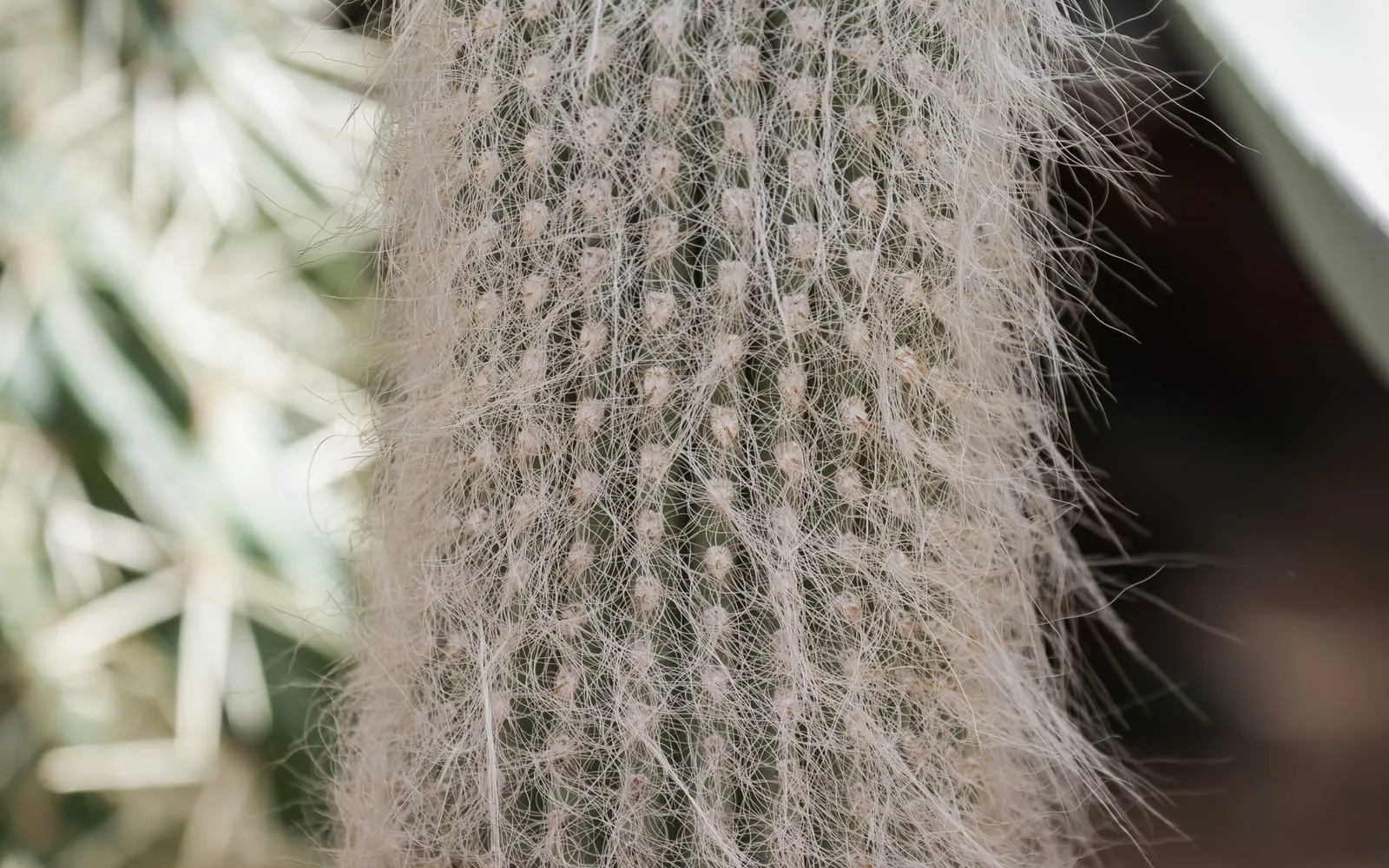
Old man cactus grows as a single upright column, covered from the crown downward in long, soft-looking white hair that gives the whole plant a shaggy, almost textile appearance unlike any other common houseplant cactus. The hair is not decorative padding. It grows over a dense covering of sharp spines and shields the growing tip from the intense high-altitude sun of its native habitat.
Growth is famously slow, among the slowest of any cactus commonly sold as a houseplant, which means a specimen of any real size has already spent years reaching it. Buying a taller plant rather than a small starter is the practical way to get a mature-looking specimen without waiting a decade for one.
Appearance and character
The column itself is ribbed like most upright cacti, pale green beneath the hair, and thickens gradually as it ages rather than branching, so a single plant usually stays one unbranched stem for most of a human lifetime. The hair emerges whitest and densest near the growing tip and yellows or greys with age lower down the column, so an older plant often shows a visible gradient from crown to base.
In its native habitat, a column has to reach several metres in height, usually after decades of growth, before it flowers, producing pale pink to white funnel-shaped blooms that open at night. Flowering at that scale essentially never happens on a potted houseplant, which stays too short and too young for its entire cultivated life.
Dust collects in the hair over time, since it is a fine, fibrous mesh rather than a smooth surface, and a light rinse or a gentle brush now and then keeps the colour from dulling to grey.
Where it is from
Cephalocereus senilis grows wild in a narrow range in the Mexican state of Hidalgo and neighbouring areas, on dry, rocky, semi-desert slopes at moderate elevation, where intense daytime sun and cool nights are both part of the normal climate. Wild populations are now considered threatened, and almost every plant sold commercially is nursery-propagated rather than collected.
That habitat explains both the hair and the plant’s tolerance of cool nights alongside strong sun; a species living at altitude routinely handles a wider day-to-night temperature swing than the average houseplant, though it still has no tolerance for a hard frost.
How it grows
Plant it in a gritty, fast-draining cactus mix in a pot with generous drainage holes, and choose a heavier pot such as terracotta if the plant is tall, since a top-heavy column in a light plastic pot can tip.
Give it the strongest light a window can offer. A south facing sill with several hours of direct sun a day suits it best; light shade or a spot back from the window slows an already slow grower down further and can leave the hair looking thin and dull rather than dense.
Repot rarely, since growth is slow enough that a young plant may sit happily in the same pot for several years. When repotting is needed, handle the column with thick gloves or a folded towel rather than by the hair, which does little to protect fingers from the spines underneath it.
Propagation from a cutting is possible but slow to establish, since a cut column has to callus for one to two weeks before it will root reliably in dry cactus mix, and growth afterward is just as unhurried as on the parent plant.
Through the seasons
Spring restarts growth after winter’s rest. Resume light feeding and begin watering a little more often as the compost dries faster.
Summer is the main growing season, when the column puts on what little height a Cephalocereus adds in a year, best given as much direct sun as possible.
Autumn slows growth again. Space out watering and stop feeding towards the end of the season as light levels drop.
Winter is a dry rest. Water sparingly, no more than once a month, and keep the plant somewhere it will stay well above 5 deg C and away from cold draughts near glass.
Care difficulty
Moderate, mostly because of how unforgiving it is of the two mistakes people default to with houseplants. Too little light and a plant that is already slow grows thin, pale hair and stalls further; too much water, particularly in winter, and the column rots from a base that is hidden under hair and therefore easy not to notice until the damage is well advanced. Given strong sun and a properly dry rest in winter, it needs very little ongoing attention.
Watering
Water thoroughly until it runs from the drainage holes, then let the mix dry out completely before watering again. In a bright, warm room in summer that might mean every two to three weeks; through a cool winter, stretch this to once a month or longer.
Check the base of the column periodically despite the hair covering it, since early rot shows there first as a softening or darkening that is easy to miss if the plant is only ever glanced at from above.
Warning signs, diseases and pests
Mealybug can hide deep in the hair where it goes unnoticed for weeks, so part the hair occasionally to check the stem underneath for small white, cottony tufts. Treat with a cotton bud dipped in alcohol, working carefully through the hair rather than trying to clear it in one pass.
Spider mite favours the same hidden, humid pocket the hair creates in hot, dry rooms, and shows as fine speckling on the stem once the hair is parted to look. Wiping the exposed stem down and improving air circulation around the plant helps prevent it taking hold.
Root rot follows a mix kept too wet, particularly over winter, and shows as a base that has softened and discoloured beneath the hair. Unpot it, cut away any soft tissue back to firm, pale flesh, let the cut dry for several days, and repot into fresh, dry mix.
Scale insects appear as small, flat brown bumps, most often near the base of an older plant. Treat the same way as mealybug and recheck after a week or two, since a first treatment rarely clears every insect at once.
Growing environment
Full sun is close to essential. This species evolved under intense high-altitude light, and a plant kept in anything less than the brightest spot a room offers grows slowly even by its own unhurried standards and produces thinner, less white hair.
Keep it above 5 deg C at all times, and ideally well above it. A brief dip close to that figure on bone-dry compost causes little harm, but cold combined with any dampness at the roots is a common way to lose a plant that otherwise needs very little.
Low humidity suits it fine. This is a dry-climate plant through and through, and consistently damp air around the hair can encourage the very rot the dry watering routine is meant to avoid.
Feeding
Feed sparingly. A low-nitrogen cactus fertiliser once or twice during spring and summer, well diluted, is enough for a plant that grows this slowly by nature; more frequent feeding pushes little extra growth and adds nothing the plant can use.
Stop feeding entirely from autumn through winter, when the plant is essentially dormant and any unused fertiliser only accumulates as salts in the compost.
Troubleshooting
The hair has gone grey and dull rather than staying white. Usually dust and light residue built up in the fibres over time, sometimes combined with too little light. A gentle rinse under lukewarm water, followed by increased light, generally restores the colour on newer growth, though hair that has already aged lower down the column will not whiten again.
The base has gone soft and dark. Root rot, almost certainly from compost that has stayed too wet, most often through winter. Unpot it, cut back to firm tissue, let the wound dry for several days, and repot into a drier, grittier mix, watering far less often afterward.
It has barely grown in years. This is largely normal for the species, which adds height at a naturally slow rate even under ideal conditions. Poor light is the likeliest thing to check first, since it slows an already slow grower down further; if light is strong and the base is firm and healthy, patience is the only remaining answer.
Why has my plant never flowered? Age and size. A column has to reach several metres in its native habitat before it flowers at all, a scale a potted houseplant essentially never reaches in a human lifetime, so a lack of flowers says nothing about the health of the plant.
Can I trim the hair to tidy it up? It is best left alone. The hair protects the growing tip and the spines beneath it, and cutting it does not encourage denser regrowth the way trimming a leafy plant might; it only exposes tissue that would otherwise stay shaded and shielded.
Old Man Cactus problem guides
Not sure what is wrong? See the common houseplant pests guide.