
Houseplant
Bunny Ears Cactus
Opuntia microdasys
Also known as Angel's Wings Cactus, Polka-dot Cactus
Practical guidance for growing bunny ears cactus, Opuntia microdasys, including glochid safety, paired pads, bright sun, dry roots, and mild toxicity.
At a glance
- Difficulty
- Easy
- Water
- Every two to three weeks in summer, monthly or less in winter
- Light
- Full sun to bright indirect light; a south facing window suits it
- Temperature
- Above 5 deg C
- Humidity
- Low; average dry room air is fine
- Hardiness
- USDA 9a-11, RHS H2, hardy to -3 C
- Type
- Evergreen shrubby succulent
- Height
- 40-60 cm potted; up to 1 m or more given years and space
- Native to
- Mexico
Less cold tolerant than most of its Opuntia relatives, several of which survive a hard freeze under snow cover. This one comes from the warmer, drier parts of the Chihuahuan Desert and takes only a brief, light frost on completely dry ground before the pads blacken and collapse. It is a houseplant or a warm-climate garden plant rather than a hardy outdoor cactus anywhere with a real winter.
Hardiness zones describe winter cold alone. Summer heat, humidity, rainfall and the length of the growing season decide as much, so treat the range as the outer limit rather than as a recommendation.
Skin irritant
- Do not eat
- The glochids covering every pad
- Harm from
- Handling it and sap in the eyes
- Affects
- People, cats and dogs
The pads themselves carry no toxin and are not listed as poisonous by the ASPCA or the RHS. What makes this cactus a genuine hazard is mechanical rather than chemical: each polka dot on the pad is a cluster of glochids, fine, barbed hairs a few millimetres long that detach at the lightest touch and lodge in skin, and are notoriously difficult to see or remove once embedded. They cause intense itching and a rash that can last for days, and a paw, muzzle or eye that brushes a pad can end up carrying dozens at once. Keep it away from low shelves a cat can jump onto or a dog can nose at, and handle a plant that needs repotting with thick gloves and a folded strip of newspaper rather than bare hands.
Sources: ASPCA toxic and non-toxic plants, RHS potentially harmful garden plants
About
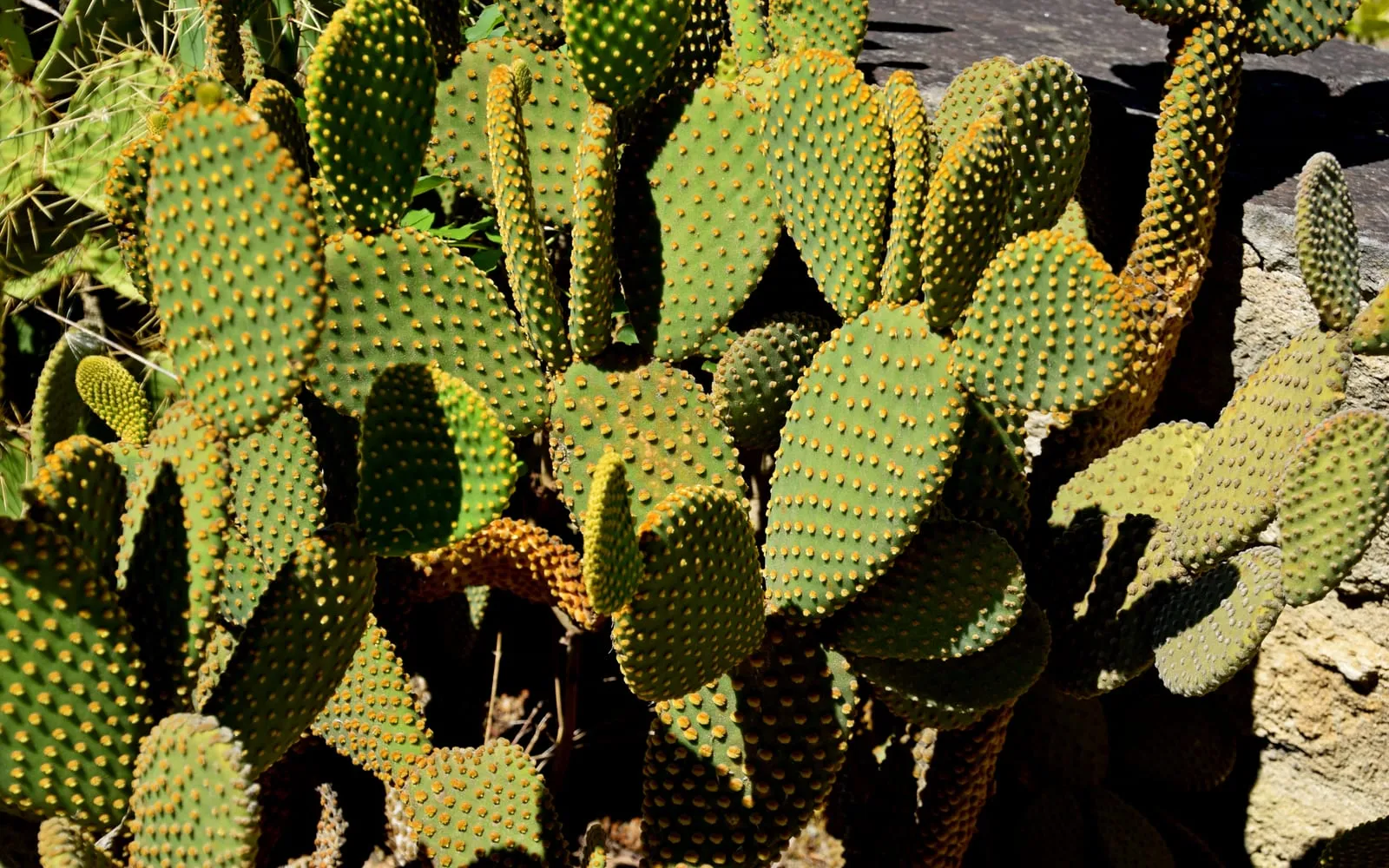
Bunny ears cactus grows as a cluster of flat, rounded pads that branch from one another in pairs, which is where the common name comes from on a young plant with just two pads standing up like a rabbit’s ears. Each pad is dotted with small tufts of golden or white glochids arranged in a neat, regular pattern that gives the species its other common name, polka-dot cactus.
It is an easy, forgiving houseplant once the one real hazard is understood. The spines that most cacti rely on to warn a hand away are largely absent from this species; in their place are glochids, which are harder to see coming and harder to get out once they land.
Appearance and character
Pads are oval to rounded, 6 to 15 cm long, blue-green to grey-green, and flattened rather than round in cross section, the shape typical of the whole Opuntia genus. New pads emerge from the edge of an older one and, over several years, a single plant branches into a low, wide clump rather than growing tall.
The glochid clusters sit in evenly spaced areoles across each pad’s surface, usually a warm gold but sometimes white or brown depending on the cultivar, and they catch low light in a way that makes the plant look faintly furry from a distance. Up close, each cluster is dozens of hair-fine barbed spicules rather than fur.
A mature plant grown in full sun can flower in late spring, producing small, pale yellow blooms along the upper edges of the pads, followed by small reddish-purple fruit. Indoor plants flower far less reliably than plants grown outdoors in a hot, sunny climate.
Where it is from
Opuntia microdasys is native to central and northern Mexico, growing across rocky, sun-baked ground in the Chihuahuan Desert and neighbouring dry scrub, where intense sun, thin soil and long rainless spells are the normal condition rather than the exception.
That desert background is why it needs so little water and so much light indoors. Its pads store water through the dry season the way a succulent leaf does, swelling after rain and slowly drawing that reserve down until the next one. A home watering routine that mimics infrequent desert rain suits it far better than a steady, regular schedule.
How it grows
Plant it in a gritty, fast-draining cactus mix, ideally with extra grit or perlite added to ordinary cactus compost, in a pot with drainage holes. A terracotta pot helps the mix dry out between waterings faster than a glazed or plastic one.
Give it as much direct sun as the room allows. A south facing windowsill suits it well; a plant kept in low or indirect light for long stretches grows pale, elongated pads reaching for the light rather than the tight, compact growth a well-lit plant produces.
Repot only when the clump has clearly outgrown its pot, using thick gloves, tongs, or a folded strip of cardboard to handle the pads rather than bare hands. New pads root readily from a cutting left to callus for a few days and then set on top of dry cactus mix, which is the easiest way to propagate or to start a second plant from a damaged one.
Prune by twisting off an unwanted or damaged pad at its joint rather than cutting, which is how the plant naturally separates growth in habitat and leaves a cleaner wound than a knife does.
Through the seasons
Spring restarts growth. Increase watering frequency gradually and begin monthly feeding as new pads start to emerge from the edges of older ones.
Summer is the main growing season and, on a plant getting strong direct sun, the best chance of flowers along the upper edges of the pads.
Autumn slows growth. Space out watering as light levels and temperatures drop, and stop feeding towards the end of the season.
Winter is a dry rest. Water only once a month or less, and keep the plant somewhere bright and above 5 deg C, since cold and damp compost together are what usually cause pads to blacken and rot over winter.
Care difficulty
Easy, and mistakes in either direction are rarely fatal on their own. Underwatering it for weeks does no visible harm since the pads draw down their stored reserve; overwatering in a slow-draining mix is the likelier way to lose one, since the pads have no early warning sign for wet roots the way a wilting leafy plant does. Handling is the main challenge: avoid the glochids.
Watering
Water thoroughly until it drains from the pot, then let the mix dry out completely before watering again. In a bright, warm room in summer that might be every two to three weeks; in a cooler room in winter, once a month or even less is enough.
Water at the base rather than over the pads, and avoid letting water pool around the base of the plant, since standing moisture there is what most often starts a rot working up from the lowest pad.
Warning signs, diseases and pests
Mealybug hides between pads where they meet, showing as small white, cottony tufts that are easy to miss among the glochid dots. Remove it with a cotton bud dipped in alcohol, working carefully to avoid the glochids nearby.
Scale insects show as small, flat brown bumps, usually on older, lower pads, gradually sapping the plant. Treat the same way as mealybug and check again after a week or two.
Root rot follows a mix that has stayed wet too long, and shows first as a lower pad turning soft, yellow or black at its base while pads above still look normal. Cut away any affected pads with a clean blade, let the cuts callus for a few days, and repot the healthy remainder into fresh, dry mix.
Growing environment
Full sun suits this species best. A south or west facing windowsill gives the closest match to the intensity of light it gets in its native desert, and a plant given plenty of direct sun stays compact with tightly packed glochid clusters rather than growing thin and pale.
Keep it above 5 deg C at all times. It tolerates only a very brief, light frost on bone-dry ground and takes real damage from anything colder or from any frost on wet compost.
Low humidity is fine and, if anything, preferred. This is a plant built for dry desert air, and a humid bathroom or a spot near a kettle does it no favours.
Feeding
Feed with a low-nitrogen cactus fertiliser monthly through spring and summer, diluted according to the product’s instructions. Too much nitrogen pushes soft, watery growth that is more prone to rot and less true to the plant’s naturally compact habit.
Stop feeding entirely from autumn through winter, when the plant is barely growing and any unused fertiliser only builds up as salts in compost that is already drying out slowly between infrequent waterings.
Troubleshooting
I have glochids in my finger and cannot see them. Try lifting them out with strips of masking or duct tape pressed onto the skin and peeled away, which lifts far more of them than tweezers alone. A dab of white glue left to dry and peeled off also works well. Avoid rubbing the area, which tends to push glochids deeper rather than out.
A pad has gone soft and dark at the base. Root rot, almost always from a mix that has been kept too wet. Cut the affected pad away with a clean blade, let the wound callus for a couple of days, and check the mix is free-draining enough before repotting.
The pads have gone pale and stretched instead of staying compact. Too little light. Move the plant to the brightest spot available, ideally direct sun for at least part of the day; new growth should come in more compact, though pads that have already stretched will not shorten again.
It has never flowered. Most likely light and, to a lesser extent, age. Flowering needs strong, direct sun for a good part of the day and a plant that has had a few years to establish; an indoor plant in bright but indirect light may never produce enough energy to flower.
Can I touch the pads at all safely? Not with bare hands, even where no glochid cluster is obviously visible, since a pad brushed the wrong way sheds them readily. Use tongs, a folded cloth, or thick gloves whenever you need to move, prune or repot the plant, and keep it out of the path of anyone likely to brush past it without looking.
Bunny Ears Cactus problem guides
Not sure what is wrong? See the common houseplant pests guide.