
Houseplant
Moon Cactus
Gymnocalycium mihanovichii
Also known as Hibotan Cactus, Ruby Ball Cactus, Red Cap Cactus
Practical guidance for growing moon cactus, Gymnocalycium mihanovichii, including grafts, rootstock lifespan, bright shaded light, dry soil, and non-toxic care.
At a glance
- Difficulty
- Easy
- Water
- Every two to three weeks in the growing season, less in winter
- Light
- Bright, indirect light; the coloured top scorches in strong direct sun and fades without enough light
- Temperature
- Above 10 deg C
- Humidity
- Average room humidity
- Hardiness
- USDA 10b-11, RHS H1b, hardy to 10 C
- Type
- Evergreen grafted succulent, a chlorophyll-free cultivar fused onto a rootstock cactus
- Height
- 15-25 cm total, most of it rootstock
- Native to
- Paraguay, Argentina
The zone number describes the rootstock rather than the coloured cap. Most moon cacti are grafted onto Hylocereus, a tropical climbing cactus with no frost tolerance at all, so the whole plant is grown as a houseplant everywhere outside the wet tropics. Even a mild chill below about 10 deg C slows the graft union and can rot it, well before the cold would trouble an ungrafted desert cactus of similar hardiness.
Hardiness zones describe winter cold alone. Summer heat, humidity, rainfall and the length of the growing season decide as much, so treat the range as the outer limit rather than as a recommendation.
Not known to be toxic
Neither half of a moon cactus carries a documented toxin. Gymnocalycium and the Hylocereus rootstock it is usually grafted onto are not listed as poisonous by the ASPCA or the RHS, and a cat, dog or child who mouths one gets nothing worse than a mouthful of firm, faintly bitter plant tissue. The real hazard is mechanical rather than chemical. Both halves of the graft carry areoles bearing short spines, and a knock or a fall can drive several into skin or a paw pad at once. Site it where it will not be brushed past or batted off a shelf, and treat a spine wound as a puncture wound rather than a poisoning.
Sources: ASPCA toxic and non-toxic plants, RHS potentially harmful garden plants
About
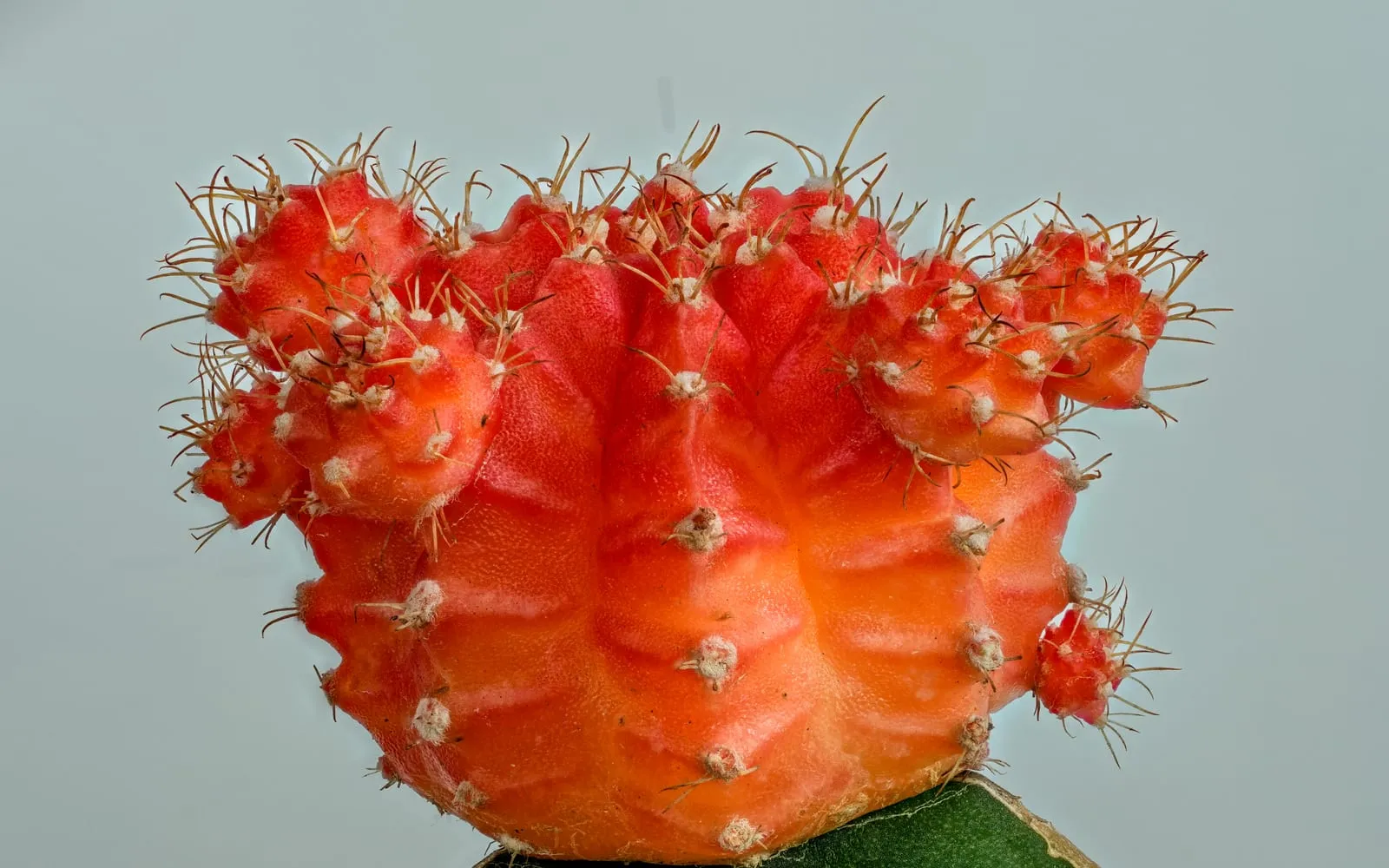
A moon cactus is two cacti fused into one plant. The coloured ball on top, usually red, orange, yellow or pink, is a cultivar of Gymnocalycium mihanovichii that lacks chlorophyll and cannot photosynthesise or survive on its own roots. Growers graft it onto a green, chlorophyll-bearing rootstock, most often a Hylocereus or Trichocereus column, which photosynthesises for the whole plant and feeds sugars up through the graft union to the cap.
The arrangement is stable but not permanent. A rootstock typically supports its coloured cap for several years to a decade before the union weakens or the top outgrows its supply of sugar, at which point the cap eventually shrivels. Buying one already grafted, rather than attempting the graft yourself, is the practical route for almost every home grower.
Appearance and character
The cap is a small, densely ribbed sphere, 3 to 6 cm across on a young plant, with white or pale spines set along raised ribs in the pattern typical of Gymnocalycium. Colour comes from carotenoid and anthocyanin pigments rather than chlorophyll, so the tissue is solid red, orange, yellow or hot pink rather than green with coloured markings.
Below it sits the rootstock, usually a ribbed, upright green column that looks nothing like the cap it carries, since the two are different genera entirely. The join between them is visible as a slightly narrowed waist, sometimes fused smoothly and sometimes with a faint ring where the graft was made.
Offsets, small coloured pups, often form around the base of the cap on a well-fed plant and can be removed and grafted onto their own rootstock to propagate the cultivar, since a coloured offset rooted directly in soil will not survive without chlorophyll of its own.
Where it is from
Gymnocalycium mihanovichii grows wild across the dry scrub and grassland of Paraguay and northern Argentina, low-growing and green like any other member of its genus. The chlorophyll-free forms sold as moon cacti do not occur in that habitat; they arose as a spontaneous mutation in cultivation in Japan in the 1940s and survive today only because growers keep grafting them onto a host that can feed them.
The rootstocks used for grafting come from their own separate native ranges, commonly Central and South American tropical forest for Hylocereus or Peruvian and Bolivian highland for Trichocereus, and each brings its own growth habits to the finished plant regardless of what the visible cap is doing.
How it grows
Plant in a free-draining cactus or succulent mix, in a pot with drainage holes, and resist the urge to bury the graft union. The union should sit clear of the compost surface where air can reach it, since damp constantly against that join is one of the more common ways a moon cactus fails.
Bright, filtered light suits it best. A windowsill that gets plenty of light without hours of direct midday sun keeps the cap’s colour saturated; too little light and the colour fades towards green as the plant tries to make what chlorophyll it can, while harsh direct sun can scorch the thin-walled cap tissue.
Repotting is rarely needed. A moon cactus stays small for years and grows slowly even by cactus standards, so moving it up a pot size every two or three years, or whenever roots crowd the current one, is enough.
Watch the graft union as the plant ages. A rootstock does eventually outgrow its usefulness or the union weakens, and a cap that stops growing or starts to shrivel despite normal care is often nearing the end of that particular graft’s working life rather than showing a fixable problem.
Through the seasons
Spring restarts growth. Resume feeding and increase watering frequency as the compost dries faster in longer days.
Summer is the main growing season, when both the rootstock and, if the plant is old enough, the cap itself put on what little growth a Gymnocalycium cultivar makes in a year.
Autumn slows things down. Taper off feeding and start spacing out waterings as light levels drop.
Winter is a rest. Water only sparingly, roughly once a month or less, and keep the plant somewhere it will not sit below 10 deg C, since cold and damp together are what usually rot a graft union over winter.
Care difficulty
Easy, and closer to a standard desert cactus than the graft might suggest. Give it bright light, a free-draining mix and long gaps between waterings. The extra care point is the graft union itself: keep it dry and unobstructed, and accept that the graft has a working life measured in years rather than being permanent.
Watering
Water thoroughly until it runs from the drainage holes, then let the mix dry out completely before watering again, checking with a finger rather than a calendar. In a warm, bright room in summer that might mean every two to three weeks; in a cooler room in winter it can stretch well beyond a month.
Avoid letting water sit around the graft union or pool in the depression between cap and rootstock after watering. Tip the pot slightly or water from below if the union tends to trap moisture.
Warning signs, diseases and pests
Mealybug tucks into the ribs near the graft union and along the rootstock, showing as small white, cottony tufts. Remove it with a cotton bud dipped in alcohol or a light spray of horticultural soap.
Scale insects appear as small, flat brown bumps on the rootstock stem, sapping the plant slowly. Treat the same way as mealybug, checking again after a week or two since scale is often not cleared in one pass.
Root rot follows a mix that has stayed wet, and shows as a rootstock that softens and discolours near the base while the cap above looks otherwise normal for a while. Unpot it, cut away any soft, discoloured tissue, let the cut dry for a day or two, and repot into fresh, dry mix.
Spider mite thrives in hot, dry indoor air and shows as faint speckling or fine webbing near the top of the rootstock. Wiping the plant down and raising humidity slightly around it helps prevent an infestation taking hold.
Growing environment
Bright, indirect light suits a moon cactus best year round. An east or west facing windowsill, or a spot a little back from a south facing one, gives enough light to keep the cap’s colour strong without the risk of scorch that full midday sun on glass can bring.
Average room temperature is fine, provided it stays above 10 deg C. Below that, growth stops and the graft union becomes far more vulnerable to rot if it is at all damp.
Ordinary room humidity is adequate; this is a desert-adapted plant at heart and does not want misting or a humidity tray.
Feeding
Feed with a diluted cactus or succulent fertiliser monthly through spring and summer, at around half the strength recommended on the packaging.
Stop feeding entirely in autumn and winter, when growth has slowed or stopped and unused fertiliser only accumulates as salts in a mix that is already being watered sparingly.
Troubleshooting
The coloured top has started to shrivel and go soft. This usually means the graft union has failed or the rootstock can no longer support it, particularly on a graft that has been growing for several years already. Check the union for rot; if the rootstock underneath is firm and healthy, an offset from the cap can sometimes be salvaged and regrafted onto a fresh rootstock, but an old union past its working life cannot usually be reversed.
The colour has faded towards green or brown. Almost always too little light. Move it somewhere brighter over the following weeks; the fresh growth that follows should come back closer to the cultivar’s true colour, though older tissue that has already faded will not recolour on its own.
The rootstock has grown much taller than the cap looks proportionate to. Normal. The rootstock keeps growing for as long as it is healthy, while the cap grows far more slowly, so an older plant often looks top-light and stem-heavy. This is cosmetic rather than a sign of a problem.
Small coloured balls have appeared around the base of the cap. These are offsets, and on a well-fed plant they are a good sign. Left in place they add more colour to the display; removed and grafted onto their own small rootstock, each can grow into a separate plant.
Can I keep the coloured cap alive without a rootstock? No. The cultivar sold as a moon cactus has no chlorophyll and cannot feed itself through photosynthesis, so it depends entirely on the green rootstock beneath it for the whole of its life. A cap separated from its graft will exhaust its stored reserves and die, however carefully it is watered.
Moon Cactus problem guides
Not sure what is wrong? See the common houseplant pests guide.