
Houseplant
Bishop's Cap Cactus
Astrophytum myriostigma
Also known as Bishop's Cap, Bishop's Hat Cactus, Mitre Cactus
How to grow bishop's cap cactus, Astrophytum myriostigma. It has no spines at all, propagates only from seed since it never offsets, and low light fades its silvery flecking to plain green.
At a glance
- Difficulty
- Moderate
- Water
- Thoroughly, then not again until the mix has dried out completely
- Light
- Full sun to very bright light
- Temperature
- Above 5 deg C for active growth; tolerates brief cold only when bone dry
- Hardiness
- USDA 9b-11, RHS H2, hardy to -2 C
- Type
- Evergreen perennial cactus
- Height
- 15-30 cm across most of its life, occasionally taller after decades
- Native to
- Mexico
Comes from a semi-desert climate where rainfall is scarce and drains instantly through limestone rubble, so the plant reads dryness rather than cold as the condition it evolved for. A dry root ball tolerates a light, brief frost that would finish it in wet soil, which is why the zone range understates how easily this species rots in a damp, cool winter and overstates how much genuine cold it can take.
Hardiness zones describe winter cold alone. Summer heat, humidity, rainfall and the length of the growing season decide as much, so treat the range as the outer limit rather than as a recommendation.
Not known to be toxic
Astrophytum myriostigma carries no recorded toxic compounds and does not appear on the RHS or ASPCA lists of harmful plants. It is also one of the few cacti with no spines at all, so the usual hazard a cactus poses, a puncture wound from careless handling, is largely absent here too. A cat or dog that chews a piece may still vomit from the fibrous plant material itself, the same reaction any tough houseplant can cause in quantity, but that is a digestive response rather than poisoning.
Sources: RHS potentially harmful garden plants, ASPCA toxic and non-toxic plants
About
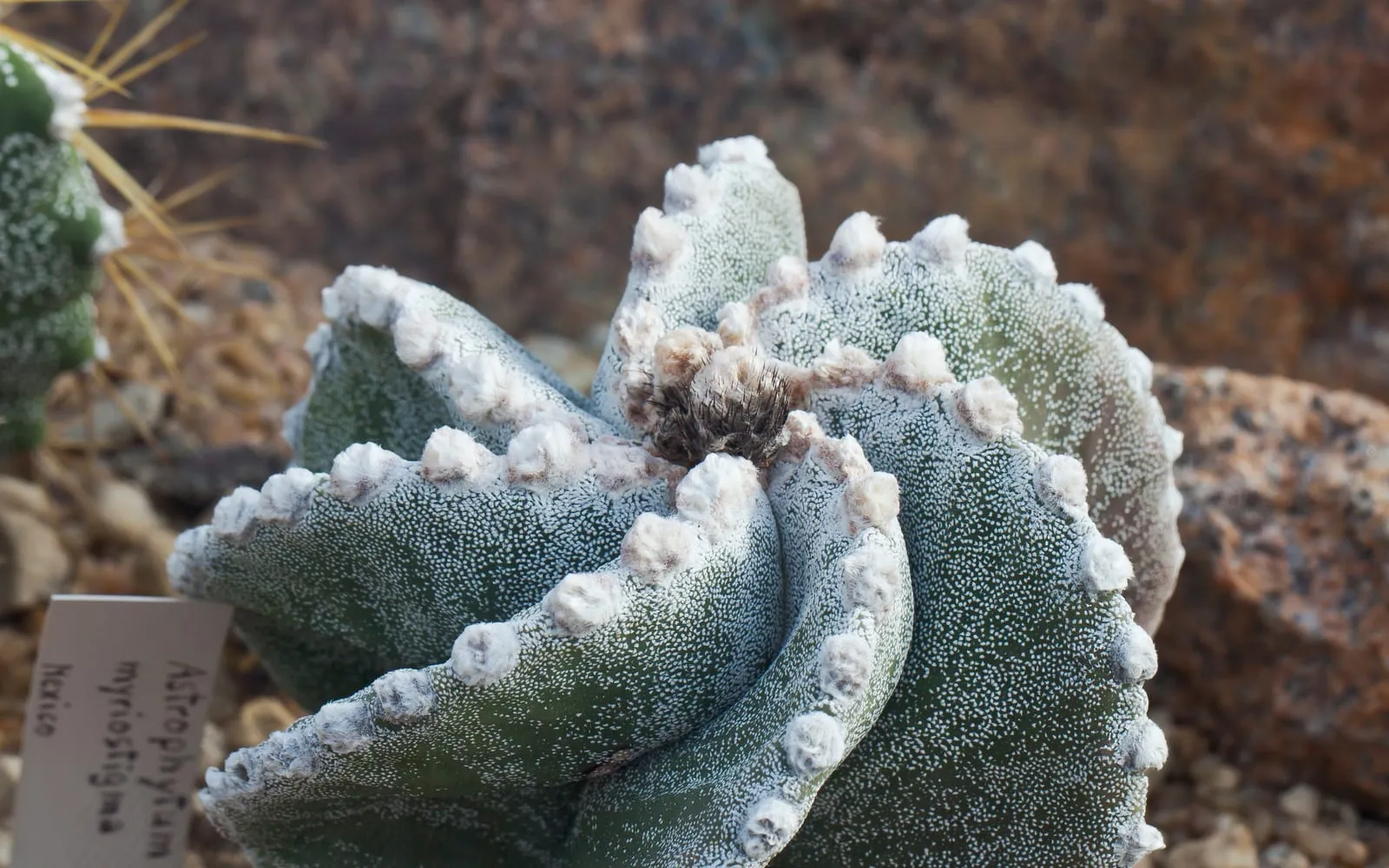
Bishop’s cap cactus grows as a solitary grey-green globe, usually divided into five ribs that taper the plant to a rounded point at the crown. It carries no spines. Instead, the whole surface is dusted with small white woolly flecks, giving it a felted, silvery look that separates it at a glance from almost every other cactus sold as a houseplant.
Growth is slow and the plant needs very little routine care beyond strong light and a root ball that dries out fully between waterings, since it comes from rocky ground where water never lingers. Get light and drainage right and a Bishop’s cap cactus can sit on a sunny windowsill for decades, elongating gradually from a flattened globe into a short column as it ages.
Appearance and character
The five ribs, occasionally four or six on an individual plant, run from base to crown in smooth vertical curves, each carrying a line of small felted areoles where the flecking is thickest. The overall colour reads as grey-green under the covering, sometimes almost silver-white on a heavily flecked specimen and closer to plain green on a more sparsely marked one, since the density of the flecking varies between individual plants and named forms.
Flowers open from the crown in summer on a mature plant, pale yellow with a darker orange-red throat in some forms, each bloom lasting only a day or two but with new ones following through the warmest months. A young plant will not flower; it needs several years of growth first.
With age the globe stretches upward into a squat column, still ribbed and still flecked, and very old specimens in habitat can reach a metre or more, far beyond what a potted plant is likely to achieve indoors.
Where it is from
Astrophytum myriostigma grows across central and northern Mexico, on limestone hillsides and among rock scree in states including San Luis Potosi, Hidalgo and Zacatecas. It roots into thin, mineral, fast-draining soil pockets between rocks rather than open ground, in a semi-desert climate with a hot dry season and rainfall concentrated into brief summer storms.
That background explains why the plant tolerates neglect so well and tolerates a soggy pot so badly. Its roots evolved to take a heavy soak and then dry within days, never to sit in damp soil for a week at a time the way a tropical houseplant’s roots do.
How it grows
Pot it in a mineral, fast-draining mix built from coarse grit, pumice and sand rather than ordinary compost, which holds far more moisture around the roots than this species can use. A ready-made cactus mix improved with extra grit works well.
Give it the brightest position available. A south-facing windowsill suits it in most climates, and a plant kept too dim over months will etiolate, stretching and losing the tight, symmetrical rib pattern that makes it worth growing. Move it outdoors into full sun for summer where the climate allows, bringing it back in before nights turn cold.
Repot every three to four years, moving up only one pot size, since a pot that is too large holds wet mix for too long around a root system built for a small volume of fast-draining soil. Being spineless, it is easier to handle safely than most cacti; a folded strip of paper or a cloth still helps you get a secure grip without marking the surface.
Propagation is from seed almost exclusively. Astrophytum myriostigma has no offsets or pups to divide, unlike many clustering cacti, so a specialist nursery raising named forms grows every plant individually from seed over several years.
Through the seasons
Spring is when growth resumes after winter. Begin watering again as temperatures rise and start monthly feeding once new growth is visible at the crown.
Summer is the main growing season and, on a mature plant, when flowers open at the crown in succession through the warmest weeks.
Autumn calls for a gradual reduction in watering as light and warmth fall away, tapering towards the near-dry conditions of winter.
Winter is a dormant rest. Water only enough to stop the roots shrivelling entirely, perhaps once over the whole season in a cool room, and keep the plant above 5 deg C wherever possible.
Care difficulty
Moderate, and the difficulty is one of restraint rather than of active work. The plant needs no pruning, no staking and very little feeding, and a well-sited specimen can go weeks without attention. Where growers lose one, it is almost always to overwatering, particularly in winter when a cool, dim room slows the plant’s water use far more than it slows a habit of watering on a fixed schedule. Strong light is the other requirement that is easy to under-supply indoors, and a plant kept too dim survives for years without ever showing the tight, silvery form it has in full sun.
Watering
Water thoroughly, until it runs from the drainage holes, then leave the mix to dry out completely before watering again. Check by pushing a finger or a wooden skewer into the mix rather than watering by the calendar, since the interval shifts with light, pot size and season.
In a bright, warm room through summer that might mean watering every two to three weeks. In a cooler room over winter, stretch that to once a month or, in a cold, dim spot, withhold water almost entirely until spring.
Warning signs, diseases and pests
Root rot follows a mix that has stayed wet, showing as a plant that looks soft, discoloured or sunken at the base despite an apparently healthy top. Unpot it, cut away any brown or mushy root tissue, let the remainder dry for a few days, then repot into fresh, dry mineral mix and hold off watering for a week or two.
Mealybug shows as small white, cottony clusters tucked into the crown or between the ribs, where they are easy to miss until a colony has built up. Treat with a cotton bud dipped in alcohol or a horticultural soap spray.
Scale insects appear as small, flat, brownish bumps on older growth, usually towards the base. Scrape them off or treat the same way as mealybug.
Spider mite thrives in hot, dry indoor air and leaves fine pale speckling across the surface, sometimes with faint webbing near the crown in a bad infestation. Raising humidity slightly and wiping the plant down with a damp cloth helps prevent it taking hold.
Growing environment
Full sun suits it best, and a position with at least four to six hours of direct light a day keeps the rib pattern tight and the flecking dense. A plant grown in low light stretches and fades, losing the compact shape that is most of its appeal.
Warmth above 5 deg C keeps it actively growing; below that it should be kept dry and treated as dormant rather than watered on the usual schedule.
Free-draining mineral soil is not negotiable. Even excellent light and correct watering cannot compensate for a mix that holds water around the roots for days at a time.
Feeding
Feed with a low-nitrogen fertiliser formulated for cacti and succulents, diluted to the strength the product recommends, once a month through spring and summer while the plant is in active growth.
Stop feeding entirely from autumn through winter. A dormant plant takes up almost no nutrients at that point, and fertiliser left in a mix that is already close to dry can build up as salts that damage the roots.
Troubleshooting
The plant has gone soft and discoloured at the base. Root rot from overwatering, most likely over winter. Unpot it, cut away any affected roots, let the cut surfaces dry, and repot into fresh mineral mix, then water far less often than before.
It has lost its silvery flecking and turned plain green. Usually low light. Move it to a brighter position; new growth at the crown should regain the denser white flecking within a season or two, though older growth further down will not change.
Why has it never flowered? Age. A young plant needs several years of steady growth before it reaches flowering size, and strong summer light throughout that time makes a real difference to how soon it starts.
The plant looks stretched and thin rather than tightly ribbed. This is etiolation from too little light. Move it somewhere brighter straight away; new growth will be more compact, though the stretched section already formed will not shorten again.
Can I grow it outdoors year round? Only in a reliably dry, frost-free or near-frost-free climate. Where winters bring rain as well as cold, grow it in a pot that can be moved under cover, since wet cold does far more damage to this species than dry cold ever does.
Bishop's Cap Cactus problem guides
Not sure what is wrong? See the common houseplant pests guide.