
Houseplant
Golden Barrel Cactus
Echinocactus grusonii
Also known as Mother-in-Law's Cushion
How to grow golden barrel cactus, Echinocactus grusonii. Its entire wild population was flooded by a dam in the 1990s, overwatering is the real risk rather than drought, and most never live long enough to flower.
At a glance
- Difficulty
- Easy
- Water
- Sparingly, only once the mix is completely dry
- Light
- Full sun
- Temperature
- Above 2 deg C for reliable growth; tolerates a brief light frost once mature and dry
- Hardiness
- USDA 9b-11, RHS H2, hardy to -4 C
- Type
- Evergreen succulent cactus, very long-lived
- Height
- 60-100 cm across in maturity, over many decades
- Native to
- Mexico
Native to a narrow area of semi-desert scrub on volcanic slopes in central Mexico, where rainfall is low and strongly seasonal and sun exposure is close to constant. The zone number describes brief, dry cold rather than a real winter, and a mature, well-established plant tolerates an occasional light frost far better than a young one does. Nothing about the zone range explains the species' most pressing fact, that its entire wild population sits in one small area now reduced by a reservoir, which the section below covers.
Hardiness zones describe winter cold alone. Summer heat, humidity, rainfall and the length of the growing season decide as much, so treat the range as the outer limit rather than as a recommendation.
Not known to be toxic
Echinocactus is not listed as toxic by the ASPCA and does not appear on the RHS list of potentially harmful garden plants, and no part of the plant is documented as poisonous to people, cats, dogs or horses. The real hazard is entirely mechanical rather than chemical: the dense covering of stiff golden spines causes painful puncture wounds on contact, and a curious pet or a child brushing against a mature specimen can be seriously scratched even though nothing in the plant's tissue is toxic. Position it well away from paths, low shelves or anywhere a pet or child might brush against it without warning.
Sources: ASPCA toxic and non-toxic plants, RHS potentially harmful garden plants
About
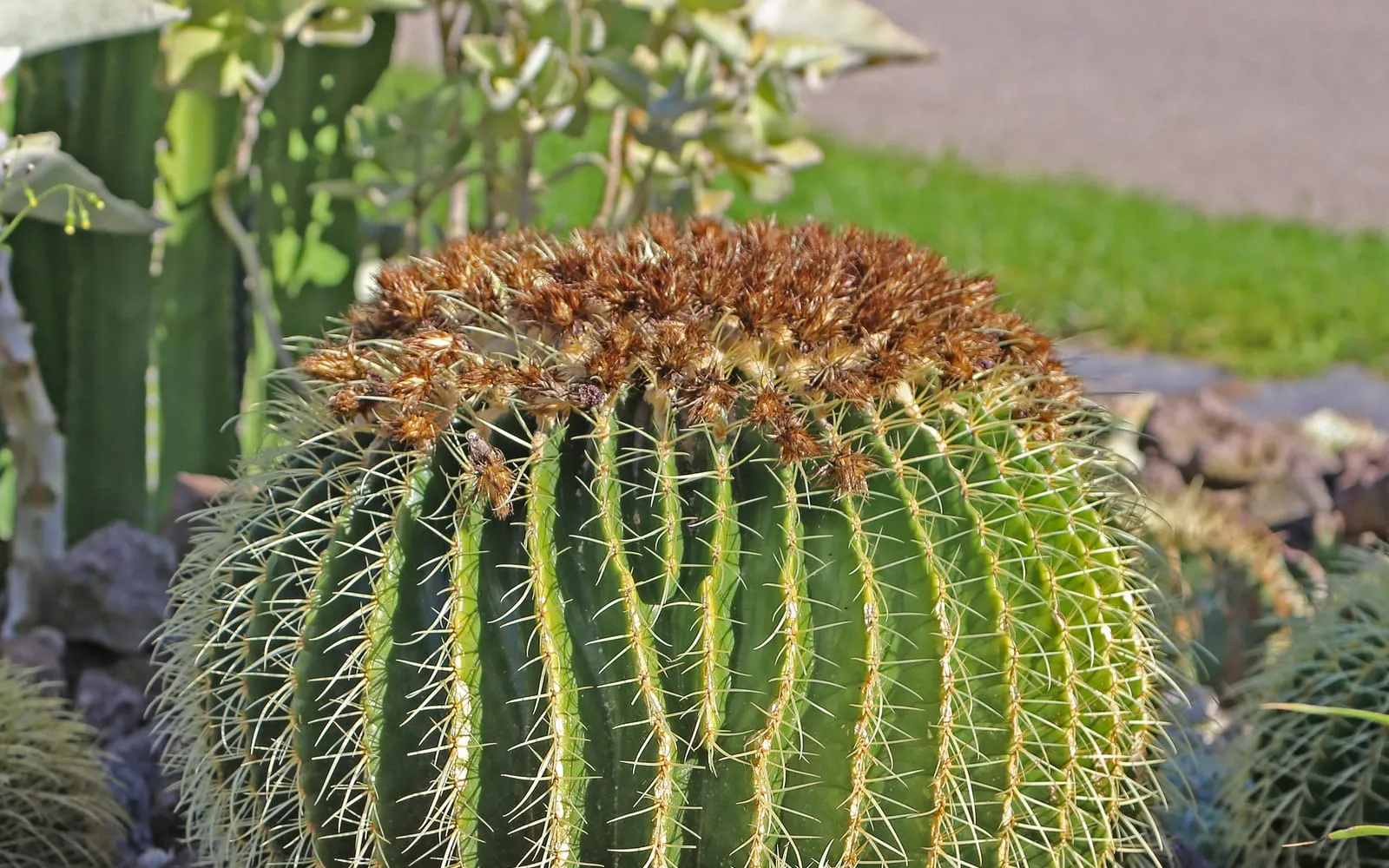
Golden barrel cactus grows as a single, ribbed sphere, densely covered in stiff, golden-yellow spines that radiate outward from each rib in neat rows. Young plants are noticeably rounder than the more barrel-like shape older specimens eventually take, and growth is slow enough that a grapefruit-sized plant may already be a decade or more old.
It is also one of the more precarious species covered on this site in the wild, despite being common in cultivation worldwide. Its entire natural range sat within a small area of Hidalgo, Mexico, much of which was flooded when a dam was built there in the twentieth century, so nearly every plant now grown anywhere descends from cultivated stock rather than wild collection.
Appearance and character
The stem is spherical when young, flattening slightly and elongating towards a true barrel shape with age, and is divided into 20 to 30 sharply defined vertical ribs running from base to crown. Clusters of stiff, golden-yellow spines emerge at regular intervals along each rib, giving the whole plant its glowing colour and its common name.
A dense ring of fine, woolly hairs develops at the crown as the plant matures, and it is from this woolly crown that a fully grown specimen, generally several decades old, eventually produces a ring of small yellow flowers in summer. Many plants in cultivation never reach flowering size, since they need to be considerably larger and older than most houseplant specimens ever get.
Growth is slow throughout the plant’s life. A cactus grown from seed can take many years to reach even a modest size, which is part of why larger specimens command a premium price and are valued as much for their age as for their appearance.
Where it is from
Echinocactus grusonii is native to a small area of semi-desert scrub on volcanic, rocky slopes in the state of Hidalgo in central Mexico, where rainfall is low, sharply seasonal, and sun exposure is close to constant for most of the year. The wild population was always naturally restricted, and construction of the Zimapan Dam in the 1990s flooded much of the remaining habitat, leaving it considered functionally extinct or critically endangered in the wild by most assessments.
The species survives in vast numbers only because it was already so widely propagated in cultivation before that habitat loss, which is a detail worth keeping in mind: buying a nursery-grown plant supports no further pressure on the wild population, since there is essentially none left to collect from.
How it grows
Pot it in a very free-draining, gritty cactus mix, in a pot only a little larger than the current root ball, since a young cactus in oversized soil sits in damp conditions for far longer than its roots can use.
Give it full sun. This is a plant adapted to close to constant, intense exposure in the wild, and even a bright windowsill indoors rarely matches that, so as much direct light as the space allows produces the best colour and the most even, symmetrical growth.
Water sparingly and only once the mix is completely dry, deep enough to wet the full root zone each time rather than little and often. Growth is naturally slow, and no amount of extra water speeds it up meaningfully, while too much water reliably causes rot.
Repotting is rarely urgent given how slowly the plant grows, needed only once it has clearly outgrown its pot, which for a mature specimen may be every five years or considerably longer.
Through the seasons
Spring brings the resumption of slow, steady growth as light and warmth increase. Begin light feeding once new growth is visible.
Summer is the main growing season and, on a large, mature specimen, when the ring of yellow flowers appears at the crown. Water more regularly, always allowing the mix to dry fully between waterings.
Autumn slows growth as light and temperature fall. Reduce watering and stop feeding.
Winter is a dry rest. Water rarely, if at all, and keep the plant in the brightest spot available.
Care difficulty
Easy, and one of the more forgiving cacti for a beginner precisely because it grows so slowly and tolerates being left alone for long stretches. The main risk by far is overwatering, particularly in winter, since the plant’s own slow metabolism means it uses stored water for a long time before showing any visible stress from drought. A gritty mix, strong light and a light hand with the watering can cover nearly everything this species needs.
Watering
Water sparingly, and only once the mix has dried out completely, testing with a finger or a wooden skewer inserted a few centimetres down rather than watering to a schedule. When you do water, soak it thoroughly so the whole root zone is wetted, then let it drain fully and leave it alone until dry again.
Cut back hard in winter, watering rarely if at all, since a slow-growing, largely dormant cactus kept damp through a cold, low-light winter is far more likely to rot than one left almost completely dry.
Warning signs, diseases and pests
Mealybug settles at the base of the plant among the spines, where the dense covering makes it hard to spot until an infestation has built up. Check the base periodically for small white, cottony tufts and treat with horticultural soap, applied carefully around the spines.
Scale insects appear along the ribs as small, flat, brownish bumps. Treat the same way as mealybug, working carefully to avoid the spines.
Root rot follows a mix that stays wet, and shows as a base that softens, discolours or develops a sunken, water-soaked patch. Cut away any affected tissue with a clean blade, let the wound dry and callus for several days, and repot into fresh, very free-draining mix once it has.
Spider mite becomes more likely in hot, dry indoor air, showing as fine, dry-looking discolouration on the skin between the ribs rather than the webbing more obvious on soft-leaved plants. Increasing air movement and checking closely under strong light both help catch it early.
Growing environment
Full sun is what this species needs above everything else, and it is one of the few houseplants that rarely gets too much light indoors. A south-facing window, ideally with several hours of unobstructed direct sun, suits it best.
Average room warmth is fine through the year, provided it stays above about 2 deg C. A mature, dry plant tolerates an occasional very light frost outdoors in a suitable climate, but a young or actively growing plant has no meaningful cold tolerance at all.
A very free-draining, mineral cactus mix is essential. Ordinary potting compost, even labelled for cacti, often benefits from extra grit or pumice worked in to get the drainage this species needs.
No particular humidity is required, and it is entirely at home in dry indoor air.
Feeding
Feed sparingly with a dedicated cactus fertiliser, low in nitrogen, a few times through spring and summer rather than on a strict monthly schedule, since heavy feeding pushes soft growth that spaces the ribs unevenly rather than the tight, symmetrical form the plant is prized for.
Stop feeding entirely from autumn through winter, when growth has slowed to a near halt and any unused fertiliser only accumulates as salts in a mix that is being watered very little.
Troubleshooting
The plant has gone soft or discoloured at the base. Root rot, almost always from overwatering, particularly in winter. Cut away the affected tissue with a clean blade, let the wound dry and callus for several days in a dry, shaded spot, and repot into fresh, very free-draining mix.
Growth looks lopsided rather than a neat sphere. Uneven light is the likeliest cause, since the side facing the strongest light grows faster than the shaded side. Rotate the pot a quarter turn every few weeks to even out the exposure and correct new growth over time.
It has never flowered. Almost certainly age and size. Golden barrel cactus needs to be a large, mature specimen, often several decades old, before it flowers at all, so a young plant grown as a houseplant is very unlikely to bloom regardless of care.
The spines look pale or sparse compared with photographs I have seen. Usually too little light. This species colours up brightest, with the densest spine cover, under strong, direct sun, and a plant kept too far from a window produces thinner, paler growth by comparison.
Is it really endangered in the wild? Yes. Its entire natural range sat within a small part of Hidalgo, Mexico, much of which was flooded by a dam in the 1990s, leaving wild populations critically reduced. Nearly every plant sold today comes from cultivated stock rather than wild collection, which is part of why buying a nursery-grown specimen is the responsible choice.
Golden Barrel Cactus problem guides
Not sure what is wrong? See the common houseplant pests guide.