
Edible
Cardamom
Elettaria cardamomum
Also known as Green cardamom, True cardamom, Elaichi
How to grow cardamom, Elettaria cardamomum. The third most expensive spice in the world, why it is picked by hand, and growing the plant under glass outside the tropics.
At a glance
- Difficulty
- Difficult
- Water
- Two or three times a week in summer, weekly in winter
- Light
- Dappled shade. It grows under forest canopy
- Temperature
- Damaged below 12 deg C and killed by frost
- Humidity
- High. It comes from monsoon forest
- Hardiness
- USDA 10-12, RHS H1b, hardy to 10 C
- Type
- Tender evergreen perennial
- Height
- 2-4 m in the tropics, 1-2 m in a pot
- Native to
- southern India and Sri Lanka
- Best month
- June and July in the Northern Hemisphere, December and January in the Southern Hemisphere
The shaded understorey of the Western Ghats at 800 to 1,500 m, which means warmth without direct sun. It wants deep shade, constant humidity and no wind, and it will not crop in the open. Capsules are picked green and cured.
Hardiness zones describe winter cold alone. Summer heat, humidity, rainfall and the length of the growing season decide as much, so treat the range as the outer limit rather than as a recommendation.
Every month named in this guide is for the temperate Northern Hemisphere. If you garden in the Southern Hemisphere, shift each one by six months, so June becomes December. Closer to the equator the wet and dry seasons matter more than the calendar, and the shift stops being a useful guide.
Not known to be toxic
- Safe to eat
- The seeds and pods
Non-toxic. Cardamom is a widely eaten spice with a very long record of safe use, and it appears on neither the RHS list of potentially harmful garden plants nor the ASPCA list. Seeds and pods are both used. The essential oil is a concentrated product and carries the usual caution applying to any essential oil, meaning it should not be given to animals or applied undiluted to skin. Nothing about growing or handling the plant presents a risk.
Sources: RHS potentially harmful garden plants, ASPCA toxic and non-toxic plants
About
Cardamom is the third most expensive spice in the world after saffron and vanilla because the harvest is slower. The pods on a stalk ripen unevenly over several weeks, they have to be picked at a precise point before they split, and every one is taken by hand. A plantation is walked over repeatedly through a season.
The plant is a large leafy relative of ginger from the monsoon forests of the Western Ghats. It grows in shade under canopy, and its flowers appear on sprawling stalks that lie along the ground rather than on the leafy shoots, which surprises people expecting them at the top.
Growing it outside the tropics is a greenhouse project. It wants heat, humidity and shade, it takes three or four years to flower and usually does not in a pot, so the honest ambition is a handsome foliage plant with an outside chance of pods.
Appearance and character
Tall leafy shoots rising from a thick creeping rhizome, 2 to 4 m in the tropics and generally 1 to 2 m in a pot.
Leaves are long and lance-shaped, 30 to 60 cm, dark green above, paler beneath, arranged alternately up the shoot in two ranks.
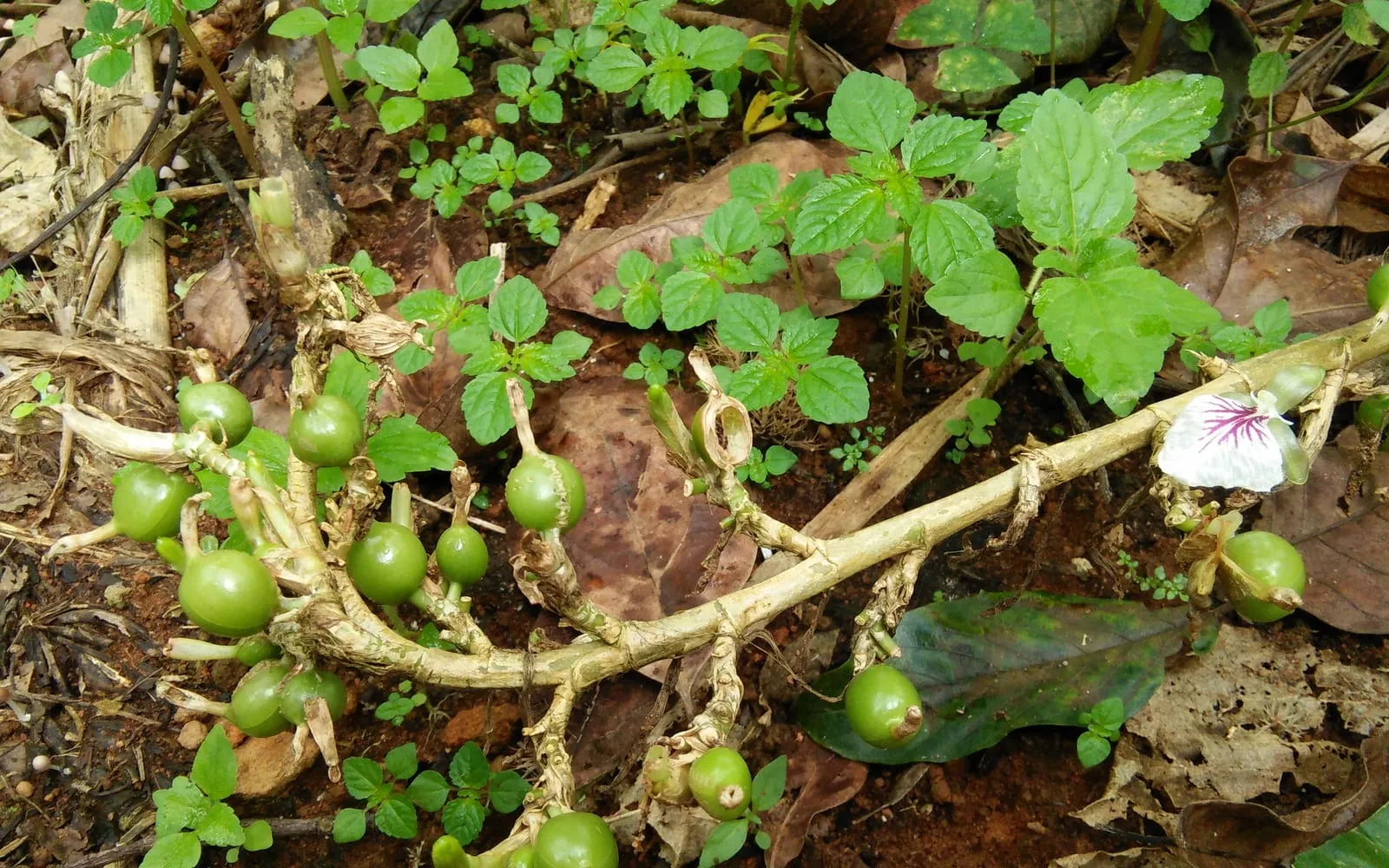
Flowering stalks are the distinctive part. They emerge from the base of the plant and sprawl along the ground, up to a metre long, carrying small white flowers marked with a violet stripe down the lip.
Pods follow on those stalks, oval, three-sided, pale green, 1 to 2 cm long, each holding fifteen to twenty small black seeds.
The scent is in the seeds rather than the pod, sweet, camphorous and eucalyptus- like, and it fades fast once the seeds are ground.
The whole plant is aromatic when crushed, though far less so than the seed.
Where it is from
Cardamom is native to the evergreen forests of the Western Ghats in southern India and to Sri Lanka, growing as an understorey plant at 600 to 1,500 metres.
The Cardamom Hills of Kerala take their name from it, and the spice has been gathered and traded from there for well over two thousand years.
Greek and Roman writers knew it and it appears in Roman trade records from Egypt, priced as a luxury.
Guatemala is now the world’s largest producer, which is a comparatively recent accident. A German coffee planter, Oscar Kloeffer, introduced it there before the First World War, and the crop expanded enormously in the twentieth century.
Most of the world’s cardamom is consumed in the Middle East, where it flavours coffee, and in India, where it goes into both sweet and savoury cooking and into masala chai.
How it grows
Buy a plant, or divide a rhizome from an established one in spring.
Seed works if it is fresh. Seed from a shop-bought pod may germinate if the pods were recently dried, though the rate is poor and germination is slow, taking one to three months at 25 deg C.
Pot into rich humus-rich compost that holds moisture and still drains, in a wide pot rather than a deep one, since the rhizome spreads sideways.
Grow it in a heated greenhouse or conservatory at a minimum of 15 deg C, and shade it from direct sun.
Keep the humidity high. This is the requirement people miss.
Water regularly in summer and less in winter, without letting it dry out completely.
Feed fortnightly through the growing season.
Divide and repot every second or third spring, which is also how to increase it.
Expect flowering from the third or fourth year in ideal conditions and often not at all in a pot. If it does flower, hand pollinate with a small brush, since the bees that do the job in Kerala are not available.
Through the seasons
Winter is survival under glass above 15 deg C, watered weekly and kept humid.
Spring brings new shoots from the rhizome. Divide, repot and begin feeding.
Early summer is rapid growth, and the time flower stalks appear on a mature plant.
Midsummer is when pods develop on a plant that has flowered.
Late summer is when they would ripen, unevenly, over several weeks.
Autumn is when to reduce watering and stop feeding.
Care difficulty
Difficult, and flowering outside the tropics is the hard part rather than keeping the plant alive.
Warmth is the first requirement. Minimum 15 deg C, preferably above 20 deg C, year round.
Humidity is the second, and dry heated air is what browns the leaves and brings spider mite.
Shade is the third and it reverses the usual advice. Cardamom grows under forest canopy and scorches in direct sun through glass.
Root room matters. The rhizome spreads sideways, so a wide pot produces a better plant than a deep one, and a restricted plant rarely flowers.
Flowering needs a mature plant, three or four years old, with consistent conditions. Most plants outside the tropics stay foliage plants, and it is better to start out expecting that.
Watering
Water two or three times a week in summer, keeping the compost evenly damp.
Water weekly in winter, without letting the compost dry out completely.
Never let it stand in water, since cold wet compost rots the rhizome.
Use tepid water in winter and rainwater in a hard water area.
Raise the humidity with misting, damp gravel trays and grouped planting.
Reduce watering from October as growth slows.
Warning signs, diseases and pests
Brown leaf edges mean dry air, which is the most common complaint.
Yellowing and general decline usually mean cold.
Spider mite shows as fine stippling with webbing in dry heated air. Raise the humidity and use a predatory mite.
Mealybug hides at the shoot bases as white waxy fluff.
Scale insects appear as brown limpets on the leaf undersides with sticky honeydew below.
Soft rot at the rhizome is root rot from cold wet compost.
No flowers is the normal outcome in a pot. A wider pot, more warmth and more patience are the only remedies.
Growing environment
A heated greenhouse or conservatory with shading. There is no outdoor option outside the tropics.
Minimum 15 deg C and preferably above 20 deg C.
High humidity throughout the year.
Dappled shade rather than direct sun, which reflects its life under forest canopy.
Rich, humus-rich, moisture-retentive but free-draining compost in a wide pot.
pH from 5.5 to 6.5.
Give it room. The rhizome spreads and a cramped plant stays small and will not flower.
Feeding
Feed a balanced liquid feed fortnightly from May to August.
A feed with reasonable nitrogen suits it while it is building leafy shoots, and potash helps a mature plant towards flowering.
Stop feeding from September and give nothing through the winter.
Repot into fresh compost every second or third spring, dividing at the same time.
Leaf mould or composted bark worked into the compost suits a forest understorey plant.
Troubleshooting
It has never flowered. The usual outcome outside the tropics. Cardamom needs three or four years, consistent warmth above 20 deg C, high humidity and a wide pot. Treat it as a foliage plant and regard flowers as a bonus.
Where do the flowers come from? From the base of the plant, on sprawling stalks that lie along the ground, rather than at the top of the leafy shoots.
Why is cardamom so expensive? The harvest. Pods ripen unevenly over weeks, each has to be picked by hand at the right moment before it splits, and a plantation is walked over repeatedly through the season.
Can I grow it from shop-bought pods? Sometimes, if the pods were recently dried. Germination is slow and the rate is poor.
The leaf edges went brown. Dry air. Raise the humidity.
Is black cardamom the same plant? No. Black cardamom is Amomum subulatum, a different genus with large smoke-dried pods and a completely different flavour. They are not substitutes for each other.
How should I store the seed? In the pod. Ground cardamom loses its aroma within weeks, and pods keep it for a year or more.