
Houseplant
Moonstones
Pachyphytum oviferum
Also known as Sugared Almond Plant, Egg Plant Pachyphytum
How to grow moonstones, Pachyphytum oviferum. Why touching a leaf leaves a permanent mark in its chalky farina bloom, and what triggers its red-orange flower spikes each winter.
At a glance
- Difficulty
- Easy
- Water
- Only once the mix has dried out completely, reduced further in winter
- Light
- Bright light with several hours of direct sun
- Temperature
- Above 5 deg C for reliable growth
- Hardiness
- USDA 9b-11, RHS H2, hardy to -2 C
- Type
- Evergreen succulent perennial
- Height
- 10-15 cm tall, spreading wider as offsets form
- Native to
- Mexico
Native to dry cliffs rather than a climate with a real winter, so the zone number covers only a brief, dry cold snap rather than a season spent outdoors anywhere with regular frost. It comes from a semi-arid part of central Mexico with strong sun and sharp drainage year round, which the zone range does not capture at all, and that combination matters more day to day than the cold tolerance does.
Hardiness zones describe winter cold alone. Summer heat, humidity, rainfall and the length of the growing season decide as much, so treat the range as the outer limit rather than as a recommendation.
Not known to be toxic
Pachyphytum does not appear on the RHS list of potentially harmful garden plants, and the ASPCA does not list the genus as toxic to cats or dogs. There is no documented case of it causing anything beyond mild stomach upset if a pet eats a leaf, and that upset is more likely to come from the sheer fibrous bulk of a succulent leaf than from any poison in it. The main hazard is not the plant itself but the thin chalky bloom on its leaves, which rubs off permanently at a touch, so a curious pet brushing past a prized rosette does more damage to its looks than to the animal.
Sources: RHS potentially harmful garden plants, ASPCA toxic and non-toxic plants
About
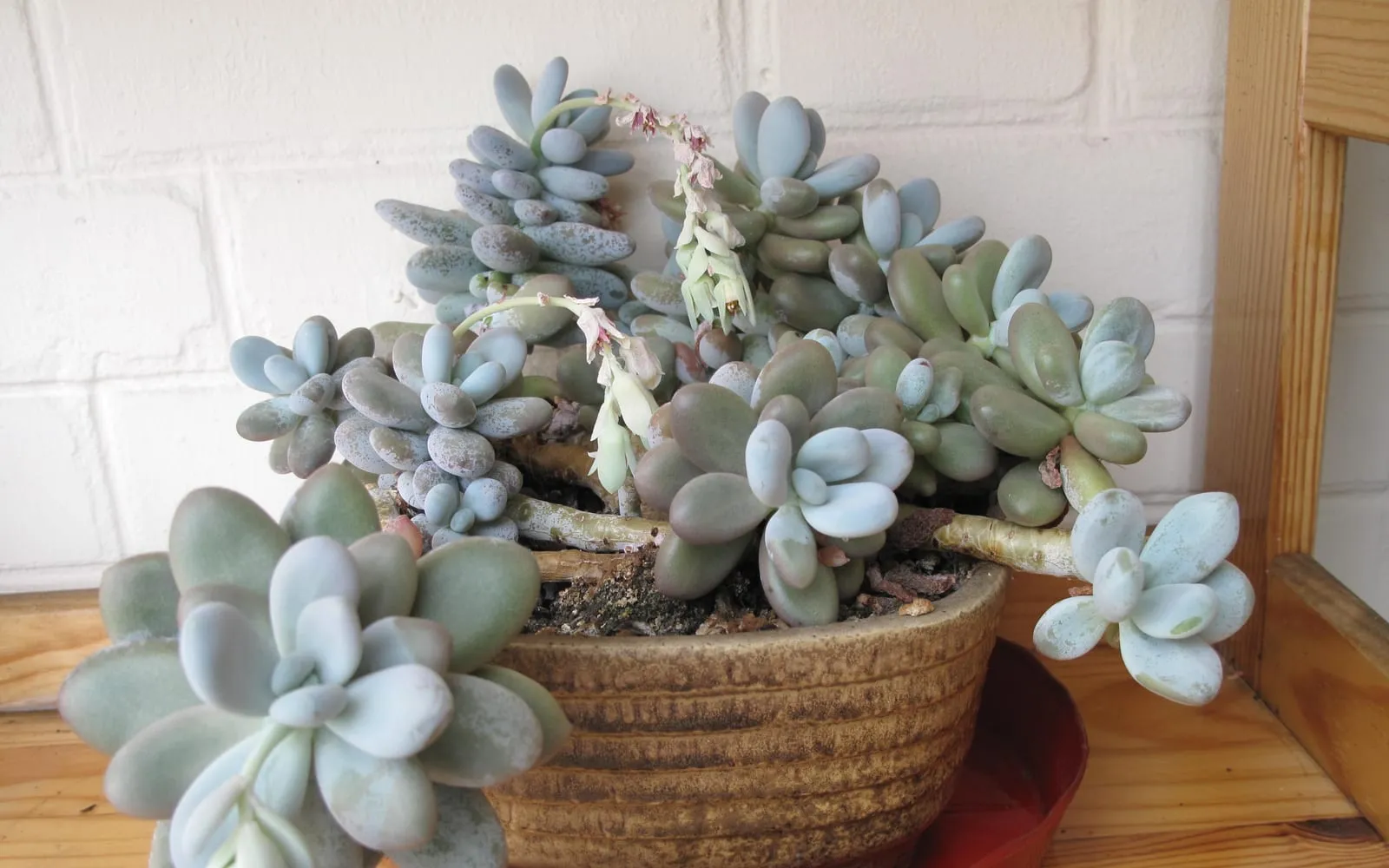
Moonstones grows a rosette of plump, egg-shaped leaves in a soft blue-grey, sometimes flushed pink, and covered in a fine, powdery bloom called farina. That bloom is the plant’s real defining feature and its most delicate one: touch a leaf and the bloom rubs away where your finger made contact, leaving a dull, faintly green mark that never returns. Handle one by the pot rather than the leaves.
It is otherwise an easy, low-maintenance succulent, spreading slowly by offsets into a mounded clump of rosettes on short, sprawling stems. Given strong light and a properly gritty mix, it needs little beyond an occasional deep soak and needs nothing at all through winter beyond being left mostly alone.
Appearance and character
Each rosette carries a dozen or so leaves, thick, rounded and slightly tapered at the tip, close enough in shape to a small hen’s egg that the plant is sometimes sold under names referencing that resemblance. The farina coating gives the whole rosette a soft, matte, almost frosted look that catches light differently from a glossy succulent leaf.
Colour shifts with light and season. A rosette kept in strong sun often develops a warm pink or lavender flush across the leaf tips, most obvious in cooler weather, while one grown in weaker light stays a plainer blue-grey and tends to space its leaves further apart on a longer stem.
Flowers appear on slender, arching stems that rise well above the foliage, usually in winter or early spring, carrying small bell-shaped blooms in red to deep orange. The contrast between the muted rosette and the brightly coloured flower spike is sharp, and a well-grown clump can throw up several flowering stems from different rosettes at once.
Where it is from
Pachyphytum oviferum grows on rocky, often near-vertical cliffs and outcrops in the state of Hidalgo in central Mexico, rooting into narrow crevices with almost no soil around the roots. Rainfall in that region is seasonal and the exposure to full sun is close to constant, conditions the thick, water-storing leaves and the farina bloom are both adapted to.
The farina itself is a sun defence as much as a decorative feature, reflecting some of the intense light the plant receives on an open cliff face and slowing water loss from the leaf surface beneath it. Losing patches of it to handling or rough weather does the plant no lasting harm, though the mark stays until that leaf is eventually shed.
How it grows
Pot it in a gritty, mineral-heavy succulent mix in a shallow, wide container rather than a deep one, since the roots stay fairly shallow and a rosette that topples from a leggy stem is easier to right in a broad, stable pot.
Give it strong light, including direct sun for at least a few hours a day. Too little light produces a stretched, open rosette on an elongated stem, chasing the sun rather than the tight, compact form the plant shows under good light.
Handle rosettes as little as possible, lifting by the pot or supporting a leaf from underneath rather than gripping it, since the farina bloom marks permanently at the lightest touch and cannot be restored once removed.
Offsets form readily around the base of an established rosette and can be detached once they have their own small roots, or left in place to build a spreading clump over several years. A dropped leaf will often root and grow a tiny new rosette of its own if left undisturbed on top of dry mix.
Through the seasons
Spring brings the start of active growth. Increase watering gradually and resume feeding as new leaves appear.
Summer is the main growing season, with steady watering and bright light supporting new rosette growth and offsets.
Autumn slows growth. Reduce watering and stop feeding as light levels fall.
Winter brings flowering on a mature clump, arching stems of red-orange blooms rising above a mostly dormant rosette. Water only sparingly through this period.
Care difficulty
Easy, provided the two real risks are kept in mind. Overwatering is the likelier of the two to kill a plant outright, since the thick leaves store enough water to disguise a rotting root system until the damage is well advanced. Careless handling is the other, cosmetic rather than fatal, rubbing the farina bloom from leaves that will carry the mark for the rest of their life. Neither problem takes daily attention to avoid, only a light touch and a watering routine that respects how slowly the plant uses water.
Watering
Let the mix dry out completely before watering again, testing with a finger rather than watering to a schedule. When you do water, soak it thoroughly at the base, avoiding the rosette itself where possible, since water sitting in the crown between the leaves can encourage rot.
Reduce watering sharply through autumn and winter, when the plant’s own growth has slowed and a wet mix at cooler temperatures is far more likely to cause root problems than it would in the height of summer.
Warning signs, diseases and pests
Mealybug hides between the tightly packed leaves of the rosette, showing as small white, cottony tufts that are easy to miss until they have spread. Treat with horticultural soap or by dabbing them with a cotton bud dipped in alcohol, working carefully around the leaves to avoid marking them.
Root rot follows a mix kept too wet, particularly over winter, and shows as a rosette that looks increasingly loose or discoloured at the base despite feeling firm on top. Unpot it, cut away any soft or brown roots, let the remainder dry, and repot into fresh, dry mix.
Vine weevil grubs feed on the roots underground, and the first visible sign is often a rosette that topples or wilts with no obvious cause above soil level. Check the roots for pale, C-shaped grubs if this happens.
Aphids sometimes cluster on the tender flowering stems in winter, feeding on the softer new growth there rather than on the tougher rosette leaves. A strong jet of water or a wipe with diluted horticultural soap usually clears a light infestation.
Growing environment
Bright light with several hours of direct sun a day suits it best. A south or west-facing windowsill works well in a temperate climate, and a rosette that colours up in pink or lavender tones is a sign of enough light rather than of stress.
Average room warmth is fine through the year, provided it stays above about 5 deg C. It has no useful frost tolerance and should never be left outside once autumn nights turn cold.
A gritty, fast-draining mix matters more here than it does for many succulents, given how easily excess moisture around the roots turns into rot in a plant that stores so much water in its leaves already.
No particular humidity is needed. Ordinary indoor air suits it as well as any greenhouse setting.
Feeding
Feed with a balanced houseplant fertiliser or a cactus and succulent feed, diluted to around half strength, monthly through spring and summer.
Stop feeding entirely from autumn through winter, when growth has slowed to a near halt and any unused fertiliser only builds up as salts in a mix that is already being watered far less.
Troubleshooting
A leaf has a dull mark where I touched it. That is farina loss, the chalky bloom rubbing off at contact. It does no harm to the plant and does not spread, but the mark on that leaf is permanent. Handle rosettes by the pot rather than the foliage to avoid it on new growth.
The rosette has stretched out on a long stem. Too little light. The plant elongates its stem searching for stronger light, and once it has stretched it will not compress back down. Move it somewhere brighter and either accept the longer stem or cut and reroot the rosette from the top.
It has never flowered. Age and light are the likeliest reasons. A young or recently propagated rosette often takes a couple of years before it flowers, and it needs strong light through the year to build up the reserves a winter flower spike draws on.
The base of a rosette has gone soft. Root rot, almost always from overwatering. Unpot the plant, trim away any soft or discoloured roots, let it dry out fully, and repot into fresh, gritty mix before adjusting your watering interval.
Can I grow a new plant from a fallen leaf? Yes. A healthy leaf that drops or is gently twisted free will often root on its own if left lying on top of dry, gritty mix in bright, indirect light, growing a tiny new rosette from its base over the following weeks.
Moonstones problem guides
Not sure what is wrong? See the common houseplant pests guide.