
Houseplant
Burro's Tail
Sedum morganianum
Also known as Donkey Tail
How to grow burro's tail, Sedum morganianum. Why its leaves detach at the lightest touch, a normal trait rather than a problem, siting it somewhere nothing brushes past it, and rooting the fallen leaves into new plants.
At a glance
- Difficulty
- Easy
- Water
- Only once the compost has dried out fully, roughly every two to three weeks
- Light
- Bright light, some direct sun
- Temperature
- Above 4 deg C
- Humidity
- Low; average room air is fine
- Hardiness
- USDA 10-11, RHS H1c, hardy to 2 C
- Type
- Evergreen trailing succulent
- Height
- 60-90 cm of hanging stem
- Native to
- Mexico
A dry, rocky-cliff succulent from central Mexico with no tolerance for wet cold and only marginal tolerance for a light chill. It is grown outdoors year round only in near frost-free climates and as a houseplant or summer patio pot everywhere else.
Hardiness zones describe winter cold alone. Summer heat, humidity, rainfall and the length of the growing season decide as much, so treat the range as the outer limit rather than as a recommendation.
Not known to be toxic
Sedum carries no identified toxin and does not appear on the ASPCA or RHS lists of plants harmful to pets or people. A cat or dog that chews or dislodges a strand may be sick afterwards from the sheer quantity of fibrous, watery leaf material eaten rather than from any poison, the same as with any houseplant eaten in bulk. The practical hazard with this species has nothing to do with toxicity: the leaves detach so readily that a plant within reach of a curious cat sheds a trail of them across the floor, which is a housekeeping problem rather than a safety one.
Sources: RHS potentially harmful garden plants, ASPCA toxic and non-toxic plants
About
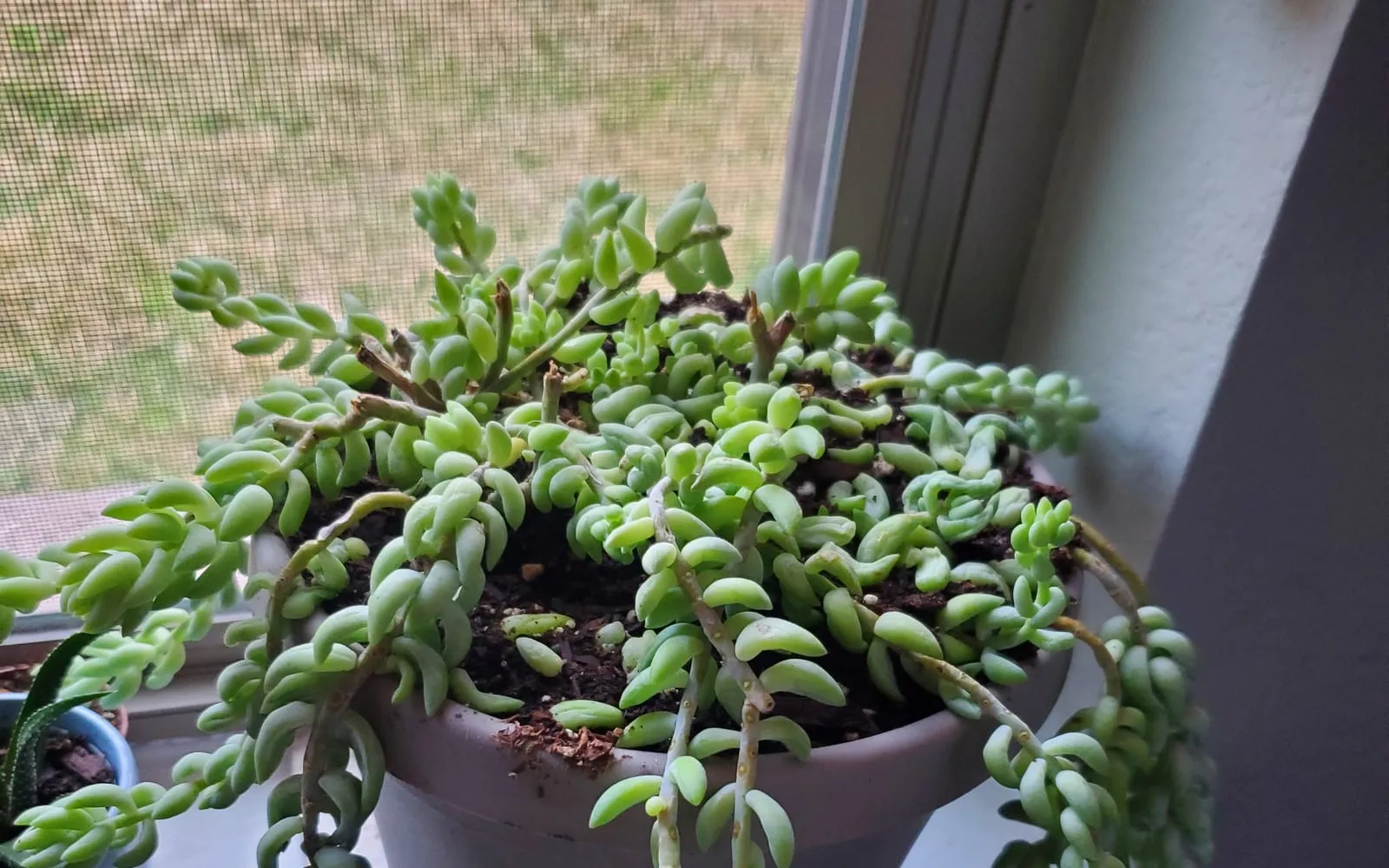
Burro’s tail is a trailing succulent with blue-green leaves that detach very easily. This is normal for the species, and each fallen leaf can root into a new plant. Indoors, it means the plant needs a quiet hanging position where people and pets will not brush past it.
Given bright light, dry compost and little handling, the stems lengthen into dense trailing ropes. Most problems come from overwatering, low light or placing the plant somewhere it is knocked.
Appearance and character
Leaves are plump, teardrop-shaped and densely packed in overlapping spirals along the stem, 1 to 2 cm each, pale blue-green under a fine powdery bloom that rubs off if handled and is easily mistaken for dust.
Stems trail rather than climb, thickening with age and eventually reaching 60 to 90 cm given an undisturbed hanging position and years of growth. A young plant sold in a small pot looks nothing like the mature specimen it can become.
Flowers, star-shaped and pink to red, appear at the tips of mature stems, though they are produced sparingly and mostly on older, well-established plants grown in strong light.
Where it is from
Sedum morganianum grows wild on steep, rocky cliff faces in the Mexican state of Veracruz, rooting into thin pockets of soil in crevices with sharp drainage and long dry spells between rains.
That cliff-dwelling habit explains the trailing growth, which lets the plant hang down a rock face rather than compete upward for light, and it explains the drought tolerance, since a plant rooted in a shallow crevice has no choice but to survive on infrequent water.
How it grows
Pot it in a gritty, fast-draining cactus and succulent compost, and choose a hanging pot or a raised position from the start, since the whole appeal of the plant depends on letting the stems hang free rather than trail across a surface where they get knocked.
Handle it as little as possible. Repotting inevitably knocks off some leaves, so do it only when necessary, typically every two to three years as the plant outgrows its pot, and expect some leaf loss as a normal part of the process rather than a sign anything went wrong.
Propagate from the leaves that fall or are gently removed: let the cut end callus over for a day or two on a dry surface, then lay it on top of gritty compost. Roots and a small new plantlet form at the base of the leaf within a few weeks. Stem cuttings root the same way and establish faster.
Through the seasons
Spring is the best time to repot if needed and to start new plants from fallen leaves, as growth resumes.
Summer is the main growing season. Give it as much direct sun as the position allows and water on the regular schedule.
Autumn slows growth. Reduce watering frequency as the compost takes longer to dry between waterings.
Winter is a rest. Water sparingly, perhaps once a month, and stop feeding; overwatering in winter is a far greater threat than the cold a houseplant experiences indoors.
Care difficulty
Easy, with a caveat that has nothing to do with light or water. The plant tolerates poor light, irregular watering and general neglect far better than most houseplants, but it does not tolerate handling, and a strand hung where sleeves, pets or passers-by brush against it will thin out no matter how well you otherwise care for it.
Watering
Water only once the compost has dried out completely, which in an average room is roughly every two to three weeks through summer and considerably less often in winter. Water thoroughly at the base until it drains, then let the pot dry out fully before watering again.
Avoid getting water trapped between the densely packed leaves, since it is slow to evaporate there and can encourage rot at points where a leaf joins the stem.
Warning signs, diseases and pests
Mealybug can hide deep among the packed leaves where it is hard to see, showing as small white, cottony tufts once you part the foliage. Treat with a cotton swab dipped in alcohol rather than a spray, which is difficult to direct accurately into the dense growth.
Root rot follows compost that has stayed wet, showing as stems that turn soft and dark at the base while the leaves above look deceptively normal for a while longer. Unpot it, cut back to firm, healthy stem tissue, let the cut ends callus, and repot into fresh, dry compost.
Vine weevil grubs occasionally feed on the roots of potted succulents, causing a plant to wilt or come loose in its pot despite normal watering. Check the roots for white, C-shaped grubs if a plant declines for no obvious reason.
Growing environment
Bright light with some hours of direct sun keeps the leaves plump and the blue-green colour strong; too little light causes the stems to stretch with wider gaps between leaves, and the plant loses its dense, braided look.
Keep it above 4 deg C, and treat that as an absolute floor for brief dips rather than a temperature it lives in comfortably; frost kills it outright.
Low humidity suits it well. This is a plant for a dry, sunny spot rather than a humid bathroom.
Hang it well clear of a busy doorway, a well-used chair, or anywhere pets jump up to investigate. That one choice of position affects how the plant looks more than any watering or feeding decision.
Feeding
Feed with a cactus and succulent fertiliser, diluted according to the label, once a month through spring and summer.
Stop feeding from autumn through winter, when growth has slowed close to a standstill and unused fertiliser only builds up as salts in compost that is drying out between infrequent waterings.
Troubleshooting
Leaves keep falling off. Check the plant’s position first. Any regular contact, from a doorway, a chair back or a curious pet, will shed leaves faster than the plant can replace them. Move it somewhere nothing brushes against it.
The stems are thin with wide gaps between leaves. Not enough light. Move it to a brighter spot; existing growth will not tighten back up, but new growth from that point will be more compact.
A whole section has gone soft and mushy. Root rot, usually from overwatering. Cut back to firm tissue, let the cuts callus, and repot into fresh, dry compost, then water less often.
Can I do anything with all the fallen leaves? Yes. Let each one callus over for a day or two, then lay it on gritty compost. Most will root and form a small new plantlet within a few weeks, which is a fast way to start several new hanging pots from one shedding plant.
Why has mine never flowered? Flowering needs a mature, well-grown plant in strong light, and many houseplants never reach that combination indoors. It has no effect on the plant’s health either way.
Burro's Tail problem guides
Not sure what is wrong? See the common houseplant pests guide.