
Houseplant
Caucasian Stonecrop
Sedum spurium
Also known as Two-row Stonecrop, Sedum spurium, Phedimus spurius
How to grow Sedum spurium, the Caucasian or two-row stonecrop, a hardy carpeting succulent with scalloped leaves, pink summer heads and rich winter colour.
At a glance
- Difficulty
- Easy
- Water
- When the soil dries; drought-tolerant once established
- Light
- Full sun to bright light
- Temperature
- Hardy; tolerates hard frost
- Humidity
- Low to average
- Hardiness
- USDA 3-9, RHS H7, hardy to -35 C
- Type
- Evergreen mat-forming succulent perennial
- Height
- 10 to 15 cm; spreading wide
- Native to
- Caucasus, Western Asia
A fully hardy mat-forming stonecrop from the Caucasus and western Asia, growing on rocky slopes and surviving hard frost well below minus 20 deg C. Unlike the tender succulents it is an evergreen groundcover that needs no winter protection, wanting full sun and free-draining soil that is not too rich, and rotting only where the ground stays cold and wet through winter.
Hardiness zones describe winter cold alone. Summer heat, humidity, rainfall and the length of the growing season decide as much, so treat the range as the outer limit rather than as a recommendation.
Not known to be toxic
This is a safe plant to grow around pets and children. Sedum is not listed as toxic by the ASPCA or the RHS, and no harmful compound is recorded in Caucasian stonecrop; some stonecrops are even eaten in small amounts as a wild green. A pet that nibbles the fleshy leaves is unlikely to be badly harmed, though mild stomach upset is possible.
Sources: ASPCA toxic and non-toxic plants, RHS potentially harmful garden plants
About
Sedum spurium is a spreading groundcover. Its trailing stems run flat across the ground, rooting where they touch and carrying rounded, scallop-edged leaves in two neat ranks, which is where the name two-row stonecrop comes from. Given room, the stems form a thick evergreen carpet that smothers weeds, drapes over a wall or fills a shallow trough, then produces flat pink flower heads in the middle of summer.
This is a cold-hardy mountain groundcover that tolerates hard frost and keeps its leaves through winter, colouring bronze and crimson in the cold instead of dying back. That toughness, together with its habit of rooting as it creeps, has made it useful for dry banks, rockeries, gravel gardens and green roofs, where it needs little beyond sun and a soil that drains. In rich, shaded or waterlogged ground it thins out and rots at the base.
Appearance and character
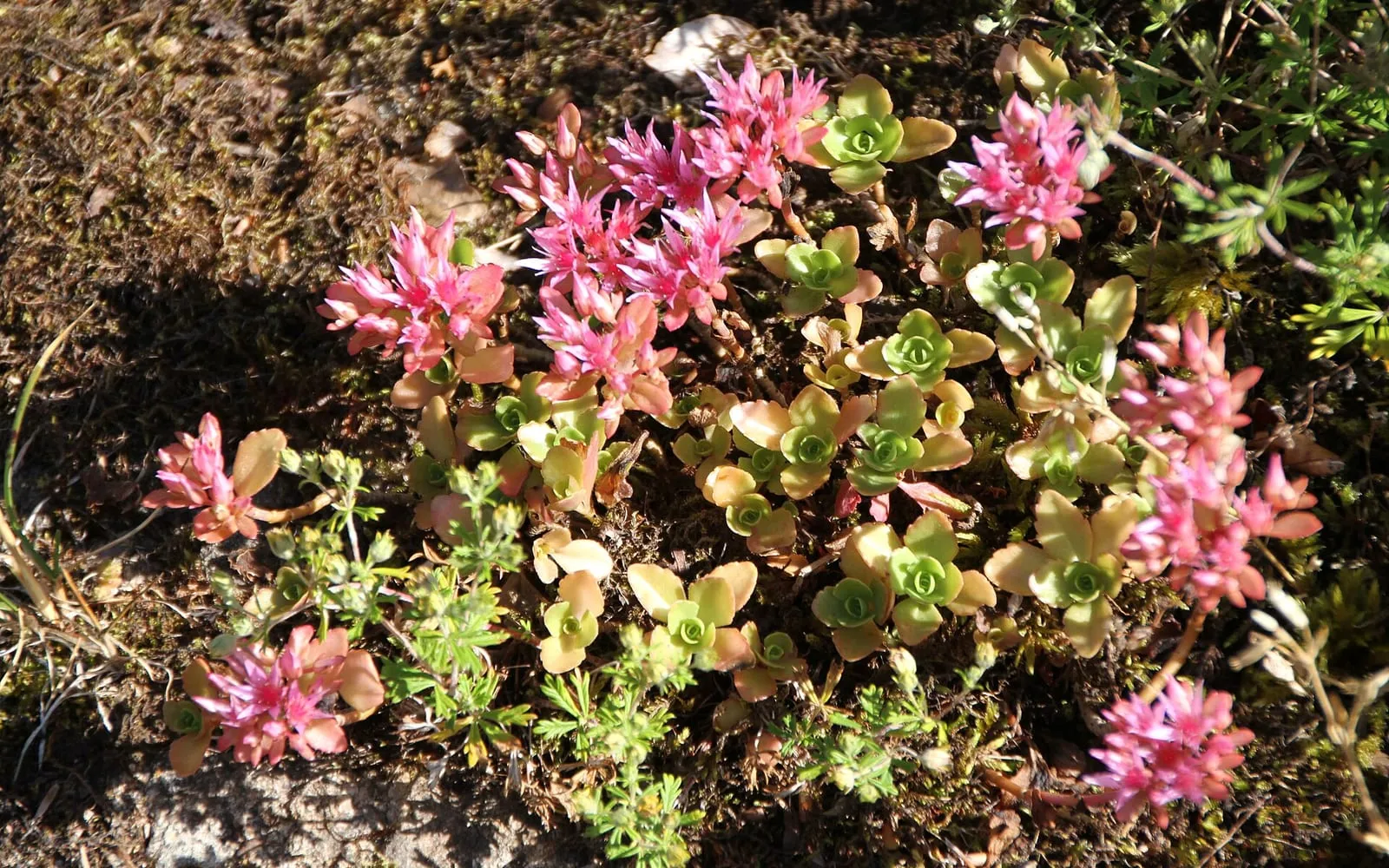
The leaves are flat and fleshy, rounded to a broad spoon shape with a scalloped or bluntly toothed rim, and they line the creeping stems in two opposite files. In sun the margins flush red, and named forms carry the colouring further, from the blood-red foliage of the darkest selections to cream-splashed and near-purple leaves.
The stems creep outward and root down as they go, building a dense low mat only ten to fifteen centimetres deep that spreads steadily sideways and spills over edges.
In midsummer the mat produces short stalks tipped with flattened clusters of small star-shaped flowers, in shades from pale pink through rose to deep red and, in some forms, white. Bees visit them readily, and the colour lasts for weeks before fading.
Through autumn and winter the foliage takes on bronze, russet and purple tints, so the plant still has colour after the flowers finish.
Where it is from
Sedum spurium grows wild in the Caucasus and western Asia, colonising rocky slopes, screes and stony banks in a climate of cold winters and warm, dry summers. The soil there is thin and gritty, the exposure open, and the plant uses shallow, wandering roots to exploit any pocket of drainage.
That mountain habitat accounts for its resilience. It needs sun and free-draining ground, copes with drought once settled, and needs no shelter from the cold. It will not tolerate rich soil or standing winter wet, either of which turns the growth soft, leggy and rot-prone.
How it grows
The mat greens up and widens through spring and summer, the running stems rooting as they extend. Flowers appear at midsummer, and the foliage stays through the cold in tinted evergreen form. It spreads at a fair pace but stays shallow-rooted, so stray growth is easy to pull back.
Plant it in gritty, free-draining soil or a lean compost in an open, sunny spot, whether a border edge, a rockery, a trough, a wall crevice or a roof. Water it while it establishes; after that it needs help only in a long drought or when a pot dries out. Trim or lift straying growth to keep it in bounds, and drop rooted pieces into any gap that needs filling.
Propagation is simple. A rooted fragment of the mat, or a short stem cutting laid on soil, roots readily.
Through the seasons
Spring greens and widens the mat. Comb out any winter-tattered growth and pull it back from where it has overrun.
Summer brings the flat pink and red heads above the carpet; water only if a drought bites, and keep the feeding to nothing.
Autumn slows the spread as the leaves begin to flush bronze and red; little needs doing.
Winter holds the mat evergreen and colour-tinted, hardy without any protection; just make sure it is not left sitting in cold, standing wet.
Care difficulty
Caucasian stonecrop spreads, flowers and returns year on year with next to no help, provided it has sun and sharp drainage. It fails mainly in the wrong place, where rich, shaded or waterlogged ground leaves it thin, drawn and liable to rot. Keep it lean and open to the light and it needs little care.
Watering
A freshly planted mat needs watering until it roots down, and after that it uses its fleshy leaves and largely takes what the weather gives. In open ground only a prolonged dry spell calls for the hose.
Grown in a trough or a pot, water it when the compost dries and let it drain freely, then hold back through winter. Cold, standing moisture around the roots is the single thing that rots it, so drainage matters most through the wet, cold months.
Warning signs, diseases and pests
Thin, bald patches in the carpet usually mean too much shade or drought, or old growth dying out at the centre. Lift rooted pieces from the edge and replant them into the gaps, and shift the whole plant somewhere sunnier if the light is the cause.
Root rot affects a mat kept cold and sodden over winter, most often in heavy soil or a poorly drained container; open up the drainage and keep it dry in the cold. In pots, vine weevil grubs may gnaw the roots, so tip out and inspect any plant that flags without explanation. Soft, drawn stems with sparse flowering point to soil that is too rich or a site that is too shaded. Move it to leaner, brighter conditions.
Growing environment
Full sun gives the densest carpet, the strongest leaf colour and the freest flowering, while shade thins it, draws it up and reduces the flowers. It needs an open, bright position.
It is fully hardy in the open and needs no winter cover, though a container is best kept where it will not stand sodden. Ordinary or dry air suits it.
Grow it in lean, free-draining soil or gritty compost in a sunny border, rockery, trough, wall or roof. It is happier outside than in, since it relies on a cold winter rest.
Feeding
Feed little, or leave it unfed. Lean ground produces the tightest, most colourful, most floriferous mat, and rich soil only makes it lax and soft. A single light feed in spring is the most it ever needs.
A trough does better for a topping of fresh gritty compost every few years than for any fertiliser, and nothing is needed through autumn or winter.
Troubleshooting
The mat has thinned to bare patches. Too much shade or drought, or worn-out central growth. Replant rooted pieces into the gaps and move it into more sun.
It has grown leggy and barely flowered. Soil too rich or a site too shaded. Grow it leaner and brighter.
Can I keep it indoors for good? It does best outdoors, since it depends on a cold winter; a pot plant should spend the cold months outside instead of in a warm room.
Is it invasive? It spreads steadily and can overrun a small space, but the shallow roots make straying growth easy to pull up or lift.
Is it safe around pets? Yes. Sedum is not listed as toxic, so this creeping carpet is safe around cats, dogs and children.
Caucasian Stonecrop problem guides
Not sure what is wrong? See the common houseplant pests guide.